

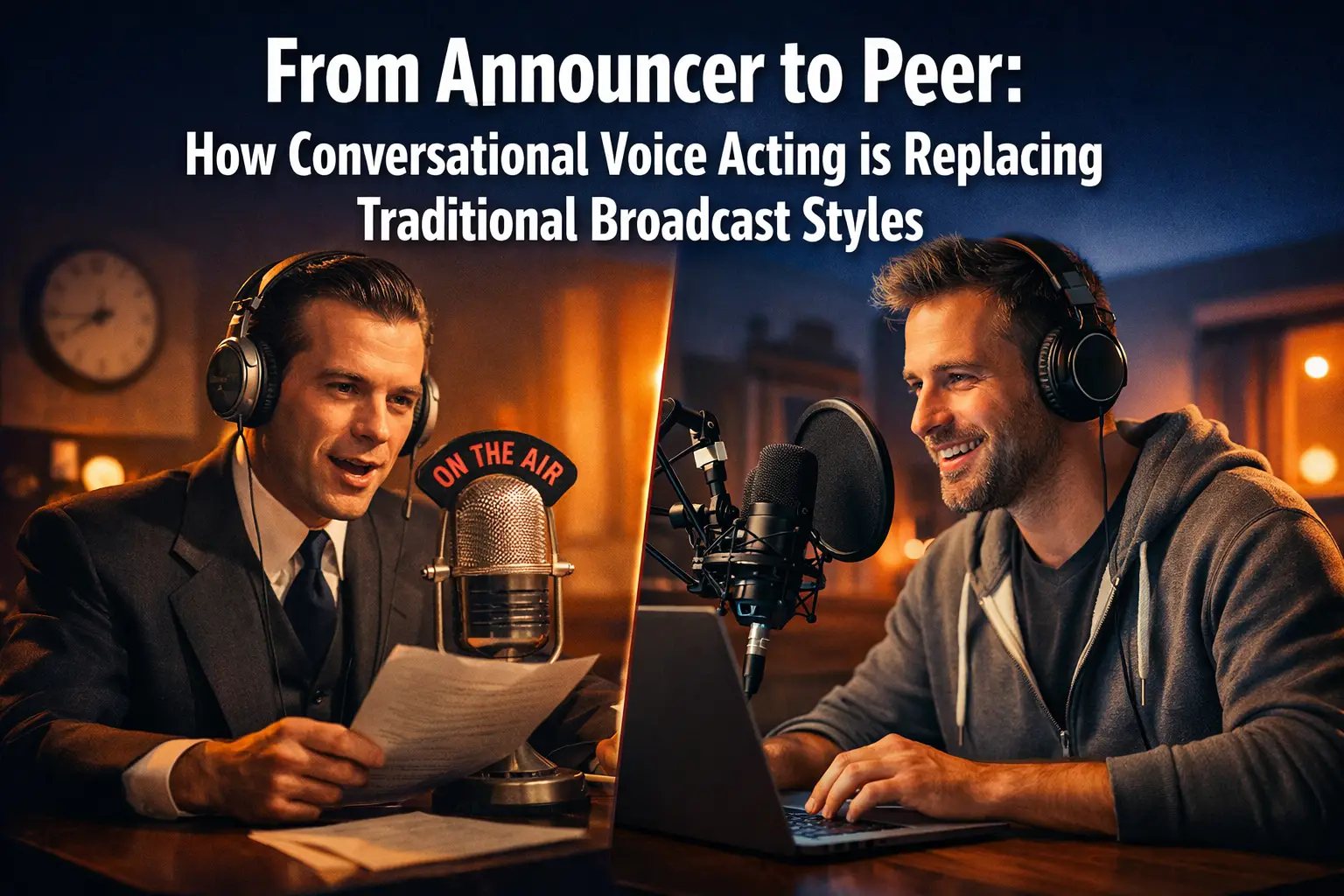
The golden-voiced announcer with perfect diction and commanding presence once ruled the airwaves. That era is over. In 2026, audiences scroll past polished corporate messaging and gravitate toward voices that sound like trusted friends sharing genuine advice over coffee. The transformation from announcer to peer represents more than a stylistic preference—it signals a fundamental shift in how brands connect with consumers and how voice actors build sustainable careers. Understanding from announcer to peer: how conversational voice acting is replacing traditional broadcast styles has become essential for anyone working in voice performance, marketing, or brand communications.
The stereotypical announcer voice that dominated advertising for decades is now considered obsolete, replaced by conversational reads that resonate with modern listeners who demand authenticity over polish.[2] This evolution reflects broader cultural changes in how people consume media and interact with brands, creating both challenges and opportunities for voice talent navigating this new landscape.
Key Takeaways
- Conversational delivery outperforms traditional broadcast styles as audiences prefer peer-to-peer communication that feels personal and relatable rather than formal corporate messaging
- Human warmth and authenticity serve as critical differentiators in an AI-saturated market, with consumers increasingly choosing brands that commit to real human voice talent
- Remote production enables more intimate performances as home studios become industry standard, allowing voice actors to deliver naturally conversational reads
- Multilingual conversational talent commands premium rates, with Spanish, French, and Chinese leading demand for culturally authentic voice performances
- Brand voice consistency across platforms drives repeat work for voice actors who master conversational personas that maintain authenticity across ads, podcasts, apps, and customer service channels
The Death of the Announcer Voice: Understanding the Shift
Why Traditional Broadcast Styles Are Becoming Obsolete
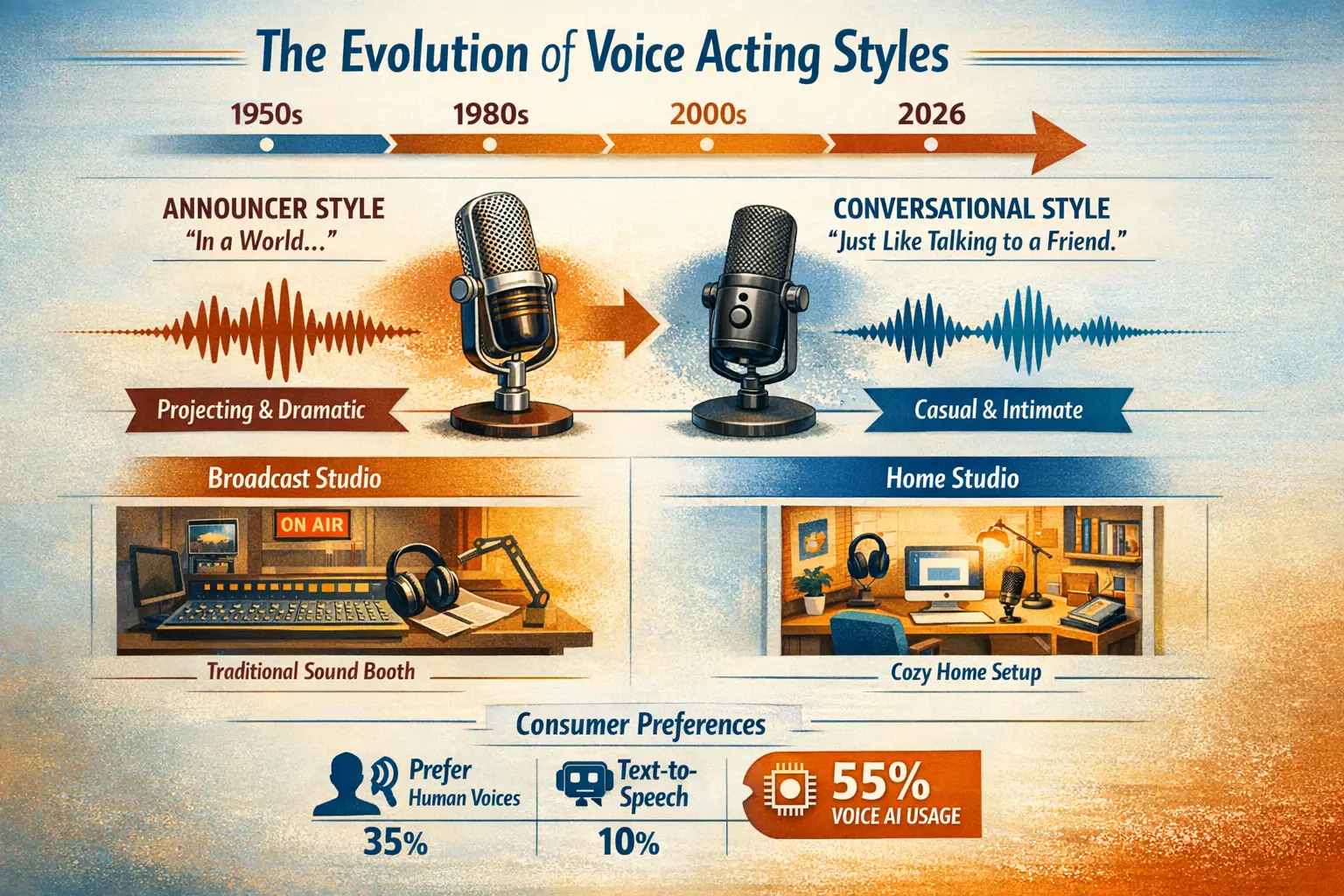
The commanding, authoritative announcer voice that once signaled credibility now triggers skepticism. Modern audiences have developed sophisticated filters for detecting inauthentic communication, and the formal broadcast delivery style reads as corporate manipulation rather than trustworthy information.
Several factors have accelerated this decline:
🎯 Media Consumption Patterns Have Changed
- Audiences consume content on personal devices rather than shared family televisions
- Intimate listening environments (earbuds, headphones) favor conversational tones
- Social media platforms reward authentic, relatable content over polished production
📱 Digital Natives Expect Different Communication
- Younger demographics grew up with influencers and content creators, not broadcast announcers
- Peer recommendations carry more weight than corporate messaging
- Transparency and authenticity rank higher than polish and perfection
💼 Brand Strategies Have Evolved
- Companies position themselves as helpful partners rather than distant authorities
- Customer relationships prioritize ongoing dialogue over one-way broadcasting
- Marketing emphasizes storytelling and emotional connection
The data supports this transformation. Listeners now respond significantly better to peer-to-peer communication styles rather than formal broadcast delivery, fundamentally changing what effective voice work sounds like.[2]
What Conversational Voice Acting Actually Means
Conversational voice acting isn’t simply “talking normally” into a microphone. It requires sophisticated technique that creates the illusion of spontaneous, genuine communication while maintaining professional quality and delivering precise messaging.
Key characteristics of conversational delivery include:
| Traditional Announcer | Conversational Peer |
|---|---|
| Projected, theatrical volume | Intimate, natural volume |
| Perfect enunciation | Natural speech patterns with slight imperfections |
| Consistent pacing | Varied rhythm matching natural thought |
| Emotional distance | Warm, relatable connection |
| Formal language | Accessible, everyday vocabulary |
| One-size-fits-all delivery | Tailored to specific audience |
Conversational voice work maintains the technical precision of professional performance—clear articulation, appropriate pacing, emotional authenticity—while sounding effortlessly natural. This paradox makes it more challenging than traditional announcer work, not less.
“The stereotypical announcer voice that once dominated advertising is no longer effective, replaced by conversational reads that sound like a trusted friend or advisor.”[2]
From Announcer to Peer: The Market Forces Driving Change
Consumer Preference for Authenticity Over Polish
Despite rapid advancement in AI voice technology throughout 2025, an interesting trend emerged: the more synthetic voices became normalized, the more consumers gravitated toward brands committed to emotionally authentic, real-life voice actors.[1] This counterintuitive response reveals something fundamental about human psychology and trust.
Consumers in 2026 have become sophisticated at detecting artificial elements in their interactions. This heightened awareness creates a premium on genuine human connection that conversational voice acting delivers.
Why authenticity matters more than ever:
- Trust erosion in digital spaces makes human warmth a competitive advantage
- AI proliferation increases the value of verifiable human performance
- Information overload makes personal, relatable communication cut through noise
- Brand differentiation increasingly relies on emotional connection rather than product features alone
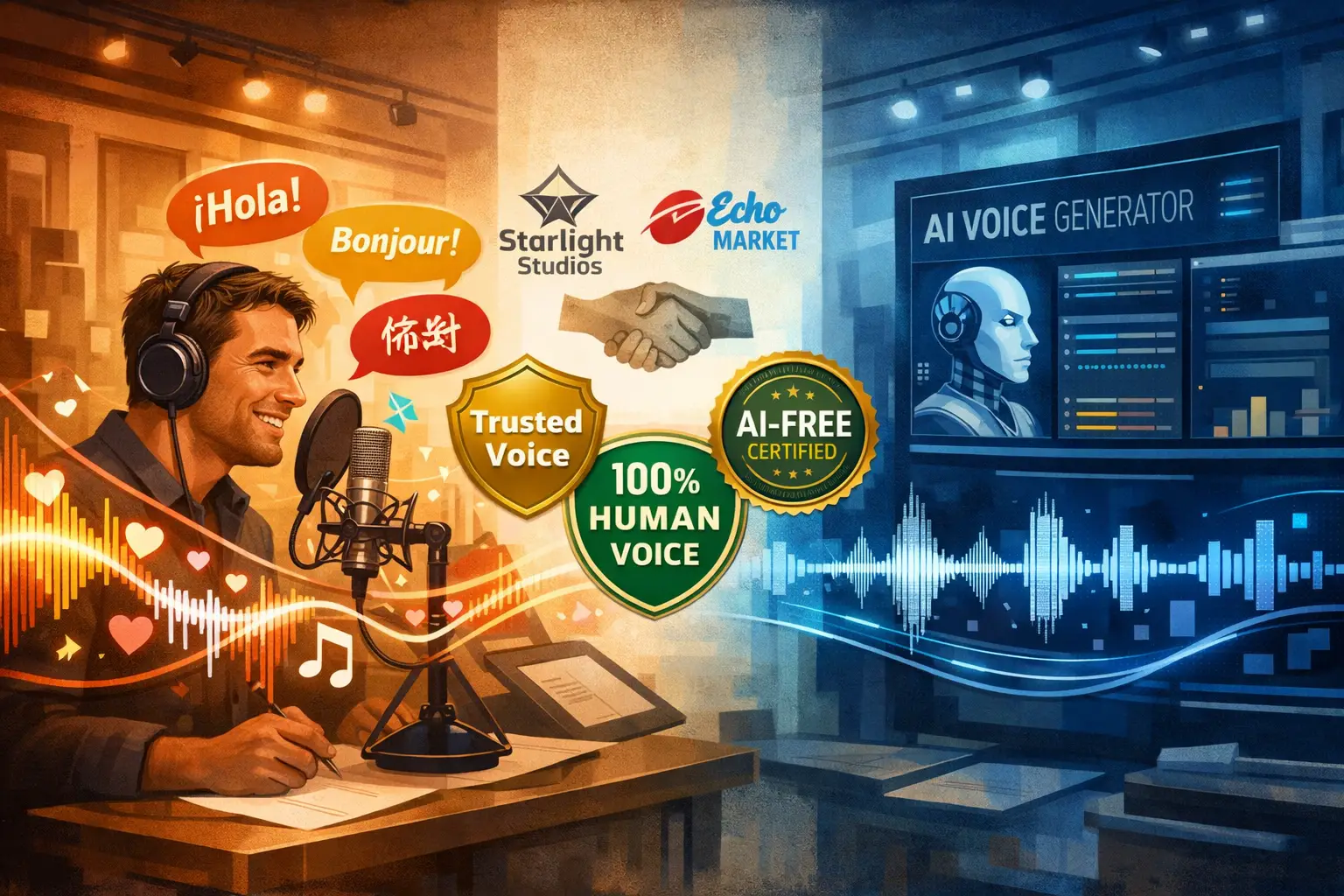
Brands are responding by actively marketing content as “AI-free” to signal their commitment to real human voice talent.[2] This trend extends beyond voice work to broader concerns about authenticity in an increasingly synthetic digital environment.
The AI Paradox: How Synthetic Voices Increase Demand for Human Talent
The relationship between AI voice technology and human voice actors isn’t the zero-sum competition many feared. Instead, a more nuanced dynamic has emerged where AI handles transactional communication while human talent commands premium rates for emotional and persuasive content.
Voice AI adoption statistics reveal this division:
- 55% of consumers now use voice to interact with AI systems[6]
- Only 29% of companies have deployed voice AI solutions, indicating significant growth ahead[6]
- Voice agents are evolving to deliver real-time, natural conversations with contextual understanding[4]
However, this technological advancement creates opportunities rather than threats for skilled conversational voice actors:
✅ AI Creates Contrast That Highlights Human Value When consumers interact with AI voices for customer service, navigation, and routine tasks, they develop sharper appreciation for human warmth in marketing, storytelling, and brand messaging.
✅ Emotional Intelligence Remains Exclusively Human Future conversational AI will improve at understanding tone and intent, but emotionally aware responses that build genuine trust remain the domain of human performers.[5]
✅ Cultural Nuance Requires Human Understanding Multilingual conversational voices demand native speakers who deliver natural tones with cultural authenticity—something AI struggles to replicate convincingly.[2]
Industry Economics: Why Conversational Talent Commands Premium Rates
The economics of voice work have shifted dramatically as conversational delivery becomes the standard. Voice actors who master this style find themselves in high demand across expanding content categories.
Growth areas requiring conversational delivery:[2]
📱 Social Media Voiceovers
- Short-form content for TikTok, Instagram Reels, YouTube Shorts
- Authentic, relatable delivery that matches platform culture
- Quick turnaround with consistent quality
🎙️ Podcast Intros and Ads
- Conversational reads that match podcast intimacy
- Host-read style for sponsor integrations
- Authentic endorsement tone
📊 Branded Explainers
- Educational content that feels helpful rather than promotional
- Complex information delivered accessibly
- Trusted advisor positioning
🥽 VR/AR Immersive Experiences
- Interactive storytelling requiring responsive delivery
- Spatial audio considerations
- Natural dialogue that enhances immersion
Brand voice consistency across these platforms creates demand for repeat work with voice actors who can maintain authentic conversational personas.[3] Organizations are building comprehensive “voice systems” requiring the same talent across ads, explainers, podcasts, apps, and customer service channels.
This consistency requirement transforms one-off gigs into ongoing relationships, providing income stability for voice actors who develop strong conversational skills.
Mastering Conversational Voice Acting: Practical Techniques and Skills
Technical Fundamentals That Enable Authentic Delivery
Conversational voice acting requires mastering specific technical skills that create intimacy and authenticity while maintaining broadcast-quality audio.
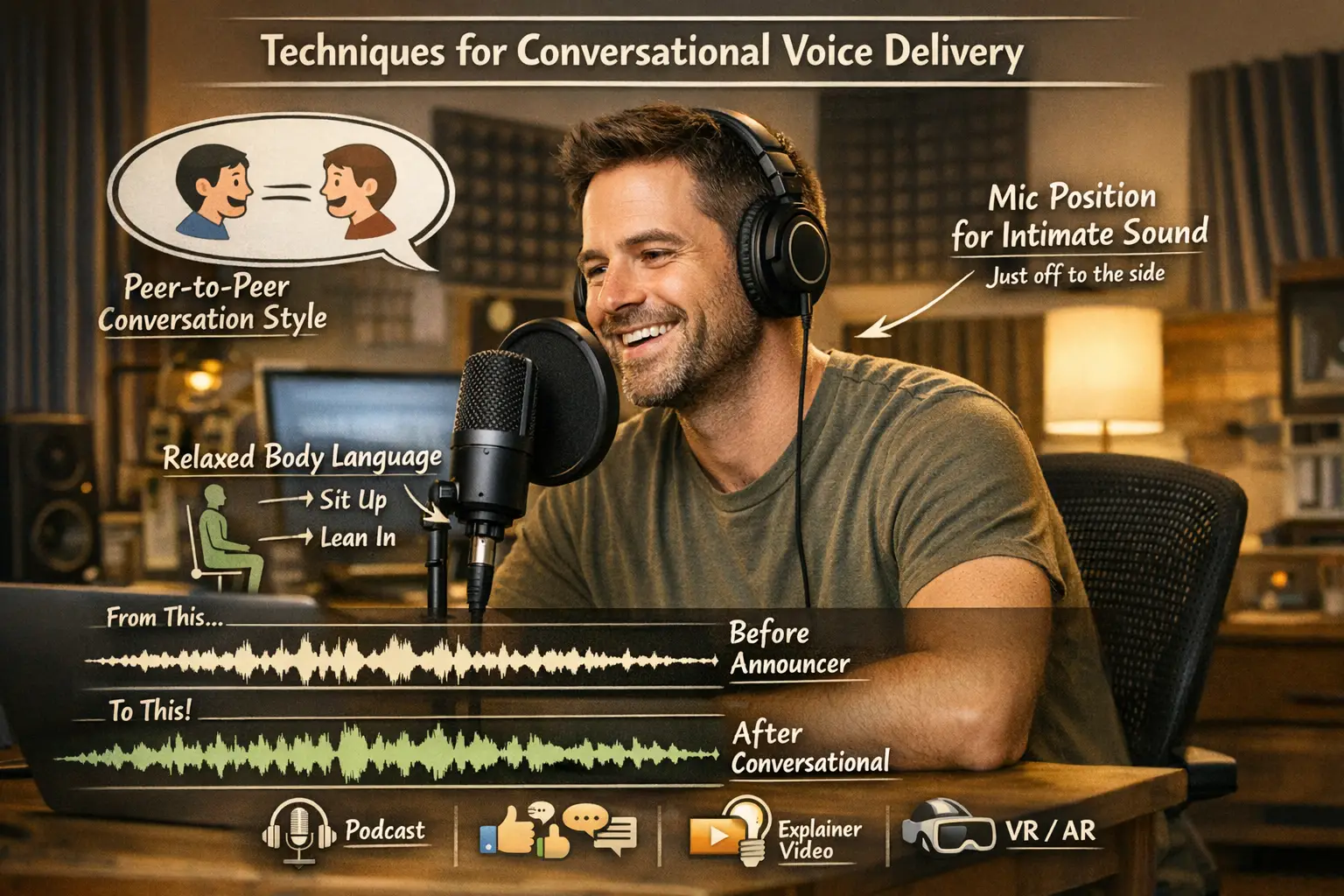
🎤 Microphone Technique for Conversational Intimacy
The physical relationship with the microphone dramatically affects conversational delivery:
- Distance: Working closer (4-6 inches) creates intimacy but requires excellent breath control and pop filter usage
- Angle: Slightly off-axis positioning reduces plosives while maintaining warmth
- Movement: Subtle position shifts during longer reads prevent static, unnatural sound
- Proximity effect: Understanding how bass frequencies increase with closeness helps manage warmth
🏠 Home Studio Advantages
Remote production has become the industry standard,[2] offering unexpected benefits for conversational delivery:
- Comfortable environment reduces performance anxiety that creates stiffness
- Familiar surroundings enable more natural, relaxed delivery
- Privacy allows experimentation without studio pressure
- Authentic atmosphere translates to recordings that feel naturally intimate rather than formally produced
🎚️ Processing That Preserves Natural Sound
Technical processing for conversational work differs from announcer-style production:
- Minimal compression preserves dynamic range and natural speech patterns
- Subtle EQ enhances clarity without creating artificial brightness
- Light de-essing maintains sibilance control without over-processing
- Room tone preservation keeps slight environmental character that signals authenticity
Performance Techniques: Sounding Natural While Staying Professional
The paradox of conversational voice acting is that sounding effortlessly natural requires deliberate technique. Professional conversational delivery isn’t simply reading casually—it’s crafted performance that creates specific psychological effects.
💬 Conversational Techniques That Build Connection:
Think, Don’t Read
- Process meaning in real-time rather than reciting memorized text
- Allow genuine thought pauses where natural
- React to the content as if encountering it freshly
Use Natural Speech Patterns
- Include slight imperfections (appropriate hesitations, natural breath patterns)
- Vary pacing to match thought progression
- Employ conversational rhythm rather than metronomic delivery
Visualize Your Listener
- Imagine speaking to a specific person, not a microphone
- Maintain mental image of trusted friend or peer
- Adjust tone to match that relationship dynamic
Employ Appropriate Inflection
- Use rising inflection for questions and engaging points
- Downward inflection for statements and conclusions
- Varied pitch patterns that match natural conversation
Manage Energy Authentically
- Maintain engagement without forced enthusiasm
- Find genuine interest in the material
- Match energy to content appropriately
Developing Your Conversational Range
Professional voice actors need versatile conversational delivery that adapts to different brands, audiences, and content types while maintaining authenticity.
🎭 Conversational Personas to Develop:
The Knowledgeable Friend
- Helpful without being condescending
- Enthusiastic about sharing useful information
- Warm but credible
The Relatable Peer
- Shared experience and understanding
- Casual but respectful
- Authentic vulnerability when appropriate
The Trusted Advisor
- Calm confidence without arrogance
- Thoughtful, measured delivery
- Empathetic understanding of concerns
The Enthusiastic Collaborator
- Genuine excitement about possibilities
- Inclusive language and tone
- Energized but not overwhelming
Each persona requires different technical execution while maintaining core conversational authenticity. Developing range across these styles increases marketability and allows voice actors to serve diverse client needs.
The Future of Conversational Voice Work: Trends Shaping 2026 and Beyond
Multilingual Conversational Voices: The Premium Opportunity
Language diversity represents one of the highest-growth opportunities for conversational voice talent. Spanish is the most requested language after English, followed by French, with Chinese flagged as a priority growth language.[2]
However, multilingual work requires more than translation—it demands cultural authenticity that only native speakers with deep cultural understanding can deliver.
🌍 What Makes Multilingual Conversational Work Valuable:
Cultural Context Understanding
- Idioms and expressions that resonate naturally
- Humor and tone appropriate to cultural norms
- Reference points that connect with specific audiences
Accent and Dialect Authenticity
- Regional variations that signal genuine cultural membership
- Avoiding “neutral” delivery that sounds artificial
- Matching target demographic’s specific linguistic patterns
Emotional Expression Differences
- Cultural variations in how emotions are vocally expressed
- Appropriate levels of enthusiasm, restraint, formality
- Non-verbal vocal cues specific to language communities
Voice actors who combine conversational delivery skills with authentic multilingual capabilities command premium rates and access global opportunities unavailable to monolingual talent.
Consent and Ethical AI Collaboration
Consent will be the new standard in AI voice use in 2026,[3] fundamentally changing how voice actors approach technology collaboration. Rather than viewing AI as threat or replacement, forward-thinking talent is establishing ethical frameworks for beneficial collaboration.
Key ethical considerations emerging:
🤝 Transparent AI Usage
- Brands clearly communicating when AI voices are used
- Voice actors licensing their voices for specific AI applications
- Compensation models for AI voice replication
📋 Consent-Based Voice Cloning
- Explicit permission for voice data usage
- Control over how replicated voices are deployed
- Ongoing royalties for AI voice usage
⚖️ Human-AI Division of Labor
- AI handling high-volume, low-emotion content
- Human talent for persuasive, emotional, brand-defining work
- Hybrid workflows that leverage both strengths
Voice actors who proactively establish consent frameworks and ethical collaboration models position themselves as professional partners rather than replaceable resources.
Platform Diversification and Content Type Expansion
The venues requiring conversational voice work continue expanding beyond traditional advertising into new platforms and content formats.
📈 Emerging Opportunities for Conversational Voice Talent:
Interactive Storytelling
- Branching narratives requiring multiple conversational deliveries
- User-responsive content that adapts to choices
- Immersive experiences where voice guides exploration
Educational Content
- Online courses requiring engaging, accessible delivery
- Tutorial content that feels like personal instruction
- Explainer videos across countless topics and industries
Corporate Communications
- Internal training that employees actually engage with
- Company culture content that feels authentic
- Leadership messaging that builds genuine connection
Gaming and Virtual Experiences
- NPC dialogue requiring natural conversation
- Tutorial and guidance voices in games
- Virtual assistant characters in applications
Each platform has specific requirements, but all share the common thread of preferring conversational authenticity over announcer formality.
Building Sustainable Careers in the Conversational Era
The shift from announcer to peer creates both challenges and opportunities for voice actors building long-term careers. Success requires strategic positioning that leverages conversational trends.
💼 Career Strategies for Conversational Voice Actors:
Develop Signature Conversational Style
- Identify your authentic voice rather than imitating trends
- Build recognizable sound that brands seek specifically
- Maintain consistency while showing versatility
Build Direct Client Relationships
- Establish ongoing partnerships with brands needing voice consistency
- Position as voice system partner, not individual project contractor
- Demonstrate understanding of brand voice strategy
Invest in Continuous Skill Development
- Study conversational patterns in successful content
- Practice diverse conversational personas
- Seek coaching that develops authentic delivery
Embrace Technology Strategically
- Master remote recording workflows
- Understand AI capabilities and limitations
- Position for human-AI collaboration opportunities
Cultivate Multilingual Capabilities
- Develop authentic delivery in additional languages
- Build cultural competency for target markets
- Network within multilingual voice communities
The conversational voice acting market rewards specialists who combine technical excellence with authentic human connection—a combination that remains uniquely human regardless of AI advancement.
Conclusion: Thriving in the Conversational Voice Acting Era
The transformation from announcer to peer represents more than a passing trend—it reflects fundamental changes in how audiences consume content, how brands build relationships, and how trust is established in digital spaces. From announcer to peer: how conversational voice acting is replacing traditional broadcast styles defines the current moment in voice performance and will continue shaping the industry for years to come.
Voice actors who embrace this shift discover expanding opportunities across platforms, content types, and languages. The key differentiators—human warmth, emotional authenticity, cultural nuance—remain exclusively human capabilities that AI cannot replicate convincingly. As synthetic voices handle transactional communication, human conversational talent becomes more valuable for persuasive, emotional, and brand-defining content.
Actionable Next Steps for Voice Actors
🎯 Immediate Actions:
- Record conversational samples across different personas (knowledgeable friend, relatable peer, trusted advisor) to identify your authentic conversational range
- Analyze successful conversational content in your target niches, noting specific delivery techniques that create connection
- Optimize your home studio for intimate conversational recording with appropriate microphone technique and processing
- Update your demo reel to emphasize conversational delivery over announcer-style reads
- Research multilingual opportunities in languages you speak or could develop with cultural authenticity
📈 Long-Term Development:
- Build brand partnerships that value voice consistency across platforms and content types
- Develop ethical AI collaboration frameworks that protect your voice while exploring beneficial technology partnerships
- Expand into emerging platforms requiring conversational delivery (VR/AR, interactive content, educational platforms)
- Cultivate cultural competency for authentic multilingual delivery in high-demand languages
- Position as voice strategy partner who understands brand voice systems, not just individual project execution
The future belongs to voice actors who master the art of sounding like trusted peers while maintaining professional excellence. Those who develop authentic conversational delivery, embrace strategic technology collaboration, and build genuine connections with audiences will thrive in this transformed landscape.
The announcer era is over. The conversational era rewards those who bring genuine human warmth, emotional intelligence, and authentic connection to every performance. The opportunity is substantial for voice actors willing to evolve from distant authority figures to trusted peers.
References
[1] Voice Over Trends For 2026 – https://www.voicecrafters.com/blog/voice-over-trends-for-2026/
[2] Voice Acting In 2025 2026 Trends Insights And The Future – https://www.gravyforthebrain.com/voice-acting-in-2025-2026-trends-insights-and-the-future/
[3] My Top 5 Voiceover Industry Trends For 2026 – https://www.melvinvermeer.nl/blog-3/2026/1/5/my-top-5-voiceover-industry-trends-for-2026
[4] Voice Agents And Conversational Ai New Developer Trends 2025 – https://elevenlabs.io/blog/voice-agents-and-conversational-ai-new-developer-trends-2025
[5] The Future Of Conversational Ai Top Trends For 2026 And Beyond – https://www.chatarm.ai/the-future-of-conversational-ai-top-trends-for-2026-and-beyond
[6] Amplified 2026 The State Of Voice Report – https://www.voices.com/blog/amplified-2026-the-state-of-voice-report/