
Listen, friends—after three decades in this business, I’ve seen technology change everything from how we audition to how we deliver our work. But nothing, and I mean nothing, has shaken up our industry quite like AI voice cloning. It’s like someone handed out keys to our instrument without asking permission first. The good news? The legal world is finally catching up, and in 2026, voice cloning consent laws are reshaping how we protect what makes us uniquely valuable: our voices.
Understanding Voice Cloning Consent Laws: What Voice Actors Need to Know About Protecting Their Voice Rights in 2026 isn’t just legal jargon anymore—it’s survival knowledge for anyone making a living with their voice. Whether you’re booking your first commercial or you’ve been the voice of a major brand for years, these emerging laws are your new best friend in an industry where your voice can now be digitally replicated with frightening accuracy.
Key Takeaways
- Tennessee’s ELVIS Act set the national precedent by becoming the first state to explicitly protect voice actors from unauthorized AI cloning, with criminal and civil penalties for violators[1]
- Your voice is now legally classified as protected identity in multiple jurisdictions, fundamentally changing how voice rights are governed and enforced[2]
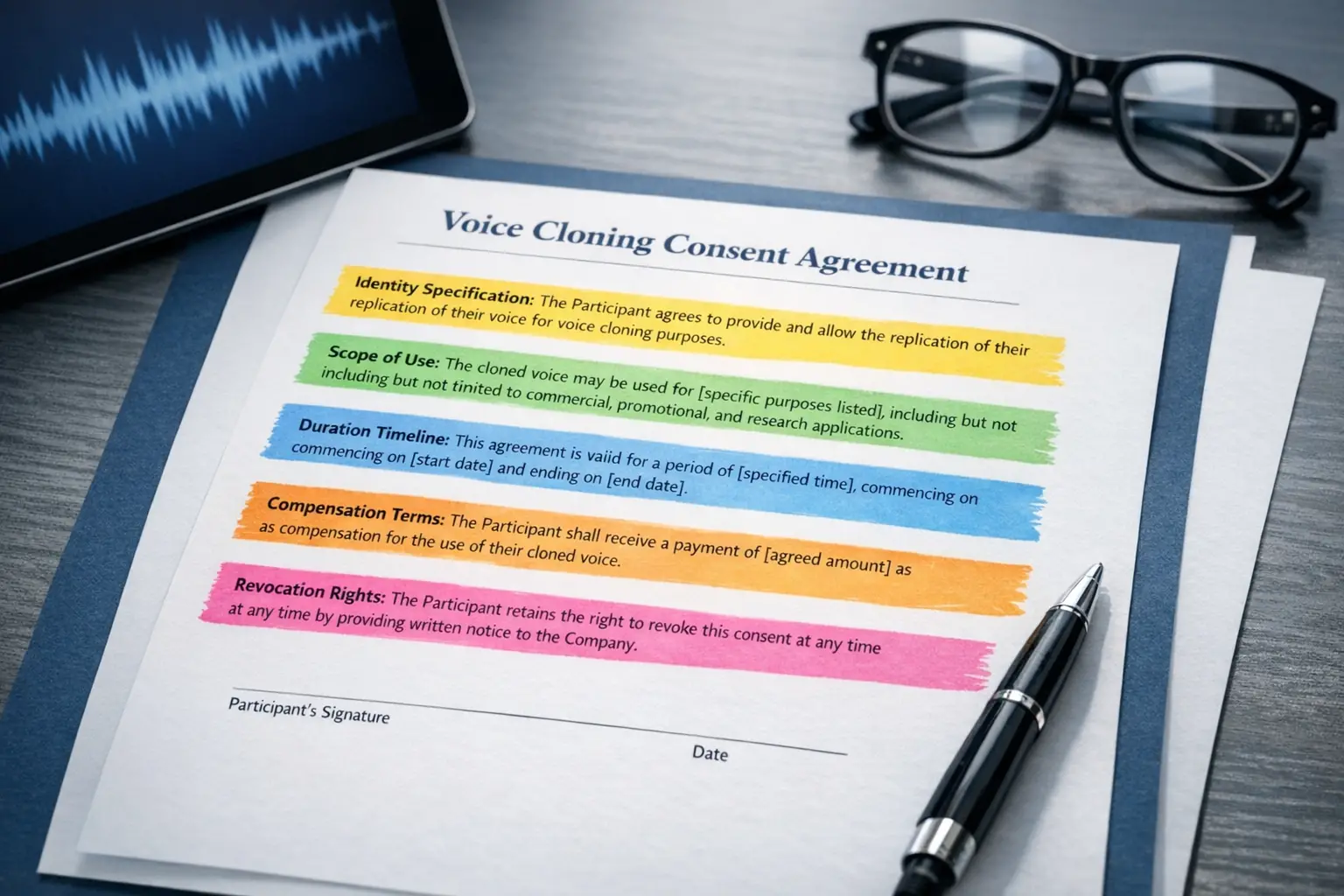
- Written consent with five essential elements (identity, scope, duration, compensation, revocation) is now the industry standard for any voice cloning agreement[2]
- State-by-state variations require careful navigation, with California, Washington, Nevada, and Arizona leading with strict protections while other states lag behind[3]
- Federal standardization is coming by 2027, with the FTC and U.S. Copyright Office developing uniform right-of-publicity rules for synthetic voice identity[3]
The Legal Landscape: How Voice Cloning Consent Laws Evolved
Here’s the thing about being a voice actor in 2026: your voice isn’t just your instrument anymore—it’s legally recognized as part of your identity, like your fingerprint or your face. This shift didn’t happen overnight, and frankly, it took some pretty scary situations to wake up legislators.
The Wake-Up Call Nobody Wanted
Think about this: one in four adults has already encountered some form of AI voice scam.[2] That’s not just statistics—that’s your neighbor getting a call from “their daughter” begging for bail money, or a colleague receiving instructions from “the CEO” to wire funds. When technology can perfectly mimic someone’s voice from a 30-second YouTube clip, we’re not in Kansas anymore.
The entertainment industry saw the writing on the wall first. Voice actors were discovering their voices being used in projects they never auditioned for, never agreed to, and certainly never got paid for. It was like showing up to a gig and finding out someone else had already performed using a recording of your voice from five years ago.
Tennessee Takes the Lead: The ELVIS Act
In 2024, Tennessee did something revolutionary. They passed the Ensuring Likeness, Voice, and Image Security (ELVIS) Act—and yes, the acronym is absolutely intentional from the state that gave us the King of Rock and Roll. This groundbreaking legislation became the first state law to expressly extend right-of-publicity protections to AI-generated voice clones.[1]
What makes the ELVIS Act so powerful? It doesn’t just wag a finger at unauthorized voice cloning—it brings real teeth to the table:
- Criminal penalties for unauthorized digital replication
- Civil remedies allowing voice actors to sue for damages
- Clear legal precedent that your voice is yours to control
This wasn’t just Tennessee protecting Elvis’s legacy (though that certainly didn’t hurt the political optics). It was a state recognizing that in the age of AI, a person’s voice is as much a part of their identity as their physical appearance.
Understanding Voice Cloning Consent Laws: What Voice Actors Need to Know About Protecting Their Voice Rights in 2026 Across Different States
If you’re working nationally—and let’s face it, most of us are in this remote-work era—you need to understand that voice protection isn’t one-size-fits-all across America. It’s more like a patchwork quilt, with some states offering you a cozy blanket of protection and others leaving you out in the cold.
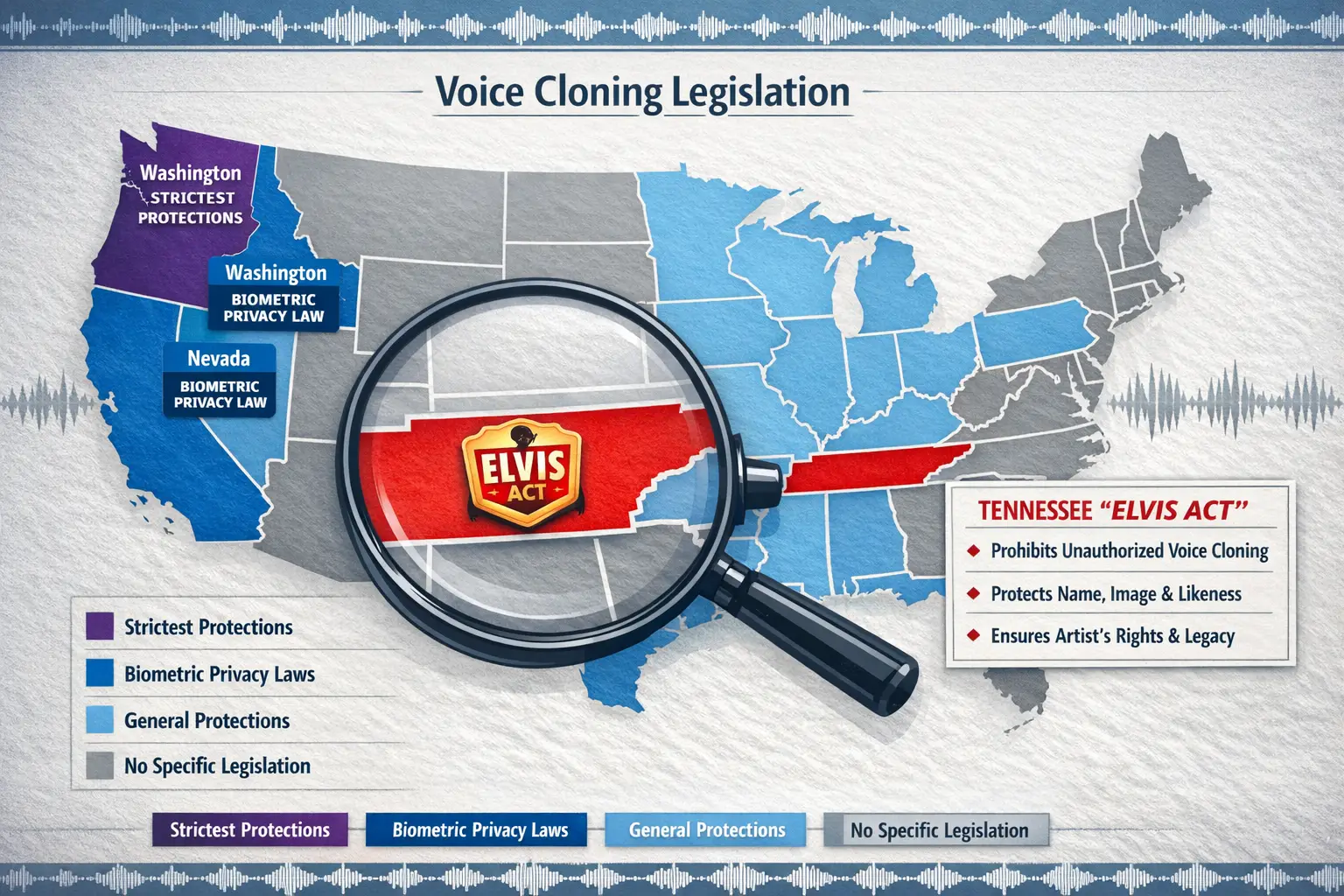
The Strictest Jurisdictions: Where Voice Actors Have Maximum Protection
California remains the gold standard, which shouldn’t surprise anyone who’s worked in entertainment. Civil Code §3344 and biometric privacy provisions classify voice as part of a person’s identity. Commercial voice cloning without permission can result in serious civil penalties, especially in entertainment and advertising.[3]
What does this mean practically? If someone clones your voice in California without permission, you’ve got legal firepower. Think of it as the state saying, “Your voice is as protected as your face on a movie poster.”
Washington State took a different but equally effective approach with the Biometric Privacy Act (HB 1493). This legislation includes voice data protection and requires developers collecting or generating speech profiles for cloning to notify users and provide deletion rights.[3] It’s like having a “right to be forgotten” specifically for your voice data.
Nevada and Arizona joined the party with transparency requirements. Both states now mandate AI synthesis labels or watermarks for commercial entertainment voice cloning applications as of 2026.[3] Imagine it like a nutrition label, but for synthetic voices—consumers have a right to know when they’re hearing the real you versus a digital clone.
The Middle Ground: States with General Protections
Many states haven’t passed voice-specific legislation but offer protection through existing right-of-publicity laws and data privacy regulations. These states treat voice cloning cases under broader identity theft or intellectual property frameworks.
It’s not ideal—kind of like using a Swiss Army knife when you really need a specialized tool—but it’s better than nothing.
The Wild West: States Without Targeted Legislation
Wyoming, Idaho, Mississippi, and several other states currently rely on general data protection and intellectual property norms.[3] If you’re working with clients in these states, you’re essentially operating under common law and whatever contracts you can negotiate.
Here’s the critical part: these jurisdictions remain subject to stricter cross-border compliance when operating nationally.[3] So if you’re based in Wyoming but your voice clone is used in California, California law might still protect you. It’s complicated, which is exactly why you need to understand these nuances.
State-by-State Comparison Table
| State | Protection Level | Key Legislation | What It Means for You |
|---|---|---|---|
| Tennessee | Strongest | ELVIS Act | Criminal + civil penalties for unauthorized cloning[1] |
| California | Strongest | Civil Code §3344 | Voice classified as protected identity; civil penalties[3] |
| Washington | Strong | HB 1493 | Biometric privacy; notification and deletion rights[3] |
| Nevada | Moderate | Transparency laws | AI synthesis labels required[3] |
| Arizona | Moderate | Transparency laws | Watermark requirements for commercial use[3] |
| Wyoming, Idaho, Mississippi | Weak | General IP laws | Rely on contracts and common law[3] |
The Five Pillars of Voice Cloning Consent: What Voice Actors Need to Know About Protecting Their Voice Rights in 2026
After watching too many colleagues get burned by vague agreements (or worse, handshake deals), the industry has finally standardized what proper consent looks like. Think of these five elements as the non-negotiables—your constitutional rights for voice cloning agreements.
1. Identity: Whose Voice Is Actually Being Cloned? 🎭
This seems obvious, but you’d be surprised how many early agreements were fuzzy about this. The consent form must explicitly state whose voice is being cloned. Not “the voice actor,” not “the talent”—your actual name.
Example language: “This agreement grants permission to clone the voice of [Your Full Legal Name], professional voice actor, for the specific purposes outlined below.”
Why does this matter? Because if the agreement is vague, someone might argue they can use your voice clone for projects you never imagined. Specificity is your friend.
2. Scope: What Can They Actually Do With Your Voice Clone? 📋
Here’s where things get interesting. The scope section needs to describe permitted uses in excruciating detail. Are they cloning your voice for:
- Audiobook narration of a specific series?
- Marketing videos for a particular product line?
- Video game character dialogue?
- Training an AI model that could be used for multiple projects?
The difference between “audiobook narration” and “any audio content” is the difference between a focused gig and giving away your entire career. Modern consent forms must be specific, documented, and revocable.[1]
Pro tip from the trenches: If someone presents you with language like “for promotional purposes” or “for various media applications,” push back. That’s like signing a blank check. Get specific about deliverables, platforms, and limitations.
3. Duration: How Long Can They Use Your Voice Clone? ⏰
Time limits matter enormously. Are they licensing your voice clone for:
- A single project with a defined end date?
- One year with renewal options?
- Perpetuity (forever)?
I’ve learned the hard way that “perpetuity” is almost never in your favor unless the compensation reflects that reality. Technology changes, your career evolves, and what seems like a great deal today might haunt you in five years.
Real-world scenario: A colleague licensed her voice clone for “perpetual use” in a video game for what seemed like good money in 2023. By 2026, that game had spawned three sequels, countless DLC packs, and a streaming series—all using her cloned voice with no additional compensation. The duration clause trapped her.
4. Compensation: What Are You Getting Paid? 💰
Let’s talk money, because that’s ultimately why we’re professionals and not hobbyists. Compensation structures for voice cloning can include:
- Upfront licensing fees (one-time payment)
- Royalties (percentage of revenue from projects using your clone)
- Usage-based fees (payment per deployment or per project)
- Hybrid models (combination of the above)
The five-element written consent structure is now industry standard,[2] and compensation is non-negotiable as one of those elements. Don’t let anyone tell you otherwise.
Negotiation insight: Instant versus professional cloning carries the same legal risk, so legal practitioners now recommend treating every voice model as a professional deployment from day one, complete with written consent and agreed revision processes.[2] This means even “test” clones deserve proper compensation agreements.
5. Revocation Rights: Can You Take It Back? 🔄
This is your escape hatch, and it’s absolutely critical. Revocation rights specify:
- Under what circumstances you can withdraw consent
- How much notice you must provide
- What happens to existing deployments of your voice clone
- Whether you can revoke partially (for specific uses) or must revoke entirely
Think of revocation rights like the emergency brake in your car. You hope you never need it, but you’d better make sure it works before you start driving.
Important distinction: Some agreements include “moral clauses” that automatically trigger revocation if your voice clone is used in ways that harm your reputation or violate the original scope. These are gold—negotiate for them.
Practical Steps for Protecting Your Voice Rights in 2026
Okay, enough theory. Let’s talk about what you actually do to protect yourself in the real world. This is the checklist I wish someone had given me when I started out.
✅ The Voice Actor’s Protection Checklist
Before Any Voice Cloning Agreement:
- Research the company’s reputation – Google them, check industry forums, ask colleagues
- Verify they have legitimate business insurance – If they’re serious, they’re covered
- Request sample contracts – Review before any recording session
- Consult with an entertainment attorney – Yes, it costs money, but so does litigation
- Understand which state’s laws apply – Jurisdiction matters enormously[3]
During Contract Negotiation:
- Ensure all five consent elements are present – Identity, scope, duration, compensation, revocation[2]
- Define “commercial use” explicitly – Don’t accept vague language
- Negotiate audit rights – You should be able to verify how your voice clone is being used
- Include termination clauses – Define how the agreement can end
- Specify dispute resolution methods – Arbitration, mediation, or litigation?
After Signing:
- Keep copies of all agreements – Digital and physical backups
- Document all voice recording sessions – Dates, times, purposes
- Monitor usage – Set up Google Alerts for your name and known projects
- Review agreements annually – Technology and laws change; your contracts should too
- Join professional organizations – SAG-AFTRA and other unions are developing voice cloning protections
Understanding Contract Law as Your Primary Protection
Here’s something crucial that many voice actors miss: contract law is the primary enforcement mechanism for voice cloning rights.[5] Most voice cloning licensing is enforced through formal contracts rather than statutes, with agreements defining boundaries of acceptable use, responsibility, and liability between parties.
What does this mean? Your contract is often more important than the state law. A well-drafted agreement in a state with weak voice protections can offer you better security than a poorly drafted agreement in California.
Think of state laws as your baseline protection—the floor, not the ceiling. Your contract is where you build the real fortress around your voice rights.
The “Professional from Day One” Approach
Remember how I mentioned that instant versus professional cloning carries the same legal risk?[2] This is why you need to treat every voice cloning opportunity—even the “quick test” or “just for fun” requests—as professional deployments requiring proper documentation.
Analogy time: It’s like the difference between letting a friend borrow your car versus renting it to them. Even if it’s a friend, you want insurance, clear expectations about mileage and gas, and a return date. Your voice deserves the same respect.
Red Flags to Watch For 🚩
After 30 years in this business, I’ve developed a pretty good radar for sketchy situations. Here are the warning signs that should make you walk away:
- “We’ll work out the details later” – No. Details now, recording later.
- “This is just a standard agreement everyone signs” – There’s no such thing as “standard” in voice cloning
- “We need this urgently and can’t wait for legal review” – Urgency is a manipulation tactic
- “Your voice will only be used internally” – Today’s internal project is tomorrow’s public product
- Refusal to specify duration or scope – Vagueness always benefits them, not you
- No compensation for the cloning itself, only for the original recording – Your voice clone has separate value
Federal Developments and What’s Coming Next
While we’re navigating this state-by-state patchwork in 2026, there’s light at the end of the tunnel. Federal standardization is anticipated by 2027, with the FTC and U.S. Copyright Office actively reviewing models to define synthetic voice identity as protected property.[3]
What Federal Standardization Might Look Like
The proposed federal frameworks include:
Uniform right-of-publicity rules that would apply across all states, eliminating the current confusion about jurisdiction and providing consistent protection regardless of where you live or work.
Real-time disclosure requirements meaning that any content using a cloned voice would need to clearly identify it as synthetic. Think of it like the “Paid Advertisement” disclaimers you see on social media, but for voice content.
Ethical flags integrated into AI voice platforms themselves, requiring developers to build consent verification directly into their cloning tools. This would shift some responsibility from individual voice actors to the technology companies enabling the cloning.
Why This Matters for Your Career Planning
If you’re making long-term career decisions in 2026, factor in that the legal landscape will likely be more standardized and protective by 2027-2028. This means:
- Existing agreements might become outdated – Build in review clauses
- Industry standards will likely tighten – Position yourself as a professional who’s ahead of the curve
- Enforcement will become more robust – Violations that are hard to prosecute now might be easier to address soon
Real-World Scenarios: Applying Voice Cloning Consent Laws
Let me share some scenarios I’ve encountered or heard about from colleagues. These aren’t hypotheticals—they’re real situations that demonstrate why understanding these laws matters.
Scenario 1: The Audiobook Expansion
The Situation: A voice actor signs an agreement to narrate a specific audiobook series (five books) using traditional recording. Midway through, the publisher asks to clone her voice to “speed up production” of the remaining books.
The Legal Question: Does the original narration contract cover voice cloning?
The Answer: Almost certainly not, unless the contract explicitly mentioned AI or synthetic voice technology. The voice actor has the right to negotiate a separate agreement for the voice cloning with appropriate compensation reflecting the different nature of the work.
The Lesson: Original performance rights and voice cloning rights are separate. Always treat them as distinct negotiations.
Scenario 2: The Corporate Training Videos
The Situation: A voice actor records corporate training videos for a tech company. The contract says “for internal training purposes.” Two years later, he discovers his cloned voice is being used in marketing videos on YouTube.
The Legal Question: Did the company violate the scope limitation?
The Answer: Yes. “Internal training” and “public marketing” are fundamentally different scopes. The voice actor has grounds for a breach of contract claim and, depending on the state, potential right-of-publicity violations.
The Lesson: Scope creep is real and often intentional. Monitor how your voice (and voice clone) is being used.
Scenario 3: The Video Game Character
The Situation: A voice actor licenses her voice clone for a video game character with a three-year term. The game becomes wildly successful. After three years, the company continues using her voice clone in sequels and DLC without new agreements.
The Legal Question: Can they continue using the voice clone after the duration expires?
The Answer: No. Duration limits are binding. Continued use after expiration is unauthorized use, giving the voice actor grounds for legal action and compensation for the unauthorized period.
The Lesson: Duration clauses protect you from indefinite exploitation. Enforce them.
Building Your Voice Protection Strategy for Long-Term Success
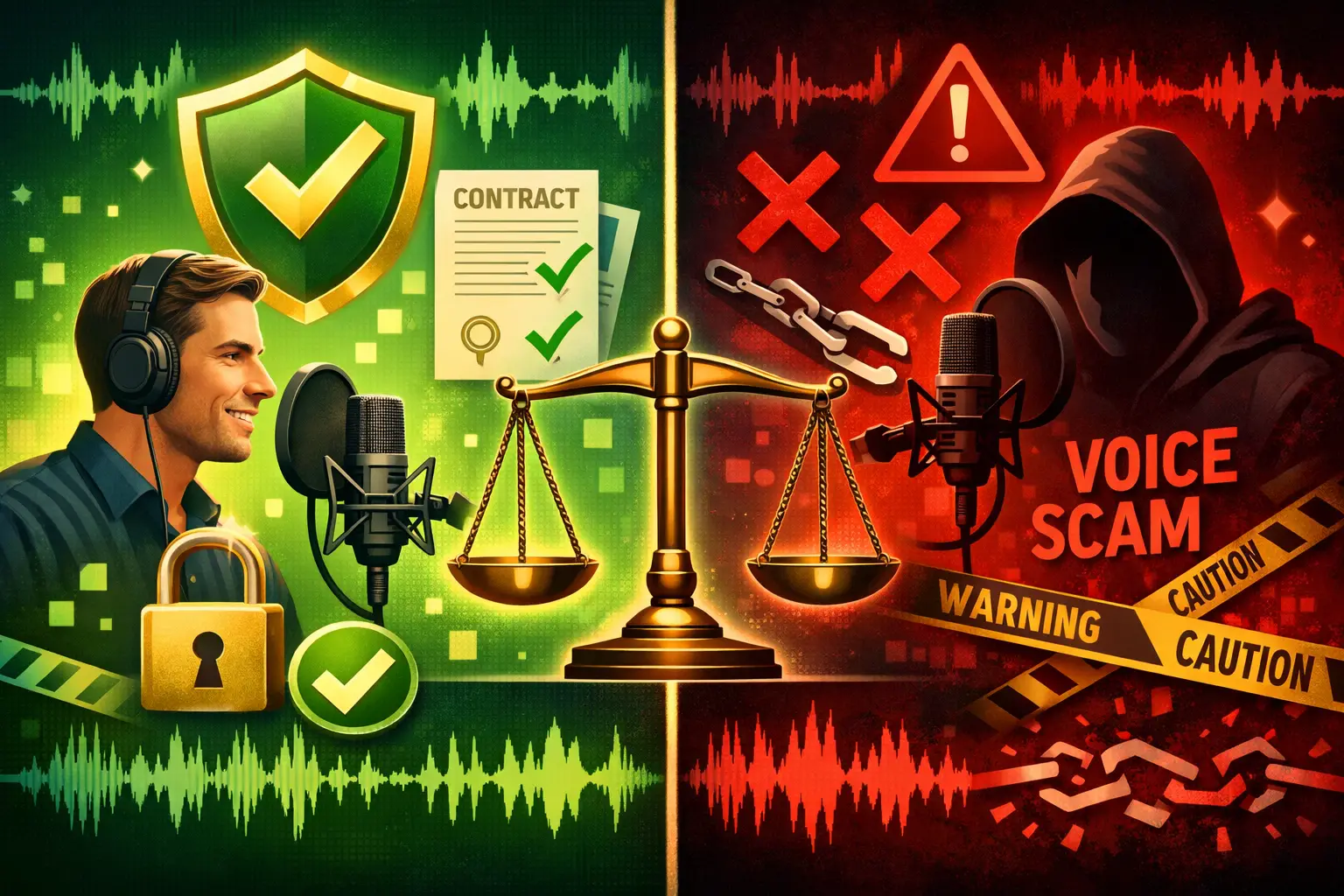
Protecting your voice rights isn’t a one-time action—it’s an ongoing professional practice, like maintaining your vocal health or updating your demo reel. Here’s how to build a sustainable protection strategy.
Develop Your Personal Voice Rights Policy
Create a document (even if it’s just for your own reference) that outlines:
- Your minimum acceptable terms for voice cloning agreements
- Types of projects you will and won’t clone your voice for
- Your standard compensation expectations
- Your non-negotiables (e.g., always include revocation rights, never agree to perpetual licenses)
This policy becomes your North Star during negotiations. When someone pressures you to accept unfavorable terms, you can reference your policy and stand firm.
Build a Professional Team
Look, I resisted getting professional help for years because I thought I couldn’t afford it. Turns out, I couldn’t afford not to have it. Consider building relationships with:
An entertainment attorney who understands voice rights and AI technology. Yes, they’re expensive, but one good contract review can save you tens of thousands in lost revenue or legal fees.
An agent or manager who stays current on voice cloning developments and can negotiate on your behalf. They should be earning their commission by protecting your interests.
An accountant who understands royalty structures and can help you evaluate compensation offers. Voice cloning deals often involve complex payment structures that require financial expertise to assess properly.
Fellow voice actors who share information and experiences. Join professional organizations, participate in online communities, and build a network of peers who understand these challenges.
Stay Educated and Informed
The legal landscape is evolving rapidly. Make it a practice to:
- Set up Google Alerts for terms like “voice cloning laws,” “voice actor rights,” and “AI voice regulation”
- Follow industry publications that cover legal developments
- Attend webinars and conferences focused on AI and voice acting
- Review your existing agreements annually to ensure they still serve your interests
- Update your knowledge of which states have passed new protections[3]
Document Everything
I can’t stress this enough: documentation is your best friend. Keep detailed records of:
- All contracts and amendments
- Email correspondence about voice cloning projects
- Recording session details (dates, times, purposes)
- Instances where you’ve discovered your voice or voice clone being used
- Attempts to contact companies about unauthorized use
If you ever need to enforce your rights, this documentation becomes critical evidence.
The Emotional Reality: It’s Okay to Feel Protective
Before we wrap up, let me address something that doesn’t get talked about enough: the emotional aspect of voice cloning. Your voice is deeply personal. It’s not just a tool—it’s part of your identity, your artistry, your livelihood.
Feeling protective, anxious, or even violated when discussing voice cloning is completely normal and valid. I’ve had colleagues describe learning about unauthorized voice cloning as feeling like “someone stole a piece of my soul.” That’s not dramatic—it’s real.
The legal protections we’ve discussed aren’t just about money (though that matters). They’re about respecting your autonomy, your artistry, and your right to control how your unique instrument is used in the world.
Don’t let anyone make you feel like you’re being difficult or old-fashioned for insisting on proper consent and compensation. You’re being professional. You’re being smart. You’re protecting your career and your craft.
Conclusion: Your Voice, Your Rights, Your Future
We’ve covered a lot of ground here, from Tennessee’s groundbreaking ELVIS Act to the five essential elements of consent, from state-by-state variations to practical protection strategies. But here’s what it all boils down to: in 2026, your voice is legally recognized as part of your identity, and you have more tools than ever to protect it.
The landscape of Voice Cloning Consent Laws: What Voice Actors Need to Know About Protecting Their Voice Rights in 2026 is complex, yes, but it’s also increasingly favorable to voice actors who do their homework and stand up for their rights.
Your Action Plan for the Next 30 Days
Don’t let this information just sit in your head. Take action:
- Week 1: Review any existing voice cloning agreements you have. Do they include all five essential consent elements?[2]
- Week 2: Research the voice cloning laws in your state and any states where your major clients are located.[3]
- Week 3: Consult with an entertainment attorney about creating a template voice cloning agreement that protects your interests.
- Week 4: Join a professional organization like SAG-AFTRA and connect with other voice actors navigating these same challenges.
The Bottom Line
Technology isn’t going to stop advancing, and AI voice cloning is here to stay. But that doesn’t mean you’re powerless. Armed with knowledge about Voice Cloning Consent Laws: What Voice Actors Need to Know About Protecting Their Voice Rights in 2026, solid contracts, and a commitment to professional standards, you can navigate this new landscape successfully.
Your voice is valuable. Your voice is unique. Your voice is yours.
Protect it like the precious instrument it is, because in this industry, it’s not just your tool—it’s your entire career. The laws are finally catching up to the technology, and voice actors who understand and leverage these protections will be the ones who thrive in this new era.
Now get out there, negotiate those contracts with confidence, and keep making amazing work with your irreplaceable voice. The future is challenging, but it’s also full of opportunity for those who are prepared.
Break a leg—or should I say, warm up those vocal cords! 🎤
References
[1] Synthetic Media Voice Cloning And The New Right Of Publicity Risk Map For 2026 – https://holonlaw.com/entertainment-law/synthetic-media-voice-cloning-and-the-new-right-of-publicity-risk-map-for-2026/
[2] Elevenlabs Voice Cloning Consent – https://margabagus.com/elevenlabs-voice-cloning-consent/
[3] Is Voice Cloning Legal State By State Guide 1041 – https://www.soundverse.ai/blog/article/is-voice-cloning-legal-state-by-state-guide-1041
[5] Ai Voice Cloning Licensing Insights – https://www.resemble.ai/ai-voice-cloning-licensing-insights/