


Every unforgettable performance begins long before the actor steps onto the stage or in front of the camera. The secret lies in the invisible work—the hours spent crafting a living, breathing person from words on a page. Building a Character From the Ground Up: Creating Detailed Character Profiles transforms flat descriptions into three-dimensional human beings with rich histories, complex motivations, and authentic emotional lives.
When actors commit to developing comprehensive character backgrounds, something magical happens. The performance shifts from mere recitation to genuine human behavior. Audiences sense the difference immediately, even if they cannot articulate why. This depth comes from understanding not just what a character does, but why they do it—the family dynamics that shaped them, the wounds that drive them, the dreams that sustain them, and the obstacles that define them.
Key Takeaways
- Comprehensive character profiles provide the foundation for authentic performances by establishing detailed family histories, formative experiences, and psychological frameworks
- Understanding character motivations requires exploring both surface-level wants and deeper emotional needs that drive behavior and decision-making
- Identifying obstacles and conflicts helps actors discover the tension and struggle that make characters compelling and relatable
- Physical and behavioral details transform abstract character concepts into specific, observable traits that audiences can recognize and connect with
- Systematic character development processes give actors repeatable frameworks for creating depth in any role, from leading characters to supporting parts
The Foundation: Why Character Profiles Matter for Actors

Character profiles serve as the blueprint for performance. Without this foundation, actors risk delivering surface-level interpretations that lack emotional truth. The difference between a good performance and a great one often comes down to how deeply the actor understands their character’s inner world.
The Psychology Behind Character Development
Human beings are products of their experiences. Every person carries invisible baggage—childhood memories, family dynamics, past traumas, and formative relationships that shape how they view the world. Characters are no different. When actors invest time in building a character from the ground up through creating detailed character profiles, they access this psychological reality [1].
The process mirrors how we understand real people in our lives. We do not know someone truly until we understand their background, their family, what motivates them, and what they fear. The same principle applies to fictional characters.
Moving Beyond Surface-Level Acting
Many actors make the mistake of focusing solely on dialogue and blocking. They memorize lines and hit their marks, but something feels hollow. This happens when the performance lacks an internal life—the thoughts, feelings, and history that inform every choice a character makes [2].
Detailed character profiles solve this problem by providing actors with:
- ✅ Emotional anchors for difficult scenes
- ✅ Behavioral justification for character choices
- ✅ Relationship dynamics that feel authentic
- ✅ Subtext that enriches dialogue delivery
- ✅ Physical specificity that makes characters memorable
Excavating Family History: The Roots of Character
Family shapes us in profound ways, whether we embrace or reject that influence. For actors, understanding a character’s family history unlocks crucial insights into behavior, values, and emotional patterns.
Mapping the Family Tree
Begin by constructing a literal family tree for your character. This exercise goes far beyond simply naming parents and siblings. Consider:
Immediate Family Structure:
- Parents: married, divorced, deceased, absent?
- Siblings: older, younger, relationship quality?
- Extended family: grandparents, aunts, uncles, cousins who played significant roles?
- Family composition: traditional, blended, chosen family?
Family Dynamics and Relationships:
- Which family member had the strongest influence?
- Were there alliances or rivalries among siblings?
- How did parents treat the character differently from siblings?
- What family secrets existed?
- Who did the character feel closest to, and why?
“The more specific you can be about family relationships, the more authentic your character’s emotional responses will become in scenes involving conflict, love, or loss.”
Socioeconomic and Cultural Background
A character’s family economic status and cultural heritage profoundly influence their worldview, values, and behavior [3]. These factors determine:
| Background Element | Impact on Character |
|---|---|
| Economic Class | Attitudes toward money, risk, education, and opportunity |
| Cultural Heritage | Communication styles, family obligations, traditions, and values |
| Geographic Origin | Speech patterns, social norms, and worldview |
| Religious Background | Moral framework, guilt, forgiveness, and life purpose |
| Educational Access | Intellectual curiosity, career options, and social mobility |
Formative Family Experiences
Identify three to five pivotal family moments that shaped your character’s personality. These might include:
- 🎭 A parent’s betrayal or abandonment
- 🎭 A sibling’s achievement that created comparison
- 🎭 A family tragedy that changed everything
- 🎭 A moment of unconditional love and acceptance
- 🎭 A family tradition that created belonging or resentment
For each formative experience, ask:
- How old was the character when this occurred?
- What did they learn about themselves or the world?
- What emotional wound or strength resulted?
- How does this memory influence current behavior?
These specific memories become emotional touchstones actors can access during performance, particularly in scenes requiring vulnerability or strong emotional reactions.
Uncovering Motivations: What Drives Your Character
Motivation is the engine of character. Every choice, every line of dialogue, every action stems from what the character wants and needs. Building a character from the ground up by creating detailed character profiles requires distinguishing between surface wants and deeper psychological needs [4].
The Hierarchy of Character Wants
Characters operate on multiple levels of desire simultaneously. Understanding this hierarchy prevents one-dimensional performances:
Level 1: Scene-Level Wants (Immediate Goals)
- What does the character want in this specific moment?
- Example: “I want my partner to apologize”
Level 2: Story-Level Wants (External Goals)
- What does the character want to achieve by the end of the story?
- Example: “I want to save my marriage”
Level 3: Deep Psychological Needs (Internal Drives)
- What emotional void is the character trying to fill?
- Example: “I need to feel worthy of love”
The most compelling performances occur when actors understand how these levels interact and sometimes conflict. A character might pursue a scene-level want (winning an argument) that actually undermines their story-level want (reconciliation) because they are really driven by a deep need (proving they are not worthless).
Identifying Core Motivations
To discover your character’s core motivations, complete these exercises:
The “Why” Chain: Start with an obvious want and keep asking “why” until you reach bedrock:
- “I want the promotion” → Why?
- “To prove I am competent” → Why?
- “Because my father never believed in me” → Why does that matter?
- “Because I need to feel I have value” → Core motivation discovered
The Fear Inventory: What your character fears often reveals what they truly want:
- Fear of abandonment → Wants security and belonging
- Fear of failure → Wants validation and respect
- Fear of vulnerability → Wants control and safety
- Fear of insignificance → Wants purpose and impact
Conflicting Motivations Create Complexity
Real people rarely want just one thing. They experience internal conflict when competing desires pull them in different directions [5]. This tension creates the most interesting performances.
Consider a character who simultaneously wants:
- ⚡ Independence (from controlling parents)
- ⚡ Approval (from those same parents)
- ⚡ Authenticity (being true to themselves)
- ⚡ Belonging (fitting into their community)
These competing motivations create rich opportunities for actors to show internal struggle through subtle choices—hesitations, contradictions, and moments where the character almost reveals their true feelings before self-protecting.
Defining Obstacles: What Stands in the Way
Obstacles create drama. Without resistance, there is no story and no opportunity for character revelation. When building a character from the ground up through creating detailed character profiles, actors must identify both external and internal obstacles that complicate their character’s journey.
External Obstacles
These are tangible barriers in the character’s world:
Physical Obstacles:
- Limited resources (money, time, access)
- Geographic distance or confinement
- Physical limitations or illness
- Environmental challenges
Social Obstacles:
- Opposing characters with conflicting goals
- Institutional barriers (laws, policies, hierarchies)
- Social expectations and norms
- Power imbalances and inequalities
Circumstantial Obstacles:
- Timing and deadlines
- Lack of information or knowledge
- Past decisions with lasting consequences
- Random events beyond control
Internal Obstacles
Often more powerful than external barriers, internal obstacles stem from the character’s own psychology:
- 💭 Limiting Beliefs: “I am not smart enough to succeed”
- 💭 Emotional Wounds: Past trauma that prevents trust
- 💭 Character Flaws: Pride, jealousy, impulsiveness, rigidity
- 💭 Conflicting Values: Honor versus survival
- 💭 Self-Sabotage: Fear of success or unworthiness
The most compelling characters face obstacles on multiple levels simultaneously. A character trying to confess their love (goal) might face both external obstacles (social class differences, a rival) and internal obstacles (fear of rejection, belief they are unlovable).
The Obstacle Inventory Exercise
For your character, create a comprehensive obstacle inventory:
- List five external obstacles preventing them from achieving their main goal
- Identify three internal obstacles that create self-imposed barriers
- Determine which obstacle is most powerful and why
- Explore how obstacles interconnect (does one obstacle create or worsen others?)
- Consider how your character typically responds to obstacles (fight, flee, freeze, manipulate, surrender?)
Understanding obstacles helps actors make specific choices about how their character strategizes, adapts, and persists—or gives up.
The Six-Point Character Building Process
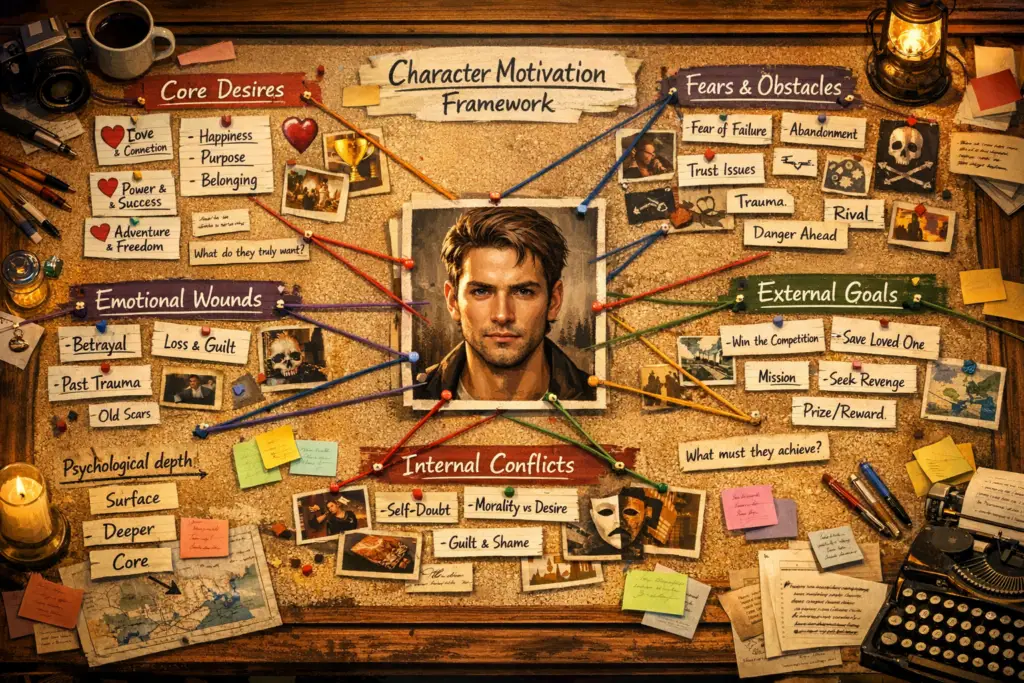
A systematic approach ensures thorough character development. This six-point process provides a framework for building a character from the ground up by creating detailed character profiles [4].
Point One: Establish the Basics
Begin with foundational information:
- Full name (including any nicknames and their origins)
- Age (exact birthdate if relevant to the story)
- Physical appearance (height, build, distinctive features)
- Occupation (current job and career history)
- Living situation (where they live, with whom, economic status)
Even these basics should connect to deeper character elements. A nickname might reveal family dynamics. Physical appearance might reflect self-care or neglect based on emotional state.
Point Two: Develop Backstory
Create a timeline of significant life events from birth to the story’s beginning:
- Childhood (0-12 years): Family dynamics, early friendships, school experiences, formative events
- Adolescence (13-18 years): Identity formation, first love, rebellion or conformity, defining moments
- Young Adulthood (19-30 years): Education, career beginnings, significant relationships, independence
- Adulthood (30+ years): Established patterns, achievements and failures, current relationships
Identify turning points—moments when the character’s life trajectory changed direction. These become reference points for understanding current behavior.
Point Three: Map Relationships
Characters exist in relationship to others. Create a relationship web that includes:
Current Relationships:
- Family members (quality of relationship, frequency of contact)
- Romantic partners (past and present)
- Friends and confidants
- Colleagues and professional connections
- Enemies or antagonists
Relationship Patterns:
- How does the character typically form attachments?
- What role do they usually play (caretaker, rebel, peacemaker, leader)?
- What relationship wounds do they carry?
- How do they handle conflict in relationships?
Point Four: Define Psychology and Personality
Go beyond surface traits to understand psychological makeup:
Personality Framework:
- Introvert or extrovert? (energy source)
- Thinking or feeling? (decision-making style)
- Organized or spontaneous? (approach to life)
- Optimistic or pessimistic? (worldview)
Psychological Dimensions:
- Core beliefs about themselves, others, and the world
- Defense mechanisms (how they protect themselves emotionally)
- Coping strategies for stress
- Emotional regulation patterns
Point Five: Identify Quirks and Specifics
Universal characters feel generic. Specificity creates memorability [6]. Develop:
Physical Mannerisms:
- How do they walk, sit, stand?
- Nervous habits or comfort gestures
- Facial expressions and eye contact patterns
- Voice qualities (pace, pitch, volume, accent)
Behavioral Patterns:
- Morning routines and rituals
- How they handle waiting or boredom
- Response to unexpected events
- Social interaction styles
Preferences and Aversions:
- Favorite foods, music, activities
- Strong dislikes or phobias
- Aesthetic preferences (colors, styles, environments)
- Pet peeves and triggers
Point Six: Establish Values and Worldview
What does your character believe about how life should be lived?
Core Values (ranked by importance):
- Family, career, freedom, security, creativity, justice, loyalty, honesty, adventure, tradition, etc.
Moral Framework:
- Where do they draw ethical lines?
- What would they never do, regardless of circumstances?
- What might they do if desperate enough?
- How do they justify morally gray choices?
Worldview Questions:
- Do people get what they deserve?
- Is the world fundamentally safe or dangerous?
- Can people really change?
- What gives life meaning?
These philosophical underpinnings inform every choice a character makes, especially under pressure.
Bringing Physical Life to Character Profiles
Characters are not just psychological constructs—they exist in physical bodies that move through space. Translating detailed character profiles into observable physical choices bridges the gap between preparation and performance [6].
Physical Characteristics and Their Implications
Every physical trait tells a story:
Posture and Carriage:
- Upright and open → confidence, social ease
- Hunched or protective → insecurity, guardedness
- Asymmetrical → past injury, emotional imbalance
- Fluid and graceful → training, self-awareness
Movement Quality:
- Quick and decisive → urgency, confidence, anxiety
- Slow and deliberate → caution, thoughtfulness, depression
- Expansive → claiming space, dominance
- Contracted → minimizing presence, submission
Gesture Patterns:
- Open palms → honesty, vulnerability
- Crossed arms → defensiveness, self-protection
- Fidgeting → nervousness, excess energy
- Stillness → control, presence, or shutdown
Creating a Physical Profile
Based on your character’s background, psychology, and current circumstances, develop specific physical choices:
Voice and Speech:
- Vocal placement (chest, throat, nasal)
- Pace and rhythm of speech
- Vocabulary and grammar patterns
- Verbal tics or repeated phrases
- Accent or dialect influences
Physical Habits:
- How they enter a room
- Where they prefer to position themselves in space
- Touch patterns (do they touch others? objects?)
- Eye contact tendencies
- Breathing patterns (shallow, deep, held)
Appearance Choices:
- Grooming and self-care level
- Clothing style and fit
- Accessories and their significance
- Colors they gravitate toward
- How appearance changes with emotional state
The Body Biography Exercise
Stand and physically embody your character while considering:
- Where do they hold tension? (jaw, shoulders, stomach, hands)
- What is their center of gravity? (head, chest, pelvis)
- How much space do they claim? (expansive or contracted)
- What is their relationship to gravity? (grounded, floating, heavy)
- How do they breathe? (shallow, deep, restricted, free)
Walk around the space as your character. Notice what changes naturally when you inhabit their physical life. These discoveries often reveal aspects of character that purely intellectual analysis misses.
Integrating Character Profiles Into Performance
The ultimate purpose of building a character from the ground up through creating detailed character profiles is not the document itself—it is the transformation that occurs when actors fully inhabit another human being.
From Page to Stage: The Translation Process
Character profiles serve as reference material, not scripts to be performed. The goal is internalization—knowing the character so thoroughly that choices arise organically rather than being consciously selected.
Internalization Techniques:
- Immersive Writing: Journal in character’s voice about events in their life, their feelings about other characters, their hopes and fears
- Improvisation: Explore scenes not in the script to discover how the character handles various situations
- Sensory Anchors: Identify smells, sounds, textures, or tastes associated with formative memories
- Playlist Creation: Compile music that captures the character’s emotional landscape
- Image Collection: Gather photos representing the character’s world, family, and aesthetic
Accessing Character in the Moment
During performance, actors cannot consciously think about all the profile details. Instead, they need entry points—quick ways to drop into character:
- Physical Trigger: A specific posture or gesture that activates character embodiment
- Emotional Memory: A real or imagined memory that connects to the character’s emotional state
- Objective Focus: Concentrating on what the character wants in this moment
- Relationship Awareness: Remembering how the character feels about whoever they are with
- Environmental Connection: Noticing how the character relates to the space they occupy
Allowing Discovery and Evolution
Even with comprehensive character profiles, remain open to discovery during rehearsal and performance. Sometimes the character reveals aspects that were not apparent during preparation. This is not a failure of the profile—it is the natural evolution that occurs when preparation meets action.
Trust that the foundational work allows for spontaneity rather than restricting it. A strong character profile provides security, enabling actors to take risks and make bold choices.
Common Pitfalls in Character Profile Development
Even experienced actors sometimes fall into traps that limit the effectiveness of their character work.
Pitfall #1: Creating Characters You Like
Not every character is likable, and that is perfectly fine. The actor’s job is not to make the character sympathetic but to make them understandable. Find the humanity and logic in even morally questionable characters by understanding their wounds, fears, and distorted reasoning.
Pitfall #2: Over-Intellectualizing
Character profiles should inform emotional and physical choices, not replace them. If preparation stays purely in the head, performances feel academic rather than alive. Balance analytical work with embodied exploration.
Pitfall #3: Ignoring Contradictions
Real people are contradictory. A character can be both generous and selfish, confident and insecure, loving and cruel—sometimes in the same scene. Embrace these contradictions rather than smoothing them into false consistency [5].
Pitfall #4: Neglecting Relationships
Characters do not exist in isolation. How they behave depends significantly on who they are with. Develop character profiles that account for how the character shifts in different relationships.
Pitfall #5: Creating Static Characters
People change, especially under the pressure of dramatic events. Character profiles should include not just who the character is at the story’s beginning, but their capacity for change—what experiences might transform them and in what direction.
Advanced Character Profile Techniques

Once comfortable with basic character development, explore these advanced approaches.
The Enneagram and Character Types
The Enneagram personality system offers nine distinct character types, each with core motivations, fears, and growth paths. Using this framework can provide structure for character psychology while avoiding stereotypes.
Trauma-Informed Character Development
For characters who have experienced significant trauma, research trauma responses and their long-term effects. This knowledge ensures respectful, accurate portrayals of PTSD, complex trauma, and healing journeys.
Cultural Competency in Character Building
When playing characters from backgrounds different from your own, extensive research becomes essential. Consult with cultural advisors, consume media created by people from that community, and approach the work with humility and respect.
The Shadow Self
Explore not just who the character presents to the world, but their shadow—the parts of themselves they hide, deny, or repress. These hidden aspects often emerge under stress, creating powerful dramatic moments.
Practical Templates and Tools
Character Profile Template
Create a master document that includes:
Section 1: Basics
- Full name, age, occupation, location
- Physical description
- Family structure
Section 2: Background
- Childhood summary
- Adolescence and young adulthood
- Current life situation
- Timeline of major events
Section 3: Psychology
- Personality traits
- Core beliefs and values
- Fears and desires
- Internal conflicts
Section 4: Relationships
- Family relationships
- Romantic history
- Friendships
- Professional connections
- Relationship patterns
Section 5: Physical Life
- Movement quality
- Voice and speech
- Mannerisms and habits
- Appearance choices
Section 6: Story-Specific
- What they want (scene, story, deep need)
- Obstacles (external and internal)
- Character arc potential
- Key relationships in this story
Quick Reference Card
For use during rehearsals and performances, create a condensed version containing:
- Core motivation (one sentence)
- Main obstacle (one sentence)
- Key relationship dynamics
- Physical anchors (posture, gesture, voice)
- Emotional touchstone (memory or image)
Conclusion: The Transformative Power of Detailed Character Work
Building a character from the ground up through creating detailed character profiles is not merely an academic exercise—it is the foundation of truthful, compelling performance. When actors invest time in understanding family history, uncovering motivations, identifying obstacles, and developing comprehensive character backgrounds, they unlock the ability to create fully realized human beings who resonate with audiences.
The process transforms acting from pretending to becoming. Instead of indicating emotions or playing results, actors grounded in thorough character work make specific, justified choices rooted in deep understanding. This authenticity captivates audiences because it reflects the complexity of real human experience.
Your Next Steps
Ready to develop your next character with depth and authenticity? Begin with these actionable steps:
- Choose a character you are currently working on or want to explore
- Set aside dedicated time (at least 3-5 hours) for initial character profile development
- Start with family history—create a detailed family tree and identify three formative family experiences
- Identify core motivations using the “why” chain and fear inventory exercises
- Map obstacles both external and internal that complicate your character’s journey
- Develop physical specificity through the body biography exercise
- Create your character profile document using the template provided
- Test your work through improvisation and journaling in character
- Refine and deepen as you discover new layers through rehearsal
- Trust the process and allow your preparation to support spontaneous, authentic performance
Remember that character development is not a one-time event but an ongoing discovery process. Each rehearsal, each performance, each moment of reflection adds depth and nuance to your understanding. The actors who create the most memorable performances are those who never stop exploring the infinite complexity of human nature.
The detailed character profile is your roadmap, your foundation, and your safety net. It provides the security to take risks, the knowledge to make specific choices, and the depth to create performances that linger in audiences’ hearts and minds long after the curtain falls. Invest in this foundational work, and watch your performances transform from competent to extraordinary.
References
[1] Character Profile – https://jerryjenkins.com/character-profile/
[2] Character Profile – https://reedsy.com/blog/character-profile/
[3] Character Development – https://plottr.com/character-development/
[4] My 6 Point Character Building Process – https://www.writersdigest.com/write-better-fiction/my-6-point-character-building-process
[5] Writing A Complex Character – https://www.thenovelry.com/blog/writing-a-complex-character
[6] How To Write Vivid Character Descriptions – https://www.masterclass.com/articles/how-to-write-vivid-character-descriptions