

The lights dim, the curtain rises, and hundreds of eyes focus on the stage. For beginning actors, this moment can feel overwhelming—but what if those audience members weren’t just passive observers? What if they were actually your most important scene partners? Mastering stage presence: how beginning actors can connect with their audience begins with a fundamental shift in perspective: treating the audience as an active participant in the theatrical experience rather than an invisible wall to perform at. This approach transforms nervousness into engagement and uncertainty into purposeful connection.
In 2026, theater remains one of the most intimate art forms, demanding a unique blend of technical skill and emotional vulnerability. Unlike film actors who can rely on close-ups and multiple takes, stage performers must command attention across physical distance, sustain energy throughout live performances, and create authentic moments that resonate in real-time. The difference between a forgettable performance and a memorable one often comes down to stage presence—that magnetic quality that makes audiences lean forward in their seats, unable to look away.
Key Takeaways
- Stage presence is the combination of confidence, awareness, and authenticity that allows actors to be fully present and believable, not loud or exaggerated [2]
- The three-quarters rule and spatial awareness help beginning actors position themselves to maximize audience connection while maintaining natural performance
- Intentional body language communicates before words are spoken, with posture, eye contact, and purposeful movement establishing immediate connection [2]
- Emotional authenticity creates magnetic performances when actors experience genuine feelings in the moment rather than simply indicating emotions [2]
- Practical exercises including mirror work, intentional walking, and breath control build the foundational skills necessary for commanding stage presence [1]
Understanding Stage Presence Beyond the Spotlight
What Stage Presence Really Means
Stage presence is often misunderstood as simply being loud, dramatic, or attention-grabbing. In reality, stage presence is defined as the combination of confidence, awareness, and authenticity that an actor projects while performing [2]. It’s not about forcing energy or exaggerating movements—it’s about being fully present, grounded, and believable in every moment on stage.
Think of stage presence as the invisible thread that connects a performer to every person in the theater. When an actor possesses genuine stage presence, audiences feel personally addressed even in a 500-seat venue. This connection happens through:
- 🎭 Physical awareness of body positioning and movement
- 👁️ Visual engagement through purposeful eye contact and focus
- 💪 Confident energy that radiates from thorough preparation
- ❤️ Emotional authenticity that invites audience empathy
- 🎯 Intentional choices that serve the character and story
The Audience as Your Acting Partner
Beginning actors often make the mistake of treating the audience as a passive entity—something to perform “at” rather than “with.” This creates a psychological barrier that manifests as stiffness, self-consciousness, or disconnection. Mastering stage presence: how beginning actors can connect with their audience requires embracing a different mindset entirely.
Professional actors understand that the audience completes the theatrical triangle. While scene partners provide direct interaction, the audience provides energy, emotional response, and the ultimate reason for the performance. This relationship should be:
| Traditional Approach | Partnership Approach |
|---|---|
| Ignore the audience completely | Acknowledge their presence subtly |
| Perform “at” them | Share the experience “with” them |
| Fear their judgment | Welcome their participation |
| Create a “fourth wall” barrier | Maintain permeable connection |
| Focus only on scene partners | Balance attention between partners and audience |
“Actors communicate before speaking through posture, eye contact, movement, and energy, establishing connection with both audience and fellow actors.” [2]
The Three-Quarters Rule: Your Secret Weapon for Audience Connection
Understanding the Three-Quarters Position
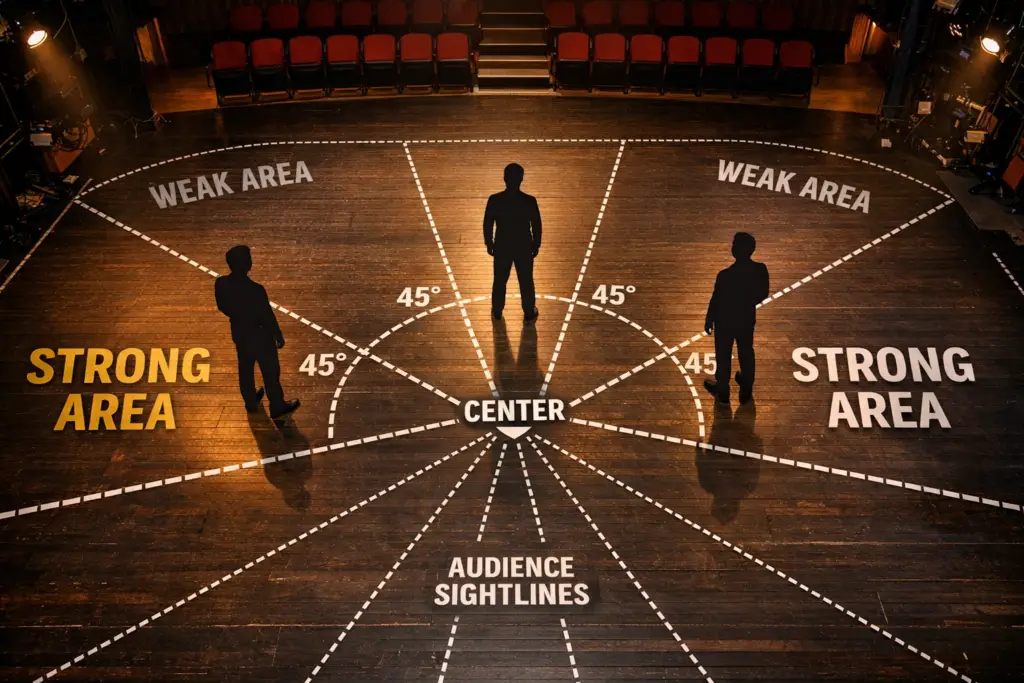
The three-quarters rule is a fundamental staging technique that maximizes both visibility and naturalness. Instead of facing the audience directly (which feels presentational and unnatural) or turning your back completely (which breaks connection), actors position themselves at approximately a 45-degree angle. This “three-quarters” position allows the audience to see facial expressions, body language, and emotional reactions while maintaining the illusion of natural interaction with scene partners.
For beginning actors learning about mastering stage presence: how beginning actors can connect with their audience, the three-quarters position offers several advantages:
- Enhanced visibility: The audience can see most of your face and body
- Natural appearance: You don’t look like you’re posing or presenting
- Maintained connection: You stay engaged with scene partners
- Emotional accessibility: Facial expressions register clearly
- Professional polish: Your blocking looks intentional and skilled
Practicing Three-Quarters Positioning
To develop comfort with three-quarters positioning, beginning actors should practice these exercises:
The Clock Exercise: Stand center stage and imagine you’re at the center of a clock face. The audience is at 6 o’clock. Practice turning to different “hours” while maintaining awareness of where the audience sits. Notice how 4:30 or 7:30 (three-quarters positions) allow you to see both your scene partner and maintain audience visibility.
The Conversation Drill: With a scene partner, practice a simple conversation while both maintaining three-quarters positions. Adjust your angles naturally as the emotional dynamics shift, but always return to positions that keep both actors visible to the audience.
The Mirror Check: Use a mirror or video recording to observe yourself from the audience’s perspective. Notice how much of your face and body language registers at different angles. This builds spatial awareness—the ability to know where you are on stage and how you appear without constantly checking [9].
Spatial Awareness: Commanding the Stage With Confidence
Understanding Stage Geography
Every stage has strong and weak areas that affect how powerfully an actor’s presence registers. Spatial awareness means understanding these zones and using them intentionally to support your character’s journey and the story’s needs.
Strong Stage Areas:
- Downstage center: The most powerful position, closest to audience
- Downstage right/left: Strong positions for featured moments
- Center stage: Commanding but can feel isolated
Weak Stage Areas:
- Upstage center: Furthest from audience, least powerful
- Upstage corners: Difficult for audience to see clearly
- Extreme sides: Can feel disconnected from main action
Beginning actors should note that “weak” doesn’t mean “never use”—it means understanding that different positions create different effects. A character’s emotional isolation might be perfectly served by an upstage position, while a moment of confrontation demands downstage power.
Moving With Purpose Across the Stage
Intentionality matters: Every movement, gesture, and shift should be purposeful and deliberate, choreographed to convey the character’s emotional state [4]. Random or nervous movement breaks the audience’s immersion and signals a lack of control. Instead, movement should:
- ✅ Serve the character’s objective: Move because your character needs to, not because you’re uncomfortable standing still
- ✅ Reflect emotional changes: Physical shifts can mark internal transitions
- ✅ Create visual variety: Strategic movement keeps the stage picture dynamic
- ✅ Respect the ensemble: Movement should support the scene, not distract from it
- ✅ Land with commitment: Complete each movement fully before beginning the next
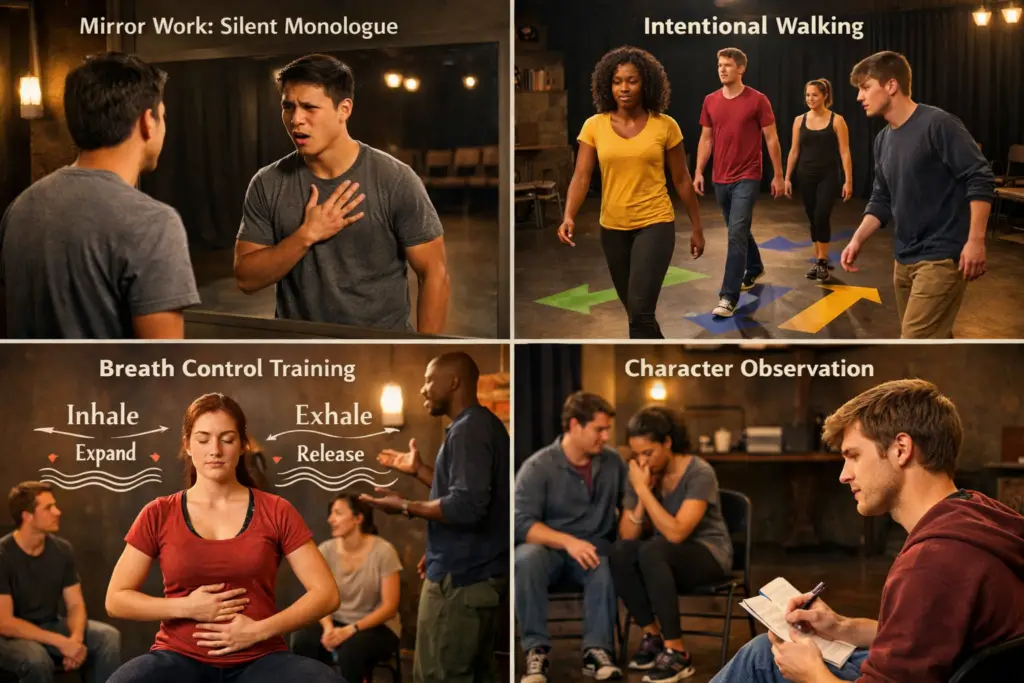
The Intentional Walking Exercise helps develop this skill: Walk across the stage with a specific emotional objective (approaching someone you love, escaping danger, searching for something lost). Notice how the emotion changes your pace, posture, and pathway. This exercise builds the connection between internal state and external expression [1].
Building the Foundation: Confidence, Body Control, and Breath
Confidence Through Preparation
Confidence is core to stage presence, and it grows from knowing the script, understanding the character, and rehearsing thoroughly [2]. There’s no shortcut to this foundation. Beginning actors who struggle with stage presence often haven’t done the deep preparation work that allows them to be truly present in performance.
Building confidence requires:
- Script mastery: Know your lines so well that they feel like your own thoughts
- Character understanding: Research and explore who you’re playing
- Rehearsal commitment: Practice until choices become second nature
- Technical preparation: Understand blocking, cues, and staging
- Emotional readiness: Connect with the character’s feelings and motivations
When preparation is thorough, actors can release anxiety about “getting it right” and focus instead on living truthfully in the moment. This shift from self-consciousness to character-consciousness is where genuine stage presence emerges.
Body Control and Physical Awareness
Body control is essential: Controlled breathing steadies the voice, while relaxed movement prevents stiffness; when body and mind are aligned, presence becomes natural rather than forced [2]. Beginning actors often carry tension in their shoulders, neck, and jaw—physical manifestations of nervousness that the audience immediately perceives.
Physical preparation exercises:
- Progressive relaxation: Systematically tense and release muscle groups to identify and eliminate unnecessary tension
- Alignment work: Practice standing with weight evenly distributed, spine lengthened, shoulders released
- Grounding exercises: Feel your connection to the floor, imagining roots extending downward
- Expansion breathing: Practice breathing that fills the entire torso, not just the upper chest
- Movement exploration: Dance, yoga, or martial arts build body awareness and control [9]
Physical training isn’t about achieving a particular body type—it’s about developing control, awareness, and expressiveness in whatever body you inhabit. The goal is to make your physical instrument responsive to your artistic intentions.
The Power of Breath
Breath is the foundation of both voice and presence. Shallow, irregular breathing creates vocal strain and signals anxiety to the audience. Deep, controlled breathing supports vocal power, emotional authenticity, and physical relaxation.
Breath control training should include [1]:
- Diaphragmatic breathing: Breathing deeply into the belly rather than the chest
- Extended exhale exercises: Practicing long, controlled exhalations to build support
- Breath and movement: Coordinating breath with physical actions
- Emotional breath patterns: Noticing how different emotions affect breathing
- Pre-performance breathing: Establishing calm, centered breath before entering
“When body and mind are aligned, presence becomes natural rather than forced.” [2]
Emotional Authenticity: The Heart of Mastering Stage Presence

Why Audiences Connect With Vulnerability
Emotional authenticity creates magnetism: Audiences connect with performers who are honest and vulnerable, experiencing emotions in the moment rather than performing them [2]. This is perhaps the most challenging aspect of mastering stage presence: how beginning actors can connect with their audience—the willingness to be genuinely affected by the character’s circumstances rather than indicating feelings from the outside.
Beginning actors often fall into the trap of “showing” emotions—making faces, using vocal inflections, or physical gestures that signal “I am sad” or “I am angry” without actually experiencing those feelings. Audiences immediately recognize this artificiality, and it breaks the connection that stage presence requires.
Authentic emotional work involves:
- 🎭 Experiencing rather than indicating: Allowing yourself to be affected by circumstances
- 💭 Connecting to personal truth: Finding genuine emotional resonance with the character’s situation
- 🔄 Staying present: Responding freshly in each performance rather than repeating results
- 🎯 Trusting the process: Believing that honest emotion will be visible without forcing it
- ❤️ Embracing vulnerability: Accepting that real emotion means real exposure
Techniques for Accessing Genuine Emotion
Several established acting techniques help performers access authentic emotional states:
Emotional Recall: Drawing on personal memories that evoke similar feelings to what the character experiences. This technique, associated with Method acting, requires careful use—actors should choose memories they can control and release [1].
Substitution: Replacing the character’s circumstances with personal equivalents. If your character is fighting with their mother, you might substitute a conflict with someone in your own life.
Sense Memory: Using sensory details (sights, sounds, smells, textures, tastes) to make imaginary circumstances feel real and immediate.
Given Circumstances: Thoroughly understanding and believing in the character’s situation, relationships, and stakes so that emotions arise naturally from those circumstances.
Emotional Recall with Object Work combines these approaches: Actors work with meaningful objects while recalling emotional experiences, building the skill of accessing genuine feeling while maintaining technical control [1].
Practical Exercises for Developing Stage Presence
Mirror Work: Seeing Yourself as the Audience Sees You
Mirror work with silent monologues is one of the most valuable exercises for beginning actors [1]. This practice involves:
- Stand before a full-length mirror
- Perform a monologue silently, using only facial expressions and body language
- Observe how emotions register physically
- Notice unnecessary tension, unclear expressions, or distracting habits
- Experiment with different physical choices
This exercise builds awareness of how internal states manifest externally. Beginning actors often discover that what feels like a huge emotional expression barely registers, while subtle authentic feeling shows clearly. The mirror provides immediate feedback about what the audience actually sees.
Advanced variation: Record yourself performing and watch the playback. This creates even more objectivity and allows you to study your work repeatedly.
Character Observation and Physical Transformation
Character observation develops the ability to embody different physical and emotional states [1]. This exercise involves:
- Observe people in public spaces (cafes, parks, transit)
- Notice specific physical details: posture, gait, gestures, facial expressions
- Identify what these physical choices reveal about emotional states
- Practice embodying these observations
- Integrate authentic physical details into character work
This practice expands your physical vocabulary and helps you make specific, grounded choices rather than generic “acting” choices. The goal isn’t mimicry but understanding how physical life reveals inner life.
The Complete Stage Presence Training Routine
For beginning actors committed to mastering stage presence: how beginning actors can connect with their audience, a comprehensive training routine might include:
| Exercise Type | Specific Practice | Frequency | Duration |
|---|---|---|---|
| Physical | Alignment, relaxation, grounding | Daily | 10-15 min |
| Breath | Diaphragmatic breathing, control exercises | Daily | 10 min |
| Spatial | Three-quarters positioning, stage geography | 3x weekly | 15 min |
| Emotional | Emotional recall, sense memory | 3x weekly | 20 min |
| Observation | Character study, physical exploration | Weekly | 30 min |
| Integration | Mirror work, recorded performance review | Weekly | 30 min |
Consistency matters more than duration. Fifteen minutes of daily practice builds skills more effectively than occasional marathon sessions.
Advanced Techniques: Energy, Focus, and the Invisible Connection
Managing and Projecting Energy
Stage presence requires understanding and controlling your energy—the vitality and aliveness you bring to performance. This isn’t about being loud or hyperactive; it’s about being fully engaged and responsive.
Energy management involves:
- Matching the space: Larger theaters require more expansive energy; intimate spaces need more contained intensity
- Supporting scene partners: Giving energy generously to create ensemble chemistry
- Sustaining throughout: Maintaining engagement even when not speaking
- Modulating appropriately: Adjusting energy to serve different moments
- Recovering between performances: Protecting your physical and emotional resources
Beginning actors often either push too hard (creating forced, exhausting performances) or hold back too much (appearing disconnected or low-energy). Finding the balance comes through experience and awareness.
The Power of Focus and Eye Contact
Where an actor looks matters enormously. Eye contact creates connection, while focus directs the audience’s attention. Beginning actors should understand:
Types of Focus:
- Direct address: Looking directly at audience members (used selectively in most realistic theater)
- Scene partner focus: Looking at and truly seeing your fellow actors
- Object focus: Directing attention to meaningful props or set pieces
- Internal focus: Looking inward during moments of reflection or decision
The audience follows your focus. If you look at something with genuine interest, they look too. If your eyes are empty or unfocused, the audience disengages.
Eye contact with scene partners should involve truly seeing and responding to them, not just looking in their general direction. This authentic connection creates the chemistry that audiences find compelling.
Creating the Invisible Thread
The most advanced aspect of stage presence is creating what might be called the invisible thread—that felt connection between performer and audience that transcends technique. This connection emerges when:
- You trust your preparation completely
- You remain genuinely present in each moment
- You allow yourself to be affected by circumstances
- You share the experience rather than performing it
- You maintain awareness of the audience as partners
- You commit fully to the truth of each moment
This invisible thread can’t be forced or faked. It arises naturally when all the elements of stage presence align: physical preparation, emotional authenticity, spatial awareness, intentional choices, and the fundamental willingness to connect.
Common Mistakes Beginning Actors Make (and How to Fix Them)
Mistake #1: Performing “At” Rather Than “With”
The Problem: Treating the audience as judges to impress rather than partners to engage.
The Solution: Shift your mindset to sharing an experience. Remember that the audience wants you to succeed—they’re on your side. Practice exercises that emphasize connection over presentation, and remind yourself that you’re inviting the audience into a story, not proving your worth.
Mistake #2: Indicating Emotions Instead of Experiencing Them
The Problem: Showing what emotions should look like rather than genuinely feeling them.
The Solution: Deepen your preparation work. Use emotional recall, sense memory, and given circumstances to make the character’s situation real for you. Trust that authentic feeling will be visible without forcing external displays.
Mistake #3: Ignoring Spatial Awareness
The Problem: Standing in weak stage positions, turning your back to the audience, or blocking other actors.
The Solution: Study stage geography and practice the three-quarters rule. Develop the habit of knowing where you are on stage and how your position affects visibility and power. Work with directors and fellow actors to create blocking that serves everyone.
Mistake #4: Carrying Physical Tension
The Problem: Tight shoulders, locked knees, shallow breathing, and other tension patterns that signal nervousness.
The Solution: Implement daily physical warm-ups that release tension and build body awareness. Practice grounding exercises and breath work. Learn to recognize where you hold tension and consciously release it.
Mistake #5: Making Unfocused or Random Movements
The Problem: Fidgeting, pacing, or moving without purpose because of nervousness.
The Solution: Practice intentional movement exercises. Every time you move on stage, know why you’re moving and what your character’s objective is. Stand still with commitment when stillness serves the moment.
Integrating Stage Presence Into Your Acting Process
From Rehearsal to Performance
Mastering stage presence: how beginning actors can connect with their audience isn’t something you turn on for performances—it’s integrated throughout your entire process:
In Early Rehearsals:
- Explore character physicality and emotional life
- Experiment with different choices without judgment
- Build relationships with scene partners
- Understand the given circumstances thoroughly
In Later Rehearsals:
- Refine blocking with spatial awareness
- Practice three-quarters positioning
- Integrate emotional authenticity with technical precision
- Develop consistency while maintaining spontaneity
In Technical Rehearsals:
- Adjust energy for the actual performance space
- Understand how lighting and set affect visibility
- Practice sustaining presence through technical elements
- Build stamina for full performances
In Performances:
- Trust your preparation completely
- Stay present and responsive in each moment
- Maintain awareness of audience energy
- Allow each performance to be fresh and alive
Continuous Development
Stage presence isn’t a skill you master once and forget—it’s a continuous practice that deepens throughout your career. Even experienced actors continue working on:
- Physical training and body awareness
- Emotional availability and authenticity
- Spatial intelligence and staging
- Energy management and focus
- Audience connection and presence
Beginning actors should approach stage presence as a journey rather than a destination. Each performance offers opportunities to learn, grow, and refine your ability to connect with audiences.
Building Your Stage Presence Training Plan
Creating a Personalized Practice Schedule
Every actor has different strengths and challenges. To develop a personalized training plan for mastering stage presence: how beginning actors can connect with their audience:
- Assess your current skills: Honestly evaluate your strengths and areas for growth
- Identify priorities: What aspects of stage presence need most attention?
- Set specific goals: “Improve stage presence” is too vague; “eliminate shoulder tension” or “practice three-quarters positioning daily” is actionable
- Schedule consistent practice: Block time for training just as you would for rehearsals
- Track progress: Keep a journal noting discoveries, challenges, and improvements
- Adjust as needed: Modify your practice based on what’s working
Resources for Continued Learning
Beginning actors can deepen their understanding of stage presence through:
- Classes and workshops: Movement classes specifically build physical awareness and stage presence [9]
- Acting techniques: Study various methods (Meisner, Stanislavski, Hagen, etc.) to find approaches that resonate [3]
- Performance opportunities: Nothing replaces actual stage experience
- Observation: Watch excellent performers and analyze their stage presence
- Feedback: Seek constructive criticism from directors, teachers, and trusted peers
- Reading: Study acting theory and technique through books and articles
- Video analysis: Record and review your own performances
The journey of developing stage presence is deeply personal. What works for one actor may not work for another. The key is consistent practice, honest self-assessment, and willingness to remain vulnerable and open to growth.
Conclusion: Your Journey to Commanding Stage Presence
Mastering stage presence: how beginning actors can connect with their audience is one of the most rewarding challenges in theatrical training. It requires developing multiple skills simultaneously—physical control, emotional authenticity, spatial awareness, intentional choices, and the fundamental willingness to treat the audience as an active partner in the theatrical experience.
The journey begins with understanding that stage presence isn’t about being the loudest or most dramatic performer in the room. It’s about being fully present, deeply prepared, and genuinely connected to your character, your scene partners, and your audience. It’s about the confidence that comes from thorough preparation, the authenticity that emerges from emotional honesty, and the awareness that allows you to command space purposefully.
Actionable Next Steps
Ready to begin developing your stage presence? Start with these concrete actions:
- This week: Implement daily 10-minute physical warm-ups focusing on alignment, breath, and tension release
- This month: Practice the three-quarters rule in all rehearsals and scene work, building spatial awareness
- Ongoing: Choose one practical exercise (mirror work, intentional walking, or emotional recall) and practice it weekly
- In your next performance: Focus on treating the audience as a scene partner, sharing the experience rather than performing at them
- Long-term: Develop a personalized training routine that addresses your specific areas for growth
Remember that every accomplished actor you admire once stood where you stand now—at the beginning of the journey. Stage presence develops through consistent practice, honest self-reflection, and the courage to remain vulnerable and authentic. The audience isn’t there to judge you; they’re there to share in the magic of live theater. When you invite them into that experience as genuine partners, stage presence emerges naturally.
The stage is waiting. The audience is ready. Your journey to mastering stage presence begins with the next rehearsal, the next performance, the next moment of genuine connection. Embrace the process, trust your preparation, and allow yourself to be fully present. That’s where the magic happens. 🎭
References
[1] 10 Acting Exercises To Improve Your Stage Presence – https://www.iam.com/actors/10-acting-exercises-to-improve-your-stage-presence/
[2] Stage Presence Enhancing Acting Skills For Performances – https://www.yellowbrick.co/blog/arts/stage-presence-enhancing-acting-skills-for-performances
[3] Top 10 Acting Techniques – https://emasla.com/blogs/main/top-10-acting-techniques
[4] The Art Of Commanding The Spotlight Stage Presence Secrets For Musical Theater – https://www.musicaltheatercenter.org/the-art-of-commanding-the-spotlight-stage-presence-secrets-for-musical-theater/
[9] Movement Classes Actors Creating Stage Presence – https://www.maggieflaniganstudio.com/post/movement-classes-actors-creating-stage-presence