

Last updated: May 5, 2026
Key Takeaways
• The Uta Hagen fourth wall exercise physical destination trains actors to create believable environments through precise physical awareness and spatial imagination
• Your body position determines exactly what you can see and interact with in the imagined space beyond the fourth wall
• The exercise uses three circles of concentration: immediate proximity, middle distance, and far distance to organize focus
• Physical placement of actual objects during rehearsal helps establish consistent spatial awareness for all actors
• This technique builds authentic character behavior by grounding imagination in real physical laws and limitations
• The exercise works best when you commit 100% to the physical reality of your imagined environment • Regular practice develops the muscle memory needed for believable stage presence and authentic theater acting skills
The Fourth Wall & Beyond
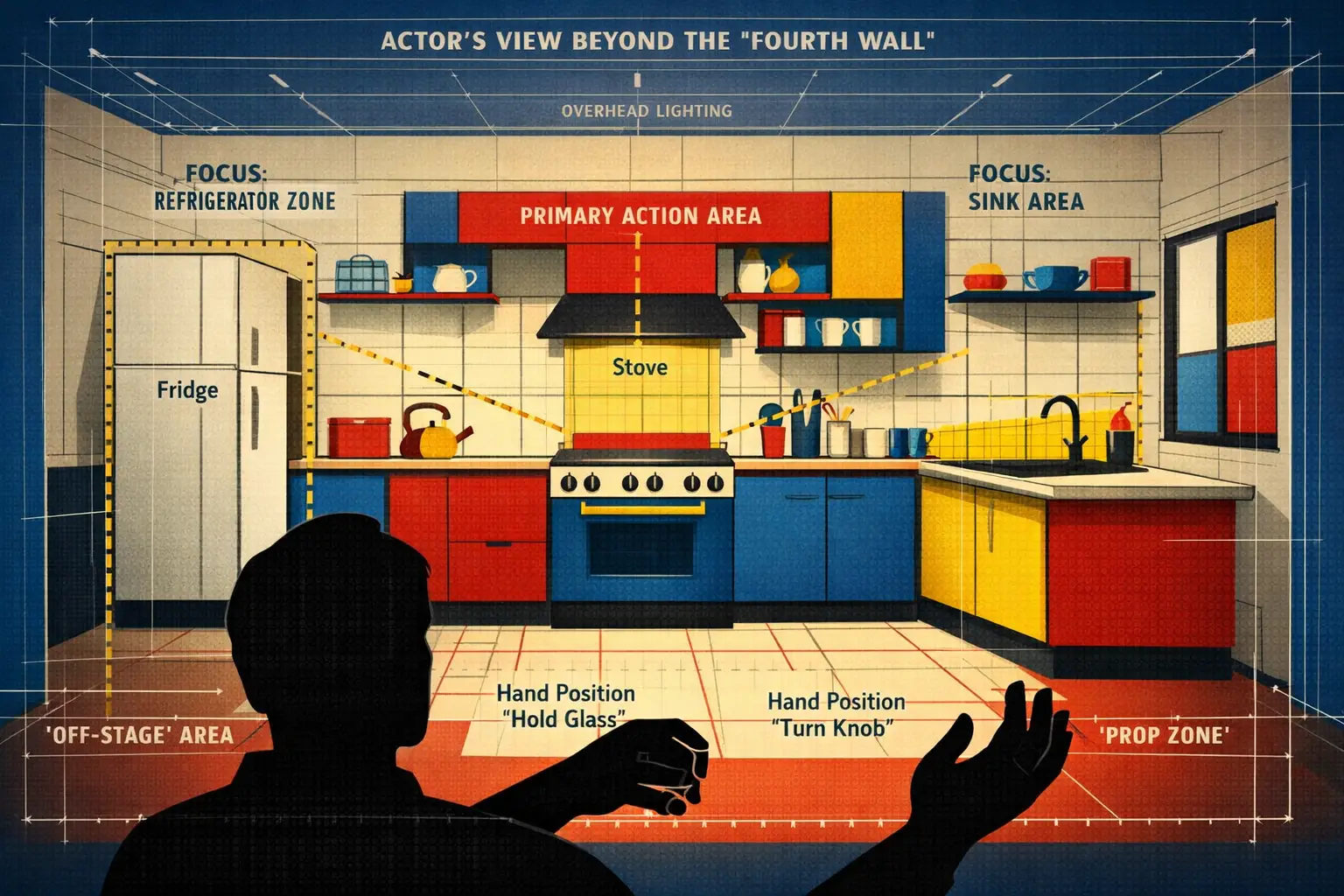
The Uta Hagen fourth wall exercise physical destination teaches actors to create believable environments by using their body position to determine what they can physically see and interact with in an imagined space beyond the audience. You select a specific location (like a kitchen), orient your body toward different areas, and practice interacting with invisible objects at varying distances while maintaining complete physical commitment to the spatial reality you’ve created.
What Is the Uta Hagen Fourth Wall Exercise Physical Destination?
The Uta Hagen fourth wall exercise physical destination is a foundational acting technique that develops your ability to create and maintain believable environments through precise physical awareness. Your body becomes the compass that determines exactly what exists in the imagined space beyond the fourth wall—that invisible barrier between you and the audience.
This exercise trains you to work with circles of concentration at three distinct levels. Your immediate proximity includes objects you can touch without moving your feet. The middle distance covers areas you’d need to walk a few steps to reach. Far distance encompasses everything else in your imagined environment, from windows to distant walls.
I’ve watched countless actors struggle with this concept until they grasp one crucial truth: your physical position determines everything. If you’re facing stage left, you cannot see what’s happening stage right in your imagined kitchen. Your body doesn’t lie, and neither should your performance.
The exercise originally helped actors practice phone conversations, but it extends to any scene work where you need to establish a believable environment. Hagen later renamed this from “Fourth Wall” to “Fourth Side” because it reveals a specific dimension of your character’s reality.
How Do You Set Up the Uta Hagen Fourth Wall Exercise Physical Destination?
Setting up the Uta Hagen fourth wall exercise physical destination starts with choosing a specific, familiar location that you know intimately. Pick your own kitchen, bedroom, or living room—somewhere you’ve spent countless hours and know every detail.
Choose Your Physical Space: • Select a real location you know well (your apartment kitchen works better than a generic “kitchen”) • Map out the major elements: appliances, furniture, windows, doors • Decide which wall of your imagined room faces the audience (this becomes your fourth wall) • Orient yourself so you’re looking into the imagined space, not at the audience
Establish Your Spatial Boundaries: • Mark where major objects would sit using actual rehearsal props if possible • Define your three circles of concentration clearly • Practice turning your body to “see” different areas of the room • Test your sight lines—can you actually see that refrigerator from where you’re standing?
I learned this lesson the hard way during a showcase performance. I’d set up an imagined bathroom but never committed to where the mirror actually was. Halfway through my scene, I was “brushing my teeth” while looking at three different spots. The audience noticed immediately—my performance lost all credibility because I hadn’t done the physical homework.
Common Setup Mistake: Don’t place too many objects in your immediate circle. If everything is within arm’s reach, you’ll never need to move, and your performance becomes static. Building authentic character profiles includes understanding how they move through space.
What Are the Step-by-Step Instructions for the Uta Hagen Fourth Wall Exercise Physical Destination?
The Uta Hagen fourth wall exercise physical destination follows a specific progression that builds your spatial awareness systematically. Start simple and add complexity as your concentration improves.
Phase 1: Establish Your Environment (5-10 minutes)
- Stand center stage facing your imagined fourth wall
- Slowly turn your head left and right, “seeing” specific objects
- Name each object silently and note its exact distance from you
- Practice reaching for objects in your immediate circle without looking away from other areas
- Walk to different positions and notice how your view changes
Phase 2: Add Physical Tasks (10-15 minutes)
- Choose a simple activity (making coffee, getting dressed, organizing papers)
- Move through the task using only imagined objects
- Maintain consistent spatial relationships—that coffee mug stays in the same spot
- Let your body position determine what you can and cannot see
- Practice shifting your attention between the three circles of concentration
Phase 3: Integrate Emotional Objectives (15-20 minutes)
- Add a simple emotional circumstance (you’re running late, expecting good news, avoiding someone)
- Let the emotion affect how you move through the space
- Maintain the physical reality of your environment regardless of emotional state
- Practice moments where you must search for objects or check different areas
During my early training, I spent weeks just making imaginary breakfast. Sounds boring, but it taught me that physical awareness and movement form the foundation of believable character work. You can’t fake spatial relationships—your body either commits to the reality or it doesn’t.
Critical Rule: Never cheat your body position to “help” the audience see what you’re doing. If you’re looking in the refrigerator, your back might be to the audience. That’s correct. Trust the exercise.
How Does Body Position Determine What You See in the Uta Hagen Fourth Wall Exercise Physical Destination?
Your body position in the Uta Hagen fourth wall exercise physical destination works exactly like real life—you can only see what’s physically possible from where you’re standing and which direction you’re facing. This isn’t a metaphor or acting trick; it’s literal spatial awareness.
The Physics of Stage Vision: • Face stage left: you cannot see anything stage right in your imagined room • Look up: you’re checking the ceiling, a high shelf, or perhaps a window • Turn your back to the audience: you’re facing the “back wall” of your imagined space • Peripheral vision follows real-world rules—you might sense movement but can’t see details
Testing Your Spatial Commitment: • Pick a spot for your imagined television and never look at it from an impossible angle • If you place a window stage right, you can’t see outside when facing stage left • Objects behind you don’t exist until you turn around • Distance affects detail—you can’t read a book title from across your imagined room
I once coached an actor who kept “seeing” her imagined cat everywhere in the room simultaneously. When I asked her to track the cat’s movement from the couch to the kitchen, she realized she’d been cheating her spatial awareness. The cat couldn’t be in both places at once, and she couldn’t see both areas without turning her head.
Advanced Spatial Work: • Practice peripheral awareness without turning your head • Work with reflective surfaces (mirrors, windows at night) • Explore how lighting changes what you can see • Notice how furniture blocks your view of certain areas
This physical honesty creates the foundation for authentic stage presence. Audiences unconsciously recognize when an actor’s spatial awareness feels real versus fabricated.
What Are Common Mistakes in the Uta Hagen Fourth Wall Exercise Physical Destination?
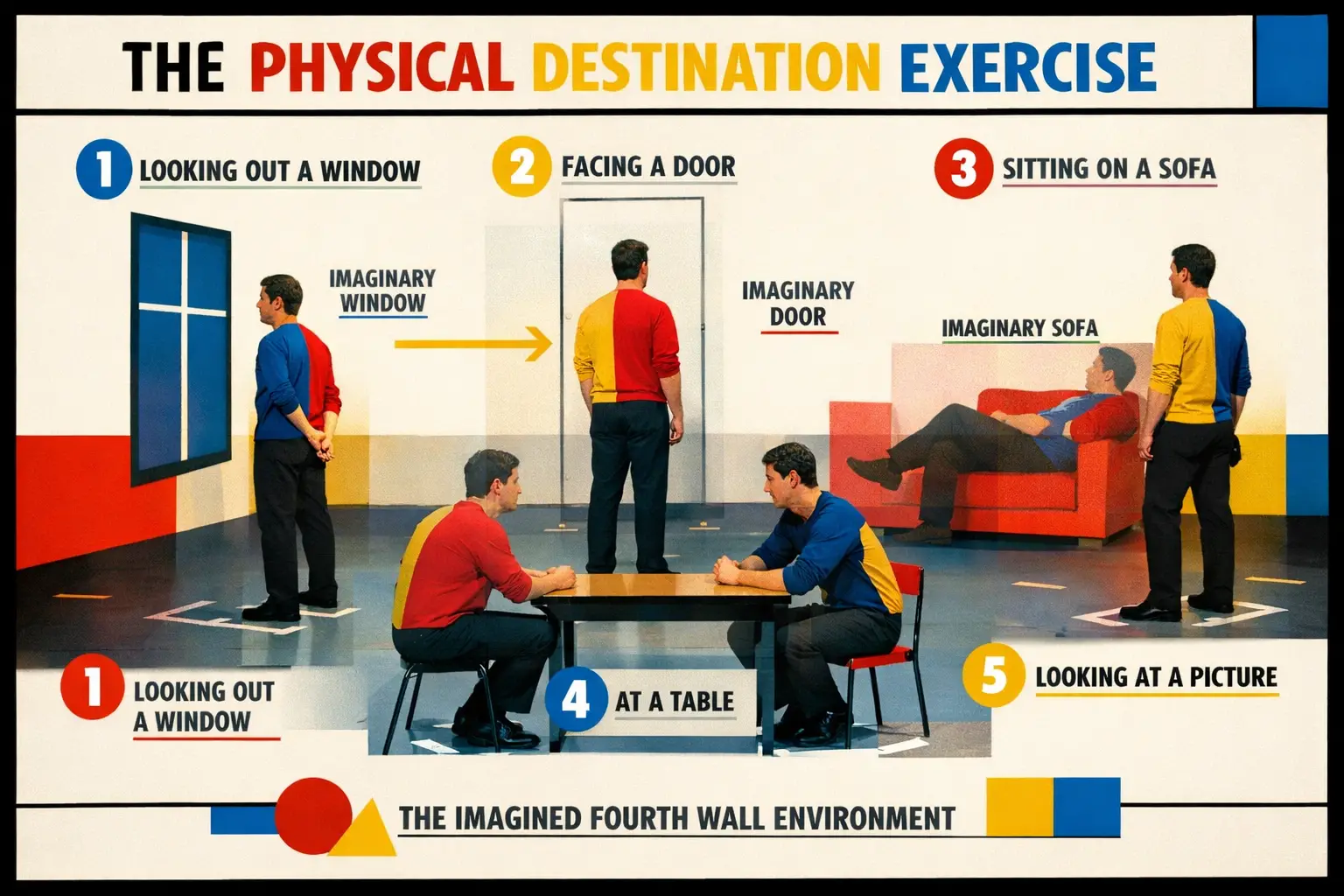
The most frequent mistake in the Uta Hagen fourth wall exercise physical destination is prioritizing the audience’s view over spatial honesty. New actors often twist their bodies into unnatural positions so the audience can “see what they’re doing,” which destroys the exercise’s entire purpose.
Spatial Honesty Violations: • Turning your shoulders toward the audience while “looking” stage left • Reaching for objects that would be impossible to access from your position • Seeing things that would be blocked by furniture or walls in your imagined space • Changing object locations mid-scene because it’s more convenient
Concentration Failures: • Rushing through the exercise instead of taking real time to “see” objects • Working only in your immediate circle and never exploring middle or far distance • Forgetting about objects once you’re not directly interacting with them • Letting your attention scatter instead of following logical sight patterns
Physical Commitment Issues: • Half-hearted reaching that doesn’t commit to specific distances • Inconsistent object placement between rehearsals • Generic gestures instead of precise interaction with specific imagined items • Floating attention that doesn’t anchor to concrete spatial points
I remember watching a student “cook dinner” in her imagined kitchen. She kept reaching for the salt in three different locations, her stove changed height depending on the moment, and she somehow stirred a pot while facing away from it. The exercise became meaningless because she never committed to the physical reality she’d created.
The Fix: Slow down and honor real-world physics. If you place an object somewhere, it stays there. If you can’t see something from your current position, don’t pretend you can. Daily practice routines help build this spatial discipline into muscle memory.
How Do You Progress from Basic to Advanced Uta Hagen Fourth Wall Exercise Physical Destination Work?
Progressing in the Uta Hagen fourth wall exercise physical destination means layering complexity while maintaining your foundational spatial honesty. Advanced work integrates multiple sensory elements and emotional circumstances without sacrificing the exercise’s core physical discipline.
Intermediate Progressions: • Add weather conditions (rain on windows, cold air from an open door) • Include sounds from different areas (phone ringing in another room, traffic outside) • Work with changing light conditions (sunset, flickering candles, lamp switches) • Practice with interruptions (doorbell, unexpected visitors, phone calls)
Advanced Integrations: • Combine with emotional preparation exercises • Layer in character-specific physical traits or limitations • Work with period-specific environments and objects • Practice rapid environment changes (moving between rooms)
Master-Level Challenges: • Maintain spatial awareness during high-emotion scenes • Work with multiple characters sharing the same imagined space • Integrate with complex blocking and choreography • Sustain the exercise through full scene work with dialogue
During my third year of training, I attempted to combine this exercise with a grief-stricken character who was packing up a deceased spouse’s belongings. The emotional weight was so intense that I kept losing track of where I’d placed objects. That taught me that advanced work means your spatial foundation must be rock-solid before adding emotional layers.
Professional Applications: • Film work where you’re acting opposite green screens or missing set pieces • Theater productions with minimal sets that require extensive imagination • Community theater auditions where you must create environments in empty rooms • Commercial work where you’re interacting with products that will be added in post-production
The goal isn’t to make the exercise more complicated—it’s to make your spatial awareness so reliable that you can maintain it under any circumstances. When directors see actors who can create believable environments with nothing but their physical commitment, those actors get hired.
Frequently Asked Questions
How long should I practice the Uta Hagen fourth wall exercise physical destination each day? Start with 15-20 minutes daily, focusing on one simple environment and activity. As your concentration improves, extend sessions to 30-45 minutes. Quality matters more than quantity—five minutes of complete commitment beats twenty minutes of scattered attention.
Can I use the same imagined location every time I practice? Yes, especially when starting. Using your own kitchen or bedroom repeatedly helps you develop detailed spatial memory and consistent object placement. Once you’ve mastered one space, gradually add new environments to expand your skills.
What should I do if I lose track of where I placed an object? Stop and re-establish the object’s location clearly. Don’t guess or approximate—this undermines the exercise’s purpose. Take a moment to “see” the object again, then continue. This happens to everyone during early practice.
How do I know if I’m really seeing the imagined objects or just going through the motions? Test yourself by describing specific details: the exact color of your coffee mug, the pattern on your dish towel, the brand name on your refrigerator. If you can’t provide concrete details, you’re not truly seeing the objects.
Should I use actual props during practice? Occasionally placing real objects helps establish consistent spatial relationships, especially when working with scene partners. However, the exercise’s power comes from working with imagination, so don’t become dependent on physical props.
What’s the difference between this exercise and general stage business? Stage business often serves the story or audience’s needs first. This exercise prioritizes spatial honesty and your character’s authentic relationship to their environment, regardless of what looks good to the audience.
How does this exercise help with memorizing lines? Creating specific physical environments gives your lines concrete anchors. When your character looks out the window or reaches for a coffee cup, those spatial moments become memory triggers that support your dialogue.
Can I practice this exercise in small spaces like dorm rooms? Absolutely. The physical space you’re actually in doesn’t limit the imagined environment you create. You can practice a full kitchen scene in a 6×6 room—your body position and spatial awareness create the reality, not the actual square footage.
What if my scene partner has a different idea about where objects are located? Discuss and agree on major object placement before starting. Use actual props or tape marks during rehearsal to establish shared spatial agreements. Both actors must commit to the same imagined environment for the exercise to work.
How do I maintain this spatial awareness during emotional scenes? Practice the exercise with gradually increasing emotional stakes. Start with neutral activities, then add mild frustration, excitement, or sadness. The spatial foundation must be solid before adding emotional complexity.
Should I tell the audience what I’m seeing in my imagined environment? Never explain or announce what you’re doing. The exercise works through your physical commitment and authentic behavior, not through verbal description. Trust that your genuine spatial awareness will communicate itself to observant audiences.
How does this exercise connect to film and television work? Film sets often have incomplete environments—missing walls, furniture that’s not there during your coverage, or green screen elements. This exercise trains you to maintain spatial relationships even when the physical environment is partial or imaginary.
Conclusion
The Uta Hagen fourth wall exercise physical destination transforms your ability to create believable environments through disciplined spatial awareness and physical honesty. By anchoring your imagination in real-world physics—where your body position determines what you can see and reach—you develop the foundation for authentic character work that audiences recognize as truthful.
Your Next Steps: • Choose one familiar location and practice basic spatial awareness for 15 minutes daily • Focus on honest body positioning rather than “helping” the audience see your work • Gradually add emotional circumstances once your spatial foundation feels solid • Apply this technique to your current scene work and audition preparation
Remember that this exercise isn’t about creating elaborate pantomime or impressive physical displays. It’s about training your instrument to respond truthfully to imagined circumstances. When you can make a simple cup of coffee with complete spatial commitment, you’ve built a skill that will serve every character you ever play.
The magic happens when you stop trying to show the audience what you’re doing and start simply doing it with complete physical honesty. That’s when your work becomes undeniably real, and that’s when directors start paying attention.