



Last updated: April 7, 2026
Picture this: you’re in rehearsal, and your director asks you to tap into a moment of devastating heartbreak for your character. Do you dig deep into your own painful memories, or do you find a creative substitute that gets you to the same emotional place? This is the core difference between Uta Hagen substitution technique vs method acting emotional recall, and choosing the wrong approach for your personality can either unlock brilliant performances or leave you emotionally drained.
Key Takeaways
• Substitution technique uses imagined or transformed personal experiences instead of direct emotional recall
• Emotional recall accesses actual past emotions and memories to fuel character work
• Substitution is generally safer for mental health and more sustainable long-term
• Emotional recall can produce more intense results but carries higher psychological risks
• Your choice depends on your emotional resilience, experience level, and the specific role
• Both techniques require proper training and should be learned under qualified instruction
• Many successful actors combine elements of both approaches
• Substitution allows for more creative flexibility and character separation • Professional actors often prefer substitution for its repeatability and control
Substitution Technique vs Emotional Recall
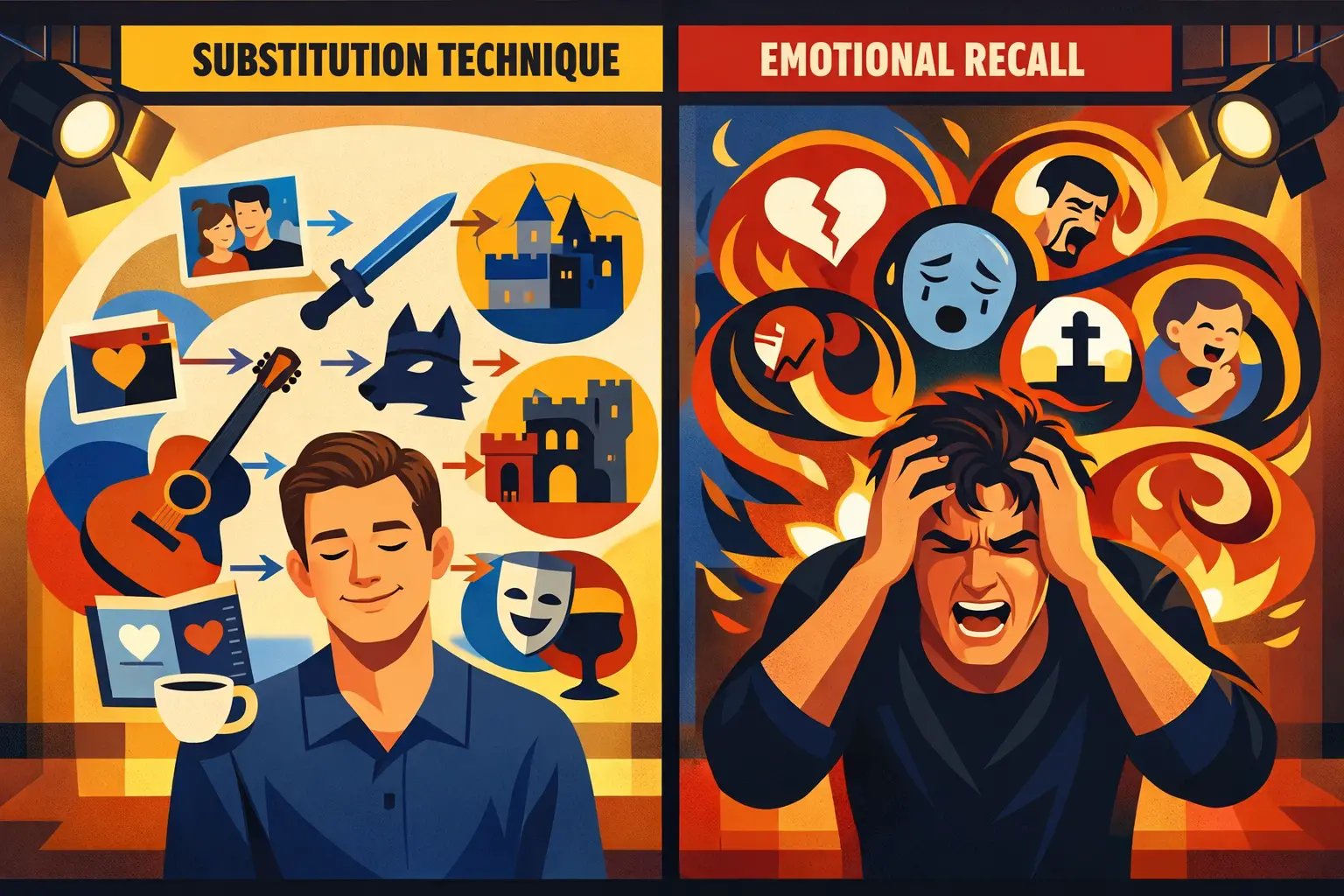
Uta Hagen’s substitution technique transforms your personal experiences into character-appropriate emotions without directly reliving trauma, while method acting emotional recall accesses your actual past emotions to fuel performances. Substitution is safer and more sustainable for most actors, especially beginners, because it maintains healthy boundaries between you and your character while still creating authentic emotional connections.
What Is the Uta Hagen Substitution Technique?
Uta Hagen’s substitution technique replaces the character’s emotional circumstances with your own imagined or modified personal experiences that would produce similar feelings. Instead of becoming the character, you ask “What would make me feel this way?”
Here’s how it works in practice. Let’s say your character just lost their mother, but you haven’t experienced that loss. Rather than forcing yourself into grief you haven’t felt, you might substitute the loss of a beloved pet, amplified to match the intensity needed. Or you could imagine losing your own mother, using your emotional connection without requiring actual trauma.
Key elements of substitution include: • Creating “as if” scenarios that parallel the character’s situation • Using your emotional memory as a starting point, not an endpoint • Maintaining clear boundaries between your life and the character’s life • Building repeatable emotional triggers that don’t drain you personally
I learned this lesson the hard way during a production of “Death of a Salesman” early in my career. Instead of substituting, I kept thinking about my own father’s struggles with depression. By closing night, I was emotionally wrecked and couldn’t separate my family’s pain from Willy Loman’s story. A mentor introduced me to Hagen’s approach, and it changed everything.
The beauty of substitution is its flexibility. You can adjust the intensity, change the circumstances, and create multiple pathways to the same emotional destination. This makes it particularly valuable for building detailed character profiles that feel authentic but don’t compromise your well-being.
How Does Method Acting Emotional Recall Work?
Method acting emotional recall, developed by Lee Strasberg, involves accessing your actual past emotions and memories to create authentic character responses. You literally relive experiences to generate the feelings your character needs in the moment.
The process typically involves deep relaxation and sense memory work. You recreate not just the emotion, but the physical sensations, sounds, smells, and visual details of your original experience. The goal is to make that past moment so vivid that your body responds as if it’s happening now.
Core components of emotional recall: • Detailed sensory recreation of past experiences • Direct access to personal emotional history • Complete immersion in the recalled moment • Transferring authentic emotions to character situations
This technique can produce incredibly powerful results. I’ve seen actors deliver performances that left audiences stunned because the emotions were completely real. The actor was genuinely feeling everything their character experienced.
However, emotional recall comes with significant risks. Repeatedly accessing traumatic or painful memories can retraumatize performers. Some actors become so identified with their characters that they struggle to return to their own emotional baseline.
Common challenges include: • Emotional exhaustion after performances • Difficulty separating personal trauma from character work • Inconsistent results when memories fade or change • Potential psychological harm from repeated trauma exposure
Choose emotional recall only if you have strong emotional boundaries, professional therapeutic support, and extensive training in the technique. It’s not recommended for beginners or actors dealing with unresolved personal trauma.
When Should You Choose Substitution Over Emotional Recall?
Substitution is the better choice for most actors, especially those starting their careers or working on emotionally demanding roles over extended periods. It offers the emotional authenticity you need while protecting your psychological well-being.
Choose substitution when:
• You’re working on a long-running production
• The character’s trauma doesn’t match your personal experience
• You want to maintain clear boundaries between yourself and the role
• You’re dealing with your own unresolved emotional issues
• You need consistent, repeatable emotional access • You’re working without professional therapeutic support
I recommend substitution for about 80% of the emotional work I see actors tackle. It’s particularly valuable in daily practice routines because you can explore intense emotions without wearing yourself down.
Substitution works especially well for: • Grief and loss scenes (substitute smaller losses, amplified) • Romantic scenes (use feelings for different people or imagined relationships) • Anger and conflict (substitute different sources of frustration) • Fear and anxiety (use parallel situations that create similar physical responses)
The key is finding substitutions that create genuine emotional connections without requiring you to relive actual trauma. This approach lets you access authentic feelings while maintaining the creative distance necessary for artistic interpretation.
Comparing Uta Hagen Substitution Technique vs Method Acting Emotional Recall: Practical Differences
| Aspect | Substitution Technique | Emotional Recall |
|---|---|---|
| Emotional Source | Modified personal experiences | Direct personal memories |
| Psychological Safety | High – maintains boundaries | Moderate to Low – can retraumatize |
| Repeatability | Excellent – can adjust intensity | Variable – memories change over time |
| Learning Curve | Moderate – requires imagination | Steep – needs extensive training |
| Professional Sustainability | High – suitable for long careers | Low – emotionally draining |
| Character Separation | Clear boundaries maintained | Risk of over-identification |
| Training Requirements | Acting coach recommended | Professional supervision essential |
The practical differences become clear when you’re actually working on a role. With substitution, I can dial my emotional intensity up or down depending on what the scene needs. If I’m playing a character who’s lost their child, I might start by substituting the loss of something precious to me, then amplify that feeling to match the character’s devastation.
With emotional recall, you’re at the mercy of your actual memories. Some nights they’re vivid and powerful, other nights they feel distant. You can’t easily adjust the intensity without changing your relationship to the original experience.
For sustainable career development, substitution wins hands down. I’ve worked with actors who built entire careers using primarily substitution techniques, while those who relied heavily on emotional recall often burned out or needed extended breaks from emotionally demanding roles.
What Are the Risks and Benefits of Each Approach?

Understanding the risks and benefits helps you make informed choices about which technique to use for specific roles and career phases.
Substitution Technique Benefits: • Protects your psychological well-being • Allows creative flexibility in emotional choices • Maintains healthy actor-character boundaries • Sustainable for long-term career development • Reduces risk of retraumatization • Enables consistent performance quality
Substitution Technique Risks: • May feel less authentic initially • Requires strong imagination and creativity • Can seem “safer” but less emotionally compelling • Needs practice to master the transformation process
Emotional Recall Benefits: • Produces intensely authentic emotions • Creates powerful, memorable performances • Develops deep emotional access and awareness • Can lead to breakthrough artistic moments
Emotional Recall Risks: • High potential for psychological harm • Emotionally exhausting over time • Can blur boundaries between actor and character • May retraumatize performers • Difficult to control intensity and consistency • Requires professional therapeutic support
The biggest mistake I see actors make is choosing emotional recall because they think it’s more “serious” or “professional.” In reality, the most successful actors I know use whatever technique serves the role best while protecting their long-term well-being.
Remember that staying in character when things go wrong becomes much easier when you’re using substitution, because you haven’t lost yourself completely in the character’s emotional reality.
How to Start Practicing Both Techniques Safely
Begin with substitution technique, regardless of which approach ultimately appeals to you. It’s safer to learn and provides a solid foundation for emotional work that you can build on throughout your career.
Starting with Substitution:
- Choose a simple emotion – Start with mild frustration or gentle sadness
- Identify your personal trigger – What makes you feel this way in real life?
- Create the “as if” scenario – How could you modify this to fit your character?
- Practice the transformation – Work on accessing the emotion through your substitute
- Test repeatability – Can you return to this emotional state consistently?
Basic Substitution Exercise: Pick a scene where your character feels betrayed. Instead of recalling when someone actually betrayed you, imagine discovering that your best friend had been lying about something important to you. Feel the disappointment and hurt, then amplify it to match what your character experiences.
If You Want to Explore Emotional Recall:
⚠️ Warning: Only attempt emotional recall with proper training and supervision. Never work alone on traumatic memories.
- Start with positive memories – Joy, excitement, love
- Work with a qualified instructor – Don’t attempt this solo
- Begin with recent, mild experiences – Avoid deep trauma initially
- Practice relaxation techniques – Learn to center yourself before and after
- Establish clear boundaries – Know when to stop and return to yourself
Essential Safety Practices: • Never work on traumatic memories without professional support • Establish a “return to self” ritual after each session • Keep a journal of your emotional responses and recovery time • Have someone you trust check in on your well-being regularly
For developing these skills systematically, consider incorporating them into your stage acting technique practice alongside other fundamental skills.
Which Technique Do Professional Actors Actually Use?
Most working professionals use a hybrid approach that leans heavily toward substitution, with occasional selective use of emotional recall for specific moments or roles. The industry has largely moved away from pure Strasberg method work due to the psychological risks and practical limitations.
What I’ve observed in 30 years of professional work:
• Theater actors typically prefer substitution for sustainability over long runs
• Film actors may use emotional recall for specific takes, then substitute for coverage
• Television actors almost exclusively use substitution due to time constraints and repetitive shooting
• Commercial actors rely on substitution for quick emotional authenticity
The actors who’ve had the longest, most successful careers are those who learned to protect themselves while still delivering authentic performances. They understand that your emotional well-being is your most important professional asset.
Industry Reality Check: You’ll never be asked which technique you use in an audition. Directors care about results, not methods. The actor who can consistently deliver authentic, controlled emotional performances will always work more than the one who creates brilliant moments but can’t repeat them reliably.
Many successful actors don’t even think in terms of specific techniques anymore. They’ve internalized emotional access skills and use whatever works for each moment. This flexibility comes from understanding both approaches and knowing when each serves you best.
FAQ
Q: Is substitution technique easier than emotional recall? A: Substitution has a gentler learning curve and lower psychological risks, but it requires strong imagination and creativity. Both techniques need practice to master, but substitution is safer for beginners and more sustainable long-term.
Q: Can I combine both techniques in the same performance? A: Yes, many actors use hybrid approaches. You might use substitution for most emotional work and selective emotional recall for specific powerful moments. The key is maintaining control and not letting either technique overwhelm your well-being.
Q: How long does it take to learn these techniques properly? A: Basic substitution skills can develop in 3-6 months of regular practice. Emotional recall requires at least a year of supervised training before attempting independently. Both techniques continue developing throughout your career.
Q: Do I need therapy to use emotional recall safely? A: Professional supervision is essential for emotional recall work. This doesn’t necessarily mean therapy, but you need qualified instruction and someone monitoring your psychological well-being throughout the learning process.
Q: Which technique works better for comedy? A: Substitution typically works better for comedy because it allows more creative flexibility and character separation. Comedy often requires you to find the humor in situations without becoming too emotionally invested in the character’s pain.
Q: Can substitution technique create performances as powerful as emotional recall? A: Absolutely. Some of the most memorable performances in theater and film history used substitution techniques. The audience can’t tell which technique you’re using – they only experience the authenticity of your emotional connection.
Q: What if my substitution doesn’t feel authentic enough? A: This usually means you need to find a more personally meaningful substitute or work on your imagination skills. The substitute should create a genuine emotional response in you, even if the circumstances are different from your character’s situation.
Q: Is it normal to feel emotionally drained after using either technique? A: Some emotional fatigue is normal, but you shouldn’t feel traumatized or unable to return to your baseline emotional state. If you’re consistently drained, you may need to adjust your technique or seek additional training.
Q: How do I know which technique is right for my personality? A: Start with substitution and see how it feels. If you have strong emotional boundaries, extensive training opportunities, and professional support, you might explore emotional recall later. Most actors find substitution meets their needs effectively.
Q: Can these techniques help with auditions? A: Yes, both techniques can enhance audition performances. Substitution is particularly useful for auditions because it allows quick emotional access without requiring extensive preparation time or risking emotional exhaustion.
Q: What’s the biggest mistake actors make with these techniques? A: Choosing emotional recall without proper training or support, thinking it’s more “professional.” The biggest mistake is prioritizing intensity over sustainability and not protecting your psychological well-being.
Q: Do different acting schools teach these techniques differently? A: Yes, there’s significant variation. Some schools focus primarily on substitution (following Hagen’s approach), others emphasize emotional recall (Strasberg method), and many teach hybrid approaches. Research the school’s philosophy before enrolling.
Conclusion
The choice between Uta Hagen substitution technique vs method acting emotional recall isn’t about which is “better” – it’s about which serves your artistic goals while protecting your well-being. After three decades in this business, I’ve seen too many talented actors burn out from emotional recall work that wasn’t properly supervised, and I’ve watched others create stunning performances using nothing but well-crafted substitutions.
Your next steps:
- Start with substitution technique – It’s safer and more sustainable for building foundational skills
- Find qualified instruction – Don’t attempt to learn these techniques from books or videos alone
- Practice regularly – Incorporate emotional work into your daily practice routine
- Protect your well-being – Your emotional health is your most valuable professional asset
- Stay flexible – Be willing to use different approaches for different roles and career phases
Remember, the audience doesn’t care which technique you use. They care about authentic, compelling performances that move them. Both substitution and emotional recall can deliver that authenticity, but only substitution lets you do it safely over the course of a long, successful career.
Trust your instincts, protect yourself, and focus on developing the skills that will serve you for decades, not just for your next audition. The best actors I know are the ones who learned to access deep emotions while maintaining the boundaries that keep them healthy, creative, and working.