

The curtain rises, the lights illuminate the stage, and an actor steps into the spotlight—but the techniques that bring characters to life in 2026 look dramatically different from those of previous generations. Stage acting techniques have evolved beyond traditional method acting and classical training to incorporate cutting-edge technology, hybrid performance formats, and digital integration that would have seemed like science fiction just a decade ago.
Today’s stage performers must master not only the timeless fundamentals of voice, movement, and emotional truth but also navigate motion-capture systems, interact with holographic co-stars, and engage audiences through sensor-driven participation platforms. The theatrical landscape has transformed into a $2.5 billion immersive experience market[1], where the boundaries between stage and screen continue to blur while demanding unprecedented versatility from performers.
Key Takeaways
- 🎭 Classical foundations remain essential: Traditional techniques like Stanislavski, Meisner, and vocal training provide the bedrock for all performance work, regardless of technological advancement
- 🤖 AI and motion-capture integration: Approximately 30% of major productions now utilize AI-driven performance tools and real-time motion capture, reducing costs by 80% while enhancing actor preparation[1]
- 🎬 Hybrid performance skills are mandatory: Modern actors must develop proficiency in green screen work, AR element interaction, and virtual production environments alongside traditional stage techniques[3]
- 📱 Multi-platform career development: The most resilient performers in 2026 work across TV, film, theater, voiceover, and digital platforms, using personal branding and social media as career tools[2]
- 👥 Audience interaction technology: Sensor-driven participation platforms increase repeat attendance by 67%, creating new performance dynamics that require real-time adaptability[1]
Understanding Foundational Stage Acting Techniques
The Stanislavski System and Emotional Memory
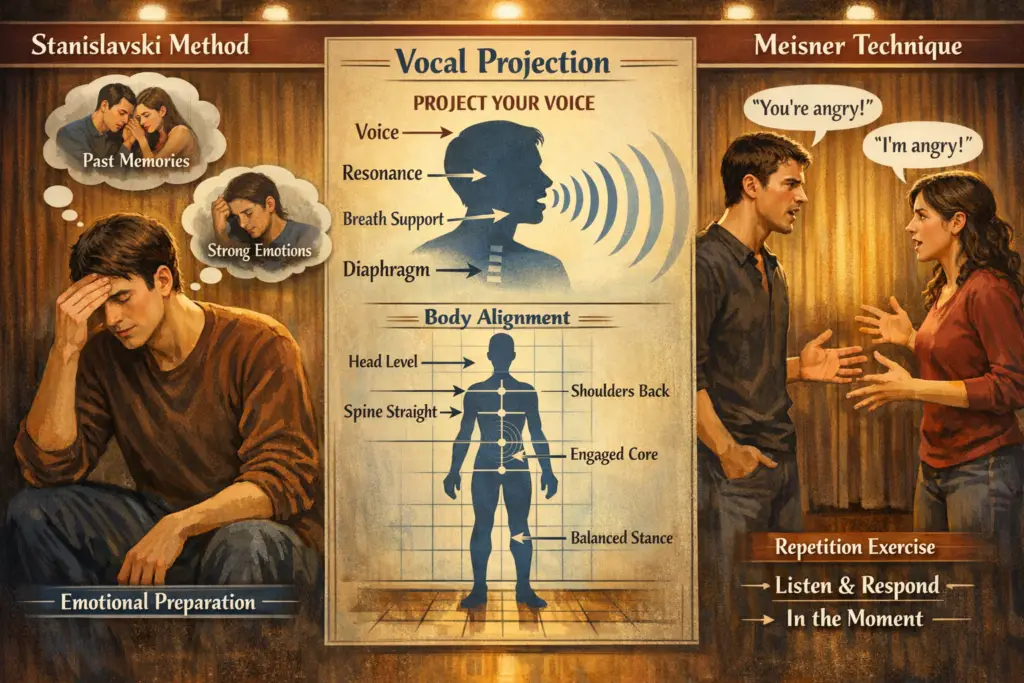
The Stanislavski System remains one of the most influential approaches to stage acting techniques, even as the industry embraces technological innovation. Developed by Russian theater practitioner Konstantin Stanislavski, this method emphasizes psychological realism and emotional truth. Actors using this technique draw upon their own memories and experiences to create authentic emotional responses on stage.
Key components of the Stanislavski System include:
- Emotional recall: Accessing personal memories to generate genuine feelings
- Given circumstances: Understanding the character’s situation, relationships, and environment
- Objectives and obstacles: Identifying what the character wants and what stands in their way
- The magic “if”: Asking “What would I do if I were in this situation?”
This foundational technique continues to inform modern performance work, even when actors perform alongside digital elements or in hybrid production environments.
The Meisner Technique: Living Truthfully
Developed by Sanford Meisner, this approach to stage acting techniques focuses on instinctive responses and genuine human interaction. The Meisner Technique trains actors to “live truthfully under imaginary circumstances” through repetition exercises that break down intellectual barriers to authentic reaction.
Core principles include:
- Repetition exercises: Partners repeat phrases to each other, responding to genuine impulses
- Emotional preparation: Creating the character’s emotional state before entering a scene
- Working off your partner: Responding authentically to what’s actually happening in the moment
- Doing fully: Committing completely to physical and emotional actions
The emphasis on genuine responsiveness makes the Meisner Technique particularly valuable when performing with holographic co-stars or in augmented reality environments[4], where actors must treat digital elements with the same authenticity as human scene partners.
Classical Voice and Speech Training
Vocal technique forms an essential pillar of stage acting techniques, distinguishing theatrical performance from screen work where microphones capture subtle nuances. Stage actors must project clearly to the back of a theater while maintaining vocal health and emotional authenticity.
Essential vocal skills include:
| Skill Area | Purpose | Training Method |
|---|---|---|
| Breath support | Sustaining long phrases, projecting volume | Diaphragmatic breathing exercises |
| Resonance | Creating rich, full tone | Placement exercises, humming |
| Articulation | Clear consonants and vowels | Tongue twisters, precision drills |
| Range expansion | Accessing emotional variety | Pitch slides, character voices |
| Stamina | Maintaining quality through long performances | Progressive conditioning |
Even as wireless microphone technology becomes more sophisticated in theatrical productions, the fundamental vocal power required for stage work remains a distinguishing characteristic of trained stage actors.
Physical Movement and Body Awareness
Movement techniques enable actors to inhabit characters physically, using their bodies as expressive instruments. Stage acting techniques emphasize larger, more deliberate physical choices than screen work, as performers must communicate clearly to audience members seated hundreds of feet away.
Key movement approaches include:
- Laban Movement Analysis: Understanding effort, shape, space, and body organization
- Viewpoints: Exploring spatial relationships, tempo, duration, and kinesthetic response
- Alexander Technique: Releasing unnecessary tension and finding natural alignment
- Stage combat: Creating safe, believable fight choreography
- Period movement: Mastering historical physicality, deportment, and gesture
These physical foundations now integrate with motion-capture training, where actors develop Andy Serkis-level capabilities previously available only to major film productions[1]. The blend of traditional movement technique with digital augmentation represents the evolution of stage acting techniques in 2026.
Modern Stage Acting Techniques Enhanced by Technology
AI-Driven Performance Analysis and Preparation
The integration of artificial intelligence into actor training and preparation represents one of the most significant developments in stage acting techniques. Approximately 30% of major productions now utilize AI-driven performance tools[1], fundamentally changing how actors prepare for roles.
Neural script analysis tools like Move.ai and DeepMotion analyze scripts 10 times faster than human analysis, identifying:
- Emotional arc patterns and intensity curves
- Character relationship dynamics
- Subtext and underlying motivations
- Vocal pattern recommendations
- Physical gesture suggestions
Broadway and American Repertory Theater productions have already integrated these tools into their rehearsal processes[1]. However, the technology serves as a supplement rather thanreplacement for traditional table work, character analysis, and directorial collaboration.
Real-Time Motion Capture Training
Motion-capture technology has revolutionized how actors prepare for physically demanding roles. AI coaches now provide real-time feedback on emotional delivery and physical performance, creating a training environment that blends traditional method acting with digital augmentation[1].
This technology offers several advantages:
✅ Immediate feedback: Actors see their physical choices visualized instantly
✅ Precision refinement: Subtle adjustments to gesture, posture, and movement quality
✅ Cost reduction: 80% lower motion-capture costs make the technology accessible[1]
✅ Accessibility: Tools once limited to major film productions now available to theater companies
Actors can now train with professional-grade motion-capture capabilities, developing skills that transfer seamlessly between stage, screen, and virtual production environments.
Performing with Holographic Co-Stars
One of the most challenging new stage acting techniques involves performing alongside holographic projections and augmented reality elements in theatrical spaces[4]. This creates unique technical demands as actors must interact with digital characters using the same techniques as live scene partners.
Essential skills for holographic performance include:
- Eye-line precision: Maintaining accurate focus on invisible or projected elements
- Timing coordination: Matching pre-recorded dialogue and movement cues
- Spatial awareness: Navigating physical space with virtual set pieces
- Emotional authenticity: Generating genuine responses to digital stimuli
- Technical rehearsal discipline: Integrating with lighting, projection, and sound cues
The Anastasia AR revival demonstrated the commercial viability of this approach, achieving 92% occupancy while adding 200 virtual balcony seats through AR technology[1]. For actors, this meant developing new techniques for acknowledging and interacting with audience members in both physical and virtual spaces.
Sensor-Driven Audience Interaction
Interactive performance technology is expanding audience engagement in unprecedented ways. Leap Motion hand-tracking sensors enable real-time audience participation in plot decisions during performances, with data showing this increases repeat attendance by 67%[1].
For actors, this technology requires:
- Improvisational readiness: Adapting to audience-influenced plot variations
- Multiple scenario preparation: Rehearsing different story branches
- Audience awareness: Reading and responding to participation energy
- Technical integration: Working with sensor triggers and response systems
Young creators’ outdoor showcases have successfully deployed this technology with 500+ participants[1], demonstrating that sensor-driven interaction extends beyond large commercial productions to experimental and emerging work.
Green Screen and Virtual Production Integration
Technical skills in real-time rendering, green screen work, and coordination with computer-generated elements have become performance requirements rather than specialized abilities[3]. The hybrid stage production market is projected to generate $2.5 billion in 2026, with an estimated 40% of Broadway musical performances adopting hybrid models[1].
Key competencies include:
| Technical Skill | Application | Performance Challenge |
|---|---|---|
| Green screen acting | Virtual backgrounds, CGI integration | Imagining environments, maintaining spatial consistency |
| Virtual production environments | LED volume stages, real-time rendering | Adjusting to digital lighting, interacting with virtual elements |
| Motion tracking markers | Performance capture, digital doubling | Physical restrictions, marker awareness |
| Interactive storytelling platforms | Choose-your-own-adventure formats | Multiple performance paths, branching scenarios |
These technical capabilities complement rather than replace traditional stage acting techniques, requiring actors to maintain emotional truth and character authenticity while navigating technological complexity.
Contemporary Career Development and Industry Adaptation

The Hybrid Audition Landscape
Self-tape submissions and virtual auditions have permanently transformed how actors access opportunities. Self-tapes remain the dominant first-round casting tool, with Zoom and virtual platforms standard for callbacks and director sessions[2]. In-person auditions are now targeted specifically for chemistry reads, blocking, or technical elements requiring physical presence.
This shift demands new stage acting techniques adapted for the camera:
- Frame awareness: Understanding composition and camera placement
- Eye-line for camera: Connecting with readers through the lens
- Technical quality standards: Professional lighting, audio, and background
- Self-direction skills: Making strong choices without immediate feedback
Algorithmic pre-screening of submissions means actors’ initial evaluations may be conducted by AI before human review[2]. This requires high-quality audio, clear framing, and strong eye-line in recorded auditions—technical standards that complement traditional performance skills.
Multi-Platform Performance Strategy
The most resilient actors in 2026 work across TV, film, commercials, voiceover, and new media, using short-form vertical content to showcase range[2]. This multi-platform approach requires adapting stage acting techniques to different mediums while maintaining core performance principles.
Platform-specific considerations include:
📺 Television: Smaller physical choices, microphone-level vocal work, continuity awareness
🎬 Film: Extreme subtlety, working with close-ups, technical precision
🎭 Theater: Projection, larger physical choices, sustained energy
🎙️ Voiceover: Pure vocal characterization, microphone technique, cold reading
📱 Digital/Social: Vertical framing, direct address, platform-specific formats
Self-generated projects and festival pieces are now recognized as equally valuable proof of concept[2], giving actors creative control over their material while demonstrating versatility across formats.
Personal Branding and Digital Presence
Social media integration and personal brand strategy development have become core components of acting careers[3]. Direct fan engagement through social media platforms influences casting decisions, audience development, and career longevity.
Essential digital skills include:
- Content creation: Producing engaging behind-the-scenes, process, and showcase material
- Audience analytics: Understanding engagement metrics and optimization
- Brand consistency: Maintaining professional identity across platforms
- Community building: Cultivating genuine connections with followers
- Platform literacy: Adapting content to TikTok, Instagram, YouTube, and emerging platforms
This digital presence complements traditional stage acting techniques by creating opportunities for actors to demonstrate their craft, build audiences, and attract industry attention outside conventional audition channels.
Protecting Performer Rights in the Digital Age
As technology enables voice replication and digital likeness recreation, contracts mentioning scans, voice replication, or synthetic reuse of performer likenesses require careful review[2]. Unions and advocacy groups have raised concerns about protecting human performers from unauthorized synthetic recreation.
Critical contract considerations include:
⚠️ Usage rights: Specific limitations on how digital likenesses can be used
⚠️ Compensation structure: Payment for initial capture versus ongoing synthetic use
⚠️ Approval rights: Actor consent for specific applications of digital recreation
⚠️ Time limitations: Duration of rights granted for digital assets
⚠️ Exclusivity clauses: Restrictions on competing synthetic performances
Understanding these legal protections ensures that actors maintain control over their performances, whether delivered physically on stage or through digital recreation.
Training Programs Adapting to Industry Evolution
Professional training institutions are updating curricula to address the expanded skill set required for contemporary stage acting techniques. Programs like the Banff Centre’s New Play Actor Training[5] integrate traditional craft with emerging industry demands.
Contemporary training components include:
- Classical technique foundations: Stanislavski, Meisner, voice, movement
- Digital performance skills: Motion capture, green screen, virtual production
- Self-tape and audition technique: Camera work, self-direction, technical setup
- Business and branding: Social media, personal marketing, contract negotiation
- Wellness and sustainability: Mental health, physical conditioning, career longevity
This comprehensive approach recognizes that stage acting techniques now encompass both timeless performance fundamentals and rapidly evolving technological capabilities.
Practical Application: Integrating Traditional and Modern Techniques
Rehearsal Process Evolution
The contemporary rehearsal process blends traditional table work and blocking with technological integration. Directors and actors collaborate to determine which elements benefit from digital enhancement and which require purely human connection.
A typical hybrid rehearsal process might include:
- Traditional table work: Script analysis, character development, relationship exploration
- AI script analysis review: Examining neural analysis insights for additional perspective
- Physical blocking: Traditional stage movement and spatial relationships
- Technical integration: Adding holographic elements, projection mapping, sensor systems
- Motion-capture refinement: Recording and reviewing physical performance data
- Audience interaction rehearsal: Practicing multiple scenario branches
- Technical dress rehearsals: Integrating all elements with full production values
This process maintains the human artistry at the center while leveraging technology to enhance rather than replace creative decision-making.
Maintaining Emotional Truth Amid Technical Complexity
The fundamental challenge of modern stage acting techniques involves maintaining authentic emotional connection while managing unprecedented technical demands. Actors must develop strategies for staying present and truthful even when wearing motion-capture suits, hitting precise marks for projection mapping, or adapting to real-time audience input.
Strategies for authentic performance include:
💡 Thorough technical rehearsal: Practicing until technical elements become second nature
💡 Strong character foundation: Deep character work that remains stable amid technical variables
💡 Present-moment focus: Using Meisner principles to stay responsive rather than mechanical
💡 Physical grounding: Maintaining breath and body awareness despite technical distractions
💡 Collaborative problem-solving: Working with technical teams to minimize performance interference
“The technology should serve the story and the character, never the reverse. When we lose sight of emotional truth in pursuit of technical spectacle, we’ve failed our audience.” — Contemporary theater director’s perspective on hybrid productions
Cross-Training for Career Resilience
Versatility has become the defining characteristic of successful actors in 2026. The ability to move fluidly between classical stage work, motion-capture performance, self-tape auditions, and digital content creation provides career stability in an evolving industry.
Recommended cross-training includes:
- Classical theater: Shakespeare, Chekhov, and period work for foundational technique
- On-camera classes: Film and television acting for subtle, naturalistic performance
- Motion-capture workshops: Digital performance and virtual production skills
- Voiceover training: Microphone technique and pure vocal characterization
- Improvisation: Adaptability, spontaneity, and collaborative creation
- Stage combat and movement: Physical versatility and safety
- Content creation: Video production, editing, and social media strategy
This comprehensive skill set ensures actors can access opportunities across all performance platforms while maintaining the core stage acting techniques that distinguish trained performers.
Balancing Artistic Integrity and Commercial Viability
The tension between artistic expression and commercial success has always existed in theater, but the $2.5 billion immersive experience market[1] raises new questions about how technology shapes artistic choices.
Considerations for artistic integrity include:
- Purpose-driven technology: Using digital elements because they serve the story, not for novelty
- Audience accessibility: Ensuring technology enhances rather than excludes audience connection
- Performer agency: Maintaining creative input rather than becoming technical operators
- Story primacy: Keeping narrative and character at the center of all decisions
- Sustainable practices: Choosing technologies that support rather than exploit performers
Successful productions find the balance where stage acting techniques, whether traditional or technologically enhanced, serve the fundamental goal of meaningful human connection through storytelling.
Future Trajectory: Where Stage Acting Techniques Are Headed

Emerging Technologies on the Horizon
While 2026 has seen widespread adoption of motion capture, AR integration, and AI analysis tools, emerging technologies promise further evolution of stage acting techniques:
- Neural interface performance capture: Direct brain-to-computer emotional state recording
- Haptic feedback costumes: Physical sensations synchronized with virtual elements
- Real-time language translation: Simultaneous multi-language performances for global audiences
- Volumetric capture: Full 3D performance recording for immersive playback
- Biometric audience response: Real-time measurement of audience emotional engagement
These technologies will require actors to develop new competencies while maintaining the emotional authenticity that defines compelling performance.
The Enduring Value of Human Presence
Despite technological advancement, the irreplaceable element of live theater remains the human presence—the breathing, vulnerable, unpredictable reality of actors and audiences sharing space and time. Stage acting techniques will continue evolving, but the core purpose remains unchanged: creating meaningful connection through embodied storytelling.
What technology cannot replace:
❤️ Spontaneous human connection: The electric exchange between live performers and audiences
❤️ Physical presence: The power of bodies in space, breath, and immediate reality
❤️ Unrepeatable moments: The unique alchemy of each performance
❤️ Collective experience: The communal ritual of gathering for live storytelling
❤️ Emotional vulnerability: The courage of human beings revealing truth in real time
The most successful applications of technology in theater recognize these irreplaceable qualities and use digital tools to enhance rather than diminish human presence.
Preparing for Continued Evolution
Actors entering the profession in 2026 must embrace continuous learning as a career constant. The stage acting techniques that define excellence will continue evolving as technology advances and audience expectations shift.
Strategies for ongoing adaptation include:
- Foundational mastery: Deep training in classical techniques provides adaptable core skills
- Technological curiosity: Willingness to experiment with emerging tools and platforms
- Cross-disciplinary learning: Drawing insights from film, gaming, virtual reality, and digital media
- Professional community: Maintaining connections with other artists navigating similar challenges
- Artistic vision: Developing clear values about what makes meaningful performance
The actors who thrive will be those who master both timeless fundamentals and emerging capabilities, using expanded tools to serve the ancient purpose of theater: illuminating human experience through live performance.
Conclusion
Stage acting techniques in 2026 represent a fascinating convergence of classical training and cutting-edge technology. From Stanislavski’s emotional memory to AI-driven script analysis, from Meisner’s truthful repetition to motion-capture performance feedback, today’s actors must develop unprecedented versatility while maintaining the emotional authenticity that defines compelling performance.
The integration of holographic co-stars, sensor-driven audience interaction, and hybrid production formats has created a $2.5 billion immersive experience market[1] that demands both traditional craft and technical proficiency. Yet amid this technological transformation, the fundamental principles remain constant: truthful emotion, clear communication, physical expressiveness, and the irreplaceable power of human presence.
Actionable Next Steps
For actors seeking to master contemporary stage acting techniques, consider these concrete actions:
- Strengthen classical foundations: Enroll in Stanislavski, Meisner, or voice training to build transferable core skills
- Develop technical competencies: Take workshops in motion capture, green screen acting, and self-tape technique
- Build multi-platform presence: Create content across theater, film, and digital platforms to demonstrate versatility
- Invest in quality self-tape setup: Professional lighting, audio, and background for algorithmic pre-screening success[2]
- Understand digital rights: Educate yourself about contracts involving likeness scans and voice replication[2]
- Engage with emerging technology: Experiment with AR, interactive platforms, and virtual production environments[3]
- Maintain artistic integrity: Use technology purposefully to serve storytelling rather than pursuing novelty
- Build professional community: Connect with other artists navigating the evolving landscape
- Practice continuous learning: Commit to ongoing skill development as industry standards evolve
- Prioritize wellness: Develop sustainable practices for career longevity in a demanding profession
The future of stage acting techniques belongs to performers who embrace both tradition and innovation, who master timeless fundamentals while developing new capabilities, and who remember that all technique—classical or cutting-edge—serves the essential human purpose of storytelling. The stage continues to evolve, but the actor’s mission remains unchanged: to illuminate truth, create connection, and remind audiences of our shared humanity through the transformative power of live performance. 🎭
References
[1] Acting Theater In 2026 How The Stage And Screen Are Evolving – https://www.hotbot.com/articles/acting-theater-in-2026-how-the-stage-and-screen-are-evolving/
[2] Casting Trends Production Shifts To Watch In 2026 – https://uptodateactor.com/blogs/post/casting-trends-production-shifts-to-watch-in-2026/
[3] Actor Roles Future Workforce Evolution – https://morganhr.com/blog/actor-roles-future-workforce-evolution/
[4] Technology Changes In The Film Tv Industry – https://www.spotlight.com/news-and-advice/the-industry/technology-changes-in-the-film-tv-industry/
[5] New Play Actor Training 2026 – https://www.banffcentre.ca/programs/theatre/new-play-actor-training-2026