

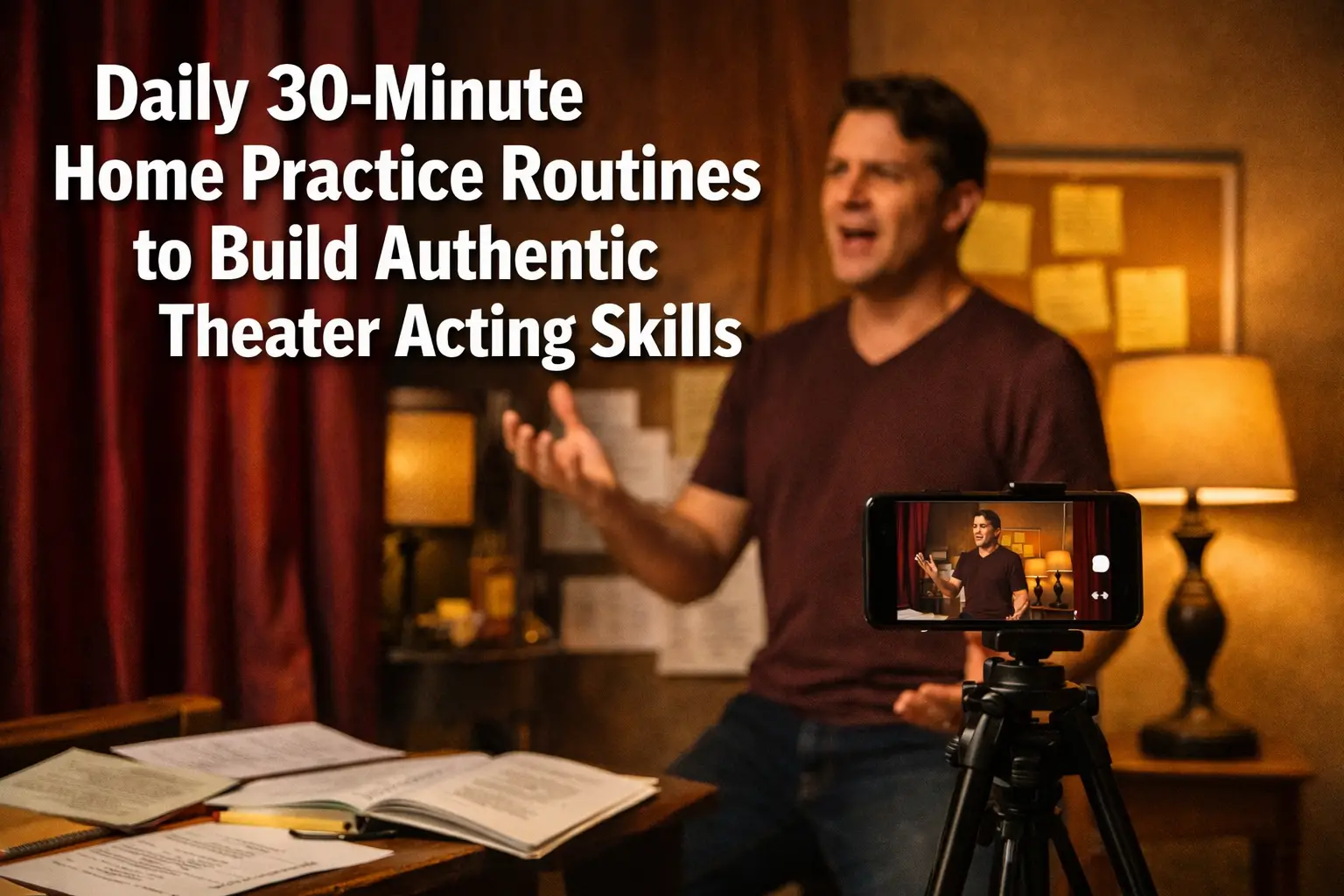
The smartphone in your pocket holds the key to transforming your acting abilities. While aspiring actors once needed expensive studio time and constant access to coaches, today’s performers can build authentic theater acting skills right at home using structured practice routines and simple recording technology. The difference between amateur and professional actors often comes down to one factor: consistent, focused practice.
Daily 30-minute home practice routines to build authentic theater acting skills offer a practical solution for actors at any level. These structured exercises combine traditional Method Acting techniques with modern technology, allowing performers to record monologues, analyze body language, and recreate scenes while matching inner emotions to outer performance. Professional actors have long understood that talent alone isn’t enough—systematic training creates the foundation for compelling, believable performances that captivate audiences.
Key Takeaways
- Structured 30-minute sessions break down into focused segments: vocal warmups, physical exercises, scene work, and self-evaluation using smartphone recording
- Sense memory exercises require only household objects and a chair, making professional Method Acting techniques accessible for solo home practice[1]
- Recording and playback analysis with your iPhone creates accountability and reveals disconnects between internal emotion and external expression
- Modular practice schedules allow flexibility from 5-minute daily skill-building to full 40-minute intensive sessions based on your availability[4]
- Consistent daily practice builds muscle memory for authentic emotional responses, vocal control, and physical presence on stage
Understanding the Foundation of Daily 30-Minute Home Practice Routines to Build Authentic Theater Acting Skills
Why 30 Minutes Creates Lasting Results
The human brain responds exceptionally well to consistent, time-bound practice sessions. Thirty minutes provides enough time to warm up properly, work on specific skills, and cool down without causing mental fatigue or burnout. This duration fits naturally into busy schedules—before work, during lunch breaks, or in the evening—making it sustainable for long-term skill development.
Professional actors understand that quality trumps quantity in practice sessions. A focused 30-minute routine with clear objectives produces better results than sporadic three-hour sessions without structure. The key lies in designing each practice block to target specific aspects of performance: voice, body, emotion, and character development.
The Role of Technology in Modern Acting Practice
Your smartphone transforms from a distraction into a powerful training tool when used strategically. Recording monologues and scene work allows actors to observe themselves as audiences would, revealing habits and patterns invisible during performance. This immediate feedback loop accelerates improvement by making the invisible visible.
The camera doesn’t lie. When actors review recordings, they often discover that their internal emotional experience doesn’t match their external expression. Perhaps the sadness they felt deeply registers as barely perceptible on screen, or their attempt at subtle anger appears as full rage. This disconnect becomes obvious through playback analysis, creating opportunities for calibration and adjustment.
Modern acting programs have embraced remote learning possibilities. The Lee Strasberg Theatre & Film Institute launched online programs teaching Method Acting techniques specifically designed for home practice[1], recognizing that location-based training no longer limits serious actors.
Structuring Your Daily 30-Minute Home Practice Routines to Build Authentic Theater Acting Skills
The Optimal Session Breakdown ⏱️
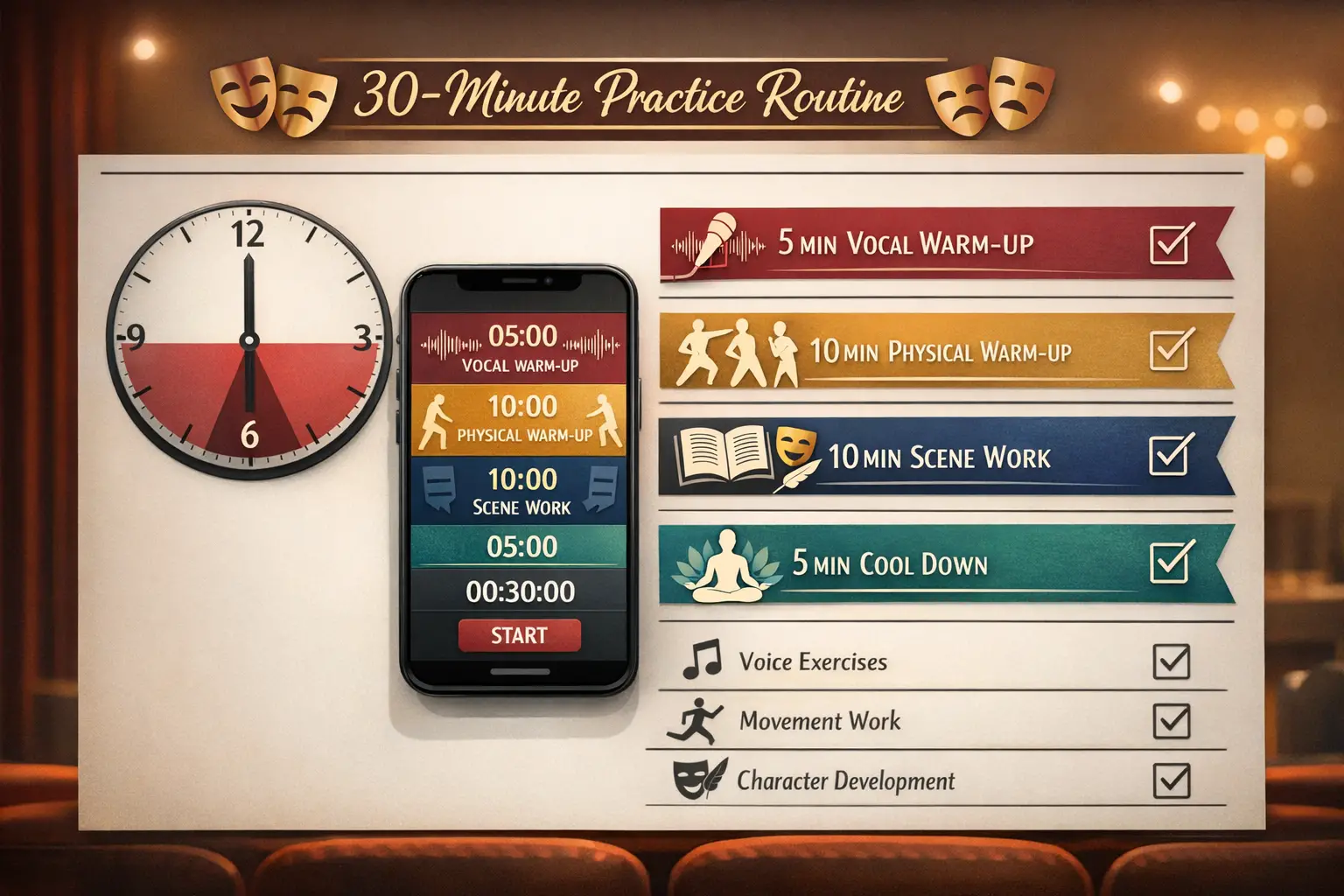
A well-structured 30-minute practice session divides into four key components:
| Time Block | Focus Area | Purpose |
|---|---|---|
| Minutes 1-5 | Vocal Warmup | Prepare voice, breathing, articulation |
| Minutes 6-12 | Physical Warmup | Release tension, increase body awareness |
| Minutes 13-25 | Core Skill Work | Scene analysis, character development, or memorization |
| Minutes 26-30 | Recording Review | Self-evaluation and adjustment notes |
This structure ensures balanced development across all performance dimensions while maintaining energy and focus throughout the session.
Flexibility Within Structure
While consistency matters, rigid adherence to exact timing can create stress. Modular exercises allow actors to adjust sessions from 5 minutes to 40 minutes based on daily availability[4]. On busy days, spending just 5-10 minutes on specific skill-building—like identifying the “five Ws” (who, what, when, where, why) in scenes—maintains momentum without overwhelming schedules[2].
The flexibility principle recognizes that some practice always beats no practice. Missing a day occasionally won’t derail progress, but having shorter backup routines prevents the “all or nothing” mentality that often leads to abandoned training programs.
Creating Your Practice Environment
Designate a specific space for acting practice, even if it’s just a corner of your bedroom. This physical boundary signals to your brain that focused work happens here, similar to how athletes perform better in dedicated training spaces.
Essential equipment for home practice includes:
- 📱 Smartphone with tripod for recording and playback
- 🪑 Comfortable chair for sense memory exercises
- 📚 Script copies with highlighting markers
- 🎤 Recording app for vocal work
- 🪞 Mirror (optional but helpful for physical work)
- 🎧 Headphones for line memorization loops
Voice and Speech Training Exercises for Home Practice
Breath Control and Support
Proper breathing forms the foundation of vocal power and control. Begin each session with diaphragmatic breathing exercises:
- Lie on your back with one hand on your chest, one on your belly
- Breathe so only the belly hand rises (chest remains still)
- Exhale slowly on a sustained “sss” sound for 20 seconds
- Gradually increase duration to 30-40 seconds over weeks
Voice and speech training encompasses multiple focused exercises[4] that build stamina, range, and clarity. These techniques prevent vocal strain during long performances while expanding expressive capabilities.
Articulation and Clarity Drills
Tongue twisters aren’t just children’s games—they’re professional tools for developing crisp articulation:
- “The lips, the teeth, the tip of the tongue” (repeat 10 times, increasing speed)
- “Red leather, yellow leather” (alternate slowly, then rapidly)
- “Unique New York, you need New York, you know you need unique New York”
Record these exercises on your phone and listen critically. Can you understand every consonant? Do vowels maintain their distinct sounds? This self-assessment reveals specific areas needing attention.
Vocal Range and Resonance
Explore your full vocal range through sirening exercises—sliding from lowest comfortable pitch to highest and back down on an “oo” or “ah” sound. This warmup prevents getting stuck in a narrow range during performance.
Resonance exercises help actors project without straining:
- Hum with lips closed, feeling vibration in face and chest
- Open to “mah-may-mee-moh-moo” while maintaining resonance
- Practice projecting to different distances (whisper, conversation, stage, auditorium)
Physical Training and Body Work for Authentic Performance
Releasing Physical Tension
Actors carry tension in predictable places: jaw, shoulders, neck, and hips. This tension blocks authentic emotional expression and creates stiff, unconvincing performances. Daily physical warmups address these problem areas:
Progressive Muscle Relaxation:
- Tense each muscle group for 5 seconds, then release completely
- Start with toes, move through legs, torso, arms, neck, and face
- Notice the difference between tension and relaxation
Jaw Release:
- Massage jaw hinges with gentle circular motions
- Open mouth wide, move jaw side to side
- Make exaggerated chewing motions
- Yawn deeply (real or fake—both work)
Building Body Awareness
Mirror work helps actors understand how their bodies communicate emotion. Stand before a mirror and explore:
- How does sadness change your posture?
- Where does anger live in your body?
- What physical shifts occur when moving from fear to confidence?
Record yourself performing these emotional transitions, then watch the playback without sound. Can you identify the emotions purely through physical expression? This exercise reveals whether your body language matches your internal state.
Movement and Gesture Control
Professional actors make intentional physical choices rather than random movements. Practice exercises include:
- Neutral stance: Find your balanced, relaxed starting position
- Isolation exercises: Move only one body part while others remain still
- Leading with different centers: Walk leading from chest, pelvis, head, or knees
- Gesture economy: Express the same idea with large gestures, then minimize to smallest effective movement
Body work and physical training constitute separate exercise categories for home practice[4], recognizing that physical authenticity requires dedicated attention beyond vocal work.
Character Development and Emotional Authenticity Exercises
Sense Memory: The Foundation of Method Acting
Sense memory exercises form a fundamental component of home practice, requiring only a chair and household objects to recreate sensations and activities[1]. This technique, emphasized by the Lee Strasberg Theatre & Film Institute, proves ideal for solo practice sessions.
The basic sense memory process:
- Select a simple activity (drinking coffee, brushing teeth, applying makeup)
- Perform without the actual object, recreating every physical sensation
- Engage all five senses: What do you see, hear, smell, taste, touch?
- Maintain detailed focus for 5-10 minutes
- Record and review to check for authentic physical behavior
This exercise trains actors to create truthful behavior from imagination, essential for portraying characters in situations they’ve never personally experienced.
Emotion Recall and Substitution
Emotion recall draws from personal experience to fuel authentic performances[3]. Rather than “pretending” to feel sad, actors access genuine memories that evoke real sadness, then channel that authentic emotion into their character’s circumstances.
Safe emotion recall practice:
- Choose a moderately emotional memory (save intense trauma for work with trained coaches)
- Close your eyes and reconstruct the memory in detail
- Notice physical sensations accompanying the emotion
- Open eyes and maintain the feeling while speaking character lines
- Record the monologue and compare to versions without emotion recall
This technique creates performances that resonate with audiences because the emotions are genuine, not manufactured.
The Five Ws of Character Analysis
Spending 5-10 minutes daily identifying the “five Ws” in scenes[2] builds strong analytical skills:
- Who am I? (character background, relationships, status)
- What do I want? (objective, goal, desire)
- When does this occur? (time period, time of day, urgency)
- Where am I? (location, environment, circumstances)
- Why do I want it? (motivation, stakes, consequences)
Write answers for each scene you’re working on. These choices inform every line delivery and physical choice, creating layered, believable characters rather than one-dimensional performances.
Scene Work and Text Analysis for Home Practice

Cold Reading Skills
Cold reading—performing material with minimal preparation—tests an actor’s fundamental skills[3]. Practice this essential audition skill at home:
- Select an unfamiliar monologue or scene
- Read through once silently
- Immediately record a performance
- Review and note first instincts versus later choices
- Record again after 10 minutes of analysis
This exercise builds confidence and quick decision-making while revealing how much actors can accomplish with limited preparation time.
Subtext Exploration
Characters rarely say exactly what they mean. Subtext—the underlying meaning beneath dialogue—creates realistic, complex performances[3]. Practice uncovering subtext:
- Write what the character says (text)
- Write what the character actually means (subtext)
- Write what the character wants the other person to do (objective)
- Perform the line three ways: emphasizing text, emphasizing subtext, balancing both
Record each version and notice how meaning shifts based on interpretation. This flexibility allows directors to guide performances while maintaining your authentic foundation.
Beat Changes and Transitions
Professional actors identify beat changes—moments when objectives or tactics shift within scenes. Practice marking beats:
- Read through the scene
- Mark where your character’s want or approach changes
- Label each beat with an action verb (to seduce, to threaten, to plead)
- Record the scene, making clear transitions between beats
- Watch playback to verify that transitions register clearly
This structural analysis prevents monotonous line delivery and creates dynamic, engaging performances.
Memorization Techniques Using Modern Technology
The Recording Loop Method
Recording lines on your phone and listening on loop creates effortless memorization[2]. This technique leverages passive learning during commutes, exercise, or household tasks:
- Record the other character’s lines with 3-second pauses
- During pauses, speak your lines aloud
- Listen repeatedly until responses become automatic
- Record yourself performing both sides to check accuracy
This method builds muscle memory for line delivery, making words feel natural rather than recited.
The Sleep Learning Approach
Reviewing scripts before sleep supports subconscious retention[2]. The brain processes and consolidates information during sleep, strengthening neural pathways formed during evening study:
- Read through scenes 15-30 minutes before bed
- Focus on understanding rather than forced memorization
- Keep script on nightstand for quick morning review
- Notice how lines feel more familiar after sleeping
This gentle approach reduces memorization stress while improving long-term retention.
Physical Association Technique
Link lines to specific physical movements or locations in your practice space:
- Deliver certain lines while standing in specific spots
- Associate gestures with particular phrases
- Walk a path through your space that mirrors scene blocking
- Use objects as memory triggers for specific moments
Physical association creates multiple retrieval pathways for lines, making them more accessible under performance pressure.
Recording, Analysis, and Self-Evaluation Strategies
Setting Up Effective Recording Sessions
Camera placement dramatically affects what you learn from recordings:
- Eye-level positioning: Captures performance as audience sees it
- Profile angle: Reveals body language and spatial awareness
- Close-up framing: Shows subtle facial expressions and micro-emotions
- Full-body shot: Displays overall physical choices and movement patterns
Rotate through these angles during different practice sessions to develop comprehensive self-awareness.
What to Look for During Playback
Watch recordings with specific evaluation criteria:
Emotional Authenticity:
- Do your eyes reflect the stated emotion?
- Does your body language support or contradict your words?
- Can you identify the exact moment emotions shift?
Technical Execution:
- Is your voice clear and audible?
- Do gestures enhance or distract from meaning?
- Are you making physical choices or defaulting to habits?
Character Consistency:
- Do mannerisms remain consistent throughout?
- Does the character’s physicality differ from your own?
- Are objectives clear in your performance?
Creating Actionable Practice Notes
Transform observations into specific improvement goals:
❌ Vague: “Be more emotional” ✅ Specific: “Access sense memory of grandmother’s funeral before line 23”
❌ Vague: “Work on voice” ✅ Specific: “Practice diaphragmatic breathing; increase volume on lines 15-18 without straining”
❌ Vague: “Better body language” ✅ Specific: “Release shoulder tension; lead with chest during confident moments; reduce hand gestures by 50%”
Specific notes create clear practice objectives for subsequent sessions.
Building Consistency and Tracking Progress
The 30-Day Challenge Approach
Commit to 30 consecutive days of practice to establish lasting habits. Research shows that consistent daily action for one month creates neural pathways that make behaviors feel automatic rather than effortful.
Track your practice with:
- 📅 Calendar marking (visual chain of completed days)
- 📊 Progress journal (brief notes after each session)
- 📹 Weekly recording archive (compare performances over time)
- 🎯 Skill-specific goals (measurable objectives for the month)
The satisfaction of maintaining an unbroken streak provides motivation during low-energy days.
Measuring Skill Development
Quantifiable metrics reveal progress that might otherwise feel invisible:
- Memorization speed: Time required to learn 10 lines (track weekly)
- Vocal range: Lowest and highest comfortable pitches (test monthly)
- Breath control: Duration of sustained sound on one breath (measure weekly)
- Cold reading confidence: Self-rating 1-10 after unfamiliar material (track after each attempt)
Numbers provide objective evidence of improvement, counteracting the subjective feeling that “I’m not getting better.”
Adjusting Your Routine Based on Results
Evaluate and adapt your practice routine monthly:
- Which exercises produce the most noticeable improvement?
- Where do you still struggle despite consistent practice?
- What aspects of performance feel natural versus forced?
- Which time of day yields the best focus and energy?
Effective practice routines evolve based on results rather than following rigid prescriptions indefinitely.
Advanced Variations for Daily 30-Minute Home Practice Routines to Build Authentic Theater Acting Skills
Genre-Specific Practice Sessions
Tailor practice routines to specific theatrical styles:
Classical/Shakespeare:
- Extended vocal warmups (10 minutes)
- Scansion and meter work
- Heightened language exploration
- Formal physicality and gesture
Contemporary Realism:
- Extensive sense memory work
- Conversational vocal patterns
- Naturalistic movement
- Modern subtext analysis
Musical Theater:
- Singing warmups integrated with acting
- Dance/movement combinations
- Character work through song interpretation
- Stamina building for sustained performance
Partner Work via Video Call
Remote scene partners expand practice possibilities:
- Schedule regular video rehearsals
- Record sessions for individual review
- Practice active listening and reaction
- Develop chemistry despite physical distance
Technology enables collaborative practice even when actors can’t share physical space.
Integrating Professional Warmup Techniques
Professional actors use specific warmup games and techniques before performances[7]. Adapt these for home practice:
Vocal Warmups:
- Lip trills and tongue trills
- Humming scales
- Resonance placement exercises
- Articulation drills with tongue twisters
Physical Warmups:
- Shake-out exercises
- Stretching sequences
- Energy-building movements
- Spatial awareness activities
Mental Warmups:
- Concentration exercises
- Imagination activations
- Emotional availability preparations
- Present-moment focus techniques
These professional techniques[7] elevate home practice from amateur to professional-quality training.
Overcoming Common Challenges in Home Practice

Maintaining Motivation Without External Accountability
Self-directed practice requires internal motivation strategies:
- 🎯 Set specific, achievable weekly goals
- 🏆 Reward consistency milestones (30 days, 60 days, 90 days)
- 👥 Share progress with supportive friends or online communities
- 📈 Review early recordings to see how far you’ve progressed
- 🎭 Schedule self-tape auditions to apply practiced skills
External validation isn’t necessary when internal standards drive improvement.
Dealing with Limited Space
Small living spaces shouldn’t prevent effective practice:
- Vocal work requires minimal space (can be done seated)
- Sense memory exercises need only a chair[1]
- Memorization works anywhere, including during walks
- Recording requires just enough space to frame yourself appropriately
Creativity overcomes constraints—professional actors have practiced in tiny apartments, shared dorm rooms, and backstage corners throughout history.
Avoiding Plateaus and Stagnation
When progress seems to stall:
- Change your material: New monologues challenge different skills
- Adjust practice structure: Swap time allocations between exercises
- Seek new learning: Watch masterclasses, read acting books, study performances
- Take strategic breaks: 2-3 days off can refresh perspective and energy
- Get external feedback: Share recordings with teachers, coaches, or trusted peers
Plateaus signal the need for variation and challenge, not abandonment of practice.
Resources and Continued Learning
Best Acting Exercises for Skill Development
Comprehensive acting exercise collections provide endless practice material. Resources like Backstage’s compilation of best acting exercises[5] offer techniques from various schools and approaches, allowing actors to customize routines based on personal needs and preferences.
Experiment with exercises from different traditions:
- Stanislavski System: Given circumstances, magic if, emotional memory
- Meisner Technique: Repetition, emotional preparation, independent activities
- Viewpoints: Spatial relationships, tempo, kinesthetic response
- Practical Aesthetics: Literal action, essential action, as-if substitution
This cross-training approach develops versatile actors comfortable with multiple methodologies.
Online Learning Platforms
Digital education has democratized access to world-class instruction:
- Lee Strasberg Theatre & Film Institute’s online Method Acting program[1]
- MasterClass sessions with renowned actors
- YouTube tutorials from professional coaches[2][4][6]
- Virtual workshops and intensives
- Acting-focused social media communities
Quality instruction no longer requires geographic proximity to major theater centers.
Building a Personal Acting Library
Invest in foundational texts that deepen understanding:
- “An Actor Prepares” by Constantin Stanislavski
- “Respect for Acting” by Uta Hagen
- “The Actor and the Target” by Declan Donnellan
- “True and False” by David Mamet
- “The Viewpoints Book” by Anne Bogart and Tina Landau
Books provide theoretical frameworks that give context and purpose to practical exercises.
Conclusion: Your Path Forward with Daily 30-Minute Home Practice Routines to Build Authentic Theater Acting Skills
The journey from aspiring actor to skilled performer doesn’t require expensive studios, constant coaching, or years of formal training. What it demands is consistent, intelligent practice using the tools already at your disposal. Daily 30-minute home practice routines to build authentic theater acting skills provide a sustainable framework for continuous improvement, combining traditional techniques with modern technology.
Your smartphone becomes a coach, mirror, and accountability partner when used strategically. Recording performances reveals the truth about your work—where internal emotion matches external expression and where disconnects require attention. This immediate feedback accelerates development in ways previous generations of actors couldn’t access.
The modular structure of these routines ensures that busy schedules never become excuses. Whether you have 5 minutes or 40 minutes[4], focused practice on specific skills moves you forward. Vocal warmups, physical exercises, sense memory work[1], character development, and scene analysis all contribute to the comprehensive skill set that defines professional actors.
Actionable Next Steps 🎯
This Week:
- Designate your practice space and gather essential equipment (smartphone, tripod, scripts)
- Choose one monologue to serve as your baseline—record it before beginning structured practice
- Complete at least four 30-minute sessions using the recommended structure
- Review recordings and create specific improvement notes
This Month:
- Commit to the 30-day consistency challenge with calendar tracking
- Experiment with different practice times to find your optimal focus period
- Record weekly progress videos of the same monologue to document improvement
- Explore at least three new exercise types from different acting methodologies
This Quarter:
- Develop genre-specific practice routines for your target performance styles
- Find a remote scene partner for collaborative video rehearsals
- Invest in one professional development resource (online class, book, or workshop)
- Apply your practiced skills to real auditions or performance opportunities
Remember: Professional actors aren’t born with innate talent that amateurs lack. They’ve simply committed to consistent, structured practice that builds skills incrementally over time. Your 30-minute daily investment compounds into transformative results. The authentic, emotionally connected performances you admire on stage result from exactly this type of dedicated home practice.
The curtain rises on your acting journey today. Your practice space awaits, your smartphone is ready, and the techniques that have trained generations of professional actors are now accessible in your home. Start today—not tomorrow, not next week, not when circumstances are perfect. Thirty minutes of focused practice right now will teach you more than hours of planning and preparation.
The stage is yours. Begin.
References
[1] How Actors Can Make The Most Of Quarantine – https://strasberg.edu/blog/how-actors-can-make-the-most-of-quarantine/
[2] Watch – https://www.youtube.com/watch?v=n2e5Wsg9PxI
[3] Unlock Your Potential With Fun Acting Exercises And Games For All Levels – https://bernardhiller.com/unlock-your-potential-with-fun-acting-exercises-and-games-for-all-levels/
[4] Watch – https://www.youtube.com/watch?v=lKlpdl-vwQQ
[5] Best Acting Exercises 76697 – https://www.backstage.com/magazine/article/best-acting-exercises-76697/
[6] Watch – https://www.youtube.com/watch?v=U5sFlMe01kk
[7] 7 Acting Warmups Games And Techniques For Actors – https://www.masterclass.com/articles/7-acting-warmups-games-and-techniques-for-actors