

Listen, after three decades in this business—from sweating under stage lights to squinting into camera lenses—I’ve watched countless talented actors sabotage themselves. Not because they lacked skill, but because they carried invisible baggage into every audition, every scene, every take. Emotional blocks and physical tension are the silent career killers nobody talks about at drama school.
In 2026, as streaming platforms demand increasingly nuanced performances and casting directors scroll through self-tapes at lightning speed, the actors who book the complex, meaty roles aren’t necessarily the most classically trained. They’re the ones who’ve mastered Presence and Block Integration: Crash Acting Exercises for Authentic Character Depth on Camera—targeted drills that systematically dismantle barriers between you and truthful performance.
Think of it like this: your talent is a radio signal, but emotional blocks are interference creating static. These crash exercises don’t just improve your acting; they clear the channel entirely.
Key Takeaways
- 🎭 Emotional and physical blocks create invisible barriers that prevent authentic character connection and camera presence
- 💪 Crash acting exercises combine presence work with deliberate block integration to build dimensional, believable characters
- 🎬 Camera-specific techniques differ significantly from stage work, requiring heightened subtlety and internal truth
- 🔄 Systematic practice routines incorporating mirror work, repetition exercises, and movement training create measurable improvement
- ⚡ Block integration transforms personal limitations into character assets rather than obstacles to overcome
Understanding Blocks: The Hidden Barriers to Authentic Performance
Before we dive into the exercises, let’s get brutally honest about what we’re dealing with. Blocks aren’t weaknesses—they’re protective mechanisms your psyche developed over years of life experience. Maybe you learned early that showing vulnerability got you hurt. Perhaps expressing anger felt dangerous. Or physical intimacy makes you freeze up.
Here’s the problem: the camera is a truth detector with zero mercy. It amplifies everything, especially inauthenticity. When you’re blocked, you’re essentially performing around the character instead of through them.
The Three Types of Blocks Actors Face
| Block Type | Manifestation | Impact on Camera Work |
|---|---|---|
| Emotional | Inability to access certain feelings authentically | Scenes feel performed rather than lived |
| Physical | Tension, restricted movement, awkward body language | Character physicality appears forced or unnatural |
| Psychological | Mental resistance to character choices or circumstances | Lack of commitment visible in eyes and micro-expressions |
The revolutionary approach of Presence and Block Integration: Crash Acting Exercises for Authentic Character Depth on Camera doesn’t ask you to eliminate these blocks. Instead, it teaches you to integrate them—to transform obstacles into texture.
I learned this the hard way during a commercial shoot in the late ’90s. The director kept saying my smile “didn’t reach my eyes.” I was blocked around genuine joy (childhood stuff, long story). Instead of faking it harder, I integrated that emotional distance into the character’s backstory. Suddenly, the performance had layers. We wrapped in one take.
Core Presence Exercises: Building Your Foundation
Presence is your ability to exist fully in the moment, available to whatever arises. It’s the difference between an actor who commands attention and one who technically hits their marks but somehow disappears on screen.
Mirror Work: The Unflinching Truth Teller
Start here, always. Stand in front of a full-length mirror for 10-15 minutes daily[1]. Not to admire yourself or fix your hair—to witness yourself without judgment.
The Exercise:
- Stand naturally, breathing normally
- Make eye contact with your reflection
- Notice every impulse to look away, adjust, or perform
- Stay present with discomfort
- Slowly explore different emotional states while maintaining eye contact
This exercise reveals where you’re blocked faster than anything else. When you shift into sadness and immediately want to look away? Block identified. When anger makes you tense your jaw unconsciously? There’s your physical manifestation.
The genius here is that mirror work builds both self-awareness and camera comfort simultaneously. The camera lens becomes just another mirror—one you can meet with complete honesty[1].
Power Pauses: Commanding Space Through Stillness
In our anxiety-driven industry, actors often fill every moment with unnecessary movement or dialogue. Power pauses teach you that presence often speaks louder than words[1].
The Practice:
- During scene work, deliberately pause for 3-5 seconds before responding
- Resist the urge to fill silence with fidgeting or vocal fillers
- Stay connected to your scene partner and your internal reality
- Notice how stillness creates anticipation and depth
I use this constantly in voiceover work. That breath before the emotional turn? That’s not dead air—that’s presence. On camera, these pauses give editors gold and give your character gravitas.
Intentional Walking: Physicality as Character Gateway
Your body holds stories your conscious mind has forgotten. Intentional walking exercises unlock physical blocks while developing character-specific movement vocabularies[1].
The Drill:
- Walk naturally across the room, noting your default gait
- Identify areas of tension (shoulders, hips, jaw)
- Experiment with leading from different body parts (chest, pelvis, head)
- Notice how each variation changes your emotional state
- Apply discoveries to character physicality
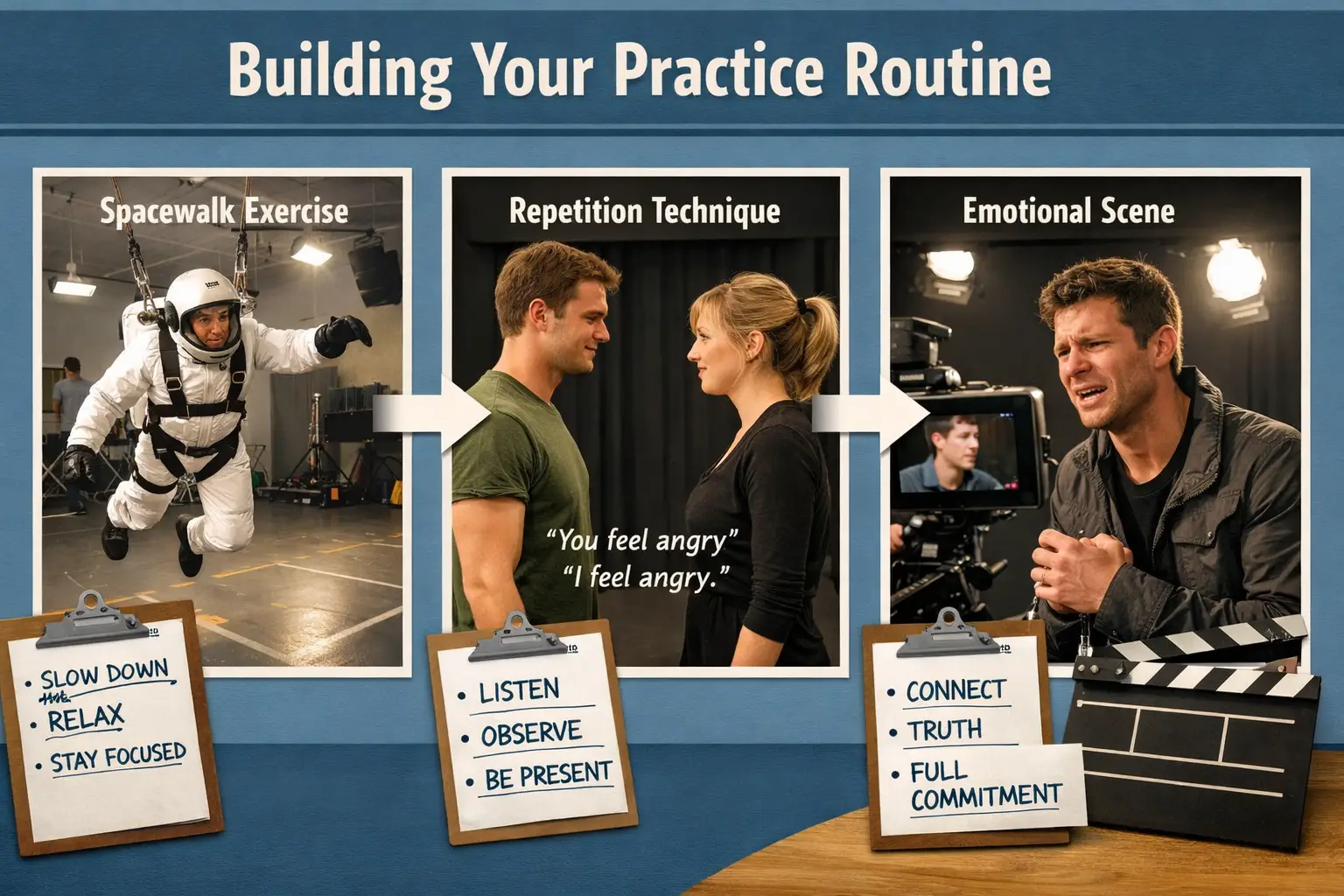
Movement-based presence work like spacewalk exercises helps actors develop authentic stage and camera presence by connecting physical awareness to emotional availability[4][5]. When you’re physically blocked—say, holding tension in your shoulders—it restricts your emotional range. Release the physical block, and suddenly you can access vulnerability.
Integrating Blocks Into Character Work: The Crash Method
Here’s where Presence and Block Integration: Crash Acting Exercises for Authentic Character Depth on Camera gets revolutionary. Instead of viewing your blocks as problems to solve, you deliberately map them onto your character’s psychology.
The Block Mapping Process
Step 1: Identify Your Personal Blocks Through mirror work and emotional recall exercises, catalog your specific blocks. Be specific: “I struggle to express anger toward authority figures” is more useful than “I have anger issues.”
Step 2: Analyze Your Character’s Blocks Every well-written character has psychological barriers. What does your character avoid? What emotions do they suppress? Where are they stuck?
Step 3: Find the Overlap This is the magic. Where your blocks intersect with your character’s blocks, you have instant authenticity. Where they diverge, you have your acting challenge.
Step 4: Integrate Deliberately Use your personal block as the foundation, then build the character’s specific manifestation on top. Your genuine discomfort becomes the character’s genuine discomfort—just in their particular circumstances.
Emotional Recall With Object Work
This exercise combines Meisner technique principles with physical anchoring to create repeatable access to blocked emotions[2].
The Exercise:
- Choose an object connected to a blocked emotion (a letter, photograph, piece of clothing)
- Handle the object while allowing memories and feelings to surface
- Notice physical sensations without judgment
- Translate those sensations into character-specific circumstances
- Practice accessing the state without the object
The Meisner Technique grounds actors in presence, truth, and active listening—essential foundations for authentic camera work[2]. By 2026, workshops continue emphasizing these principles because they work. Truth on camera is non-negotiable.
I once used a coffee mug from my father’s kitchen to access grief for a dramatic scene. The block was real—I couldn’t cry about his death even years later. But that mug, combined with my character’s parallel loss, created something authentic that served both my healing and the performance.
The Repetition Exercise: Breaking Through Mental Blocks
This classic Meisner drill builds active focus on scene partners while systematically dismantling self-consciousness[3].
How It Works:
- Two actors face each other
- Actor A makes an observation about Actor B (“You’re wearing a blue shirt”)
- Actor B repeats it (“I’m wearing a blue shirt”)
- They continue repeating with variations as truthful impulses arise
- The exercise continues until genuine emotional connection emerges
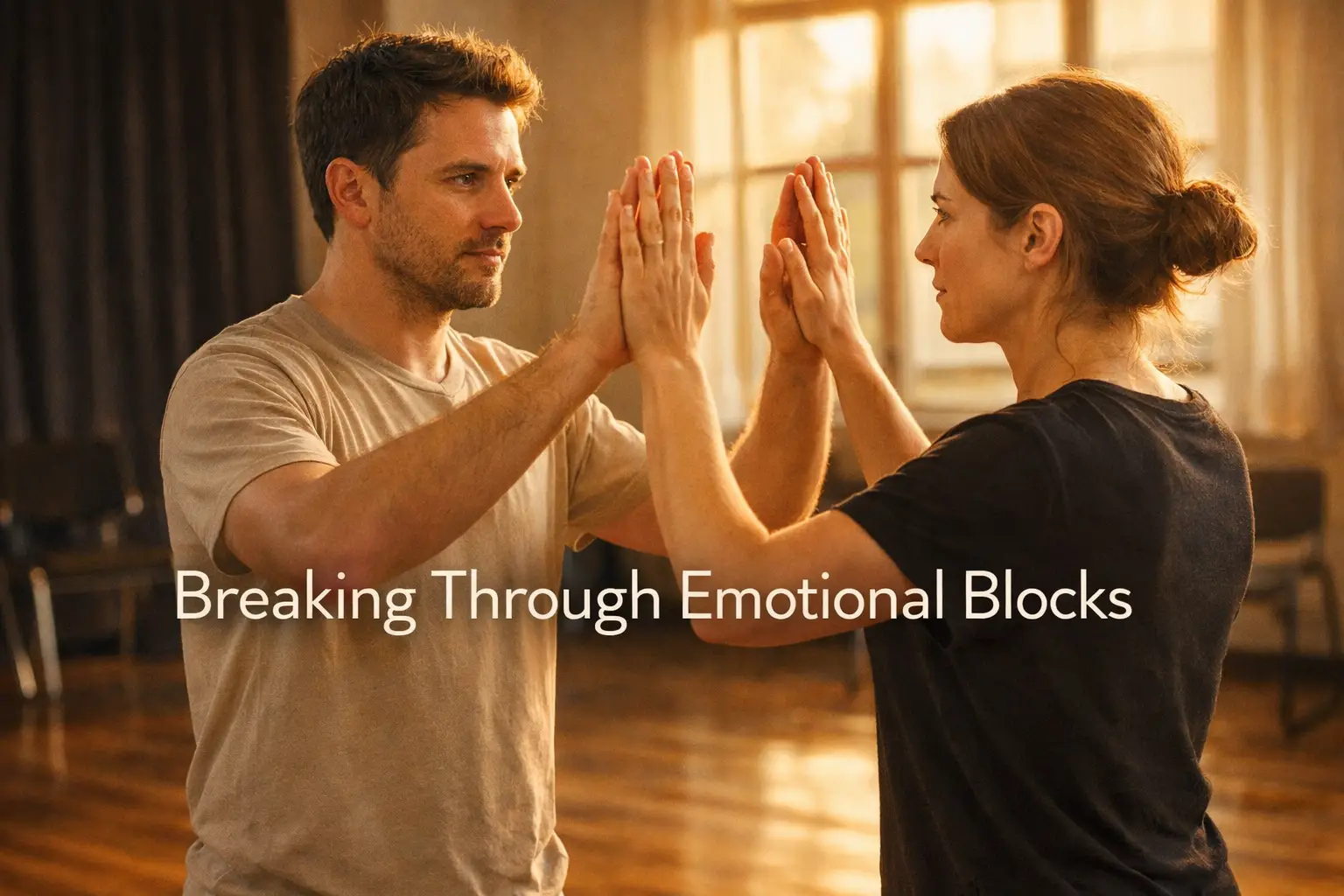
This seems simple, but it’s devastatingly effective for actors blocked around vulnerability or authentic connection. You can’t fake your way through 15 minutes of repetition—your blocks become obvious, then gradually dissolve.
For camera work specifically, this exercise trains you to listen and react authentically rather than waiting for your cue. The camera loves actors who genuinely respond to what’s happening in the moment[3].
Advanced Crash Exercises for Camera-Specific Presence
Stage acting and camera acting are different animals. On stage, you project to the back row. On camera, you whisper to someone six inches from your face. Presence and Block Integration: Crash Acting Exercises for Authentic Character Depth on Camera must account for this intimacy.
Minimal Dialogue Scenes: The Subtlety Challenge
Practice scenes with extremely limited dialogue—or none at all[3]. This forces you to communicate through micro-expressions, eye movement, and subtle physical adjustments.
The Practice:
- Take a dialogue-heavy scene
- Remove 80% of the words
- Communicate the same information and emotion through presence alone
- Film yourself and review for authenticity
- Identify where blocks create tension or falseness
Camera work demands this level of subtlety. In 2026’s streaming landscape, viewers watch on phones and tablets, often with headphones. They’re close to your performance. Any block-related tension reads as inauthenticity.
Follow the Leader: Ensemble Presence Building
This exercise develops reactive presence—the ability to stay open and responsive to unexpected choices[3].
The Drill:
- One actor leads with movements, sounds, or emotional shifts
- Other actors mirror and respond without planning
- Leadership rotates spontaneously
- Focus stays on genuine connection rather than performance
This breaks down blocks around control and perfectionism. You can’t plan your way through Follow the Leader—you have to surrender to the moment. That surrender is exactly what creates magnetic camera presence.
Eye Contact Practice: The Window to Blocked Emotions
Your eyes reveal everything, especially what you’re avoiding. Structured eye contact exercises expose and integrate emotional blocks[1].
The Exercise:
- Sit facing a partner at comfortable distance
- Maintain eye contact for 5 minutes without speaking
- Notice when you want to look away and why
- Stay present with discomfort
- Gradually extend duration to 10-15 minutes
The first time I did this exercise, I lasted maybe 45 seconds before my eyes watered and I had to break contact. Intimacy block, identified. But after weeks of practice, I could hold eye contact through any emotional state. That skill translates directly to camera work, where your eyes carry the scene.
Character Observation: Integrating External Blocks Into Performance
Sometimes your character’s blocks differ entirely from your own. Character observation techniques help you authentically embody unfamiliar psychological barriers[1].
The Observation Process
Step 1: Find Your Model Identify someone who exhibits the blocks your character has. This could be someone you know or a public figure.
Step 2: Study Specifics How do they hold their body when blocked? What happens to their voice? Their breathing? Their eye contact?
Step 3: Embody Physically First Start with the physical manifestations before attempting the emotional state. Physicality often unlocks emotion more reliably than the reverse.
Step 4: Find Your Personal Connection Even if the specific block is foreign to you, find the emotional family it belongs to. Fear manifests differently than anger, but you know both.
Step 5: Integrate and Practice Combine the observed external behaviors with your emotional understanding until it becomes second nature.
I once played a character with severe social anxiety—not something I personally struggle with. But I observed a friend who did, noting how she made herself physically smaller in groups, how her breathing became shallow, how her eyes darted to exits. I mapped those physical choices onto my own experience of feeling trapped, and suddenly the character’s blocks became authentic.
Building Your Personal Practice Routine
Presence and Block Integration: Crash Acting Exercises for Authentic Character Depth on Camera isn’t a one-time workshop—it’s a daily practice. Here’s how to structure your training for maximum impact.
The 30-Minute Daily Foundation
Weeks 1-2: Presence Building
- 10 minutes: Mirror work with emotional exploration
- 10 minutes: Intentional walking and physical awareness
- 10 minutes: Power pauses and stillness practice
Weeks 3-4: Block Identification
- 10 minutes: Emotional recall with object work
- 10 minutes: Eye contact practice (with partner or video call)
- 10 minutes: Journaling about discovered blocks
Weeks 5-6: Integration Practice
- 10 minutes: Repetition exercise (with partner)
- 10 minutes: Minimal dialogue scene work
- 10 minutes: Character observation and embodiment
Weeks 7-8: Camera Application
- 10 minutes: Self-tape practice applying integrated blocks
- 10 minutes: Review and analysis
- 10 minutes: Adjustment and re-recording
Partner Work: Finding Your Training Allies
Many of these exercises require a committed partner. In 2026, with virtual collaboration tools, you don’t need to be in the same city. Schedule regular video sessions for:
- Repetition exercises
- Follow the Leader
- Eye contact practice
- Scene work with feedback
The actors who advance fastest are those who build consistent practice communities. Find your people. Train together. Hold each other accountable.
Tracking Progress: The Metrics That Matter
Unlike technical skills, presence and block integration can feel subjective. Track these concrete indicators:
✅ Self-tape quality: Are you booking more callbacks?
✅ Emotional access: Can you reach previously blocked states on demand?
✅ Physical ease: Has chronic tension decreased?
✅ Partner feedback: Do scene partners notice increased authenticity?
✅ Camera comfort: Does filming feel natural rather than performative?
Document your journey. Record yourself monthly doing the same monologue. The progression will astound you.
Common Pitfalls and How to Avoid Them
After 30 years, I’ve seen actors make the same mistakes with this work. Learn from their (and my) failures:
Pitfall #1: Using Blocks as Excuses
The Trap: “I can’t play confident characters because I have insecurity blocks.”
The Truth: Block integration means using your authentic insecurity to inform confidence, creating layered, believable characters. Confident people often mask deep insecurity—that’s called being human.
Pitfall #2: Forcing Emotional Breakthroughs
The Trap: Pushing yourself to cry or rage before you’re ready, creating false catharsis.
The Truth: Blocks dissolve gradually through consistent, gentle practice. Forcing creates new blocks around the forced emotion.
Pitfall #3: Neglecting the Physical
The Trap: Treating this as purely emotional work while ignoring body-based blocks.
The Truth: Your body holds more blocked emotion than your conscious mind. Movement classes and physical exercises are non-negotiable[5].
Pitfall #4: Practicing Only in Isolation
The Trap: Doing all exercises alone, avoiding the vulnerability of partner work.
The Truth: Presence is relational. You can’t develop authentic on-camera connection without practicing actual connection.
Real-World Application: From Exercise to Audition
Theory is useless without application. Here’s how to translate Presence and Block Integration: Crash Acting Exercises for Authentic Character Depth on Camera into booking work.
The Pre-Audition Protocol
48 Hours Before:
- Analyze the character’s blocks using script clues
- Map them against your personal block inventory
- Identify integration opportunities
24 Hours Before:
- Practice scenes using minimal dialogue exercise
- Record self-tape focusing on authentic presence
- Review for blocked moments (tension, falseness, disconnection)
Day Of:
- 15 minutes: Mirror work and power pauses
- 10 minutes: Physical warm-up addressing tension areas
- 5 minutes: Intentional breathing and centering
The Self-Tape Advantage
Self-taping gives you unlimited takes to experiment with block integration. Use this:
Take 1: Technical baseline—hit your marks, know your lines
Take 2: Integrate one identified block deliberately
Take 3: Add physical manifestation of that block
Take 4: Reduce by 50%—subtlety for camera
Take 5: Full integration—you ARE the character with these blocks
Submit Take 5. That’s where the magic lives.
On-Set Application
When you book the job (notice I said when, not if), your preparation pays dividends:
- Between takes: Use power pauses and intentional breathing to reset
- During scenes: Trust your integrated blocks to inform authentic reactions
- With scene partners: Apply repetition exercise principles—truly listen and respond
- Under pressure: Your consistent practice creates muscle memory that survives stress
I’ve watched actors crumble on set because they relied purely on talent without systematic preparation. I’ve also watched “less talented” actors thrive because they had unshakeable technique. Be the latter.
The 2026 Landscape: Why This Work Matters More Than Ever
The industry has shifted seismically. Streaming platforms produce more content than ever, but competition is fiercer. Casting directors see hundreds of self-tapes weekly. Attention spans are measured in seconds.
Authenticity is the only currency that matters. Audiences in 2026 have sophisticated BS detectors honed by decades of content consumption. They know when you’re blocked, even if they can’t articulate why. They just know something feels “off.”
The actors booking complex, nuanced roles—the ones that launch careers—are those who’ve mastered Presence and Block Integration: Crash Acting Exercises for Authentic Character Depth on Camera. They bring dimensional humanity to every frame because they’ve done the internal work to access it.
This isn’t optional anymore. It’s the baseline.
Conclusion: Your Next Steps Toward Authentic Depth
Look, I’m not going to sugarcoat this: the work is hard. Confronting your blocks means facing parts of yourself you’ve spent years avoiding. It’s uncomfortable, sometimes painful, and occasionally feels impossible.
But here’s what I know after three decades: every single actor who commits to this work transforms. Not overnight. Not magically. But systematically, measurably, undeniably.
Your blocks aren’t defects—they’re the raw material of authentic performance. The exercises outlined here give you the tools to transform obstacles into assets, barriers into bridges, and tension into truth.
Your Action Plan Starting Today:
- This Week: Begin daily 10-minute mirror work sessions
- This Month: Find a practice partner and schedule weekly repetition exercises
- This Quarter: Record monthly self-tape progress checks using the same material
- This Year: Integrate block work into every audition and performance
The camera doesn’t lie, but it also doesn’t judge. It simply reveals. When you’ve integrated your blocks into authentic presence, what it reveals is a fully dimensional human being bringing truth to imaginary circumstances.
That’s not just good acting. That’s art.
Now get to work. Your breakthrough role is waiting for someone brave enough to show up fully present, blocks and all. Make sure that someone is you.
References
[1] 10 Acting Exercises To Improve Your Stage Presence – https://www.iam.com/actors/10-acting-exercises-to-improve-your-stage-presence/
[2] Meisner Workshops – https://sophiahirtmeisner.com/classes/meisner-workshops/
[3] Acting Reactions Exercises For Enhancing Presence – https://321talentshowcase.com/acting-reactions-exercises-for-enhancing-presence/
[4] Best Acting Exercises 76697 – https://www.backstage.com/magazine/article/best-acting-exercises-76697/
[5] Movement Classes Actors Creating Stage Presence – https://www.maggieflaniganstudio.com/post/movement-classes-actors-creating-stage-presence