

Imagine an actor stepping onto stage without uttering a single word, yet the audience immediately understands everything about their character—their age, social status, emotional state, and personality. This is the power of physical acting, where the body becomes the primary instrument for storytelling. The Physical Actor: Using Body Language and Movement to Build Character represents a fundamental approach to performance that transcends dialogue and relies on the expressive potential of the human form. In 2026, as theatrical training continues to evolve, understanding how to communicate character through physicality alone has become an essential skill for performers across all mediums.
The journey from neutral body to fully realized character requires dedicated training, specific exercises, and a deep understanding of how physical choices shape audience perception. Whether creating signature entrances, developing distinctive walks, or crafting gesture vocabularies that define a role, actors who master physical characterization unlock new dimensions of performance authenticity and impact.
Key Takeaways
- Physical choices communicate character instantly: Body language, posture, and movement patterns convey age, status, emotion, and personality before any words are spoken
- Signature physical elements define memorable roles: Distinctive walks, gestures, and entrances create recognizable character motifs that audiences remember
- Systematic training develops physical awareness: Techniques including contact improvisation, mime work, and spatial exercises build the coordination and control needed for physical acting
- Movement technique bridges studio and stage: Preparatory exercises translate directly into practical application for scenes, monologues, and devised theatre work
- Physical acting requires both observation and imagination: Successful character building combines real-world study with creative transformation of physical traits
Understanding the Foundation of Physical Acting
Physical acting represents more than simply moving on stage—it encompasses a comprehensive approach to character development where body language and movement serve as the primary communication tools. This methodology recognizes that human beings constantly express themselves through physical means, often revealing more through gesture and posture than through words.
The Body as Primary Instrument 🎭
Every actor possesses a unique instrument: their body. Just as musicians must learn to play their instruments with precision and expressiveness, actors must develop mastery over their physical form. This mastery includes:
- Postural awareness: Understanding how spinal alignment, shoulder position, and hip placement communicate character traits
- Gestural vocabulary: Building a repertoire of meaningful hand movements, facial expressions, and physical reactions
- Movement quality: Controlling tempo, rhythm, weight, and flow in physical actions
- Spatial intelligence: Navigating stage space with purpose and awareness of relationships to other performers and the environment
The foundation of physical acting training draws from multiple disciplines and traditions. Annie Loui’s approach, for instance, incorporates training from legendary practitioners including Étienne Decroux (the father of modern mime), Carolyn Carlson (contemporary dance innovator), and Jerzy Grotowski (experimental theatre pioneer)[1]. This synthesis creates a comprehensive methodology that addresses the full spectrum of physical performance needs.
The Science Behind Physical Communication
Research in nonverbal communication confirms what actors have long understood intuitively: the body speaks volumes. Studies suggest that over 55% of communication effectiveness comes from body language, with tone accounting for 38% and words only 7%. For actors, this means that physical choices can either reinforce or completely contradict verbal content.
Key physical elements that communicate character include:
| Physical Element | Character Information Conveyed |
|---|---|
| Posture | Confidence level, social status, age, health, emotional state |
| Gait/Walk | Energy level, purpose, physical condition, personality type |
| Gestures | Cultural background, nervousness, authority, openness |
| Facial Expression | Emotional state, thoughts, reactions, sincerity |
| Spatial Choices | Relationship to others, comfort level, dominance/submission |
| Breathing Pattern | Emotional intensity, physical condition, stress level |
The Physical Actor: Building Character Through Movement Training
Developing the skills necessary for The Physical Actor: Using Body Language and Movement to Build Character requires systematic training that addresses multiple physical competencies. The Loui Movement Technique provides a structured approach that prepares actors for both contact improvisation work and practical stage application[1].
Core Training Components
1. Partnering Skills and Trust Work
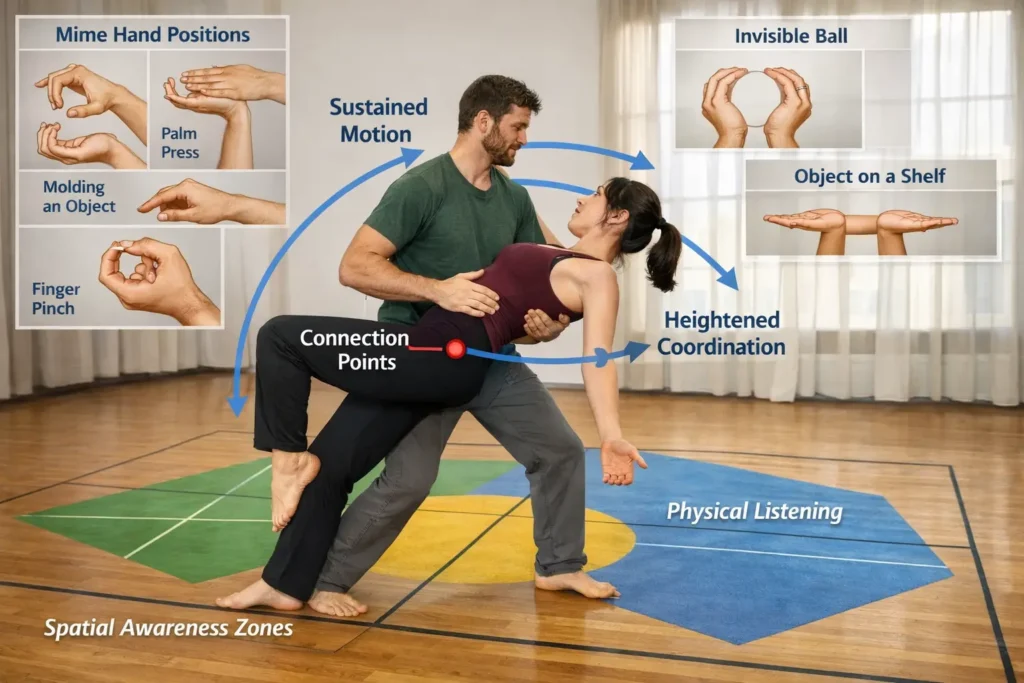
Contact improvisation forms a crucial foundation for physical acting. This discipline teaches actors to:
- Share weight with partners while maintaining balance
- Respond spontaneously to physical impulses
- Develop physical listening skills
- Build trust that enables risk-taking in performance
Through partnering exercises, actors learn that physical connection creates authentic relationships on stage. The give-and-take of weight mirrors the emotional exchange between characters, making physical work a metaphor for dramatic interaction.
2. Spatial Awareness Development
Understanding and utilizing stage space effectively distinguishes trained physical actors from untrained performers. Spatial awareness training includes:
- Proxemics: The study of personal space and how distance communicates relationships
- Stage geography: Using different areas of the performance space to create meaning
- Levels: Incorporating height variations (floor work, standing, elevated positions)
- Pathways: Creating intentional movement patterns that support storytelling
Actors with strong spatial awareness make every movement choice purposeful, using the entire performance environment as a canvas for character expression.
3. Fine Motor Control Through Mime ✋
Mime training, particularly in the Decroux tradition, develops extraordinary precision in physical expression. This work focuses on:
- Isolating individual body parts for independent movement
- Creating the illusion of objects and environments through physical suggestion
- Developing muscular control that allows for subtle, detailed physical choices
- Understanding the grammar of physical expression
Fine motor control enables actors to communicate complex ideas through minimal physical means—a raised eyebrow, a slight shift in weight, or a particular quality of touch can convey volumes about character and intention.
4. Heightened Coordination
Physical acting demands coordination that exceeds everyday movement. Training exercises develop:
- Multi-tasking abilities (speaking while executing complex physical actions)
- Rhythm and timing precision
- Balance and stability in unusual positions
- Quick physical transitions between states
5. Sustained Motion Practice
Many character choices require maintaining specific physical qualities over extended periods. Sustained motion training builds the stamina and consistency needed to:
- Hold character physicality throughout entire performances
- Maintain energy levels in physically demanding roles
- Execute slow, controlled movements that require muscular endurance
- Repeat physical sequences with precision across multiple performances
Creating Signature Physical Elements That Define Character
The practical application of The Physical Actor: Using Body Language and Movement to Build Character manifests most clearly in the creation of distinctive physical signatures—unique movement patterns and body language choices that immediately identify a character. The 2nd edition of Loui’s work specifically addresses direct application to scenes, monologues, and blocking[1], providing tools that translate training into performance.
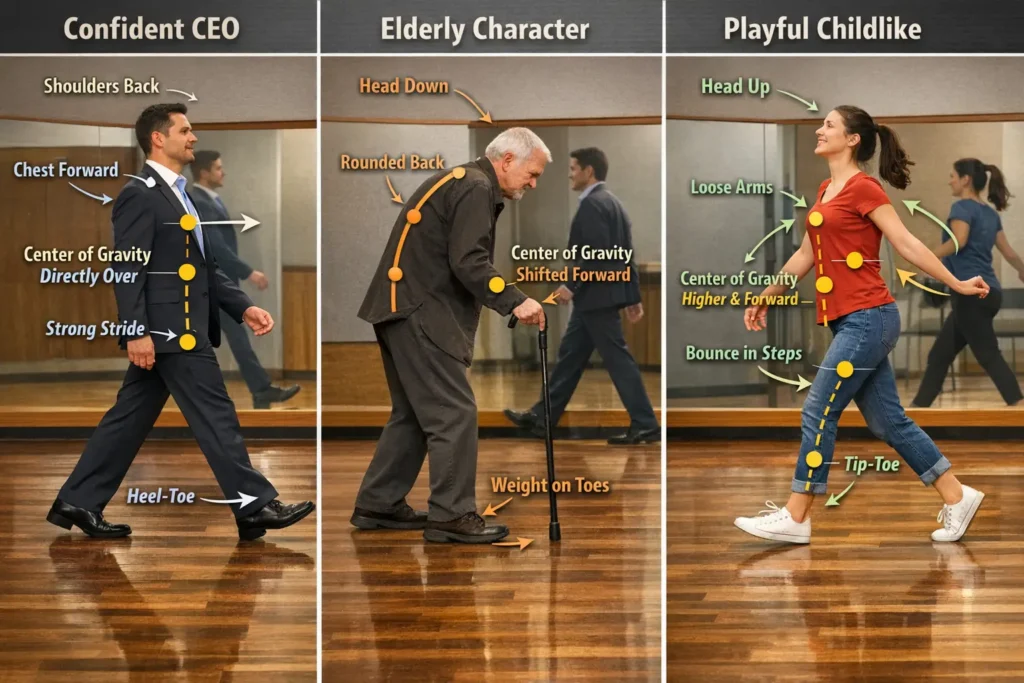
Developing Character Walks 🚶
A character’s walk serves as one of the most powerful physical signatures. The way someone moves through space reveals:
- Physical condition: Health, age, injuries, energy level
- Emotional state: Confidence, fear, joy, depression
- Social status: Authority, subservience, comfort in environment
- Personality: Impulsiveness, caution, playfulness, rigidity
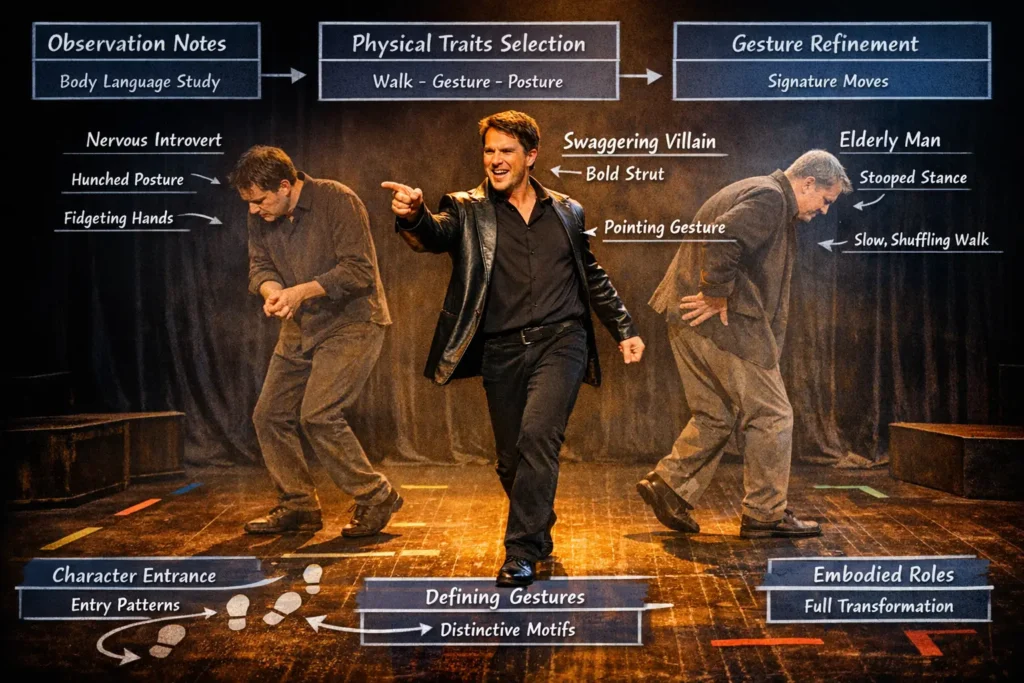
Exercise: Building a Character Walk from Observation
- Observe real people in various settings, noting specific physical details
- Identify center of gravity: Where does the person lead from (chest, hips, head)?
- Analyze tempo and rhythm: Fast or slow? Steady or irregular?
- Note foot placement: Wide or narrow stance? Heel-first or toe-first?
- Examine arm swing: Natural, restricted, exaggerated, or asymmetrical?
- Combine elements into a reproducible physical pattern
- Practice until automatic, allowing the walk to influence how you think and feel
“The walk is the character’s signature in motion—it’s how they announce themselves to the world before they speak a word.”
Crafting Signature Gestures
Gesture vocabulary distinguishes one character from another. Some characters might:
- Touch their face when nervous
- Use expansive hand movements when excited
- Keep arms close to body when defensive
- Point frequently when directing others
- Fidget with objects when thinking
Creating a Gesture Palette:
- Select 3-5 signature gestures that align with character psychology
- Determine triggers for each gesture (specific emotions or situations)
- Practice integration until gestures emerge organically
- Vary intensity based on dramatic circumstances
- Ensure gestures support rather than distract from storytelling
Designing Memorable Entrances 🎬
A character’s entrance establishes immediate presence and sets audience expectations. Physical actors craft entrances that communicate:
Energy and Intention
- Does the character burst in or slip in quietly?
- Are they rushing toward something or reluctant to arrive?
- Do they command attention or seek to avoid it?
Relationship to Space
- Familiar territory or unfamiliar ground?
- Comfortable or uncomfortable in the environment?
- Claiming space or minimizing presence?
Physical State
- Fresh and energized or exhausted?
- Physically comfortable or in pain?
- Relaxed or tense?
Exercise: Entrance Variations
Take a simple entrance (walking through a door) and execute it with different physical choices:
- Status variation: Enter as royalty, then as a servant
- Emotional variation: Enter joyfully, then fearfully
- Physical condition variation: Enter healthy, then injured
- Age variation: Enter as young adult, then as elderly person
- Urgency variation: Enter casually, then in extreme hurry
Notice how each variation changes the audience’s immediate understanding of character and situation.
Posture as Character Foundation
Posture serves as the baseline from which all other physical choices emerge. A character’s habitual posture reveals:
Psychological State
- Confidence: Open chest, lifted head, grounded stance
- Insecurity: Collapsed chest, lowered gaze, unstable base
- Aggression: Forward-leaning, tension in shoulders
- Depression: Rounded shoulders, downward energy
Physical History
- Labor background: Developed muscles, callused hands, specific movement patterns
- Sedentary lifestyle: Different muscle development, particular tension patterns
- Athletic training: Specific postural habits from sport disciplines
- Injuries or illness: Compensatory patterns, protective positioning
Exercise: Postural Transformation
- Stand in neutral alignment: Balanced, relaxed, centered
- Shift one element: Round shoulders forward
- Notice cascade effects: How does this change breathing, gaze, emotional state?
- Adjust another element: Shift weight to one hip
- Observe cumulative impact: How do multiple adjustments create character?
- Add simple action: Walk across room, pick up object, sit down
- Maintain postural choice throughout all actions
Advanced Physical Acting Techniques for Scene Work
The Physical Actor: Using Body Language and Movement to Build Character extends beyond individual character development into the realm of interactive scene work. Physical choices must support not only individual characterization but also relationship dynamics and dramatic action.
Physical Relationship Dynamics
The physical distance and orientation between characters communicates relationship status:
Intimate Relationships
- Closer proximity (within 18 inches)
- Open body positions facing each other
- Frequent physical contact
- Synchronized movement patterns
Professional Relationships
- Moderate distance (4-7 feet)
- Formal postures
- Limited, purposeful contact
- Independent movement patterns
Antagonistic Relationships
- Variable distance (either invasive closeness or avoidant distance)
- Closed or aggressive body positions
- Physical tension and readiness
- Contrasting movement qualities
Blocking as Physical Storytelling
Blocking—the planned movement of actors through stage space—becomes a powerful storytelling tool when approached from a physical acting perspective. Rather than arbitrary positioning, each movement choice should:
- Reflect character intention: Where is the character trying to go (physically and metaphorically)?
- Reveal power dynamics: Who controls the space? Who yields?
- Support dramatic arc: How does physical positioning change as the scene progresses?
- Create visual composition: What does the audience see, and what does it mean?
Applying Contact Improvisation to Scenes
The partnering skills developed through contact improvisation translate directly into scene work[1]. When actors develop:
- Physical listening: Responding authentically to partner’s physical impulses
- Weight-sharing: Creating moments of physical interdependence
- Flow states: Allowing movement to emerge organically from dramatic circumstances
- Trust: Taking physical risks that heighten dramatic intensity
These skills enable spontaneous, authentic physical interactions that elevate scripted material beyond predetermined blocking.
Monologue Physicality
Even solo performance benefits from physical acting principles. Monologue work should include:
Physical Journey
- Beginning physical state
- Transitions triggered by thoughts and emotions
- Ending physical state
- Purposeful physical arc that supports textual arc
Environmental Interaction
- Relationship to imagined space
- Physical responses to imagined stimuli
- Use of real or imagined objects
- Spatial movement that supports narrative
Physical Subtext
- Body language that contradicts or complicates words
- Physical hesitations and impulses
- Gestural patterns that reveal character psychology
- Postural shifts that mark emotional transitions
Physical Theatre Devising and Character Creation
The revised chapter on physical theatre devising in the 2nd edition[1] addresses how physical actors create original work through movement-based exploration. This process reverses traditional character development, beginning with physical exploration rather than textual analysis.
Movement-First Character Development
In devised physical theatre, characters often emerge from movement exploration:
- Physical improvisation: Explore movement qualities without predetermined character
- Pattern recognition: Notice repeated physical choices that emerge
- Character discovery: Ask “Who moves this way?”
- Narrative development: Build story around discovered physical characters
- Refinement: Clarify and strengthen physical signatures
Ensemble Physical Work 🤝
Physical theatre devising emphasizes ensemble creation where:
- Group movement creates visual metaphors
- Physical composition replaces traditional staging
- Collective character emerges from ensemble interaction
- Movement vocabulary serves as shared language
Ensemble Exercise: Group Character
- One person initiates a simple repetitive movement
- Others join, adopting and adapting the movement
- Group finds unison while maintaining individual variation
- Add vocal sounds that match movement quality
- Develop narrative from emerged physical pattern
- Assign individual roles within group character
Physical Score Development
Physical scores—precise sequences of movement—function like choreography but serve dramatic rather than purely aesthetic purposes:
Creating a Physical Score:
- Identify key moments in narrative or emotional journey
- Assign specific physical actions to each moment
- Determine transitions between actions
- Set timing and rhythm for sequence
- Practice until reproducible yet alive
- Allow for variation within structure
Physical scores provide structure while maintaining spontaneity, giving actors a reliable framework that supports rather than restricts authentic performance.
Practical Exercises for Developing Physical Character Skills
Building proficiency in The Physical Actor: Using Body Language and Movement to Build Character requires consistent practice with specific exercises designed to develop physical awareness, control, and expressiveness.
Daily Physical Warm-Up Routine
10-Minute Foundation (Every Day):
- Spinal articulation (2 minutes): Roll down through spine vertebra by vertebra, then roll up
- Joint mobilization (2 minutes): Circle all major joints (ankles, knees, hips, shoulders, wrists, neck)
- Center awareness (2 minutes): Stand balanced, shift weight subtly, find center of gravity
- Spatial exploration (2 minutes): Walk space in different patterns, varying tempo and level
- Isolation practice (2 minutes): Move individual body parts independently
Character Transformation Exercise 🎭
20-Minute Deep Dive:
- Begin in neutral (2 minutes): Stand without character, relaxed awareness
- Add age (3 minutes): Gradually transform into elderly person, noticing all physical changes
- Add emotion (3 minutes): Layer fear onto elderly physicality
- Add status (3 minutes): Make elderly fearful person high-status (royalty, wealthy)
- Add urgency (3 minutes): Give character urgent mission
- Perform simple tasks (3 minutes): Make tea, answer phone, greet visitor
- Return to neutral (3 minutes): Gradually release all character choices
Observation and Application Practice
Weekly Assignment:
- Select real person to observe in public setting
- Note specific physical details: Walk, posture, gestures, facial expressions, breathing
- Record observations in physical journal
- Reproduce physicality accurately
- Adapt into fictional character by exaggerating or combining with other traits
- Apply to scene or monologue material
Mirror and Shadow Work
Partner Exercise (15 minutes):
Mirror Phase:
- Partners face each other
- One leads, other mirrors exactly
- Switch leaders seamlessly
- Develop synchronized movement
Shadow Phase:
- One partner follows behind other
- Shadow copies all movements with slight delay
- Leader moves through space naturally
- Develop physical awareness and memory
Character Application:
- Leader adopts specific character physicality
- Shadow must identify and replicate character choices
- Discuss what physical elements communicated character
Integrating Physical Acting into Professional Practice
For working actors in 2026, The Physical Actor: Using Body Language and Movement to Build Character represents not just a training methodology but a practical approach to professional work across multiple media.
Film and Television Applications 📺
Physical acting principles apply directly to screen work:
Camera Awareness
- Understanding how different shot sizes affect physical choices
- Scaling movement appropriately for close-ups versus wide shots
- Using subtle physical adjustments that read on camera
Continuity Considerations
- Maintaining consistent physical choices across multiple takes
- Reproducing specific gestures and positions for editing
- Tracking physical character development across shooting schedule
Character Consistency
- Creating physical signatures that remain recognizable across episodes or films
- Documenting physical choices for long-running characters
- Adapting physicality for character aging or development
Theatre Applications
Stage work demands heightened physical clarity:
Projection Without Exaggeration
- Making physical choices visible to back row without appearing false
- Using levels and space to create visual interest
- Maintaining authentic quality while increasing scale
Stamina and Consistency
- Sustaining physical characterization through long runs
- Maintaining energy in physically demanding roles
- Preserving body health while performing challenging physical work
Audition Strategies
Physical choices create memorable auditions:
Immediate Physical Choices
- Making strong physical impression within seconds
- Demonstrating range through physical transformation
- Using physicality to distinguish yourself from other actors
Physical Preparation
- Developing physical character choices during audition preparation
- Walking into audition room already in character physicality
- Using entrance and exit as performance opportunities
Conclusion: Embodying Character Through Physical Mastery
The Physical Actor: Using Body Language and Movement to Build Character represents a comprehensive approach to performance that recognizes the body as the actor’s most powerful tool. Through systematic training in partnering skills, spatial awareness, fine motor control, coordination, and sustained motion[1], actors develop the physical literacy necessary to communicate complex characters without relying solely on dialogue.
The journey from neutral body to fully realized character requires dedication, observation, imagination, and practice. By creating signature walks, gestures, postures, and entrances, actors craft physical vocabularies that make characters immediately recognizable and deeply authentic. Whether applying these principles to scripted scenes, monologues, devised theatre, or screen work, physical acting skills enhance every aspect of performance.
Actionable Next Steps 🎯
Beginners:
- Start daily physical warm-up routine focusing on body awareness and control
- Begin observation journal documenting real people’s physical characteristics
- Practice neutral stance and simple transformations (age, emotion, status)
- Take introductory movement or mime class to build foundational skills
Intermediate Actors:
- Study contact improvisation to develop partnering skills and physical listening
- Create detailed physical profiles for all characters you’re working on
- Experiment with physical score development for monologues and scenes
- Join physical theatre workshop or ensemble to deepen ensemble skills
Advanced Practitioners:
- Develop signature training routine that maintains and expands physical capabilities
- Explore integration of multiple movement disciplines (martial arts, dance, circus)
- Create original devised work using movement-first methodology
- Teach or mentor others to deepen your own understanding
All Levels:
- Prioritize physical health: Proper warm-up, cool-down, injury prevention
- Document your process: Video record physical explorations for analysis
- Seek feedback: Work with directors, teachers, and fellow actors
- Stay curious: Continue exploring how people move and what it reveals
The physical actor understands that every gesture, every step, every shift in weight tells a story. By mastering the language of the body, actors access a universal form of communication that transcends cultural and linguistic barriers, creating performances that resonate deeply with audiences. In 2026 and beyond, as performance continues to evolve across platforms and media, the fundamentals of physical acting remain essential tools for creating authentic, compelling, memorable characters.
The body never lies. When actors learn to speak truthfully through physical means, they unlock the full potential of their instrument and create performances that live in audiences’ memories long after the final curtain or the last frame fades to black.
References
[1] The Physical Actor – https://counterbalancetheater.com/our-history/the-physical-actor/
[2] The Physical Actor Annie Loui V9781351839105 – https://www.vitalsource.com/products/the-physical-actor-annie-loui-v9781351839105