


Picture this: an actor delivers a powerful monologue on stage, pouring emotion into every word. The performance is compelling, the gestures are perfect, but there’s one critical problem—the audience in the back rows can’t hear a single word. This scenario plays out in theaters across the world, highlighting a fundamental truth: theatrical speaking is vastly different from everyday conversation. Diction and Projection for Stage: Technical Skills Every Beginning Actor Must Master represents the foundation upon which all successful stage performances are built. Without these essential vocal abilities, even the most talented actors will struggle to connect with their audience and bring characters to life in the demanding environment of live theater.
Key Takeaways
- 🎭 Projection is about vocal placement, not yelling – proper diaphragmatic breathing enables actors to fill a theater space while remaining relaxed and avoiding vocal strain
- 🗣️ Diction encompasses clarity, enunciation, and expression – it ensures every word reaches the audience with precision while conveying character and emotion
- 💪 Daily practice is non-negotiable – actors should dedicate at least 30 minutes per day to vocal warm-ups covering body, breath, phonation, projection, and articulation exercises
- 🎪 Theatrical speaking differs dramatically from conversation – stage performance requires heightened vocal energy, exaggerated articulation, and controlled volume that would seem unnatural in everyday life
- 🎯 Space-specific adjustment is crucial – vocal techniques must adapt to venue size, microphone availability, and performance medium to maintain authenticity while ensuring audibility
Understanding the Fundamental Difference Between Stage Speech and Everyday Conversation

When actors first step onto a stage, they quickly discover that the conversational voice they use with friends simply doesn’t translate to theatrical performance. Everyday conversation happens at close range, typically within a few feet, where subtle vocal nuances, quiet tones, and mumbled words can still be understood through context and body language. In contrast, theatrical speaking must reach audience members sitting 50, 75, or even 100 feet away while maintaining the illusion of natural dialogue.
This fundamental challenge requires actors to develop what voice coaches call “heightened naturalism”—speech that appears effortless and authentic to the audience while actually employing sophisticated technical skills. The voice must carry power without sounding forced, clarity without seeming artificial, and emotional authenticity while maintaining precise articulation.
The Physics of Voice in Large Spaces
Theater spaces present unique acoustic challenges. Unlike intimate conversations where sound travels a short distance, stage voices must:
- Travel long distances without electronic amplification in many traditional theaters
- Compete with ambient noise from air conditioning systems, audience movement, and environmental sounds
- Maintain clarity despite acoustic dead spots and reverberations in the performance space
- Convey emotional subtlety while projecting sufficient volume for the back row
According to industry professionals, you will lose your audience’s attention if they cannot hear or understand you, making good vocal technique essential for keeping the audience engaged [2]. This reality makes mastering diction and projection non-negotiable for stage actors.
The Science Behind Vocal Projection: More Than Just Speaking Loudly
Projection is the volume at which you speak to ensure your voice fills the performance space [4]. However, this definition only scratches the surface of what projection truly involves. Many beginning actors mistakenly believe projection means yelling or forcing their voice, which leads to vocal strain, fatigue, and potential damage. True projection uses proper vocal placement to remain relaxed while sending your voice effectively [2].
The Foundation: Diaphragmatic Breathing
The body and breath serve as your foundation for healthy vocal projection and articulation [2]. Diaphragmatic breathing—where the stomach moves rather than the chest during inhalation—is crucial for proper vocal projection and releases tension that inhibits vocal quality [2].
Here’s how diaphragmatic breathing works:
- Inhalation: The diaphragm (a dome-shaped muscle below the lungs) contracts and flattens, creating space for the lungs to expand downward
- Expansion: The abdomen expands outward as the lungs fill with air from bottom to top
- Support: The filled lungs and engaged diaphragm create a stable foundation for controlled exhalation
- Phonation: Air releases in a controlled stream, vibrating the vocal cords to produce sound with power and consistency
Chest breathing, by contrast, involves shallow breaths that fill only the upper portion of the lungs, providing insufficient air support for sustained vocal projection and causing tension in the shoulders, neck, and throat.
Why Projection Benefits Actors and Audiences
Voice projection is important for actors because it grabs and keeps audience attention, allows audiences to clearly hear and understand lines, helps actors feel more confident, and fills descriptive gaps for scenes audiences cannot see [1]. These benefits create a virtuous cycle: confident actors with strong projection deliver more compelling performances, which engage audiences more deeply, which in turn energizes the actors.
“The voice is the actor’s most powerful instrument. Without proper projection, even the most brilliant performance remains locked inside the actor, never reaching the hearts and minds of the audience.”
Mastering Diction: The Art of Clear and Expressive Speech
While projection ensures your voice reaches the audience, diction is the quality or style of speaking anactor uses to demonstrate their character, including elements such as accent, enunciation, and inflection [4]. It differs from projection in that it focuses on clarity and expression rather than volume [2].
The Components of Effective Diction
Diction encompasses several interconnected elements:
| Component | Definition | Impact on Performance |
|---|---|---|
| Enunciation | Clear pronunciation of individual sounds and syllables | Ensures every word is understood, even in rapid dialogue |
| Articulation | Physical formation of words using lips, jaw, teeth, and tongue | Creates crisp consonants and full vowels that carry across space |
| Inflection | Variation in pitch and tone | Conveys emotion, intention, and subtext |
| Accent/Dialect | Regional or character-specific speech patterns | Establishes character background and authenticity |
| Pacing | Speed and rhythm of speech delivery | Controls dramatic tension and audience comprehension |
Articulation is the physical act of creating spoken words using the lips, jaw, teeth, and tongue [2]. Effective articulation directly improves audience comprehension [2], making it one of the most critical skills for stage actors to develop.
Space-Specific Diction Adjustments
Diction must vary based on the space. In a theatrical space without a microphone, more aggressive enunciation is needed; however, the same aggressive approach will not work in intimate environments like small rooms or studio settings [2]. This adaptability separates professional actors from beginners.
Consider these scenarios:
- Large proscenium theater (500+ seats): Requires exaggerated articulation, particularly for consonants at the ends of words, to ensure clarity reaches the back rows
- Black box theater (50-100 seats): Allows for more natural articulation while maintaining precision and clarity
- Film/television close-up: Demands subtle, naturalistic diction that would be insufficient for stage but appears authentic on camera
- Voice-over work: Permits intimate vocal quality with precise articulation for microphone proximity [2]
Essential Breathing Techniques to Reach the Back of the House
Mastering diaphragmatic breathing transforms an actor’s vocal capabilities. Here are practical exercises to develop this foundational skill:
Exercise 1: The Lying Down Breath Check ✨
- Lie flat on your back on a comfortable surface
- Place one hand on your chest and one hand on your stomach
- Breathe naturally and observe which hand moves more
- Goal: The stomach hand should rise significantly while the chest hand remains relatively still
- Practice for 5 minutes daily until this becomes automatic
Exercise 2: The Hissing Breath
- Stand with feet shoulder-width apart, knees slightly bent
- Inhale deeply through the nose for 4 counts, expanding the abdomen
- Exhale slowly through the teeth making a “sssss” sound for 8 counts
- Gradually increase the exhalation count to 12, then 16, then 20
- Benefit: Builds breath control and diaphragm strength
Exercise 3: The Panting Dog 🐕
- Take quick, shallow breaths through the mouth while keeping shoulders relaxed
- Feel the diaphragm bounce with each breath
- Continue for 30 seconds, then return to normal breathing
- Purpose: Develops awareness of diaphragmatic movement and releases tension
Exercise 4: Sustained Phonation
- Take a deep diaphragmatic breath
- Release the air on a comfortable mid-range pitch saying “Ahhhh”
- Sustain the sound for as long as possible without strain
- Track your progress—beginners might sustain 10-15 seconds, while trained actors can exceed 30 seconds
- Development: Builds the connection between breath support and vocal production
Articulation Exercises for Crystal-Clear Stage Diction
Regular practice of articulation exercises and tongue twisters helps develop muscle memory and improve diction over time [6]. These exercises target the specific muscles involved in creating clear, precise speech.
Lip and Jaw Warm-Ups
Lip Trills (Raspberries) 💋
Recommended exercises include lip flutters (raspberries) [1], which involve:
- Relaxing the lips and blowing air through them to create a buzzing sound
- Adding pitch variation by sliding from low to high notes
- Maintaining the trill for extended periods to build stamina
Jaw Stretches
Closed-mouth yawns limber the jaw [1] and prepare it for the wide range of motion needed for clear articulation:
- Yawn with the mouth closed, feeling the jaw stretch internally
- Open the mouth wide as if yawning, then close slowly
- Move the jaw side to side, then in circles
- Massage the jaw hinge points to release tension
Tongue Twisters for Precision
Tongue twisters target specific sound combinations that commonly cause articulation problems:
For Plosive Consonants (P, B, T, D, K, G):
- “Peter Piper picked a peck of pickled peppers”
- “Betty Botter bought some butter, but she said the butter’s bitter”
- “The tip of the tongue, the teeth, the lips”
For Sibilant Sounds (S, SH, Z):
- “She sells seashells by the seashore”
- “Six thick thistle sticks”
- “Freshly fried fresh flesh”
For Liquid Consonants (L, R):
- “Red leather, yellow leather” (repeat rapidly)
- “Truly rural, really rural”
- “Around the rugged rocks, the ragged rascal ran”
The Articulation Ladder Exercise
This progressive exercise builds articulation precision:
- Level 1: Speak a simple sentence at conversational speed with normal articulation
- Level 2: Repeat the same sentence with exaggerated articulation at the same speed
- Level 3: Increase speed while maintaining exaggerated articulation
- Level 4: Return to conversational articulation but retain the precision developed in previous levels
Example sentence: “The actor’s voice must reach every audience member clearly.”
Projection Drills to Fill Any Performance Space
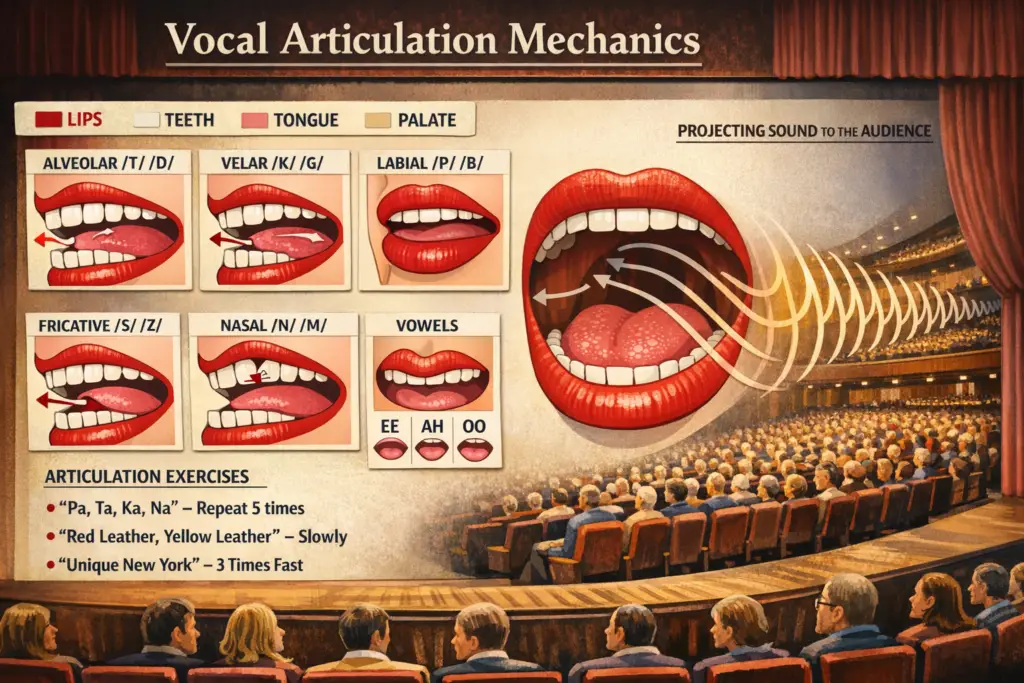
Developing projection requires exercises that build vocal power while maintaining healthy technique.
The Distance Drill 📏
- Stand at one end of a large room or outdoor space
- Place a partner or recording device at increasing distances (10 feet, 20 feet, 30 feet, etc.)
- Speak a line of dialogue at each distance, adjusting projection to ensure clarity
- Have your partner signal when they can clearly hear and understand you
- Focus: Increase volume through breath support, not throat tension
Vocal Slides and Flexes
Recommended exercises include vocal slides with increasing intervals, flexes progressing from low to high and quiet to loud [1]:
Vocal Slides:
- Start at a comfortable low pitch
- Slide smoothly up to your highest comfortable pitch on an “oo” sound
- Slide back down to the starting pitch
- Repeat with different vowel sounds (ah, ee, oh, oo)
Vocal Flexes:
- Begin with quiet, low-pitched sounds
- Gradually increase both volume and pitch simultaneously
- Reach your maximum comfortable volume and pitch
- Reverse the process back to quiet and low
- Builds: Dynamic range and vocal flexibility
The Calling Exercise
This exercise mimics real-world projection scenarios:
- Imagine calling to someone across a large field
- Use their name or a simple phrase: “Hello there!” or “Over here!”
- Project from the diaphragm, not the throat
- Feel the sound originating from your core and traveling outward
- Variation: Practice calling with different emotions (urgency, joy, concern) while maintaining projection
Managing Emotional Impact on Voice Quality
One often-overlooked aspect of vocal technique is how emotions affect voice production. Playing anger can introduce tension into the body, which introduces tension in the voice, making it difficult to project [2]. Similarly, excitement or giddiness can cause faster speech, leading to dropped consonant sounds and insufficient attention to vowels [2].
Strategies for Emotional Vocal Control
For Anger or Intensity:
- Consciously relax the shoulders, neck, and jaw before and during emotional scenes
- Use breath support to power the voice rather than throat constriction
- Channel energy into articulation precision rather than volume alone
- Practice angry dialogue at various volumes to separate emotion from projection
For Excitement or Rapid Speech:
- Deliberately slow down during rehearsal to establish clear articulation patterns
- Mark consonants with extra emphasis during practice
- Use physical gestures to pace yourself and prevent rushing
- Record yourself to identify where clarity breaks down
For Sadness or Quiet Emotions:
- Maintain breath support even when speaking softly
- Focus on vowel resonance to carry sound despite reduced volume
- Use the full vocal range rather than dropping into a monotone
- Remember that “intimate” on stage still means audible to the back row
The 30-Minute Daily Vocal Warm-Up Routine
Actors should spend at least 30 minutes per day on vocal warm-ups that include exercises for the body, breath, phonation, projection, and articulation [2]. Here’s a comprehensive routine that addresses all these elements:
Minutes 1-5: Physical Warm-Up 🏃
- Gentle neck rolls (both directions)
- Shoulder shrugs and releases
- Full body stretches reaching high and low
- Shaking out tension from arms, legs, and torso
- Purpose: Release physical tension that restricts vocal freedom
Minutes 6-12: Breath Work
- Lying down breath check (2 minutes)
- Hissing breath exercise (3 minutes)
- Sustained phonation on various vowels (2 minutes)
- Purpose: Establish diaphragmatic breathing and build breath control
Minutes 13-18: Phonation and Resonance
- Humming at various pitches to feel facial resonance
- Vocal slides from low to high
- Lip trills with pitch variation
- Exploring vocal range with different vowel sounds
- Purpose: Warm up the vocal cords and develop resonance
Minutes 19-25: Projection Practice
- Distance drill or calling exercise (3 minutes)
- Vocal flexes from quiet to loud (2 minutes)
- Speaking text at various volumes while maintaining quality (2 minutes)
- Purpose: Build projection strength and control
Minutes 26-30: Articulation Refinement
- Jaw stretches and lip warm-ups (1 minute)
- Tongue twisters starting slowly, increasing speed (3 minutes)
- Articulation ladder with rehearsal text (1 minute)
- Purpose: Sharpen diction and prepare for performance
Medium-Specific Applications of Diction and Projection for Stage: Technical Skills Every Beginning Actor Must Master
The techniques and intensity for voice projection and articulation vary by the medium. In live theater, actors must use more vocal energy and exaggerate pronunciation for large venues, whereas in voice-over work close to a microphone, projection does not need to be as far or articulation as exaggerated [2].
Theater vs. Film vs. Voice-Over
Live Theater:
- Maximum projection and articulation
- Heightened vocal energy throughout
- Sustained volume for entire performance
- Adaptation to specific venue acoustics
- No opportunity for retakes or volume adjustment in post-production
Film and Television:
- Natural, conversational vocal quality
- Microphone proximity allows for intimate volume
- Subtle articulation that appears authentic on camera
- Multiple takes allow for adjustments
- Sound editing can enhance clarity
Voice-Over and Radio:
- Close microphone technique
- Precise articulation without visual context
- Controlled breath to avoid microphone pops
- Expressive inflection to compensate for lack of visual performance
- Intimate connection despite distance from audience
Adapting Your Technique
Professional actors develop the flexibility to adjust their vocal technique based on the performance medium. This adaptability comes from:
- Understanding the fundamentals of projection and diction deeply enough to modify them appropriately
- Practicing in various spaces to develop spatial awareness and adjustment skills
- Recording yourself in different contexts to hear how your voice translates
- Studying performances in various media to observe how professionals adapt their technique
- Working with directors and voice coaches who can provide medium-specific guidance
Common Mistakes Beginning Actors Make with Vocal Technique
Mistake #1: Projecting from the Throat 😣
The Problem: Forcing volume by tightening the throat creates strain, limits vocal range, and can cause damage.
The Solution: Always initiate projection from diaphragmatic breath support, keeping the throat open and relaxed.
Mistake #2: Sacrificing Diction for Volume
The Problem: Shouting without attention to articulation creates noise without clarity.
The Solution: Maintain precise articulation even at high volumes; projection and diction work together, not against each other.
Mistake #3: Inconsistent Vocal Energy
The Problem: Starting strong but fading as scenes progress, particularly at the ends of sentences.
The Solution: Practice sustaining breath support through complete thoughts and sentences; mark breath points in scripts.
Mistake #4: Ignoring the Warm-Up
The Problem: Attempting to perform without proper vocal preparation leads to strain and inconsistent quality.
The Solution: Commit to daily warm-ups and pre-performance routines without exception.
Mistake #5: One-Size-Fits-All Approach
The Problem: Using the same vocal technique regardless of venue size, character, or emotional context.
The Solution: Develop adaptability through varied practice and conscious adjustment to each performance situation.
Advanced Considerations: Character Voice and Dialect Work

Once actors master fundamental projection and diction, they can layer character-specific vocal choices onto this technical foundation. Character voices and dialects require:
- Maintained technical support: Even when adopting an accent or character voice, diaphragmatic breathing and proper projection remain essential
- Researched authenticity: Dialects should be studied from primary sources and dialect coaches rather than stereotypes
- Consistent application: Character voices must remain consistent throughout the performance while adapting to emotional and situational changes
- Clarity preservation: Accents and character choices should enhance, not obscure, audience comprehension
Building Long-Term Vocal Health and Stamina
Vocal technique isn’t just about immediate performance—it’s about sustaining a career. Professional actors protect their voices through:
Hydration 💧
- Drinking adequate water throughout the day (not just before performance)
- Avoiding excessive caffeine and alcohol which dehydrate vocal cords
- Using a humidifier in dry climates or heated/air-conditioned spaces
Vocal Rest
- Scheduling quiet time before and after performances
- Avoiding excessive talking, shouting, or whispering on performance days
- Recognizing early signs of vocal fatigue and responding appropriately
Professional Support
- Working with voice coaches for ongoing development
- Consulting with speech pathologists if vocal problems arise
- Attending workshops and classes to continue learning
Lifestyle Factors
- Getting adequate sleep to support vocal recovery
- Managing stress which creates physical tension
- Avoiding smoking and secondhand smoke exposure
- Maintaining overall physical fitness which supports breath control
Conclusion: Your Journey to Vocal Mastery
Diction and Projection for Stage: Technical Skills Every Beginning Actor Must Master represents far more than simple vocal exercises—these skills form the essential bridge between an actor’s internal artistic vision and the audience’s experience. Without clear, powerful, and expressive vocal technique, even the most profound character work remains invisible to those watching from the theater seats.
The journey from conversational speech to commanding stage presence requires dedication, consistent practice, and patience. The 30-minute daily warm-up routine outlined in this article provides a structured path forward, while the specific exercises for breathing, projection, and articulation offer concrete tools for development.
Your Next Steps 🎯
- Assess your current abilities: Record yourself performing a monologue and honestly evaluate your projection and diction
- Implement the daily warm-up routine: Commit to 30 minutes of vocal practice every day for the next 30 days
- Practice in various spaces: Seek opportunities to perform in different venues to develop spatial awareness and adaptability
- Work with a voice coach: Professional guidance accelerates development and prevents bad habits from forming
- Study professional performances: Watch live theater and analyze how experienced actors handle vocal challenges
- Be patient with yourself: Vocal development takes time; celebrate small improvements rather than expecting overnight transformation
Remember that every accomplished stage actor once stood where you stand now, struggling to make their voice reach the back row while maintaining clarity and emotional authenticity. The difference between those who succeed and those who don’t isn’t talent—it’s consistent, focused practice of these fundamental technical skills.
Your voice is your instrument. Like any musical instrument, it requires tuning, maintenance, and daily practice to produce beautiful results. Start today with the exercises in this article, commit to the daily routine, and trust the process. The back of the house is waiting to hear you—clearly, powerfully, and expressively. 🎭
References
[1] Tips For Speaking Loudly Clearly As An Actor 73193 – https://www.backstage.com/magazine/article/tips-for-speaking-loudly-clearly-as-an-actor-73193/
[2] The Importance Of Learning Voice Projection Articulation And Diction – https://castingfrontier.com/blog/the-importance-of-learning-voice-projection-articulation-and-diction/
[4] Acting Terms To Know For Aspiring Actors – https://www.nycastings.com/acting-terms-to-know-for-aspiring-actors/
[6] Unit 4 – https://fiveable.me/acting-for-the-stage/unit-4