

Picture this: You’re sitting in a darkened theater, watching a tense scene unfold. The actors haven’t spoken a word yet, but your heart is already racing. Why? Because somewhere in the background, there’s a subtle rumble of distant thunder, a clock ticking just a bit too loudly, and the faint whisper of wind that makes the hair on your neck stand up. That, my friends, is the magic of Sound Design for Theater: Using Audio to Enhance Storytelling and Create Immersive Experiences.
After three decades in this business—from community theater productions where we literally used cassette tapes (yes, I’m dating myself) to high-tech Broadway shows with spatial audio systems—I’ve learned one undeniable truth: sound is the invisible actor that can make or break a performance. It’s not just about making sure the audience can hear the dialogue. It’s about creating an emotional landscape that wraps around your performance like a warm blanket or grips it like a vice.
Whether you’re a fresh-faced actor stepping onto your first stage or a seasoned performer looking to understand how sound design elevates your work, understanding Sound Design for Theater: Using Audio to Enhance Storytelling and Create Immersive Experiences will transform how you approach every production.
Key Takeaways
- Sound design is storytelling: Audio elements function as an invisible character that guides audience emotions and enhances narrative depth
- Layered audio creates immersion: Combining ambient sounds, music, and strategic sound effects builds a three-dimensional world that supports actor performances
- Technology is increasingly accessible: Affordable digital tools and software now allow independent productions to achieve professional-quality sound design
- Collaboration is essential: Actors who understand sound design can work more effectively with sound designers to create cohesive, powerful performances
- Timing and subtlety matter most: The most effective sound cues are often the ones audiences feel rather than consciously notice
Understanding the Foundation of Sound Design for Theater
What Makes Theatrical Sound Design Different?
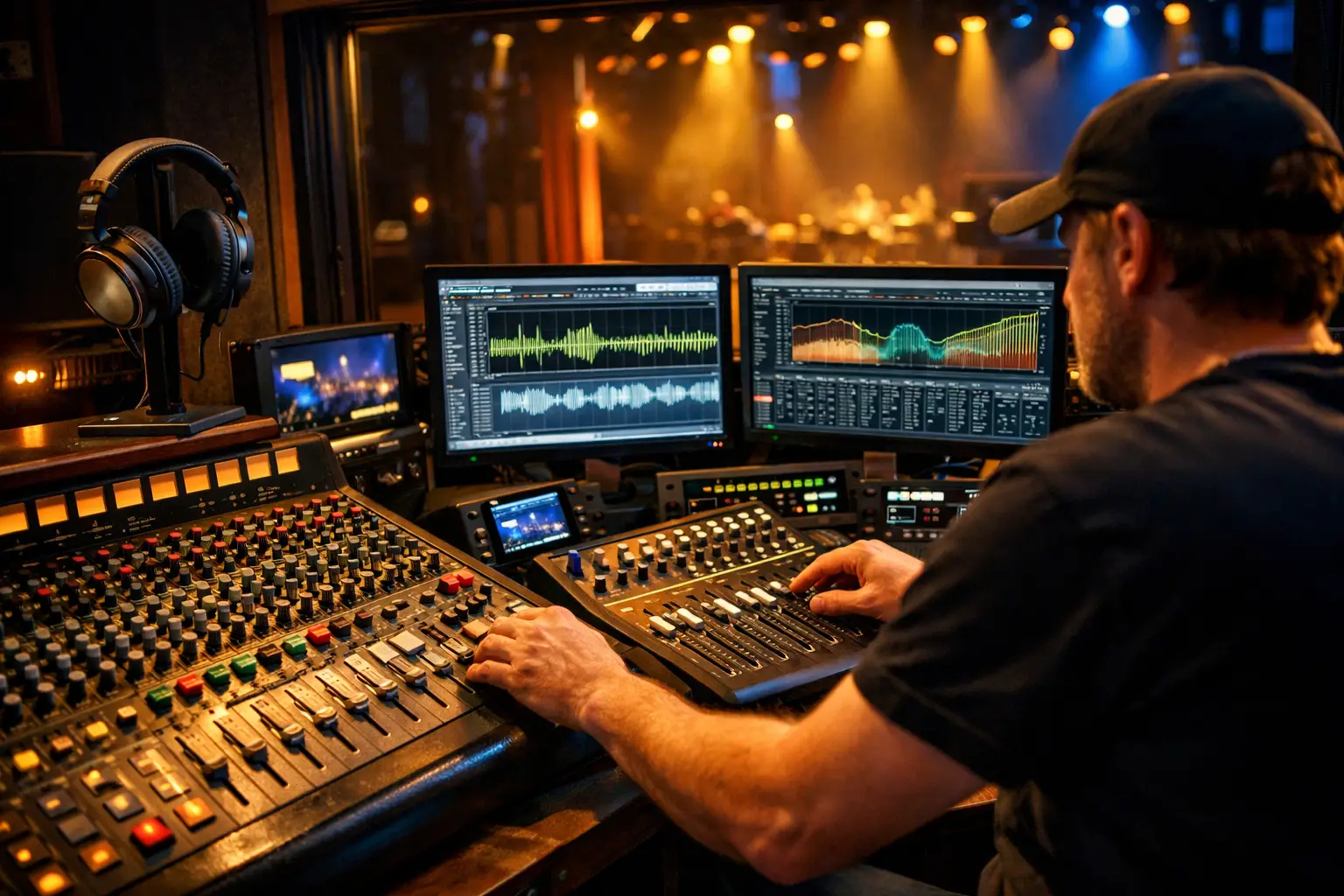
Here’s something I learned the hard way during a production of “A Streetcar Named Desire” back in the late ’90s: theatrical sound design isn’t just movie audio with the volume turned up. It’s a completely different beast.
In theater, sound design serves multiple masters simultaneously. It needs to:
- Support the actors’ performances without overshadowing them
- Guide audience attention to specific moments or areas of the stage
- Create emotional resonance that amplifies the script’s intentions
- Establish time, place, and atmosphere instantly
- Fill the unique acoustic properties of each specific venue
Think of sound design as the seasoning in a gourmet meal. Too little, and the dish tastes bland. Too much, and you’ve ruined the chef’s carefully crafted flavors. The perfect amount? That’s when magic happens, and the audience doesn’t even realize they’re experiencing something extraordinary—they just know they’re completely absorbed in the story.
The Three Pillars of Theatrical Audio
When we talk about Sound Design for Theater: Using Audio to Enhance Storytelling and Create Immersive Experiences, we’re really discussing three interconnected elements:
Ambient Audio and Soundscapes 🌊
- Environmental sounds that establish location and mood
- Background textures that create realistic or stylized worlds
- Continuous audio that maintains atmosphere throughout scenes
Sound Effects and Cues ⚡
- Specific, timed sounds that support action on stage
- Practical effects (doorbells, phones, gunshots, etc.)
- Symbolic or metaphorical sounds that represent internal states
Music Integration 🎵
- Underscoring that enhances emotional moments
- Transition music between scenes
- Source music (diegetic sound that characters can hear)
- Thematic musical motifs that represent characters or ideas
The real artistry comes from weaving these three pillars together so seamlessly that the audience experiences them as one cohesive sonic tapestry.
The Psychology Behind Audio in Storytelling
How Sound Manipulates Emotion (In the Best Way)
Let me share a story that illustrates this perfectly. During a production of “The Crucible,” we had a scene where John Proctor confronts Abigail. The words were powerful on their own, but our sound designer added something brilliant: a barely perceptible low-frequency rumble that gradually increased in intensity as the confrontation escalated.
The audience couldn’t consciously hear this rumble—it was below the threshold of normal hearing—but they felt it. Their bodies responded to the vibration, creating physical tension that mirrored the emotional tension on stage. That’s the power of understanding how Sound Design for Theater: Using Audio to Enhance Storytelling and Create Immersive Experiences works on a psychological level.
Sound affects us in ways that bypass our rational brain:
| Audio Element | Psychological Effect | Theatrical Application |
|---|---|---|
| Low frequencies (20-100 Hz) | Creates unease, tension, or dread | Horror scenes, impending danger |
| High frequencies (8000+ Hz) | Signals alarm, urgency, or fragility | Moments of crisis, delicate emotions |
| Irregular rhythms | Induces anxiety and unpredictability | Psychological thrillers, chaos |
| Steady rhythms | Provides comfort or builds anticipation | Establishing normalcy or mounting tension |
| Silence | Creates anticipation and focuses attention | Dramatic reveals, intimate moments |
The Cocktail Party Effect in Theater
You know how at a crowded party, you can somehow tune out dozens of conversations to focus on the one person speaking to you? That’s called the cocktail party effect, and smart sound designers use it brilliantly.
By carefully layering sounds at different volumes and frequencies, designers can guide your attention exactly where they want it. A whispered confession can cut through orchestral music if it’s mixed correctly. A single creaking floorboard can be more terrifying than a thunderclap when placed strategically.
As actors, understanding this helps us work with the sound design rather than against it. I’ve seen too many performers try to “compete” with the audio, shouting over music that was meant to underscore their moment, not drown it out.
Practical Techniques for Creating Immersive Audio Experiences
Building Soundscapes That Transport Audiences
Creating an immersive soundscape is like painting with audio. You start with broad strokes—the general atmosphere—and then add details that bring the world to life.
The Layering Technique:
When I worked on a production of “Our Town,” our sound designer used a brilliant layering approach for the morning scene in Act One:
- Base layer: Gentle morning breeze (continuous, barely audible)
- Mid layer: Distant rooster crow, birds chirping (sporadic, natural timing)
- Detail layer: Specific sounds tied to stage action (milk bottles clinking, screen door, etc.)
- Accent layer: Church bells in the distance (marking time, adding nostalgia)
Each layer served a purpose, and together they created a complete small-town morning that the audience could practically smell. That’s Sound Design for Theater: Using Audio to Enhance Storytelling and Create Immersive Experiences at its finest.
Strategic Use of Silence 🤫
Here’s a counterintuitive truth I’ve learned: sometimes the most powerful sound design choice is no sound at all.
Silence in theater is never truly silent—there’s always the breathing of the audience, the subtle creaks of the building, the hum of HVAC systems. But when you strategically remove designed audio, you create a vacuum that draws focus like nothing else can.
I remember performing in “Death of a Salesman” where, right before Willy’s final exit, all the ambient sound cut out for exactly three seconds. Those three seconds felt like an eternity, and every eye in the house was locked on that moment. The silence gave weight to what was about to happen in a way that no music or sound effect could have achieved.
Music Integration That Doesn’t Overwhelm
One of the biggest mistakes I see in amateur productions is music that competes with actors rather than supporting them. Here’s the golden rule: if the audience is more aware of the music than the performance, something’s wrong.
Effective music integration follows these principles:
✅ Complement, don’t duplicate: If an actor is expressing sadness, the music doesn’t need to be mournful—it might be more effective to provide contrast or complexity
✅ Respect the text: Music should never make dialogue unintelligible (unless that’s a specific artistic choice)
✅ Use dynamics strategically: Music can swell during non-verbal moments and pull back when actors speak
✅ Consider instrumentation: A solo cello creates intimacy; a full orchestra suggests epic scope—choose instruments that match the emotional scale
✅ Establish musical themes: Recurring musical motifs help audiences unconsciously track character arcs and thematic elements
Modern Technology and Affordable Tools for Independent Productions
The 2026 Sound Design Landscape
The theatrical audio world has transformed dramatically, especially in recent years. As someone who started in an era when we literally spliced tape to create sound cues, I’m amazed by what’s possible now—and more importantly, what’s affordable.
According to recent industry trends, spatial audio and immersive sound technologies are becoming increasingly accessible to smaller productions [1]. What used to require six-figure budgets can now be achieved with smart software and strategic equipment choices.
The integration of AI-powered audio processing is also changing the game in 2026 [6]. These tools can help clean up recordings, balance levels, and even suggest sound effects based on script analysis—though I still believe the human artistic touch is irreplaceable.
Essential Equipment for Budget-Conscious Productions
You don’t need a Broadway budget to create professional-quality sound design. Here’s what I recommend for independent theater companies and emerging sound designers:
The Starter Kit (Under $1,000):
- Digital Audio Workstation (DAW): Software like Reaper ($60) or even free options like Audacity
- Audio Interface: Focusrite Scarlett 2i2 ($180) or similar
- Quality Headphones: Audio-Technica ATH-M50x ($150)
- Portable Recorder: Zoom H4n Pro ($220) for field recordings
- Speakers: Powered monitors like JBL 305P MkII ($300/pair)
- Microphone: Shure SM58 ($100) for recording and playback testing
The Software Arsenal (Mostly Free!):
- QLab (Mac): Industry standard for theatrical playback, free for basic use
- SFX (Windows): Free alternative for sound cue management
- Freesound.org: Massive library of free sound effects
- REAPER: Affordable DAW with professional capabilities
- Audacity: Free audio editing software
The trend toward wireless audio systems is also making theater sound more flexible [7]. While professional wireless systems are still pricey, the technology is trickling down to more affordable options that work beautifully for smaller venues.
DIY Sound Recording Techniques
One of the most satisfying aspects of sound design is creating custom recordings. I’ll never forget spending an afternoon in a parking garage with a portable recorder, capturing the perfect reverberant footsteps for a noir-style production.
Pro tips for recording your own sound effects:
🎙️ Record everything at the highest quality your equipment allows: You can always reduce quality, but you can’t add it back
🎙️ Capture room tone: Record 30 seconds of “silence” in every location—it’s invaluable for smoothing edits
🎙️ Get multiple takes: Record each sound 5-10 times with slight variations—you’ll thank yourself later
🎙️ Think beyond the literal: A cabbage being torn apart sounds remarkably like breaking bones; creativity saves money
🎙️ Layer sounds: The “perfect” gunshot or door slam is often three different recordings combined
Collaboration Between Actors and Sound Designers
Why Actors Need to Understand Sound Design
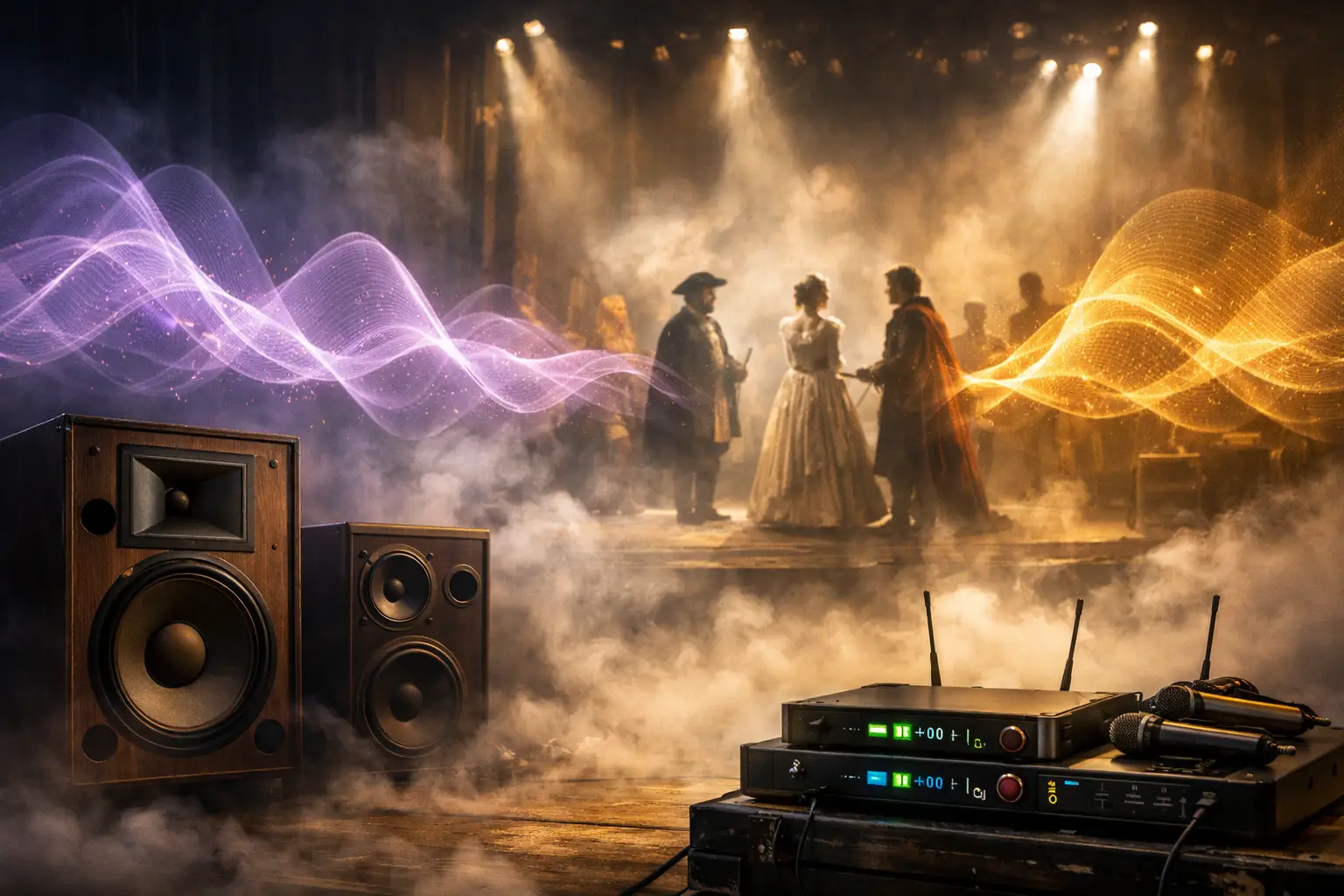
Here’s something they don’t teach you in most acting classes: your relationship with the sound designer is just as important as your relationship with the director.
I learned this lesson during a production where I had a crucial monologue that the sound designer wanted to underscore with ambient traffic noise. I initially resisted, thinking it would distract from my performance. But when I actually listened to what he’d created—a subtle, rhythmic pulse that matched my character’s anxiety—I realized it made my job easier, not harder.
The sound design gave me something to play against, a sonic representation of my character’s internal state that the audience could feel. Once I understood that, I adjusted my pacing and energy to work with the audio, and the scene became ten times more powerful.
Communication Strategies for Better Collaboration
For actors working with sound designers:
- Attend sound design meetings: Understand the sonic world you’ll be inhabiting
- Share your character work: Sound designers can create audio that reflects your character’s psychology
- Discuss timing early: If you need flexibility in a scene, communicate that before sound cues are locked
- Provide feedback respectfully: “The music feels too loud here” is better than “I can’t hear myself”
- Trust the process: Sound designers hear things you don’t—literally
Questions to ask your sound designer:
- What’s the overall sonic concept for this production?
- Are there any sound cues I need to be aware of for timing?
- How will my voice be amplified (if at all)?
- What’s the acoustic profile of the performance space?
- Can I hear a preview of major sound cues during rehearsal?
Case Studies: Sound Design Excellence in Action
“Hamilton” and the Art of Musical Soundscape
While “Hamilton” is obviously a musical, its sound design goes far beyond amplifying the performers. The production uses spatial audio techniques to place different instruments and vocal parts in specific locations around the audience, creating a three-dimensional sonic experience that supports the storytelling.
The design also brilliantly uses silence and dynamic range. The quiet moments hit harder because they contrast with the explosive ensemble numbers. That’s a lesson applicable to any theatrical production: contrast creates impact.
Immersive Theater and 360-Degree Audio
Productions like “Sleep No More” have pioneered the use of environmental audio that changes based on where audience members are in the space. This approach to Sound Design for Theater: Using Audio to Enhance Storytelling and Create Immersive Experiences creates a choose-your-own-adventure sonic landscape.
While most of us aren’t working on immersive theater pieces, the principle applies: consider the audience’s physical relationship to the sound sources. Where are your speakers? How does audio reach different parts of the house? Can you use that to your advantage?
Regional Theater Innovation on a Budget
I consulted on a production at a small regional theater that used smartphone apps to deliver personalized audio to audience members during certain scenes. Using free software and audience members’ own devices, they created an intimate, individualized experience for a fraction of what traditional headphone systems would cost.
This kind of creative problem-solving represents the future of accessible sound design. The tools are there—it’s about thinking outside the traditional theatrical box.
Emerging Trends in Theatrical Sound Design for 2026
Spatial Audio and Object-Based Sound
The shift toward spatial audio technology is one of the most exciting developments in theatrical sound design [1]. Unlike traditional stereo or surround sound, spatial audio treats individual sounds as objects that can be placed anywhere in three-dimensional space.
Imagine a production where a character’s voice can literally move around the audience, or where rain sounds come from above rather than from stage speakers. This technology, once reserved for high-end installations, is becoming more accessible through software solutions that work with conventional speaker arrays.
AI-Assisted Sound Design
Artificial intelligence is beginning to play a role in theatrical audio production [6]. AI tools can:
- Analyze scripts and suggest appropriate soundscapes
- Clean up and enhance recorded audio automatically
- Generate ambient sounds based on parameters you set
- Help with mixing and mastering for different venue acoustics
Important note: AI should be a tool that enhances human creativity, not replaces it. The artistic vision still needs to come from a human who understands storytelling and emotional resonance.
Sustainable and Eco-Conscious Audio Practices
There’s a growing movement toward environmentally sustainable theater practices, and sound design is part of that conversation. This includes:
- Using energy-efficient amplification systems
- Choosing equipment with longer lifespans and repairability
- Digital distribution of sound files instead of physical media
- Renting equipment for specific productions rather than purchasing
Practical Exercises for Actors to Develop Sound Awareness
The Soundwalk Exercise 👂
Here’s an exercise I give to every actor I coach: Take a 20-minute walk in your neighborhood, but instead of looking at your phone or listening to music, actively listen to the world around you.
Notice:
- How many distinct sounds can you identify?
- Which sounds are constant, which are intermittent?
- How do sounds change as you move through different spaces?
- What emotions do different sounds evoke?
- How does the “soundtrack” of real life create atmosphere?
This exercise trains you to think like a sound designer and helps you understand how audio shapes our experience of space and emotion.
The Silence Game
During rehearsal, try running a scene with absolutely no designed sound—no music, no effects, nothing. Then run it again with the planned sound design. Notice:
- How does the audio change your performance?
- What new emotional colors emerge?
- Where does the sound support you, and where might it challenge you?
- How can you adjust your performance to work in harmony with the audio?
Creating Your Character’s Soundtrack
For your next role, create a personal soundtrack for your character—not music they would listen to, but sounds that represent their internal world. Is your character’s mind like:
- A busy city street (chaotic, overwhelming)?
- A quiet forest (peaceful, contemplative)?
- A ticking clock (anxious, time-pressured)?
- Ocean waves (rhythmic, powerful)?
Share this with your sound designer. You might be surprised how it influences the production’s audio landscape.
Troubleshooting Common Sound Design Challenges

When Sound Cues Go Wrong
In live theater, Murphy’s Law applies: if something can go wrong, it eventually will. I’ve experienced:
- Sound cues that fired at the wrong moment
- Music that played at 10% volume (or 1000% volume)
- Wireless microphones that picked up taxi dispatchers
- Speakers that decided to emit feedback at the worst possible moment
The actor’s response toolkit:
✅ Stay in character: The audience doesn’t know what was supposed to happen
✅ Adjust your energy: If music doesn’t play, you might need to fill that emotional space yourself
✅ Trust your training: Your performance should work even without the sound design
✅ Communicate non-verbally: A glance to the booth can alert the operator without breaking the scene
✅ Debrief afterward: Help the team understand what happened from your perspective
Balancing Amplification and Authenticity
The debate over voice amplification in theater is ongoing. Some purists believe theater should never use microphones; others argue that modern audiences expect clarity and that amplification allows for more nuanced performances.
My take after 30 years? It depends on the space, the production, and the artistic goals. What matters most is that amplification, when used, should be invisible. The audience should hear the character, not a “mic’d actor.”
If you’re working with amplification:
- Learn proper microphone technique (it’s different from stage projection)
- Understand that you can use a wider dynamic range when mic’d
- Be aware of mic placement and how your movement affects sound
- Work with the sound designer to find your optimal levels
The Future of Sound Design for Theater: Using Audio to Enhance Storytelling and Create Immersive Experiences
Where We’re Headed
The theatrical sound landscape in 2026 is more exciting than ever. The convergence of affordable technology, innovative software, and creative thinking means that even small productions can achieve sonic sophistication that was impossible a decade ago [3].
We’re seeing:
- Personalized audio experiences through apps and wireless headphones
- Adaptive soundscapes that respond to audience reactions in real-time
- Hybrid productions that blend live and recorded audio seamlessly
- Accessibility features that make theater more inclusive through audio description and assistive listening
- Cross-pollination with gaming and VR bringing new techniques to traditional theater
The Human Element Remains Essential
Despite all the technological advances, the core of Sound Design for Theater: Using Audio to Enhance Storytelling and Create Immersive Experiences remains unchanged: it’s about human connection and emotional truth.
The best sound design I’ve ever experienced wasn’t necessarily the most technically sophisticated. It was the design that made me feel something, that transported me into the world of the play so completely that I forgot I was sitting in a theater.
That’s the goal we should all be chasing—actors, directors, designers, and technicians alike. Technology is a tool, but storytelling is an art that requires human heart, human creativity, and human understanding of what moves us.
Conclusion: Your Role in the Sonic Story
Whether you’re an actor, director, or theater enthusiast, understanding Sound Design for Theater: Using Audio to Enhance Storytelling and Create Immersive Experiences transforms how you approach every production. Sound isn’t just a technical element to be managed—it’s a powerful storytelling tool that can elevate good performances to great ones and create moments of magic that audiences remember for years.
Your action steps moving forward:
Develop your listening skills: Practice active listening in everyday life to understand how sound shapes experience
Collaborate early and often: Include sound designers in your creative process from the beginning, not as an afterthought
Experiment with affordable tools: You don’t need a massive budget to explore sound design—start with free software and your smartphone
Study great examples: Attend productions with excellent sound design and analyze what makes them work
Trust the process: Sound design, like acting, is both a technical craft and an art form—give it the respect it deserves
Stay curious about new technology: The tools available in 2026 are incredible, and they’re only getting better and more accessible
Remember, every time you step on stage, you’re not performing in silence—you’re part of a carefully crafted sonic landscape. The more you understand that landscape, the more effectively you can use it to enhance your performance and serve the story.
After 30 years in this business, I still get chills when I experience truly brilliant sound design. It reminds me why we do this work: to create moments of connection, emotion, and truth that transcend the ordinary. Sound is one of the most powerful tools we have to achieve that goal.
So listen carefully, collaborate generously, and never underestimate the power of the invisible actor that is sound design. Your audiences—and your fellow artists—will thank you for it.
Now get out there and create some theatrical magic. And this time, pay attention to what you’re hearing, not just what you’re seeing. That’s where some of the real magic lives. 🎭🎵
References
[1] The Future Of Audio Technology 3 Defining Trends From Ces 2026 – https://trocglobal.com/blog/the-future-of-audio-technology-3-defining-trends-from-ces-2026/
[3] Trends To Watch In 2026 Broadcast And Audio Visual Technology Wp – https://www.keycodemedia.com/trends-to-watch-in-2026-broadcast-and-audio-visual-technology-wp/
[6] Game Changing Audio Trends To Watch For In 2026 – https://www.mellostudio.com/blog/game-changing-audio-trends-to-watch-for-in-2026
[7] Home Theatre Installations In 2026 Whats New With 8k Wireless Av Systems – https://touchandfeel.co/home-theatre-installations-in-2026-whats-new-with-8k-wireless-av-systems/