

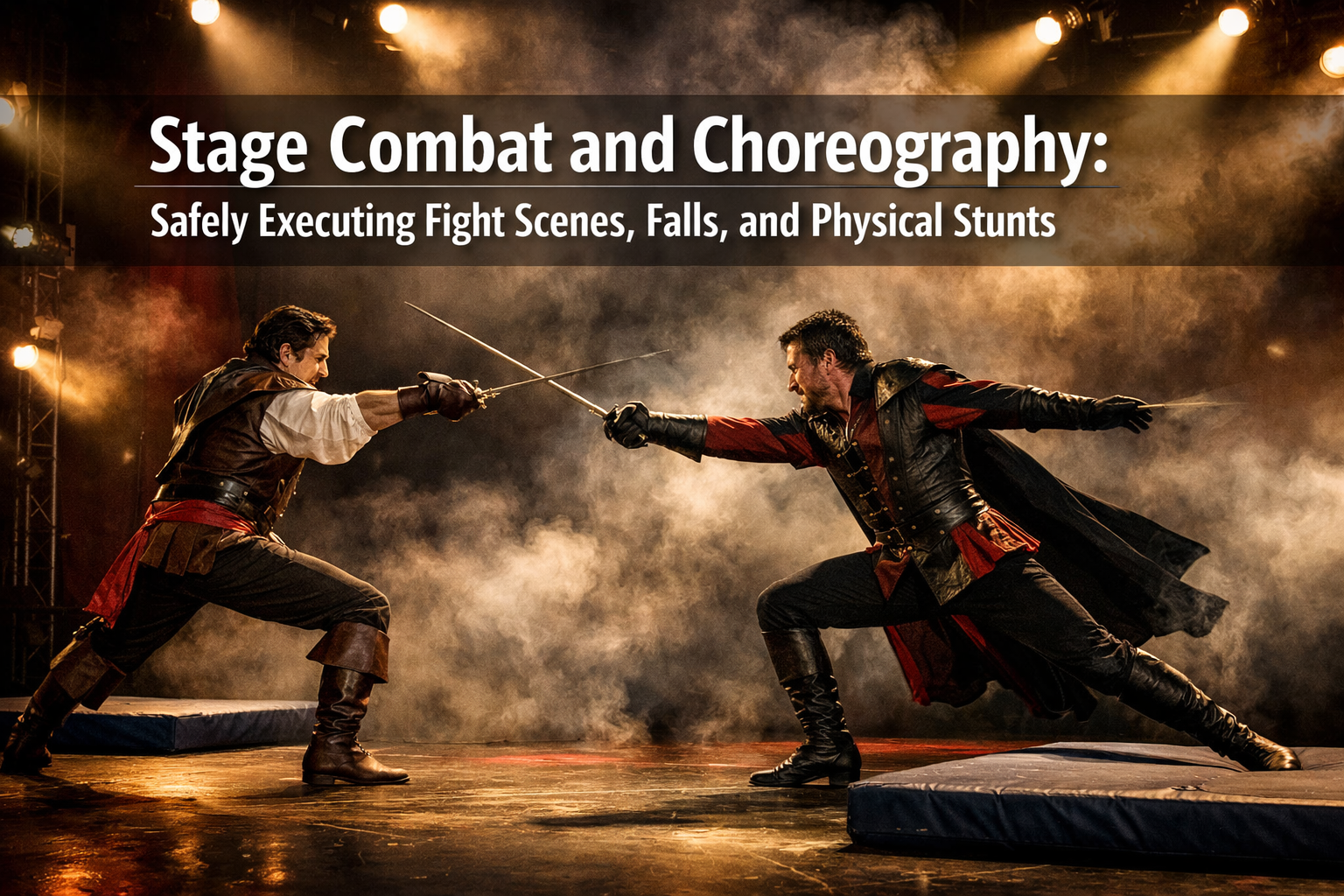
Picture this: You’ve just landed a role in a gritty period drama, and the script calls for an intense sword fight in Act Two. Your heart races with excitement—until you realize you’ve never held a stage weapon in your life. Here’s the thing: Stage Combat and Choreography: Safely Executing Fight Scenes, Falls, and Physical Stunts isn’t just about looking tough or convincing on stage. It’s about mastering a specialized skill set that keeps you and your fellow performers safe while delivering edge-of-your-seat action that audiences will remember long after curtain call.
After three decades in this business, I’ve seen brilliant actors hesitate to audition for physically demanding roles simply because they lacked confidence in stage combat. I’ve also witnessed the magic that happens when performers commit to learning these techniques properly. The good news? With the right training, mindset, and respect for safety protocols, any actor can master the fundamentals of stage combat and open up a whole new world of opportunities.
Key Takeaways
- Safety is non-negotiable: The foundational motto of all stage combat is “Safety first, Safety last, Safety always!” with strict protocols that must never be compromised[1][2]
- Professional choreography is mandatory: All fight scenes and stunts require a qualified fight director to ensure proper execution and performer safety[5]
- Distance and speed control everything: Maintaining an eight-inch minimum distance for punches and performing at three-quarter speed (never full speed) are essential safety measures[1][4]
- The victim controls the movement: The person receiving the strike determines the reaction and movement, creating the illusion of impact while maintaining safety[1][2]
- Preparation prevents injuries: Eye contact, silent agreement between partners, and mandatory pre-performance run-throughs are critical safety checkpoints[5][6]
Understanding the Foundation of Safe Stage Combat
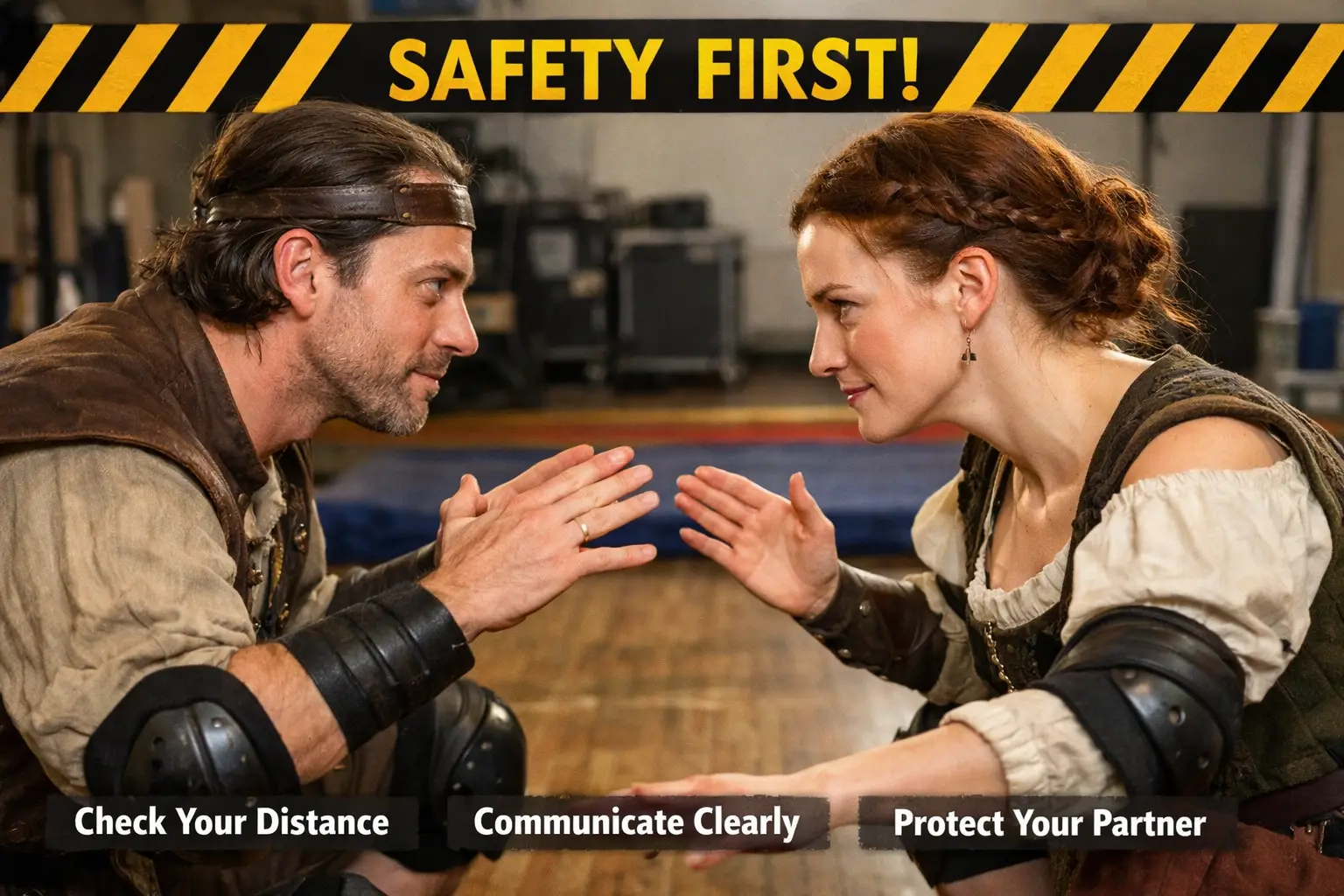
Let’s start with the golden rule that every fight choreographer will drill into your head from day one: “Safety first, Safety last, Safety always!”[1][2] This isn’t just a catchy phrase—it’s the bedrock principle that separates professional stage combat from dangerous amateur hour.
Think of stage combat like a carefully orchestrated dance where both partners are equally responsible for each other’s wellbeing. Unlike real fighting where the goal is to harm your opponent, stage combat is a collaborative art form where both performers work together to create the illusion of violence while ensuring zero actual harm occurs.
The Role of Professional Fight Directors
Here’s something that might surprise newer actors: you should never, ever attempt to choreograph your own fight scene unless you have specific training and certification in stage combat. All stage combats and stunts should be choreographed or arranged by a fight director with specific knowledge of the requested type of fight or stunt[5].
Why? Because a qualified fight director brings:
- ✅ Technical expertise in various combat styles
- ✅ Knowledge of safety protocols and injury prevention
- ✅ Understanding of theatrical storytelling through physical action
- ✅ Ability to adapt choreography to different skill levels
- ✅ Experience troubleshooting potential hazards
I learned this lesson the hard way early in my career when a well-meaning director tried to stage a bar brawl without professional help. The result? A sprained wrist, a near-miss with a prop bottle, and a fight sequence that looked about as convincing as a middle school playground scuffle. Don’t be that production.
Essential Safety Protocols for Stage Combat and Choreography
Distance Requirements: Your Safety Buffer
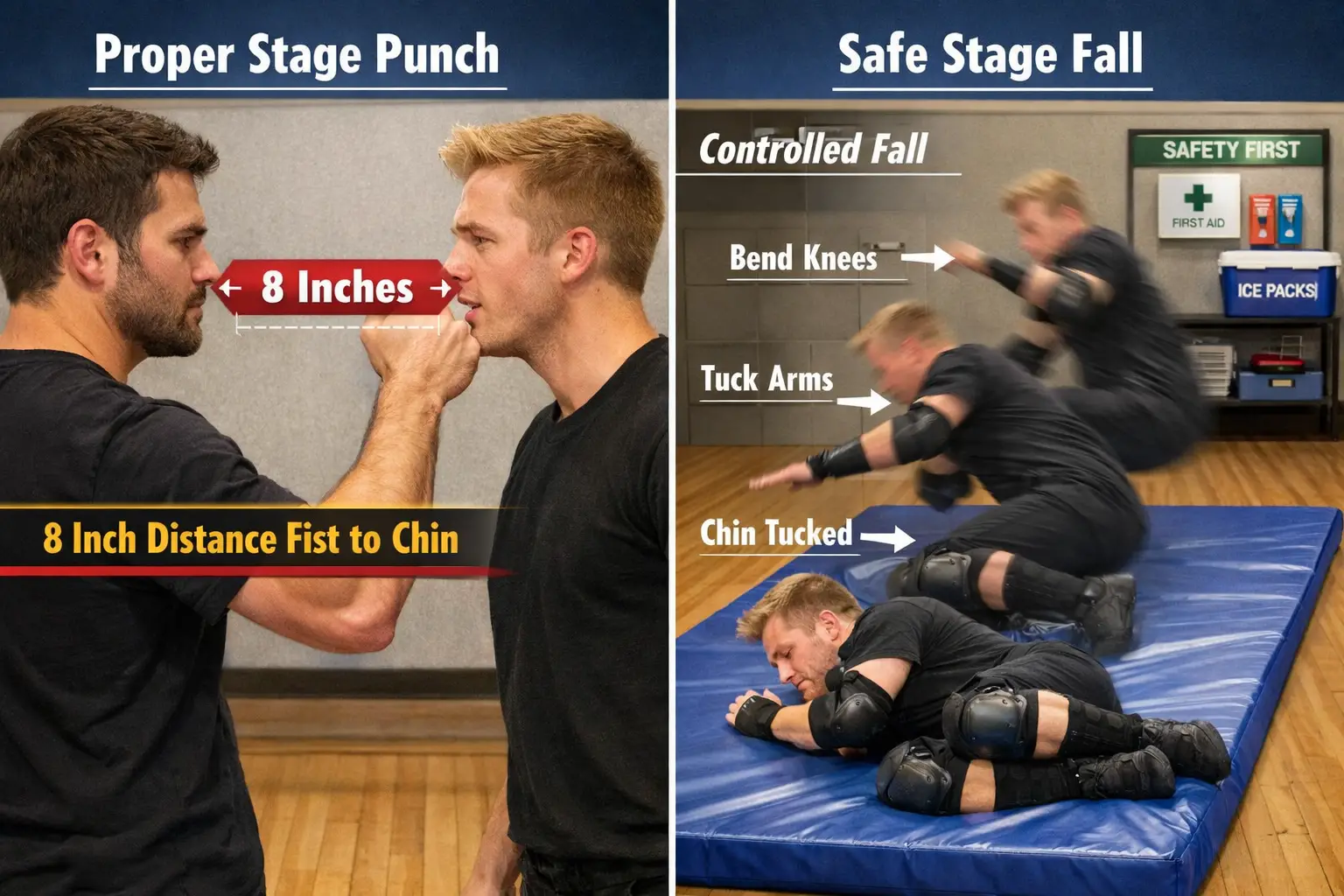
One of the most critical measurements in Stage Combat and Choreography: Safely Executing Fight Scenes, Falls, and Physical Stunts is the minimum distance between partners, which should be an outstretched hand span[1][4]. For specific moves like fist-to-chin punches, this distance is precisely eight inches[1][4].
Think of this eight-inch rule as your invisible force field. It might not sound like much, but it’s the difference between a convincing stage punch and an actual assault charge. When practiced correctly, this distance is completely invisible to the audience while providing a crucial safety margin for performers.
Pro tip: During rehearsals, actually measure this distance with a ruler until it becomes second nature. Your muscle memory needs to lock in that eight-inch gap so thoroughly that you could maintain it in your sleep.
Speed Control: The Three-Quarter Time Rule
Here’s something that shocks many actors new to stage combat: fights are never performed at full speed. Even during actual performances, combat sequences occur only in three-quarter time (¾ time)[1][2].
Why? Because full-speed movements:
- Increase the risk of accidental contact exponentially
- Make it harder to maintain proper distance
- Reduce reaction time if something goes wrong
- Create unpredictable momentum that’s difficult to control
During the learning phase, practice in slow motion is mandatory[1][2]. I know, I know—it feels awkward and unnatural at first. You’re thinking, “This looks ridiculous! How will this ever look convincing?” Trust the process. Slow-motion practice allows your body to learn the choreography safely, and the speed will come naturally as muscle memory develops.
The Victim Determines the Movement
This principle is absolutely fundamental: the person receiving the strike controls the reaction and movement, not the aggressor[1][2].
Let me explain with an analogy. Imagine you’re playing catch, but instead of trying to make your partner miss the ball, you’re trying to place it exactly where they can catch it safely every single time. In stage combat, the “aggressor” is delivering the movement to a specific spot, and the “victim” is responsible for selling the impact through their reaction.
This means:
- The receiver decides when to react
- The receiver controls the intensity of their response
- The receiver determines the timing and trajectory of their fall or movement
- The aggressor adjusts their movement to match the receiver’s needs
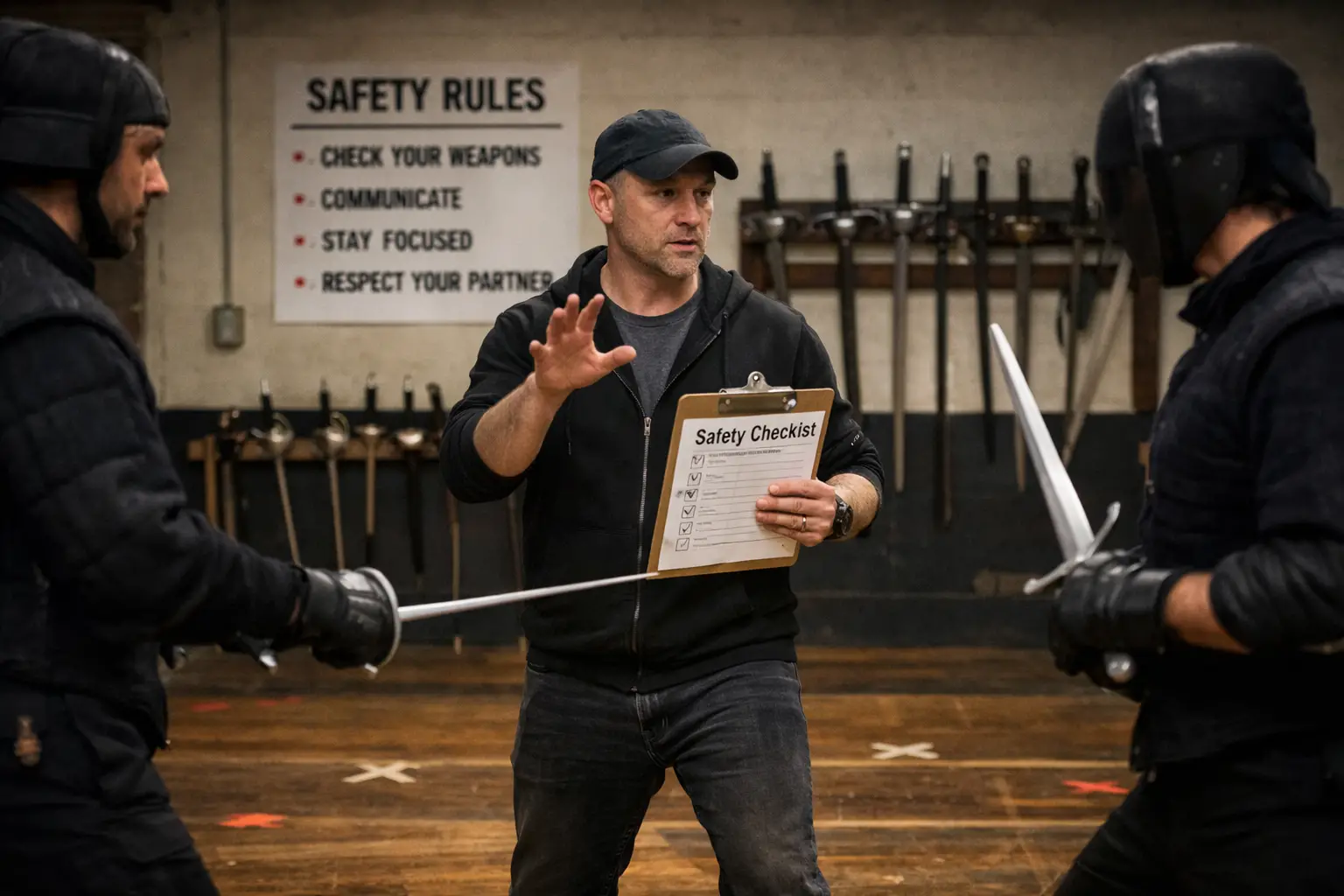
Pre-Rehearsal Safety Checklist for Fight Scenes
Before you even begin learning choreography, the rehearsal environment must meet specific safety standards. I’ve walked out of rehearsals that didn’t meet these requirements, and you should too—your body is your instrument, and protecting it isn’t negotiable.
Space and Environment Requirements
Rehearsal spaces must be large enough to allow safe weapon use with adequate visibility, appropriate flooring free of debris, and accessible first aid equipment including ice packs[4][5].
Here’s your pre-rehearsal safety checklist:
| Safety Element | Requirements | Why It Matters |
|---|---|---|
| Floor Surface | Wooden floors preferred; clean, debris-free[1] | Prevents slips and provides proper traction |
| Space Dimensions | Adequate room for full weapon arcs plus safety margin | Prevents accidental contact with walls/furniture |
| Lighting | Bright, even illumination throughout combat area | Ensures performers can see each other clearly |
| Tumbling Mats | Available for practicing falls[1] | Cushions accidental falls during learning phase |
| First Aid Station | Easily accessible with ice packs, bandages, etc.[4][5] | Enables immediate response to minor injuries |
| Footwear | Sensible, non-slip shoes; avoid high heels, boots, slippery soles[1][4] | Maintains balance and prevents ankle injuries |
Protective Gear Essentials
Don’t let ego prevent you from wearing appropriate protective gear during rehearsals. Protective gear includes knee pads, elbow pads, back padding, and sensible footwear[1][4].
When I was rehearsing a particularly intense stage combat sequence for a production of Romeo and Juliet, I initially resisted wearing knee pads because I thought they looked bulky under my rehearsal clothes. After one hard landing during a fall sequence left me limping for a week, I swallowed my pride and padded up. Guess what? Nobody cared how I looked in rehearsal, and my knees thanked me.
Mastering Hand-to-Hand Combat Techniques
The Sacred Pre-Fight Ritual: Eye Contact and Agreement
Before every single fight sequence—whether in rehearsal or performance—eye contact and silent agreement between partners is essential to prevent injury[6]. This isn’t optional. This isn’t something you skip when you’re running late or feeling confident.
This moment of connection serves multiple purposes:
- 🎯 Confirms both performers are mentally present and focused
- 🎯 Establishes non-verbal communication that continues throughout the fight
- 🎯 Provides a final safety check before physical contact begins
- 🎯 Creates a moment of trust and mutual responsibility
Think of it like a pilot’s pre-flight checklist. No matter how many times you’ve flown the plane, you still check the instruments. No matter how many times you’ve performed the fight, you still make eye contact and get that silent “yes” from your partner.
Tempo Synchronization
Partners must work at the same tempo throughout the choreography[1]. This is where stage combat truly becomes a dance. If one partner is rushing while the other is moving deliberately, the timing falls apart and safety is compromised.
During rehearsals, try these techniques to maintain synchronized tempo:
- Count out loud together during early run-throughs
- Use a metronome to establish consistent rhythm
- Designate one partner as the tempo leader
- Practice sections repeatedly until the rhythm becomes automatic
- Record rehearsals and review for tempo inconsistencies
Common Hand-to-Hand Techniques
While specific choreography varies by production, most hand-to-hand stage combat includes these fundamental techniques:
Stage Punches: The eight-inch rule applies here[1][4]. The “puncher” throws their fist to a spot eight inches from the target, while the “victim” snaps their head back and provides the sound effect (a sharp exhale or vocal reaction). The illusion is sold through precise timing and the victim’s reaction, not through actual contact.
Slaps: These require even more precision than punches. The aggressor’s hand passes in front of the victim’s face without contact while the victim turns their head sharply. The sound is created by the aggressor clapping their hands together or the victim creating the sound effect through other means.
Grabs and Holds: These involve actual contact but must be executed with control. The person being grabbed should never resist the movement—resistance creates tension that can lead to muscle strains or joint injuries.
Chokes: Stage chokes are all about hand placement and the victim’s performance. Hands are placed on the collarbone or shoulders, never on the actual throat, while the victim sells the effect through facial expression and body language.
Weapon Work: Adding Props to Stage Combat and Choreography
Working with stage weapons—whether swords, daggers, staffs, or improvised objects—adds another layer of complexity and risk to Stage Combat and Choreography: Safely Executing Fight Scenes, Falls, and Physical Stunts.
Weapon Safety Fundamentals
First things first: stage weapons should be specifically designed for theatrical use, not actual weapons. Even “dulled” real weapons carry unnecessary risk. Theatrical weapons are balanced differently, constructed from safer materials, and designed to withstand repeated use in choreographed sequences.
Before handling any stage weapon:
- ✅ Inspect it for damage, loose parts, or sharp edges
- ✅ Understand its weight and balance point
- ✅ Practice basic handling without a partner
- ✅ Learn proper grip and stance
- ✅ Never point it at anyone’s face or eyes, even in jest
Sword Fighting Basics
Stage sword fighting is perhaps the most iconic form of theatrical combat, but it’s also one of the most technically demanding. The fundamental principle remains the same: the weapons never actually make contact with the performers’ bodies.
Target zones in sword fighting are typically the opponent’s weapon or carefully controlled areas away from the body. The classic “blade-to-blade” contact creates the satisfying clash of steel while keeping the sharp (or even dulled) edges away from flesh.
The choreography follows a call-and-response pattern:
- Attacker initiates movement toward a specific target zone
- Defender moves their weapon to intercept
- Contact occurs between weapons, not bodies
- Both partners maintain awareness of blade position throughout
Dagger and Close-Quarters Weapon Work
Daggers and other close-quarters weapons require even more precision than swords because the movements happen in tighter spaces with less reaction time. The same distance principles apply, but the smaller weapon size can create optical illusions that make safe distances appear closer than they are.
Pro insight: When working with daggers, slow the tempo down even further than you would with swords. The audience’s eye can follow the action just fine at reduced speed, and the safety margin increases dramatically.
Fall Techniques: Making the Ground Your Friend
Falls are among the most dangerous elements in stage combat if executed improperly, but they’re also some of the most visually impressive when done right. The key is learning to fall safely while making it look devastating.
Basic Fall Principles
The golden rule of stage falls: distribute the impact across as much body surface area as possible. Never land on a single point like a knee, elbow, or wrist. Instead, think of your body as a wave that rolls across the floor, spreading the force of impact.
Proper falling technique involves:
- Keeping your head up and chin tucked (never let your head hit the floor)
- Bending your knees to lower your center of gravity
- Using your arms to guide the fall, not catch yourself
- Rolling through the impact when possible
- Exhaling on impact to prevent the wind being knocked out
Types of Stage Falls
The Backward Fall: This is often the first fall taught because it’s relatively controlled. Start from a standing position, bend your knees while keeping your back straight, sit down in a controlled manner, then roll backward while tucking your chin and protecting your head.
The Forward Fall: More challenging than backward falls because you can’t see where you’re going. The key is to turn your head to one side before impact and use your forearms (not your palms) to absorb some of the force while your body continues to the ground.
The Side Fall: Useful for reactions to punches or pushes. Drop to one knee, then roll onto your hip and side, using your arm to cushion but not stop the fall.
The Dramatic Collapse: Often used for death scenes or knockout punches. This requires the most control because it looks completely uncontrolled. Practice on mats extensively before attempting on a hard stage floor.
Practicing Falls Safely
Always begin fall practice on tumbling mats[1] and progress gradually to harder surfaces only after the technique is solid. I still practice my falls on mats during warm-ups, even after thirty years—there’s no shame in protecting your body.
Start every fall practice session with:
- Proper warm-up focusing on flexibility and core strength
- Review of technique in slow motion
- Practice on mats before moving to harder surfaces
- Gradual increase in speed and intensity
- Cool-down stretching to prevent muscle soreness
Pre-Performance Protocols and Maintenance
The Mandatory Fight Call
Here’s a non-negotiable rule: a fight run-through must occur before each performance[5]. This isn’t a suggestion or a “nice to have”—it’s an essential safety protocol that should never be skipped, even if you’ve performed the show a hundred times.
The fight call serves several critical functions:
- 🎭 Refreshes muscle memory after time away from the choreography
- 🎭 Allows performers to check in with each other physically and mentally
- 🎭 Identifies any physical issues (soreness, injury, fatigue) that might affect performance
- 🎭 Provides opportunity to adjust choreography if needed
- 🎭 Reinforces safety protocols and communication
I’ve seen productions where tired or overconfident actors tried to skip fight calls, and I’ve seen the injuries that resulted. Don’t be that actor. Show up for your fight call with the same focus and professionalism you bring to the performance itself.
Maintaining Skills Throughout a Run
Stage combat skills can deteriorate surprisingly quickly without consistent practice. During a long run, maintain your technique by:
- Attending every fight call without exception
- Practicing challenging sequences during warm-ups
- Communicating immediately with your partner about any concerns
- Staying physically conditioned through the run
- Never getting complacent, even in the final performances
Common Mistakes and How to Avoid Them
Rushing the Learning Process
The biggest mistake I see from eager actors is trying to move too fast through the learning process. Stage combat looks simple when professionals do it, but that’s because they’ve drilled the fundamentals thousands of times.
Remember: Practice in slow motion is mandatory while learning techniques[1][2]. There are no shortcuts. The actor who patiently masters the basics at slow speed will ultimately perform more convincingly and safely than the one who rushes to full speed.
Breaking Character During Combat
Here’s a paradox: stage combat requires intense technical focus, but the performance must look spontaneous and emotionally charged. New actors often let their concentration show on their faces, breaking character to focus on technique.
The solution? Over-rehearse until the technique becomes invisible. When you’ve practiced a sequence so many times that your body executes it automatically, your mind is free to stay in character and react emotionally.
Neglecting Communication
Stage combat is built on trust and communication between partners. Never:
- Change choreography without discussing it with your partner first
- Perform a fight sequence while angry, upset, or distracted
- Skip the pre-fight eye contact and agreement
- Ignore your partner’s signals that something feels wrong
- Let ego prevent you from admitting when you’re struggling with a technique
Performing While Injured or Fatigued
This is where professionalism really matters. If you’re injured, exhausted, or otherwise not at 100%, you need to communicate that to your fight partner, the fight director, and the stage manager. Trying to push through can result in serious injury to yourself or your partner.
I once performed a demanding fight sequence while nursing a sore shoulder that I didn’t disclose. During the performance, my timing was off by a fraction of a second, and my partner ended up with a bruised rib. The guilt I felt far outweighed any pride I had about “toughing it out.”
Building Your Stage Combat Skills: Next Steps
Formal Training and Certification
If you’re serious about expanding your acting opportunities, consider pursuing formal stage combat training. Organizations like the Society of American Fight Directors (SAFD) offer structured training programs and certification in various weapon styles and unarmed combat.
Certification demonstrates to directors and casting agents that you:
- Have received professional training from qualified instructors
- Understand and respect safety protocols
- Can be trusted with physically demanding roles
- Bring specialized skills that add value to productions
Continuing Education
Stage combat techniques evolve, and maintaining your skills requires ongoing practice and education. Consider:
- Workshop attendance: Regular workshops keep skills sharp and introduce new techniques
- Cross-training: Martial arts, dance, and gymnastics all complement stage combat skills
- Observation: Watch professional fight choreography in film and theater analytically
- Practice groups: Form regular practice sessions with other trained actors
- Physical conditioning: Maintain strength, flexibility, and cardiovascular fitness
Integrating Combat Skills Into Your Actor Toolkit
Even if you’re not pursuing roles that require extensive fight work, basic stage combat training makes you a more versatile performer. The skills you develop—spatial awareness, physical control, partner communication, and precision timing—transfer to all aspects of physical performance.
Conclusion: Safety, Skill, and Storytelling
Stage Combat and Choreography: Safely Executing Fight Scenes, Falls, and Physical Stunts represents the intersection of athletic skill, artistic expression, and unwavering commitment to safety. It’s not about being the toughest or most fearless performer—it’s about being the most disciplined, communicative, and technically proficient.
The actors who excel in stage combat are those who respect the craft enough to train properly, practice patiently, and never compromise on safety protocols. They understand that the motto “Safety first, Safety last, Safety always!”[1][2] isn’t a limitation on their artistry—it’s the foundation that makes artistry possible.
Your Action Plan
Ready to start your stage combat journey? Here’s what to do next:
Seek professional training: Never attempt to learn stage combat from videos or books alone. Find a qualified instructor or workshop in your area.
Start with fundamentals: Master basic distance, timing, and communication before attempting complex choreography.
Invest in safety: Purchase proper protective gear and practice on appropriate surfaces.
Find practice partners: Regular practice with trusted partners builds the skills and communication essential for safe performance.
Stay humble: Respect the learning process, acknowledge your limitations, and never let ego override safety.
Communicate constantly: With your partners, directors, and fight choreographers about concerns, questions, or physical issues.
The stage combat skills you develop will open doors to roles you might never have considered, from classical Shakespeare to contemporary action dramas. More importantly, you’ll join a community of performers who understand that creating the illusion of violence requires discipline, artistry, and above all, a commitment to keeping everyone safe.
Now get out there, find a qualified instructor, and start your training. Your future self—and your future scene partners—will thank you for taking the time to learn these skills properly. Break a leg (but only figuratively, and with proper fall technique)! 🎭⚔️
References
[1] Attachment 1 Stage Combat Safety Handout Docx – https://tedb.byu.edu/0000018b-0570-df69-a3df-95fe61cb0000/attachment-1-stage-combat-safety-handout-docx
[2] 1 Stage Combat Safety Handout Docx – https://www.scribd.com/document/459809516/1-Stage-Combat-Safety-Handout-docx
[3] Guide To Stage Combat – https://theperformersmanifesto.com/guide-to-stage-combat/
[4] Stage Combat Basics 16768 – https://www.backstage.com/magazine/article/stage-combat-basics-16768/
[5] Stage Combatstunts And Weaponry – http://www.ontario.ca/document/safety-guidelines-live-performance-industry/stage-combatstunts-and-weaponry
[6] 10 Basic Rules Of Stage Combat That Keep Everyone Safe – https://performerstuff.com/mgs/10-basic-rules-of-stage-combat-that-keep-everyone-safe/
[7] Stage Combat 101 What Your Students Need To Know – https://www.theatrefolk.com/blog/stage-combat-101-what-your-students-need-to-know
[8] Stage Combat – https://finearts.illinoisstate.edu/theatre-dance/dance/minor/stage-combat/
[9] Watch – https://www.youtube.com/watch?v=LlQgIYZAHXM
[10] Unarmed Stage Combat – https://weaponsofchoice.com/the-textbook-of-stage-combat/staging-violence/unarmed-stage-combat/