

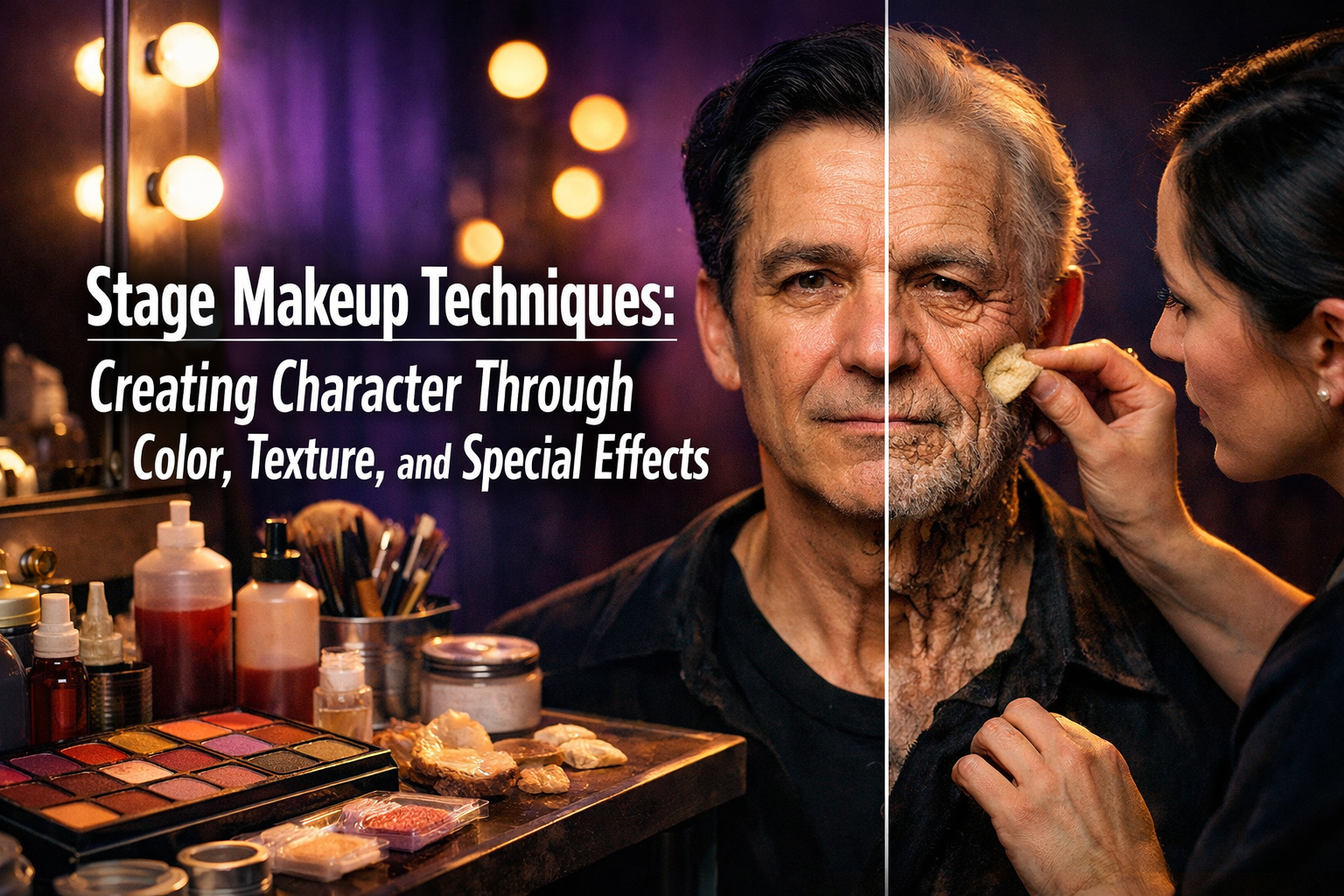

Listen, in my three decades of treading the boards, I’ve seen actors transform from everyday folks into kings, monsters, and everything in between—and it all starts at the makeup mirror. Stage Makeup Techniques: Creating Character Through Color, Texture, and Special Effects aren’t just about slapping on some foundation and calling it a day. They’re about understanding how light, distance, and pigment work together to create believable characters that can be seen from the back row of a 2,000-seat theater. Whether you’re playing Hamlet in a black box or a creature in a Broadway spectacular, mastering these techniques is as essential as knowing your lines.
Here’s the thing: stage makeup is a completely different beast from your everyday street makeup or even film work. Under those powerful stage lights, subtlety disappears faster than free donuts at an audition holding room. You need to think bigger, bolder, and more strategically. The audience member in row Z needs to see your character’s age, emotion, and transformation just as clearly as the critic in the orchestra pit.
Key Takeaways
- Color theory and lighting conditions are fundamental to creating makeup that reads correctly from stage distance, with warm and cool tones serving different purposes under theatrical lighting
- Texture techniques including stippling, highlighting, and shadowing create three-dimensional effects that overcome the flattening effect of stage lights
- Special effects and prosthetics require specific adhesives, blending methods, and setting techniques to withstand performance conditions while maintaining believability
- Distance-appropriate application varies dramatically between intimate black box theaters and large proscenium stages, requiring different levels of exaggeration
- Practice and preparation before tech week prevents disasters and ensures consistent character appearance throughout a show’s run
Understanding the Fundamentals of Stage Makeup Techniques

The Science Behind Stage Visibility
Think of stage makeup like painting a portrait that needs to be viewed from across a football field. Everything that works for a close-up selfie fails spectacularly under stage conditions. The powerful lights washing over performers create a bleaching effect that can make even the most dramatic street makeup look washed out and flat. This is where understanding Stage Makeup Techniques: Creating Character Through Color, Texture, and Special Effects becomes your secret weapon.
Stage lighting typically ranges from 500 to 2,000 watts per instrument, and multiple lights hit you from various angles. This creates what we call “flattening”—where the natural shadows and contours of your face disappear, making everyone look like a featureless mannequin. Your job with makeup is to artificially recreate those shadows and highlights so your features remain visible and expressive.
Key principle: What looks ridiculously overdone in your bathroom mirror will look just right from row M. I learned this the hard way during my first professional show when my “subtle” makeup rendered me practically invisible during Act One. The stage manager politely suggested I “actually apply some makeup” during intermission. Lesson learned!
Color Theory for the Stage
Color isn’t just about looking pretty—it’s about physics and perception. Here’s what you need to know:
| Lighting Color | Effect on Makeup | Correction Strategy |
|---|---|---|
| Warm (amber/yellow) | Enhances reds and oranges, dulls blues | Use cooler tones in base, avoid excessive pink |
| Cool (blue/white) | Enhances blues and greens, dulls reds | Warm up base tones, intensify lip color |
| Green | Makes reds appear brown | Use purple-based correctors |
| Red/Pink | Flattens features dramatically | Increase contour contrast significantly |
The makeup trends of 2026 emphasize bold, dramatic looks [3], which actually aligns perfectly with theatrical needs. However, stage work requires understanding how these trends translate under specific lighting conditions rather than natural daylight or ring lights.
Mastering Color Application in Stage Makeup Techniques
Foundation and Base Work
Your foundation is the canvas for everything else. Unlike beauty makeup where “your skin but better” is the goal, stage foundation serves multiple purposes:
Purpose 1: Color Correction Stage lights can make you look sickly, washed out, or oddly colored. Your foundation corrects this by providing a base that looks natural under your specific lighting design. Always—and I mean always—test your makeup under the actual stage lights during tech rehearsal. What looks perfect in the dressing room might look like you’ve contracted a rare disease once you hit your mark on stage.
Purpose 2: Creating a Uniform Canvas Foundation evens out skin tone variations, covers blemishes, and provides a surface that holds additional makeup layers. For stage work, you’ll typically go 1-2 shades darker than your natural skin tone because lights wash you out.
Purpose 3: Establishing Character Age and Health A young, healthy character gets a smooth, even foundation. An older or ill character might get a more sallow or ruddy base color as the starting point for aging techniques.
The Art of Contouring and Highlighting
This is where Stage Makeup Techniques: Creating Character Through Color, Texture, and Special Effects really start to shine. Contouring for stage isn’t about Instagram-ready cheekbones—it’s about recreating the natural shadows that stage lighting erases.
Basic Contouring Principles:
✨ Shadows recede, highlights advance – This is your mantra. Anything you want to look farther away gets darker; anything you want to pop forward gets lighter.
✨ Blend like your career depends on it – Because it kind of does. Harsh lines look amateurish even from the back row. Use brushes, sponges, or fingers to create seamless gradients.
✨ Exaggerate proportionally to distance – Black box theater (under 100 seats)? Keep it relatively subtle. Regional theater (500+ seats)? Go bold. Broadway house (1,000+ seats)? Channel your inner drag queen with the intensity.
Step-by-Step Contouring Process:
- Apply foundation base across entire face and neck (always blend down onto the neck—nothing screams amateur like a makeup line at the jawline)
- Identify natural shadow areas – hollows of cheeks, temples, sides of nose, under jawline
- Apply contour color (typically 3-4 shades darker than base) to these areas
- Apply highlight color (2-3 shades lighter) to cheekbones, bridge of nose, center of forehead, chin
- Blend thoroughly using circular motions where colors meet
- Set with powder to prevent shine and ensure longevity
Eyes: The Windows to Character
Eye makeup for stage serves both practical and artistic purposes. Practically, it prevents your eyes from disappearing into shadow under stage lights. Artistically, it conveys emotion, age, and character traits visible from distance.
Young Character Eyes:
- Clean, defined lines
- Bright, light colors on lids
- Mascara to define lashes
- Minimal liner, focused on definition rather than drama
Mature Character Eyes:
- Deeper crease shadows
- Slightly drooping outer corners (achieved with liner technique)
- Muted lid colors
- Possible addition of crow’s feet using fine liner
Character/Fantasy Eyes:
- Bold colors that support character concept
- Exaggerated shapes extending beyond natural eye
- Possible addition of rhinestones, glitter, or specialty products
- Consider how colors interact with costume palette
The bold makeup trends defining 2026 [2] actually provide excellent inspiration for theatrical character work, particularly for contemporary productions or stylized pieces.
Creating Dimension Through Texture in Stage Makeup Techniques
Stippling: The Foundation of Realistic Texture
Stippling is the technique of creating texture by applying makeup in a dabbing motion rather than smooth strokes. It’s absolutely essential for creating realistic skin texture, aging effects, and character-specific features. I remember watching a master makeup artist transform a 25-year-old actor into a convincing 70-year-old using primarily stippling techniques—it was like watching magic happen.
Stippling Tools:
- Natural sponges – Create irregular, realistic texture
- Stipple brushes – Provide more control for specific areas
- Coarse sponges – Generate pronounced texture for extreme aging or creature work
- Fingers – Surprisingly effective for certain effects, plus they’re always with you
Stippling Technique for Aging:
- Apply base foundation smoothly
- Mix a slightly darker shade (representing shadow in wrinkles)
- Lightly stipple this darker color where wrinkles would naturally form—forehead, crow’s feet, laugh lines, neck
- Mix a lighter shade (representing raised skin between wrinkles)
- Stipple lighter color adjacent to darker areas
- Blend edges gently while maintaining texture
- Set with powder applied with stippling motion to maintain texture
Pro tip: Have your actor make the facial expression that creates natural wrinkles in the area you’re working on, apply the darker color in those creases, then have them relax their face. This ensures wrinkles appear in anatomically correct locations.
Highlighting and Shadowing for Three-Dimensional Effects
Stage lights flatten everything. Your job is to fight back by creating artificial dimension. This goes beyond basic contouring into the realm of sculptural makeup.
Advanced Shadowing Techniques:
🎭 Cheekbone Enhancement – For characters with prominent bone structure, create a shadow that starts at the ear, curves under the cheekbone, and fades toward the mouth. Highlight the top of the cheekbone from temple to apple of cheek.
🎭 Nose Reshaping – Narrow a wide nose by shadowing the sides; widen a narrow nose by highlighting the sides. Lengthen by highlighting down the bridge; shorten by shadowing the tip.
🎭 Jawline Definition – Shadow under the jawline and down the neck; highlight the jawbone itself. This is especially important for characters meant to appear strong or angular.
🎭 Forehead Modification – Create the appearance of a higher forehead by shadowing the hairline; lower it by highlighting. Add character-specific bumps or ridges using highlight/shadow combinations.
Creating Realistic Aging Effects
Aging makeup is one of the most requested Stage Makeup Techniques: Creating Character Through Color, Texture, and Special Effects skills. Done well, it’s invisible—the audience simply believes the actor is that age. Done poorly, it looks like a kid playing dress-up in grandma’s clothes.
Components of Convincing Age Makeup:
Skin Texture Changes:
- Broken capillaries (tiny red lines on nose and cheeks using fine liner or stippling)
- Age spots (stippled brown tones on hands, face, neck)
- General texture (stippled foundation creating appearance of less elastic skin)
- Sagging (shadow and highlight creating jowls, eye bags, neck wattles)
Color Changes:
- Sallower overall tone (slightly yellow or gray mixed into foundation)
- Thinner lips (concealer to reduce natural lip line, redraw smaller)
- Paler or more uneven coloring (less uniform foundation application)
Feature Changes:
- Deeper nasolabial folds (shadow and highlight technique)
- Pronounced eye bags (shadow under eyes, highlight on “bag”)
- Receding hairline (shadow at hairline, possible use of bald cap)
- Thinning eyebrows (block out portions with glue stick, redraw sparser)
The Layering Approach:
I always tell actors that aging makeup is built in layers, like a painting. Start subtle and add more until it reads correctly from house distance. During dress rehearsal, have someone sit in the back row and give feedback. What seems like too much up close might be just right from the cheap seats.
Advanced Special Effects in Stage Makeup Techniques

Prosthetics and Three-Dimensional Additions
When shadow and highlight aren’t enough to create the character transformation you need, it’s time to add dimensional elements. Stage Makeup Techniques: Creating Character Through Color, Texture, and Special Effects reach their peak when incorporating prosthetics.
Types of Stage Prosthetics:
Pre-made foam latex pieces – Noses, chins, foreheads, ears. These are affordable and readily available but require proper blending to look seamless.
Custom silicone prosthetics – Created from life casts of the actor. Expensive but provide the most realistic results for long runs.
Built-up pieces using modeling materials – Derma wax, nose putty, or rigid collodion built directly on the actor’s face. Less expensive but require more skill and time.
Gelatin prosthetics – Excellent for wounds, scars, or temporary effects. Can be melted and reused but don’t withstand heat well.
Prosthetic Application Techniques
Applying prosthetics properly is crucial. I once watched an actor’s nose piece slide off mid-performance because it wasn’t adhered correctly—not a moment anyone wants to experience, trust me.
Application Process:
Skin Preparation – Clean and dry the application area thoroughly. Some artists use alcohol to remove oils, followed by a barrier spray.
Adhesive Selection – Spirit gum (traditional, works well for most applications), Pros-Aide (stronger, better for silicone, requires remover), medical adhesive (strongest, can irritate sensitive skin).
Piece Placement – Position prosthetic carefully before pressing down. Once adhered, repositioning damages both piece and skin.
Edge Blending – This is where skill separates amateurs from professionals. Use adhesive to melt edges into skin, then stipple foundation over the blend line. The edge should be invisible.
Color Matching – Paint the prosthetic to match surrounding skin using the same foundation and contouring used on the rest of the face.
Setting and Sealing – Powder thoroughly, then seal with setting spray or special prosthetic sealers to withstand sweat and performance conditions.
Removal and Skin Care:
Always use proper removers—never just pull prosthetics off. Spirit gum remover, Pros-Aide remover, or oil-based removers protect skin. Follow with gentle cleansing and moisturizing. During a long run, skin health is paramount.
Creating Wounds, Scars, and Fantasy Effects
Sometimes your character needs visible damage or fantastical features. These effects must withstand movement, sweating, and multiple performances while remaining convincing from stage distance.
Scar Techniques:
Fresh scars – Rigid collodion painted in a line creates a puckered effect as it dries. Add red around edges, possible theatrical blood in the “wound.”
Healed scars – Build up with scar wax, blend edges, color with foundation slightly lighter or darker than surrounding skin, add irregular texture.
Keloid scars – Build up significantly with wax or silicone, create shiny surface with petroleum jelly, color with reddish-purple tones.
Fantasy Effects:
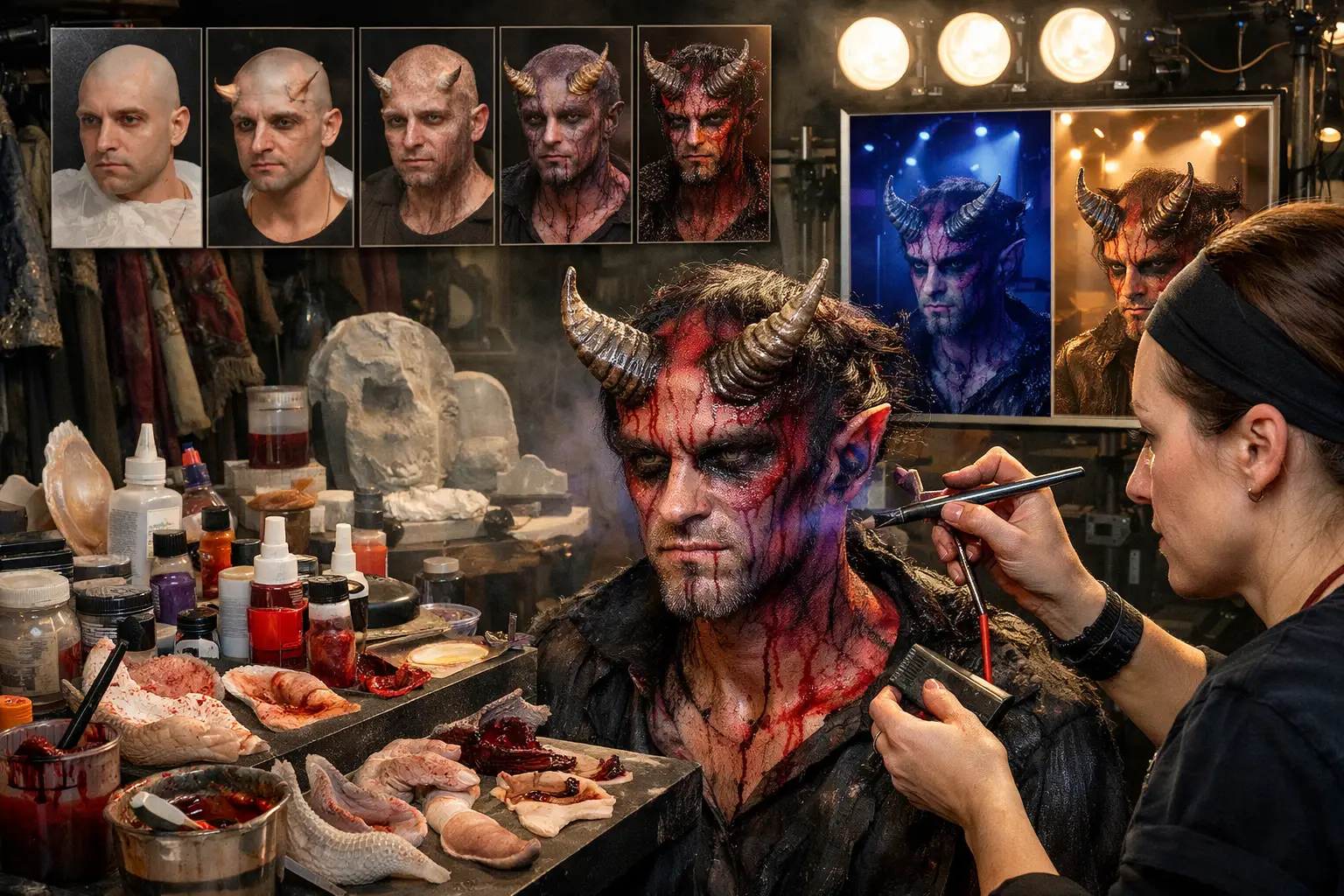
The beauty of theatrical fantasy makeup is that it doesn’t need to be “realistic” in the everyday sense—it needs to support the production’s aesthetic and be visible from distance. Think bigger and bolder than you would for film.
- Scales – Created with netting pressed into wax or latex, painted with iridescent colors
- Horns/ridges – Foam latex pieces or built-up wax formations, highlighted and shadowed for dimension
- Unnatural skin colors – Full-coverage body paints in greens, blues, metallics (always test for allergies first)
- Glitter and metallics – The bold makeup trends of 2026 embrace shimmer [3], which works beautifully for fantasy characters when applied strategically
Airbrush Techniques for Stage
Airbrushing provides even coverage and can create effects impossible with traditional application. It’s particularly useful for:
- Full body color – Covering large areas quickly and evenly
- Gradient effects – Smooth color transitions for fantasy characters
- Tattoos – Temporary designs that look realistic from distance
- Bruising and dirt – Realistic texture and color variation
Airbrush Considerations:
Airbrushing requires investment in equipment and practice to master. The learning curve is real—my first attempts looked like I’d attacked actors with a spray paint can. But once mastered, it’s incredibly efficient for certain applications.
Use alcohol-based paints for longevity and water-resistance. Always use proper ventilation and protective equipment. Clean equipment thoroughly after each use to prevent clogging and bacterial growth.
Adapting Stage Makeup Techniques for Different Performance Spaces
Black Box and Intimate Theaters
In small venues where audience members sit within 20 feet of performers, Stage Makeup Techniques: Creating Character Through Color, Texture, and Special Effects require a lighter touch. The goal shifts from broad visibility to detailed believability.
Intimate Theater Approach:
- Reduce intensity by 30-40% compared to large theater applications
- Focus on detail – Fine lines, subtle color variations, realistic texture
- Blend meticulously – Audience will see every harsh line
- Consider close-up photography – Many small theaters use projection or live feed
- Test under actual lighting – Intimate spaces often use more varied, colorful lighting
I performed in a 50-seat black box where the front row was literally five feet from the stage. The makeup that worked in regional theaters looked absolutely clownish. We had to completely recalibrate our approach, treating it almost like film makeup but with slightly more definition.
Proscenium and Large Theaters
This is where traditional stage makeup really shines. In a 1,000+ seat house, subtlety is your enemy.
Large Theater Approach:
- Exaggerate everything – Lines, colors, contrasts all need to be 2-3x more intense
- Prioritize shape over detail – Broad strokes of shadow and highlight matter more than fine texture
- Use high-contrast colors – Pastels disappear; bold, saturated colors read clearly
- Extend makeup beyond face – Ears, neck, hands, any visible skin needs treatment
- Account for distance blur – Fine details merge together; focus on overall shape and color
Pro tip: During tech week, take photos from the back of the house with your phone. If features don’t read clearly in the photo, they won’t read for the audience either.
Outdoor and Festival Performances
Outdoor theater presents unique challenges—natural lighting changes throughout the performance, weather affects makeup longevity, and viewing distances vary wildly.
Outdoor Performance Strategies:
🌞 Use setting sprays and sealers religiously – Sweat and humidity are your enemies
🌞 Waterproof everything – Unexpected rain shouldn’t melt your character
🌞 Account for natural light – Makeup that works at 2 PM looks different at 8 PM
🌞 Bring touch-up kits – Quick fixes between acts or during intermission
🌞 Consider sun protection – Long outdoor rehearsals and performances require SPF under makeup
Adapting for Livestream and Hybrid Performances
The events of recent years have created a new category: performances designed for both live and streaming audiences. This requires a hybrid approach to Stage Makeup Techniques: Creating Character Through Color, Texture, and Special Effects.
Hybrid Performance Makeup:
- Balance stage and camera needs – Slightly less intense than pure stage makeup, more defined than pure film makeup
- Avoid extreme shimmer – Can create camera glare while looking fine in person
- Test on actual cameras – Different cameras render colors differently
- Consider HD close-ups – Streaming often includes close-up shots requiring better blending
- Matte down strategically – Camera lights can create shine that’s invisible to live audience
Building Your Stage Makeup Kit and Skills
Essential Products for Every Actor
You don’t need to spend a fortune, but investing in quality products pays off. Here’s what belongs in every actor’s stage makeup kit:
Foundation and Base:
- Cream foundation in your shade plus 1-2 shades darker/lighter
- Translucent setting powder
- Color correctors (green for redness, purple for sallowness)
Contouring and Highlighting:
- Contour palette with multiple shades
- Highlighting palette
- Blending sponges and brushes
Eyes:
- Neutral eyeshadow palette
- Black, brown, and white eyeliner pencils
- Mascara (waterproof for long performances)
Lips:
- Red lipstick (classic theater staple)
- Neutral/natural shades
- Lip liner
Special Effects Basics:
- Spirit gum and remover
- Nose putty or derma wax
- Stipple sponges
- Rigid collodion (for scars)
Tools:
- Variety of brushes (foundation, powder, detail, blending)
- Beauty sponges
- Spatulas for cream products
- Mixing palette
- Mirror with good lighting
- Makeup remover and cleansing supplies
Setting and Finishing:
- Setting spray (regular and long-wear formulas)
- Powder puffs
- Oil-blotting papers
Practicing and Developing Your Skills
The only way to master Stage Makeup Techniques: Creating Character Through Color, Texture, and Special Effects is through practice. Lots of it. Here’s how to build your skills efficiently:
Practice Schedule:
📅 Weekly practice sessions – Dedicate 1-2 hours to trying new techniques
📅 Character studies – Choose a character and create their makeup from scratch
📅 Speed drills – Time yourself applying basic stage makeup; professional actors often have 15 minutes or less for changes
📅 Technique focus – Spend entire sessions mastering one skill (aging, contouring, prosthetics)
📅 Lighting tests – Practice under different colored lights to understand how they affect your work
Learning Resources:
The newest edition of “Stage Makeup” by Richard Corson [6] remains the industry bible, providing comprehensive technical instruction. Combine book learning with hands-on practice for best results.
Watch professional makeup artists work whenever possible. Many theaters allow observers during makeup calls if you ask politely. I learned more watching a veteran makeup designer work for two hours than I did from months of solo practice.
Health and Safety Considerations
Your skin is your instrument’s packaging—protect it. Years of stage makeup can take a toll if you’re not careful.
Safety Practices:
⚠️ Always patch test new products – Allergic reactions mid-run are nightmares
⚠️ Never share makeup – Bacteria spread easily; pink eye is no joke
⚠️ Clean tools regularly – Brushes and sponges harbor bacteria
⚠️ Remove makeup thoroughly – Sleeping in stage makeup ages skin rapidly
⚠️ Moisturize religiously – Stage makeup is drying; counteract with good skincare
⚠️ Check expiration dates – Old makeup loses effectiveness and can cause infections
⚠️ Ventilate when using adhesives – Spirit gum, Pros-Aide, and sealers contain chemicals requiring airflow
⚠️ Protect eyes – Be careful with products near eyes; one slip can scratch a cornea
Skin Care Routine for Stage Actors:
Before makeup: Cleanse, moisturize, prime After makeup: Remove thoroughly with proper remover, cleanse again, tone, moisturize Weekly: Deep cleansing mask, exfoliation Daily: SPF protection (yes, even if you perform at night)
Collaborating with Directors, Designers, and Other Actors
Understanding the Production’s Visual Concept
Your makeup doesn’t exist in isolation—it’s part of a larger visual design including costumes, lighting, and set. The best Stage Makeup Techniques: Creating Character Through Color, Texture, and Special Effects work in harmony with these elements.
Design Collaboration Process:
Read the script with design in mind – Note any specific makeup requirements or character descriptions
Attendproduction meetings – Understand the director’s vision and designer’s concepts
Review costume designs – Your makeup should complement, not clash with, costume colors and style
Consult with lighting designer – Understand what colors and intensities will be used; this dramatically affects makeup choices
Create makeup plots – Document your design with sketches or photos for consistency
Conduct makeup tests – Try designs under actual stage lights with costume pieces
Communication is Key:
I once designed an elaborate aging makeup for a character, spent hours perfecting it, only to discover the costume designer had created a hat that covered half my work. A simple conversation beforehand would have saved everyone time and frustration. Always communicate with your team.
Maintaining Consistency Throughout a Run
Once you’ve established a character’s makeup, you need to replicate it exactly for every performance. Audiences notice inconsistencies, and it breaks the theatrical illusion.
Consistency Strategies:
✅ Photo documentation – Take detailed photos from multiple angles after finalizing the design
✅ Written notes – Document products used, application order, specific techniques
✅ Timed routine – Develop a consistent application sequence and timing
✅ Product backup – Keep backups of all products; running out mid-run forces compromises
✅ Regular checks – Have someone verify your makeup matches photos before performances
✅ Adapt for understudies – If you have an understudy, document how to adapt the makeup for their features
Teaching and Learning from Fellow Performers
Theater is collaborative. The makeup knowledge you share comes back to you tenfold.
Building a Supportive Makeup Community:
- Offer to help fellow actors with challenging makeup
- Ask for feedback on your own work
- Share products and techniques
- Create makeup call camaraderie rather than stress
- Document and share successful techniques with the company
Some of my best makeup education came from a fellow actor who’d worked in opera for years. She taught me contouring techniques I still use today, and in exchange, I showed her some special effects tricks. We both became better artists through collaboration.
Conclusion: Your Journey with Stage Makeup Mastery
Mastering Stage Makeup Techniques: Creating Character Through Color, Texture, and Special Effects is a journey, not a destination. After 30 years in this business, I’m still learning new approaches and refining my skills. The beauty of theatrical makeup is that it combines artistry with technical skill, creativity with precision, and personal expression with collaborative vision.
Remember these core principles as you develop your skills:
Start with the fundamentals – Master basic color theory, contouring, and highlighting before attempting advanced effects. A solid foundation makes everything else possible.
Practice consistently – Skills deteriorate without use. Regular practice sessions keep your techniques sharp and build muscle memory for quick changes.
Understand your specific performance context – A black box show requires different approaches than a proscenium theater or outdoor festival. Adapt your techniques to your venue and lighting.
Invest in quality products and tools – Your face is your instrument. Cheap makeup can cause skin problems and won’t perform reliably under stage conditions.
Collaborate and communicate – Your makeup serves the production’s overall vision. Work with directors, designers, and fellow actors to create cohesive visual storytelling.
Prioritize health and safety – Protect your skin, use products safely, and maintain good hygiene practices. Your career longevity depends on it.
Never stop learning – Attend workshops, watch tutorials, study other artists’ work, and experiment with new techniques. The field constantly evolves, and staying current keeps you competitive.
Your Next Steps
Ready to transform your stage makeup skills? Here’s your action plan:
Assess your current kit – Identify gaps in your products and tools; create a shopping list prioritizing essentials
Schedule practice time – Block out weekly practice sessions in your calendar; treat them as seriously as rehearsals
Choose a technique to master – Select one skill from this article (aging, contouring, prosthetics) and focus on it for the next month
Document your progress – Take before/after photos of your practice sessions; track what works and what doesn’t
Find a practice partner – Connect with another actor to practice on each other and exchange feedback
Attend your next production meeting prepared – Bring questions about lighting, costumes, and character design to inform your makeup choices
Build your reference library – Collect images of successful stage makeup, character inspiration, and technical tutorials
The stage is waiting, and your characters are ready to come to life. With dedication to mastering these techniques, you’ll transform not just your appearance, but your ability to fully embody every role you play. The makeup mirror is where character creation begins—make it count.
Now get out there, practice like your career depends on it (because it kind of does), and create some unforgettable characters. Break a leg! 🎭
References
[1] Spring 2026 Makeup Trends – https://coveteur.com/spring-2026-makeup-trends
[2] The Makeup Trends Set To Define 2026 – https://beautymatter.com/the-makeup-trends-set-to-define-2026
[3] Makeup Trends 2026 Bold Makeup Is Back – https://www.qcmakeupacademy.com/blog/2026/01/makeup-trends-2026-bold-makeup-is-back
[6] Stage Makeup 10th Edition Corson Newest Ebook Edition 2026 – https://www.scribd.com/document/986570883/Stage-Makeup-10th-Edition-Corson-newest-ebook-edition-2026