

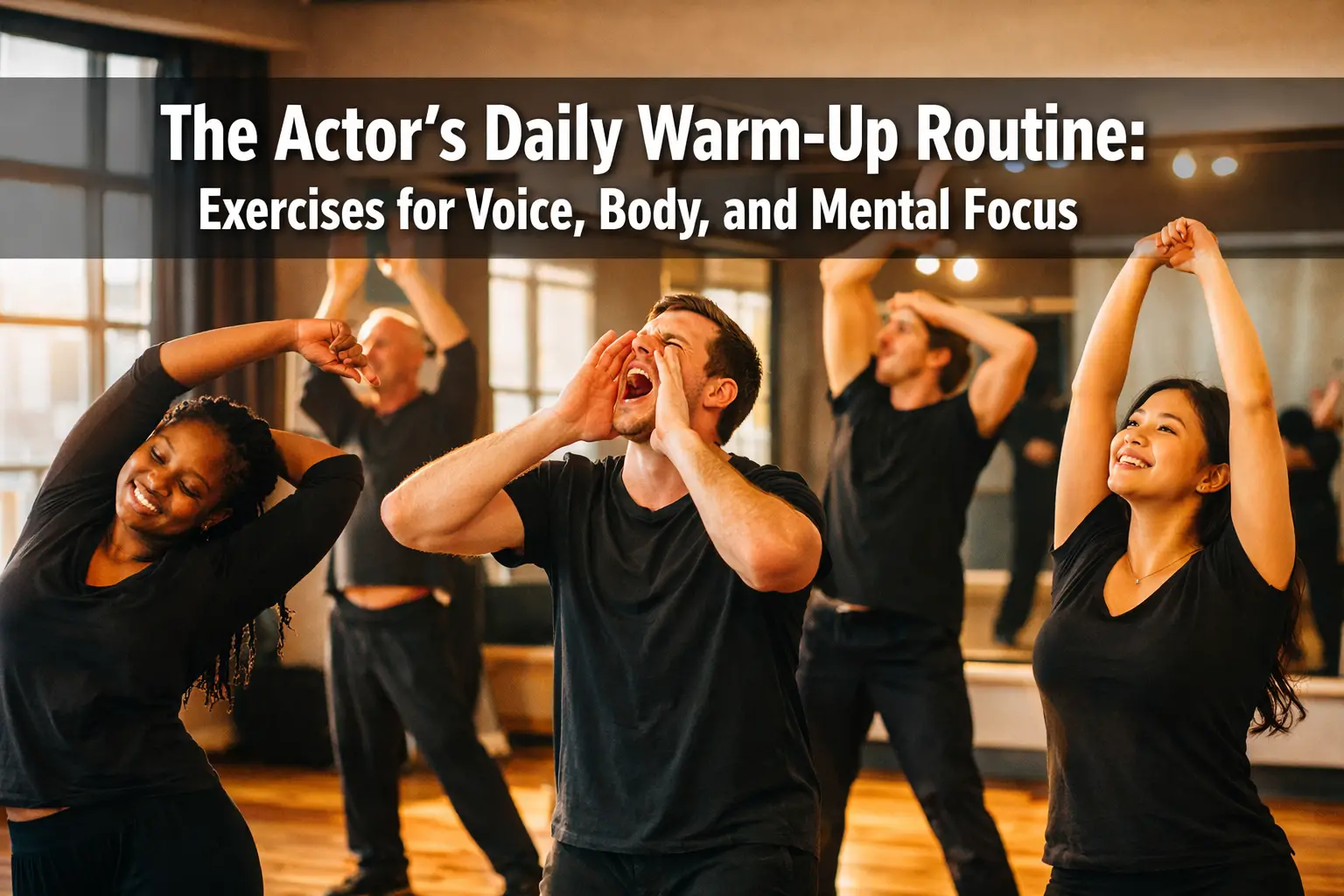
Every performance begins long before the curtain rises or the camera starts rolling. For professional actors, the foundation of compelling performances lies in a comprehensive warm-up routine that prepares the entire instrument—voice, body, and mind. Whether stepping onto a theater stage or arriving on a film set in 2026, actors who commit to The Actor’s Daily Warm-Up Routine: Exercises for Voice, Body, and Mental Focus gain a competitive edge through enhanced physical readiness, vocal clarity, and mental presence.
The acting profession demands extraordinary physical and mental stamina. Unlike athletes who warm up before every game, actors must maintain their instrument daily, treating their bodies and voices as finely-tuned tools that require consistent care. A structured warm-up routine not only prevents injury but also unlocks creative potential, allowing performers to access deeper emotional ranges and physical expressiveness.
Key Takeaways
- Daily 20-minute physical warm-ups including aerobic work, stretching, and mobilization exercises are recommended for maintaining an actor’s physical instrument[1]
- Vocal preparation techniques such as the “Ha!” exercise and diaphragmatic breathing activate the voice safely and expand vocal range[5]
- Mental focus practices including visualization, positive affirmations, and mindfulness create the psychological readiness necessary for authentic performances[4]
- Comprehensive warm-ups address all three components—physical, vocal, and mental—to prepare actors for the demands of rehearsal and performance
- Consistency matters more than duration—establishing a daily routine builds muscle memory and creates reliable pre-performance rituals
Understanding The Actor’s Daily Warm-Up Routine: Exercises for Voice, Body, and Mental Focus
The concept of warming up before performance has evolved significantly in contemporary actor training. Modern approaches recognize that acting engages the whole person—not just memorized lines or blocking patterns. The Actor’s Daily Warm-Up Routine: Exercises for Voice, Body, and Mental Focus represents a holistic approach to preparation that honors the interconnected nature of physical, vocal, and psychological readiness.
Why Actors Need Comprehensive Warm-Ups 🎭
Professional actors face unique physical demands. Stage performers must project their voices to the back row while maintaining authentic emotional expression. Film actors need precise physical control for continuity across multiple takes. Both require mental flexibility to respond truthfully to scene partners and directorial adjustments.
Without proper warm-up, actors risk:
- Vocal strain or injury from pushing unprepared vocal cords
- Physical tension that blocks emotional access and natural movement
- Mental fog that prevents quick thinking and genuine reactions
- Reduced stamina throughout long rehearsal or performance days
- Limited range in both physical and emotional expression
Conversely, actors who commit to daily warm-up work develop kinetic awareness—a heightened sensitivity to their bodies in space that translates directly to more nuanced performances[5].
The Physical Component: Body Warm-Up Exercises
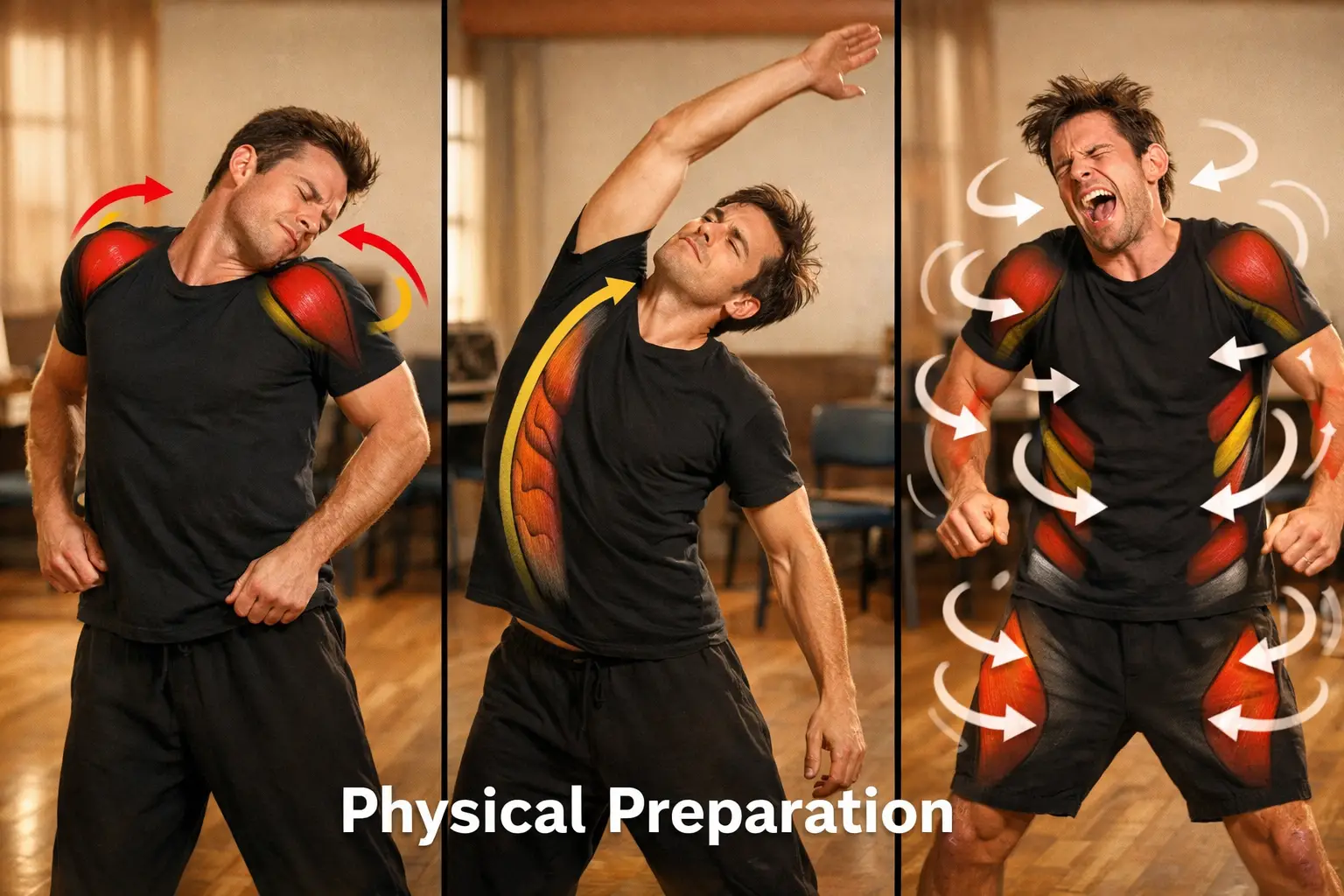
Physical preparation forms the foundation of The Actor’s Daily Warm-Up Routine: Exercises for Voice, Body, and Mental Focus. Experts recommend dedicating at least 20 minutes daily to physical warm-ups that include aerobic work, stretching, and mobilization exercises[1]. These practices improve range of motion, release tension, and create the physical openness necessary for authentic performance.
Essential Stretching Techniques
Stretching provides improved range of motion and kinetic awareness crucial for performance work[5]. The following sequence addresses major muscle groups while promoting body awareness:
Upper Body Stretches:
- Arm Reaches – Extend arms overhead, alternating reaching toward the ceiling with each arm to lengthen the sides of the body[5]
- Shoulder Rolls – Roll shoulders backward in large circles, then forward, releasing tension in the neck and upper back[3]
- Wrist and Ankle Circles – Rotate wrists and ankles in both directions to mobilize joints[5]
Core and Lower Body Work:
- Side Body Stretches – Reach one arm overhead and lean to the opposite side, creating length through the intercostal muscles[3]
- Toe Touches – Fold forward from the hips with bent or straight knees, releasing the spine and hamstrings[5]
- Hip Circles – Make large circles with the hips to mobilize the pelvis and lower back
Dynamic Movement Exercises
Beyond static stretching, actors benefit from dynamic movements that activate the entire body:
| Exercise | Purpose | Duration |
|---|---|---|
| Full-Body Shaking | Releases muscular tension and nervous energy[5] | 2-3 minutes |
| Aerobic Warm-Up | Increases heart rate and blood flow[1] | 5-7 minutes |
| Spinal Rolls | Mobilizes vertebrae and releases back tension | 1-2 minutes |
| Leg Swings | Loosens hip joints and improves balance | 1 minute each leg |
Full-body shaking deserves special attention as a tension-release technique. Starting from the feet and moving upward, actors shake each body part vigorously, allowing muscles to release holding patterns. This exercise proves particularly valuable before emotionally demanding scenes, as physical tension often blocks emotional access[5].
Building Physical Impulses Through Group Work
Group warm-up exercises develop physical impulses and creativity essential for rehearsals and performances[7]. Ensemble exercises like mirror work, group stretches, and physical games create connection between actors while warming up individual instruments. These collaborative warm-ups build trust and establish the ensemble energy crucial for theatrical work.
The Vocal Component: Voice Warm-Up Exercises
Vocal warm-ups are integral to preparing an actor’s instrument[1]. The voice requires careful, systematic preparation to achieve optimal resonance, clarity, and range without strain. The Actor’s Daily Warm-Up Routine: Exercises for Voice, Body, and Mental Focus dedicates significant attention to vocal preparation because the voice serves as the primary tool for communicating text and emotion.
Breath Work Foundations
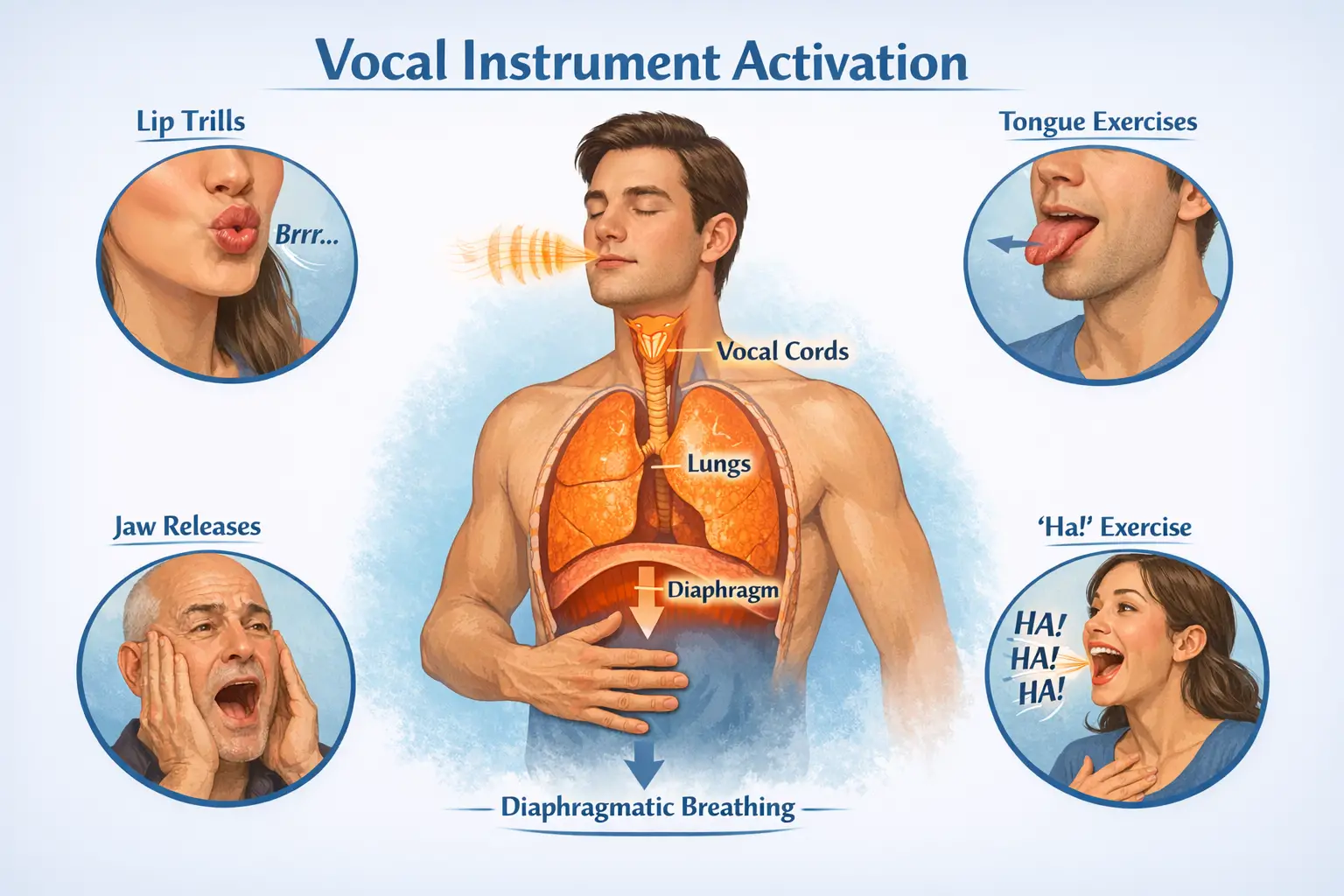
All vocal work begins with breath. Breathing exercises should stretch the abdomen and stomach muscles, creating space for deep, supported breath[5]. Proper breathing technique supports vocal projection while reducing strain on the throat and vocal cords.
Diaphragmatic Breathing Exercise:
- Place one hand on the chest and one on the abdomen
- Inhale deeply through the nose, feeling the abdomen expand while the chest remains relatively still
- Exhale slowly through the mouth, feeling the abdomen contract
- Repeat for 2-3 minutes, establishing a steady rhythm
This foundational exercise trains actors to breathe from the diaphragm rather than shallow chest breathing, which limits vocal power and creates tension.
The “Ha!” Exercise for Diaphragm Activation
The “Ha!” exercise activates the diaphragm through short bursts of exhalation[5]. This powerful technique builds breath support while warming up the vocal mechanism:
How to Practice “Ha!” Breathing:
- Stand with feet hip-width apart, knees slightly bent
- Take a deep breath into the lower abdomen
- Exhale sharply on the sound “Ha!” feeling the abdomen contract quickly
- Repeat in sets of 10-15, maintaining consistent vocal quality
- Gradually increase speed while maintaining support
This exercise should feel energizing rather than straining. If throat tension develops, return to gentle diaphragmatic breathing before continuing.
Resonance and Articulation Exercises
Once breath support is established, actors can safely explore vocal resonance and articulation:
Lip Trills and Tongue Trills:
- Blow air through loosely closed lips, creating a vibrating “brrrr” sound
- Slide pitch up and down while maintaining the trill
- Repeat with tongue trills (rolling R’s)
Jaw Release:
- Gently massage the jaw muscles in circular motions
- Open and close the mouth slowly, releasing tension
- Yawn fully to stretch the soft palate
Tongue Stretches:
- Extend tongue out and down toward chin
- Reach tongue toward nose, then each corner of mouth
- Circle tongue around outside of teeth
Vocal Sirens:
- Make a continuous sound from lowest to highest comfortable pitch
- Slide smoothly through the range like a siren
- Repeat 5-7 times, exploring full vocal range
Text-Based Vocal Warm-Ups
Transitioning from abstract sounds to actual text helps bridge warm-up to performance:
- Tongue Twisters – Practice articulation with classic phrases like “Red leather, yellow leather” or “Unique New York”
- Resonance Phrases – Speak sentences rich in nasal consonants (M, N, NG) to feel vibration in the mask of the face
- Volume Variation – Practice the same phrase at different volumes, maintaining vocal quality throughout
“The voice is the actor’s most vulnerable instrument. Daily vocal warm-ups aren’t just about preventing injury—they’re about building the confidence to use your full vocal range with power and precision.” – Professional voice coach perspective
The Mental Component: Focus and Concentration Techniques
The psychological dimension of The Actor’s Daily Warm-Up Routine: Exercises for Voice, Body, and Mental Focus often receives less attention than physical and vocal preparation, yet mental readiness proves equally crucial for compelling performances. Pre-performance routines that include visualization, positive affirmations, mindfulness, and emotional character connection prepare actors psychologically for the demands ahead[4].
Visualization Practices
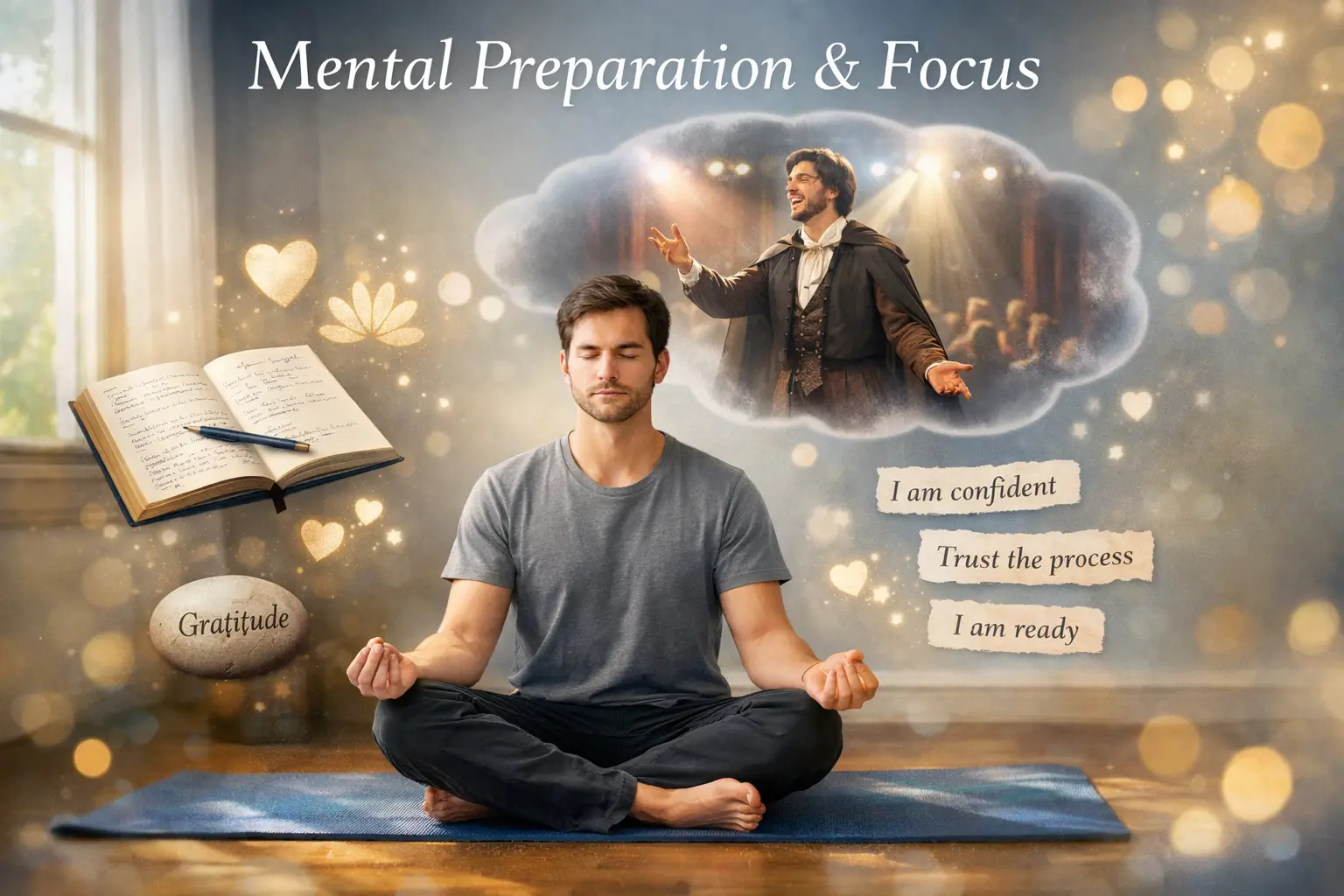
Visualization creates mental rehearsal that primes the brain for actual performance. Athletes have long used visualization to improve performance, and actors benefit from the same neurological preparation:
Character Visualization Exercise:
- Find a quiet space and close your eyes
- Visualize your character in their environment
- See specific details—colors, textures, lighting
- Imagine the character moving through key moments
- Notice emotional responses that arise
- Spend 5-10 minutes in this visualization
This practice creates neural pathways that support authentic performance choices when cameras roll or curtains rise.
Positive Affirmations and Self-Talk
Many actors incorporate positive affirmations into their warm-up routines[4]. These statements counter performance anxiety and build confidence:
Effective Affirmations for Actors:
- “I am prepared and ready to bring this character to life”
- “My training supports me in every moment”
- “I trust my instincts and choices”
- “I am present and connected to my scene partners”
- “My unique perspective enriches this performance”
Speak these affirmations aloud during warm-up, allowing the voice to reinforce the mental message. 💪
Mindfulness and Present-Moment Awareness
Mindfulness practices train actors to stay present rather than getting lost in anxiety about outcomes. Simple mindfulness exercises include:
Five Senses Check-In:
- Notice 5 things you can see
- Notice 4 things you can touch
- Notice 3 things you can hear
- Notice 2 things you can smell
- Notice 1 thing you can taste
This grounding exercise takes only 2-3 minutes but effectively brings attention to the present moment, reducing performance anxiety.
Breath Awareness Meditation:
- Sit comfortably with eyes closed
- Focus attention on the natural breath
- When the mind wanders, gently return focus to breath
- Practice for 5-10 minutes
Gratitude Practices
Some actors incorporate gratitude practices into their pre-performance routines[4]. Taking a moment to acknowledge gratitude for the opportunity to perform, for collaborators, or for the craft itself shifts mindset from anxiety to appreciation.
Gratitude Journal Prompt: Before performances, write three things related to the work:
- Something about the character or story you’re grateful to explore
- A collaborator whose contribution enriches the work
- An aspect of your own growth as an artist
This practice takes only 3-5 minutes but significantly shifts emotional state toward openness and generosity—qualities that serve performance well.
Emotional Character Connection
Connecting emotionally to character during warm-up creates a bridge between the actor’s personal experience and the character’s circumstances[4]. This might involve:
- Music playlists that evoke the character’s emotional world
- Physical gestures associated with the character
- Key phrases from the script spoken with different intentions
- Memory work connecting personal experiences to character circumstances
Creating Your Personal Pre-Performance Protocol
While The Actor’s Daily Warm-Up Routine: Exercises for Voice, Body, and Mental Focus provides a comprehensive framework, each actor must customize their warm-up to address individual needs, time constraints, and specific performance demands.
The 20-Minute Essential Warm-Up
For actors with limited time, this condensed routine addresses all three components:
Minutes 1-7: Physical Warm-Up
- 2 minutes: Full-body shaking and gentle aerobic movement
- 3 minutes: Essential stretches (shoulder rolls, side stretches, spinal rolls)
- 2 minutes: Dynamic movement (leg swings, arm circles)
Minutes 8-14: Vocal Warm-Up
- 2 minutes: Diaphragmatic breathing
- 2 minutes: “Ha!” exercise
- 2 minutes: Lip trills and sirens
- 1 minute: Tongue twisters
Minutes 15-20: Mental Focus
- 3 minutes: Visualization or character connection
- 2 minutes: Positive affirmations
- 1 minute: Five senses grounding exercise
The Comprehensive 45-Minute Routine
When time allows, a more thorough warm-up provides deeper preparation:
| Time Block | Component | Specific Exercises |
|---|---|---|
| 0-5 min | Centering | Breath awareness, intention setting |
| 5-15 min | Physical | Full stretching sequence, aerobic work |
| 15-25 min | Vocal | Complete breath work, resonance, articulation |
| 25-35 min | Integration | Text work, character physicality |
| 35-45 min | Mental | Visualization, affirmations, emotional preparation |
Adapting for Different Performance Contexts
Theater Performance Warm-Up:
- Emphasize vocal projection and stamina
- Include full physical warm-up for stage movement
- Practice in the performance space when possible
- Coordinate with ensemble for group warm-up
Film/TV Set Warm-Up:
- Focus on subtle physical control for camera work
- Vocal warm-up for natural speech patterns
- Mental preparation for multiple takes and continuity
- Quick reset exercises between takes
Audition Warm-Up:
- Abbreviated physical warm-up in limited space
- Quiet vocal exercises appropriate for waiting rooms
- Strong mental focus on confidence and presence
- Character connection work specific to audition material
Common Warm-Up Mistakes to Avoid ⚠️
Even experienced actors sometimes develop warm-up habits that undermine rather than support their work:
Physical Mistakes:
- Bouncing during stretches – This triggers the stretch reflex and can cause injury
- Rushing through exercises – Quality matters more than speed
- Skipping warm-up on “easy” days – Consistency builds the instrument
Vocal Mistakes:
- Starting with high-intensity exercises – Always begin gently and build
- Pushing for volume or range – Warm-up should never strain
- Neglecting breath work – All vocal work depends on proper breathing
Mental Mistakes:
- Treating warm-up as a checklist – Engage mindfully with each exercise
- Focusing on outcomes – Warm-up is about process, not results
- Comparing to others – Each actor’s instrument is unique
Advanced Warm-Up Techniques for Experienced Actors
As actors develop in their craft, they can incorporate more sophisticated warm-up practices:
Laban Movement Analysis
Laban’s movement framework explores effort qualities (weight, time, space, flow) that inform character physicality. Advanced actors might warm up by exploring these qualities:
- Weight: Practice movements that are light vs. strong
- Time: Explore sudden vs. sustained actions
- Space: Move with direct vs. indirect pathways
- Flow: Experience bound vs. free movement
Alexander Technique Principles
The Alexander Technique addresses habitual tension patterns. Incorporating Alexander principles into warm-up:
- Notice habitual holding patterns without judgment
- Practice “constructive rest” position for spinal release
- Explore “inhibition”—pausing before automatic responses
- Apply “direction”—thinking about lengthening and widening
Viewpoints Training
Viewpoints, developed by Mary Overlie and Anne Bogart, provides a vocabulary for movement improvisation. Warm-up using Viewpoints explores:
- Spatial Relationship: Distance between bodies
- Kinesthetic Response: Impulse-based movement
- Shape: Body forms in space
- Gesture: Behavioral and expressive movements
- Repetition: Repeating movements or sounds
- Tempo: Speed of actions
Building Sustainable Daily Practice
The most effective warm-up routine is one that actors actually maintain. Building sustainable practice requires:
Starting Small and Building Gradually
Rather than attempting a comprehensive 45-minute routine immediately, begin with:
- Week 1: 10 minutes daily focusing on one component
- Week 2: 15 minutes adding a second component
- Week 3: 20 minutes incorporating all three components
- Week 4+: Gradually extend as the habit solidifies
Creating Environmental Cues
Support consistent practice by:
- Designating a warm-up space in your home
- Setting a specific time each day
- Laying out comfortable clothing the night before
- Using a playlist that signals warm-up time
Tracking Progress
Maintain a simple warm-up journal noting:
- Which exercises were practiced
- Physical or vocal discoveries
- Mental/emotional state before and after
- Any areas needing additional attention
Finding Accountability
Support consistency through:
- Warm-up partners who practice together virtually or in person
- Social media check-ins sharing commitment to daily practice
- Teacher or coach who provides guidance and accountability
The Long-Term Benefits of Consistent Warm-Up Practice
Actors who commit to The Actor’s Daily Warm-Up Routine: Exercises for Voice, Body, and Mental Focus over months and years experience profound benefits:
Physical Benefits:
- Increased flexibility and range of motion
- Reduced injury risk
- Greater stamina for long performance days
- Enhanced body awareness and control
Vocal Benefits:
- Expanded vocal range
- Improved resonance and clarity
- Reduced vocal fatigue
- Greater vocal confidence
Mental Benefits:
- Enhanced focus and concentration
- Reduced performance anxiety
- Stronger character connection
- Improved creative access
Professional Benefits:
- Reputation for professionalism and preparation
- Ability to work at higher levels consistently
- Faster warm-up when time is limited
- Resilience during demanding production schedules
“Warm-up isn’t just preparation for performance—it’s the daily practice that builds the instrument itself. What you do every day determines what you’re capable of when it matters most.”
Conclusion: Committing to Excellence Through Daily Practice
The Actor’s Daily Warm-Up Routine: Exercises for Voice, Body, and Mental Focus represents more than a pre-performance checklist—it embodies a professional commitment to craft excellence. In 2026’s competitive entertainment landscape, actors who treat their instruments with the same care that musicians give their violins or athletes give their bodies gain significant advantages in auditions, rehearsals, and performances.
The comprehensive approach outlined here—addressing physical preparation through stretching and movement, vocal readiness through breath work and resonance exercises, and mental focus through visualization and mindfulness—creates the foundation for authentic, powerful performances. Whether dedicating 20 minutes or 45 minutes daily, consistency matters more than duration.
Your Next Steps 🎯
This Week:
- Choose three exercises from each category (physical, vocal, mental)
- Practice this abbreviated routine for 15 minutes daily
- Notice which exercises feel most beneficial for your instrument
This Month:
- Expand to a full 20-minute routine incorporating all components
- Experiment with timing—find whether morning or pre-performance works best
- Journal about discoveries and adjustments needed
This Year:
- Develop your personalized warm-up protocol based on your unique needs
- Explore advanced techniques like Laban, Alexander, or Viewpoints
- Share your warm-up practice with other actors, building community around excellence
The actor’s instrument—body, voice, and mind—requires daily attention to reach its full potential. By committing to comprehensive warm-up practice, actors invest in their craft, their careers, and their capacity to move audiences. The work done in daily warm-up sessions creates the freedom and flexibility that allows for spontaneous, truthful performances when the curtain rises or the camera rolls.
Start today. Your future performances will thank you.
References
[1] Work That Actors Should Be Doing Every Day – https://www.stagemilk.com/work-that-actors-should-be-doing-every-day/
[2] Watch – https://www.youtube.com/watch?v=0E9-UHcwgVA
[3] The Best Physical And Vocal Warm Ups For Actors – https://castingfrontier.com/blog/the-best-physical-and-vocal-warm-ups-for-actors/
[4] Whats Your Warm Up Routine Before You Go On Set – https://www.castingnetworks.com/news/whats-your-warm-up-routine-before-you-go-on-set/
[5] Vocal Physical Actor Warmup Guide 74817 – https://www.backstage.com/magazine/article/vocal-physical-actor-warmup-guide-74817/
[6] How To Warm Up As An Actor – https://www.lauramacmethod.com/blog/how-to-warm-up-as-an-actor
[7] Watch – https://www.youtube.com/watch?v=zpmbFqEoCWc
[8] 7 Acting Warmups Games And Techniques For Actors – https://www.masterclass.com/articles/7-acting-warmups-games-and-techniques-for-actors