


Standing under the bright stage lights for the first time, many beginner actors face a common challenge: how to deliver a performance that feels genuine rather than forced. The difference between wooden, self-conscious acting and a captivating, believable performance often comes down to mastering a few fundamental techniques. In 2026, theater training continues to evolve, yet the core principles of realistic acting remain rooted in time-tested methods that beginners can start applying immediately. Acting Realistically on stage: 5 Techniques Beginners Can Master Right Away provides a practical roadmap for developing authentic stage presence through focused listening, clear point-of-view work, and confident personalization strategies.
The journey toward realistic acting doesn’t require years of training before seeing results. By understanding and practicing specific techniques designed for the theatrical environment, newcomers can transform their performances from the very first rehearsal. These methods focus on creating truthful moments under imaginary circumstances while maintaining the energy and projection necessary for live theater.
Key Takeaways
- Active listening forms the foundation of realistic acting, requiring actors to genuinely respond to scene partners rather than waiting for cues to deliver memorized lines
- Point-of-view techniques help actors embody their character’s unique perspective by developing detailed backstories, objectives, and substitution exercises drawn from personal experience
- Balanced emotional expression combines authentic feeling with theatrical awareness, avoiding both under-emoting and over-dramatization through grounded preparation
- Physical awareness through techniques like the Alexander Method creates natural movement patterns and reduces tension that blocks genuine performance
- Script annotation and actioning transforms dialogue into active choices by assigning specific verbs and intentions to every line, revealing subtext and motivation
Understanding Realistic Acting in the Theater Context 🎭
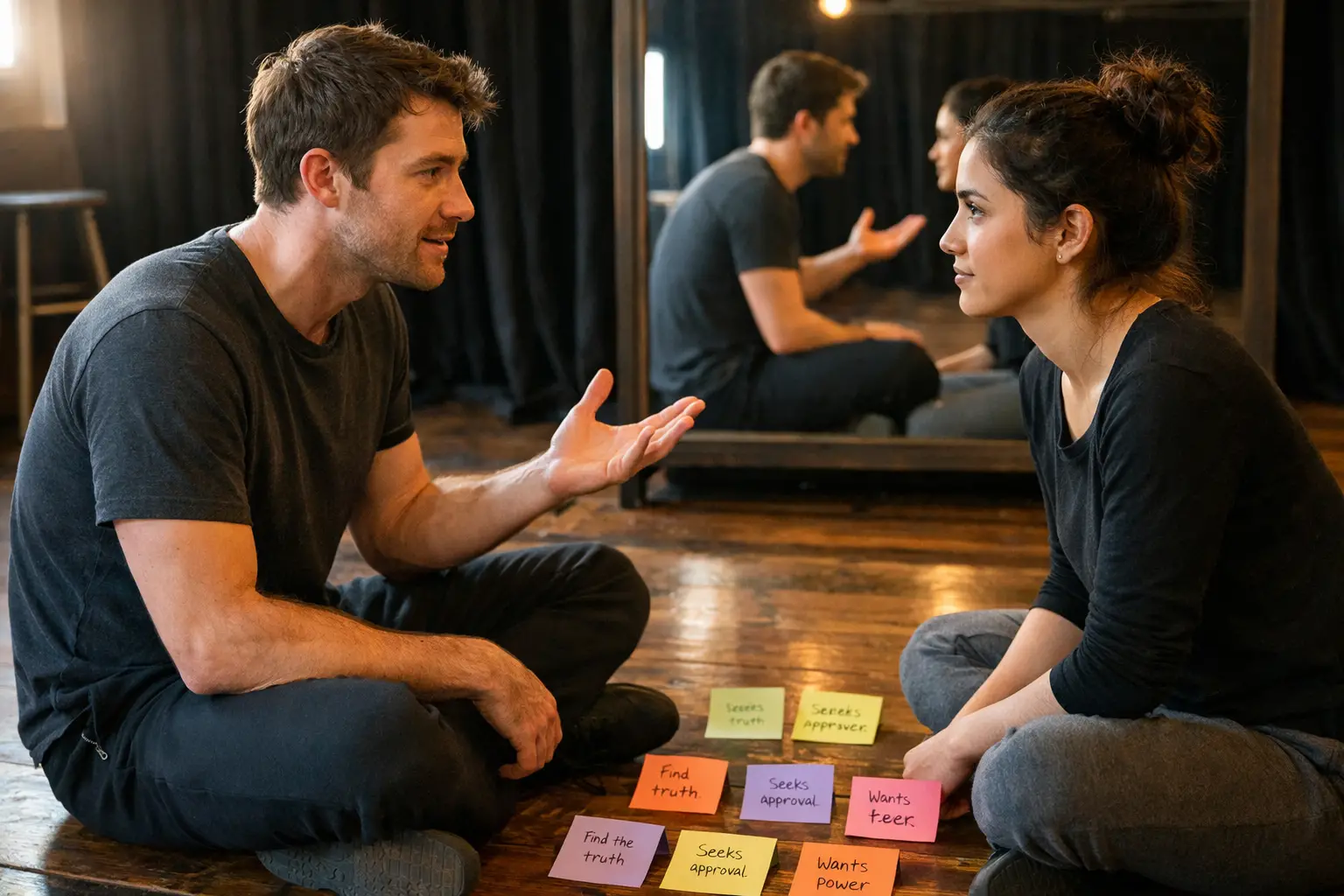
Realistic acting on stage presents unique challenges compared to film or television work. Theater actors must project their voices, use larger physical gestures to reach audience members in the back row, and sustain performances without the safety net of multiple takes. Yet despite these technical demands, the most compelling stage performances still feel intimate and truthful.
The foundation of realistic acting lies in what renowned teacher Sanford Meisner called “living truthfully under imaginary circumstances.”[2] This principle acknowledges that while the situation is fictional, the actor’s emotional responses and moment-to-moment reactions should be genuine. Rather than indicating emotions or presenting a predetermined performance, actors learn to respond authentically to what’s happening in the scene.
Modern approaches in 2026 integrate classical training methods with contemporary understanding of psychology, mindfulness, and embodied performance practices. The goal remains consistent: creating characters that audiences recognize as fully human, with all the complexity, contradiction, and spontaneity that real people possess.
The Evolution of Realistic Performance Techniques
Theater has moved through various performance styles throughout history, from the heightened delivery of classical theater to the naturalistic revolution of the late 19th century. Today’s actors benefit from a rich toolkit of techniques developed by master teachers including Stanislavski, Meisner, Hagen, and others. These methods share common ground in their emphasis on truthful behavior, active objectives, and genuine connection between performers.[2]
Technique #1: Active Listening and Genuine Response
The single most important skill for Acting Realistically on Stage: 5 Techniques Beginners Can Master Right Away is active listening. Many beginning actors focus so intently on remembering their lines and blocking that they forget to actually hear what their scene partners are saying. This creates a disconnected, mechanical quality that audiences immediately recognize as inauthentic.
The Meisner Repetition Exercise
The Meisner Technique provides one of the most effective tools for developing active listening skills through repetition exercises.[2] In this foundational drill, two actors face each other and repeat simple observations back and forth, allowing the repetition to evolve organically based on genuine impulses and emotional shifts.
How to practice:
- Partner with another actor and sit facing each other
- Make a simple observation about your partner (e.g., “You’re wearing a blue shirt”)
- Have your partner repeat your exact words back to you
- Continue the repetition, allowing the emphasis, tone, and emotional quality to shift naturally based on what you observe in each other
- Don’t plan ahead—respond only to what you genuinely notice in the moment
This exercise trains actors to stay present and responsive rather than living in their heads. Over time, this presence transfers directly to scene work, creating performances where actors truly affect each other rather than simply taking turns speaking.
Listening Beyond Words
Realistic listening involves more than hearing dialogue. Actors must observe:
- Facial expressions and micro-expressions
- Body language and physical tension
- Vocal tone, pitch, and rhythm changes
- Energy shifts in the scene partner
- Subtext—what remains unspoken beneath the words
“The foundation of acting is the reality of doing.” — Sanford Meisner
By training attention on these elements, actors develop the ability to respond to the full communication happening in a scene, not just the scripted words.
Theater-Specific Listening Drills
For stage work specifically, try these exercises:
| Exercise | Purpose | Duration |
|---|---|---|
| Mirroring | Match partner’s movements with slight delay to develop observation skills | 5-10 minutes |
| Emotional Repetition | Repeat partner’s lines while matching their emotional state | 10-15 minutes |
| Blocking with Listening | Practice scene blocking while maintaining genuine eye contact and response | 15-20 minutes |
| Distance Listening | Practice active listening from across the stage to maintain connection in larger spaces | 10 minutes |
These drills help actors maintain authentic connection even when separated by stage distance or during movement sequences.
Technique #2: Developing Clear Point-of-View Through Character Work
Acting Realistically on Stage: 5 Techniques Beginners Can Master Right Away requires actors to see the world through their character’s eyes rather than their own. This shift in perspective—developing a clear point-of-view—transforms generic line delivery into specific, motivated behavior.
Creating Comprehensive Character Biographies
Detailed character development allows actors to flesh out their character’s backstory, daily routines, and inner monologue.[1] This preparation work happens during script study, before rehearsals even begin.
Essential elements of a character biography:
- ✅ Family background and formative relationships
- ✅ Education and work history
- ✅ Significant life events that shaped worldview
- ✅ Daily routines and habits
- ✅ Likes, dislikes, fears, and desires
- ✅ Relationships with other characters in the play
- ✅ What the character wants (overall objective)
- ✅ What prevents them from getting it (obstacles)
Writing this biography in first person, as the character, helps actors internalize the perspective. Even details that never appear in the script inform how the character moves, speaks, and reacts to circumstances.
The Substitution Technique
Uta Hagen’s technique grounds performance in realism through substitution—replacing script elements with personal experiences.[2] When a character experiences an emotion or situation the actor hasn’t personally encountered, substitution allows them to draw on parallel experiences that evoke similar feelings.
Practical substitution process:
- Identify the character’s emotional state in a particular moment
- Search your own memory for a time you felt something similar
- Recall specific sensory details from that personal experience
- Allow those memories to inform your emotional preparation
- Let the emotion emerge naturally rather than forcing or indicating it
For example, if a character mourns the loss of a parent but the actor hasn’t experienced that loss, they might substitute the grief they felt when a beloved pet died or when a significant relationship ended. The specific circumstances differ, but the emotional truth remains authentic.
Script Annotation for Point-of-View
Script annotation involves writing notes about character thoughts, emotions, pauses, intonation, and facial expressions throughout the text.[1] This detailed analysis reveals the character’s perspective at every moment.
Annotation categories:
- 📝 Thoughts: What is the character thinking but not saying?
- 💭 Emotions: What is the character feeling?
- ⏸️ Pauses: Where does the character hesitate or search for words?
- 🎵 Intonation: How should specific words be emphasized?
- 😊 Physical expression: What does the character’s face and body do?
- 🎯 Actioning: What active verb drives this line?
Actioning deserves special attention. This technique involves assigning active verbs to dialogue lines to reveal subtext and motivation.[1] Instead of simply saying a line, the actor identifies what they’re trying to do with that line.
Example actioning:
- “I love you” could be: to reassure, to plead, to manipulate, to comfort, or to convince
- “Where were you?” could be: to interrogate, to worry, to accuse, to understand, or to trap
Each choice creates a different performance, all potentially valid depending on the character’s point-of-view and objectives in that moment.
Technique #3: Balanced Emotional Expression
One of the trickiest aspects of Acting Realistically on Stage: 5 Techniques Beginners Can Master Right Away involves finding the sweet spot between authentic emotion and theatrical effectiveness. Beginning actors often struggle with either under-emoting (remaining too internal and unexpressive) or over-emoting (pushing feelings to melodramatic extremes).
Accessing Genuine Emotion Through Emotional Memory
Stanislavski’s System uses emotional memory by drawing on past experiences to evoke genuine feelings aligned with the character’s emotional state.[2] This technique, combined with clear objectives and actions, creates performances grounded in real human experience.
Emotional memory process:
- Identify the required emotion for the scene
- Recall a specific moment from your life when you felt that emotion intensely
- Reconstruct the sensory details: What did you see, hear, smell, taste, touch?
- Allow the feeling to resurface without forcing it
- Channel that authentic emotion into the character’s circumstances
The key distinction: actors don’t try to recreate the original situation but rather access the genuine feeling it produced. That emotional truth then expresses itself through the character’s words and actions.
Avoiding Over-Emoting While Staying Connected
Theater requires projection and clarity, but realistic acting maintains authenticity even when performing for large audiences. When struggling to connect emotionally, actors should identify moments from their own life that mirror the character’s emotional experience.[1]
Signs of over-emoting:
- ❌ Pushing volume beyond what the emotion would naturally produce
- ❌ Exaggerating facial expressions beyond human behavior
- ❌ Adding unnecessary physical gestures for emphasis
- ❌ Indicating emotions rather than experiencing them
- ❌ Playing the emotion rather than the objective
Strategies for balanced expression:
- ✅ Trust the text: Let the words carry meaning without adding artificial emphasis
- ✅ Focus on objectives: Play what the character wants, not how they feel
- ✅ Allow vulnerability: Real emotion often appears quieter than expected
- ✅ Use physical grounding: Stay connected to your body and breath
- ✅ Remember the relationship: React to your scene partner, not the audience
The 2026 Approach to Emotional Preparation
Modern training in 2026 incorporates mindfulness and somatic practices into emotional preparation. Actors learn to recognize where emotions live in the body and how to access them through physical awareness rather than purely mental techniques.
Pre-scene emotional preparation checklist:
- 🧘 Center yourself through breath work
- 💭 Review character objectives for the scene
- 🎭 Recall substitution experiences if needed
- 🤝 Connect with scene partners through eye contact
- 🎯 Identify the first action you’ll take
- 🌊 Release expectations and stay open to discovery
This preparation creates readiness without predetermining the performance, allowing genuine moments to emerge organically.
Technique #4: Physical Awareness and Natural Movement

Realistic acting requires the body to move naturally and expressively without drawing attention to itself. Many beginning actors carry physical tension that blocks authentic expression or develop artificial movement patterns that feel staged rather than real.
The Alexander Technique for Actors
The Alexander Technique develops physical awareness, body alignment, and mind-body connection to support more relaxed and natural performances by recognizing and correcting habitual tension patterns.[2] This method proves particularly valuable for stage actors who must maintain physical presence for extended performances.
Core principles of Alexander Technique:
- Inhibition: Pausing before action to prevent habitual tension
- Direction: Mentally guiding the body toward optimal alignment
- Primary control: Recognizing the relationship between head, neck, and spine
- End-gaining vs. means-whereby: Focusing on process rather than forcing results
Practical exercises for physical awareness:
- Body scan: Lie on the floor and systematically notice tension in each body part
- Constructive rest: Lie with knees bent, feet flat, allowing spine to lengthen
- Chair work: Practice sitting and standing with minimal effort and maximum ease
- Walking meditation: Move across the stage while maintaining awareness of alignment
- Gesture exploration: Experiment with character movements from a place of physical freedom
Translating Character to Physical Expression
Every character moves differently based on their age, health, profession, emotional state, and personality. Developing specific physical choices helps actors embody their character completely.
Physical character development questions:
- How does this character’s posture reflect their psychology?
- What is their natural tempo of movement?
- Where do they carry tension in their body?
- How do they gesture when speaking?
- What is their relationship to space—do they expand or contract?
- How does their occupation affect their physicality?
- What physical habits reveal character traits?
Theater-Specific Physical Considerations
Stage acting requires additional physical awareness beyond naturalistic movement:
| Challenge | Solution |
|---|---|
| Projecting to back row | Ground movement in strong core support while maintaining natural quality |
| Cheating out | Angle body toward audience while keeping focus on scene partner |
| Stage combat | Commit fully to realistic intention while executing safe choreography |
| Period movement | Research and embody historical physicality until it feels natural |
| Quick changes | Develop efficient movement patterns that maintain character even offstage |
The goal remains making technical adjustments invisible to the audience while maintaining authentic behavior.
Technique #5: Confident Personalization and Ownership
The final technique in Acting Realistically on Stage: 5 Techniques Beginners Can Master Right Away involves making bold, specific choices and committing to them fully. Tentative, apologetic acting never appears realistic because real people act with conviction, even when uncertain.
Making Strong Choices
Realistic acting paradoxically requires actors to make definite choices about indefinite situations. Rather than playing vague or general emotions, effective actors select specific tactics and commit to them completely.
The choice-making process:
- Analyze the scene for multiple possible interpretations
- Select one specific choice based on character analysis
- Commit fully to that choice in rehearsal
- Observe the results and adjust if needed
- Trust your instincts while remaining open to direction
Directors can always ask actors to adjust or modify choices, but they can’t create specificity from vague, uncommitted performances. Bold choices provide material to work with.
Personalizing the Text
Making the playwright’s words feel like the character’s own thoughts requires personalization—finding the connection between the scripted dialogue and authentic human expression. This doesn’t mean changing the text but rather discovering why these specific words emerge at this specific moment.
Personalization techniques:
- 🗣️ Paraphrase in your own words during rehearsal before returning to the script
- 🎯 Identify what each line accomplishes for the character’s objective
- 💭 Explore the thought before the line—what prompts the character to speak?
- 🔄 Experiment with different deliveries to find what feels most authentic
- 📖 Research unfamiliar references in the text to understand them fully
Building Confidence Through Preparation
Confidence in performance comes from thorough preparation combined with willingness to take risks. Actors who feel secure in their character work, script knowledge, and technical skills can relax into authentic moments rather than monitoring their performance anxiously.
Confidence-building strategies for 2026:
- ✨ Memorize thoroughly so lines become automatic
- 📚 Research extensively to understand context and references
- 🤝 Build ensemble trust through rehearsal and connection exercises
- 🎬 Record and review rehearsals to identify strengths and growth areas
- 🎭 Perform regularly to develop comfort with the performance state
- 🧠 Develop pre-show rituals that center and prepare you mentally
Embracing Failure as Part of the Process
Realistic acting requires vulnerability and risk-taking, which inevitably means some choices won’t work. The most confident actors view these moments as valuable information rather than personal failures.
“There are no mistakes in theater, only opportunities for discovery.”
Developing a growth mindset:
- Treat each rehearsal as experimentation rather than evaluation
- Celebrate bold failures over safe, boring choices
- Ask for feedback actively and receive it without defensiveness
- Observe other actors with curiosity rather than comparison
- Trust the process of development over time
This confident, personalized approach allows actors to take full ownership of their performances while remaining collaborative and open to the creative process.
Integrating All Five Techniques for Realistic Performance
While each technique provides value individually, Acting Realistically on Stage: 5 Techniques Beginners Can Master Right Away becomes most powerful when integrated into a comprehensive approach. Realistic acting emerges from the intersection of genuine listening, clear perspective, balanced emotion, natural physicality, and confident choices.
The Rehearsal Process
Week 1-2: Table work and analysis
- Develop character biographies and point-of-view
- Annotate scripts with thoughts, emotions, and actions
- Research context and references
- Begin memorization
Week 3-4: Exploration and blocking
- Practice active listening exercises with scene partners
- Experiment with physical choices and movement
- Block scenes while maintaining genuine connection
- Try multiple interpretations before committing to choices
Week 5-6: Refinement and integration
- Polish emotional preparation techniques
- Refine physical awareness and natural movement
- Strengthen confidence through repetition
- Integrate technical elements (lights, sound, costumes)
Week 7-8: Performance preparation
- Run full performances maintaining realistic behavior
- Adjust for audience energy while staying truthful
- Trust preparation and remain present
- Celebrate growth and learning
Common Pitfalls and Solutions
| Pitfall | Solution |
|---|---|
| Getting in your head | Return to active listening and focus on scene partner |
| Losing emotional connection | Use substitution or emotional memory techniques |
| Physical tension | Practice Alexander Technique awareness exercises |
| Playing results | Focus on objectives and actions rather than emotions |
| Inconsistent performance | Strengthen preparation and develop reliable rituals |
| Self-consciousness | Commit fully to character perspective and choices |
Continuing Development Beyond Beginner Level
These five techniques provide a foundation that actors continue refining throughout their careers. As skills develop, the techniques become more sophisticated and integrated:
- Advanced listening includes ensemble awareness and playing status dynamics
- Deeper character work explores psychological complexity and transformation
- Nuanced emotional expression balances subtlety with theatrical clarity
- Sophisticated physicality incorporates style, period, and heightened movement
- Artistic confidence allows for bold experimentation and creative risk-taking
The journey toward mastery involves consistent practice, ongoing training, and regular performance opportunities that challenge and expand capabilities.[4][6]
Practical Exercises to Start Today
Beginners can begin developing these skills immediately through focused practice:
Daily Practice Routine (30 minutes)
10 minutes: Physical awareness
- Body scan and tension release
- Alexander Technique constructive rest
- Character movement exploration
10 minutes: Emotional preparation
- Recall and journal about emotional memories
- Practice substitution exercises
- Explore emotional range through improvisation
10 minutes: Text work
- Annotate script with actions and objectives
- Practice lines with different intentions
- Record and review delivery choices
Partner Exercises (60 minutes)
20 minutes: Listening drills
- Meisner repetition exercise
- Emotional mirroring
- Distance connection work
20 minutes: Scene work
- Apply actioning to dialogue
- Experiment with blocking while maintaining connection
- Explore different character choices
20 minutes: Feedback and reflection
- Share observations about each other’s work
- Identify moments of authentic connection
- Set goals for next practice session
Performance Opportunities in 2026
Seeking regular performance experience accelerates development. Consider:
- 🎭 Community theater productions
- 📚 Scene study classes at local studios
- 🎬 Student films requiring theatrical training
- 🎪 Improv groups building spontaneity and listening skills
- 📖 Staged readings focusing on text interpretation
- 🎓 Workshop productions in educational settings
Each performance provides opportunities to apply these techniques in front of audiences, building confidence and discovering what works.[8]
Resources for Continued Learning

Books:
- “Sanford Meisner on Acting” by Sanford Meisner and Dennis Longwell
- “Respect for Acting” by Uta Hagen
- “An Actor Prepares” by Constantin Stanislavski
- “The Actor and the Target” by Declan Donnellan
Classes and Training:
- Local theater companies offering acting workshops
- University extension programs in theater
- Online courses in specific techniques
- Private coaching for personalized development
Practice Communities:
- Scene study groups meeting regularly
- Theater companies with training programs
- Online forums for actors sharing techniques
- Peer accountability partnerships
Consistent engagement with training, practice, and performance creates steady improvement in realistic acting skills throughout 2026 and beyond.[4][6]
Conclusion: Your Path to Realistic Stage Performance
Acting Realistically on Stage: 5 Techniques Beginners Can Master Right Away provides a practical framework for developing authentic performances that connect with audiences. By focusing on active listening, clear point-of-view, balanced emotional expression, natural physicality, and confident personalization, beginning actors can transform their work immediately.
The journey toward realistic acting is ongoing, with each performance offering new opportunities for discovery and growth. These techniques don’t require years of training before application—they can be practiced starting today, in rehearsal rooms, classrooms, and on stages around the world.
Action steps to begin now:
- ✅ Choose one technique to focus on this week
- ✅ Find a practice partner or scene study group
- ✅ Commit to daily practice even if only 15-30 minutes
- ✅ Seek performance opportunities to apply skills
- ✅ Record and review your work regularly
- ✅ Stay curious and open to continued learning
- ✅ Celebrate progress while embracing ongoing development
Remember that realistic acting emerges from genuine human behavior observed carefully and reproduced truthfully. The most compelling performances come from actors who remain present, connected, and committed to authentic expression under imaginary circumstances.
As theater continues evolving in 2026, the fundamental principles of truthful performance remain constant. By mastering these five techniques, beginning actors build a solid foundation for a lifetime of growth, discovery, and powerful stage work that moves audiences through its honesty and humanity.
The stage awaits. Trust your preparation, connect with your scene partners, commit to your choices, and allow realistic performance to emerge naturally from dedicated practice and genuine presence. Your journey as an actor begins with these first steps toward authenticity, and every rehearsal brings new opportunities to deepen your craft and share truthful stories that resonate with audiences everywhere. 🎭
References
[1] How To Act Realistically 75551 – https://www.backstage.com/magazine/article/how-to-act-realistically-75551/
[2] Top 10 Acting Techniques – https://emasla.com/blogs/main/top-10-acting-techniques
[4] 10 Things Actors Can Do To Start 2026 On The Right Foot – https://www.actorsconnection.com/2026/01/10-things-actors-can-do-to-start-2026-on-the-right-foot/
[6] The Actors Complete Checklist 6 Essential Steps Actors Must Take For 2026 – https://www.howtoactandmodel.com/the-actors-complete-checklist-6-essential-steps-actors-must-take-for-2026/
[8] What Is Stage Acting Understanding The Basics – https://www.italiaconti.com/what-is-stage-acting-understanding-the-basics