



Here’s something I learned the hard way after three decades in this business: talent alone doesn’t pay the bills. I’ve watched incredibly gifted voice actors struggle financially while less naturally talented performers built thriving six-figure businesses. The difference? They understood that voice acting isn’t just an art—it’s a business that demands the same strategic planning, financial discipline, and entrepreneurial mindset as any successful enterprise.
Building Your Voice Actor Business Plan for 2026: Financial Projections, Tax Planning, and Sustainable Income Streams isn’t about crushing your creative spirit with spreadsheets and tax codes. Think of it as building the foundation that allows your artistry to flourish without the constant anxiety of where next month’s rent is coming from. The voice-over market reached $4.4 billion in 2024 with a projected annual growth rate of 9%[4], which means opportunity is knocking louder than ever. But here’s the catch: 75% of U.S. voice actors report making less than $40,000 annually[2]. The market is growing, yet most performers aren’t capturing their fair share.
Why? Because they’re treating a business like a hobby.
Key Takeaways
- Diversify revenue streams across commercials, audiobooks, corporate work, and brand partnerships to create financial stability and maximize 2026 earnings potential in a $4.4 billion growing market
- Establish proper business infrastructure including dedicated business checking accounts, appropriate legal structure (LLC vs. sole proprietor), and comprehensive tax planning to protect income and reduce liability
- Develop a strategic marketing plan with daily outreach goals to bridge the gap where 75% of voice actors market less than three times daily, missing significant opportunities
- Understand that AI is creating opportunities, not just threats, with 79% of business leaders preferring AI voices sourced from real voice actors, opening new revenue channels
- Plan for the full financial picture including health insurance, retirement savings, equipment investments, and emergency funds to build sustainable long-term success
Understanding the 2026 Voice Acting Landscape: Market Realities and Opportunities
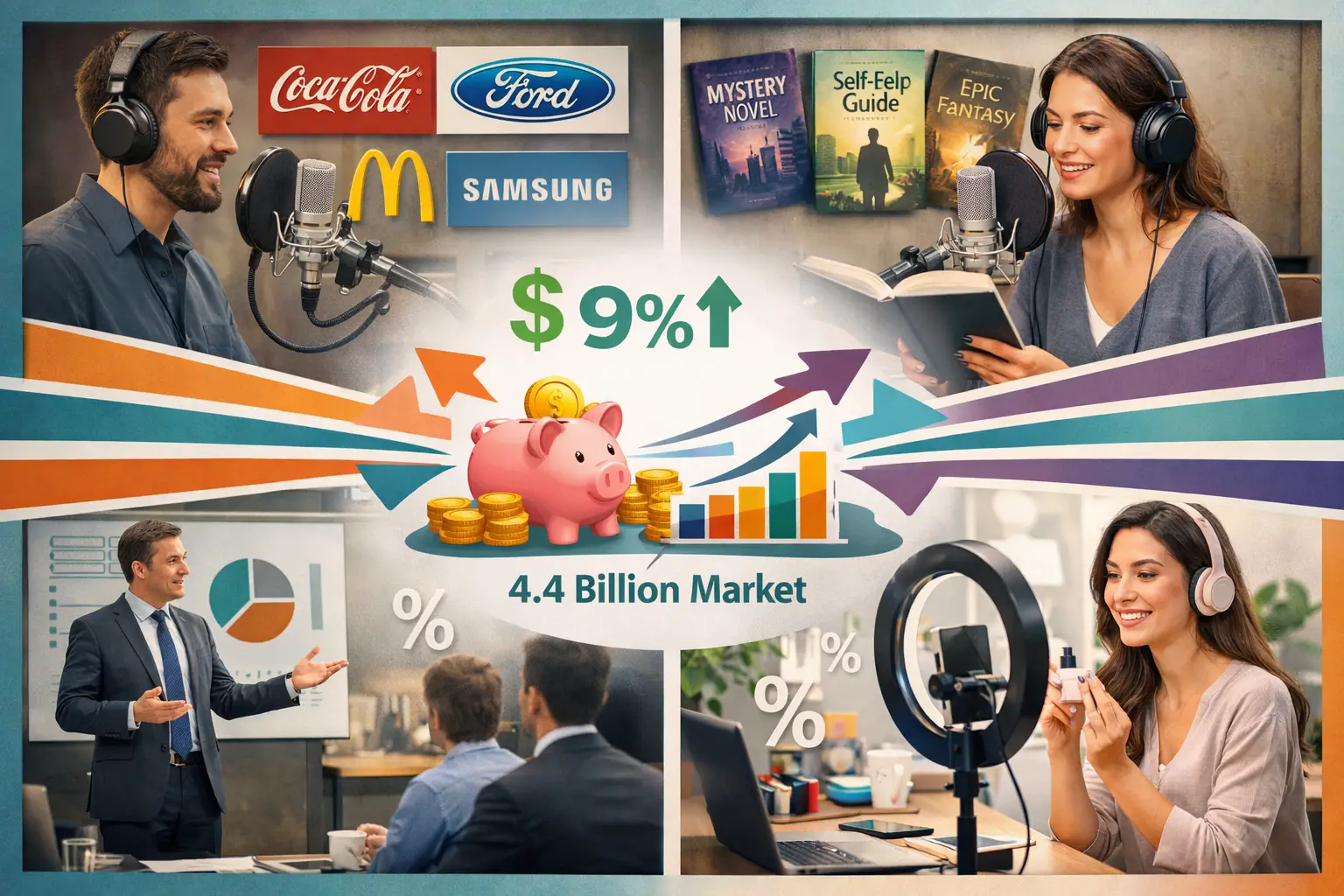
Let me paint you a picture of where we stand heading into 2026. The voice-over industry isn’t just surviving—it’s thriving. But like any gold rush, knowing where to dig makes all the difference between striking it rich and coming up empty-handed.
Over 50% of companies surveyed planned to use real human voice actors for brand marketing in 2025, and nearly 50% anticipated needing voice actors for animation, broadcast, online ads, and television[3]. Translation? The demand is real, diverse, and expanding. But here’s what keeps me up at night for newer actors: the competition has never been fiercer.
The AI Elephant in the Recording Booth
Everyone’s talking about AI, and yes, it’s changing our industry. But here’s the plot twist most doom-and-gloom articles miss: 79% of business leaders say AI voices should come from real voice actors[6]. Read that again. AI isn’t necessarily your replacement—it could be your next income stream.
Think of AI like the synthesizer in music. When synths arrived, everyone predicted the death of live musicians. Instead, smart musicians learned to incorporate synthesis into their work, creating entirely new genres and revenue opportunities. The same applies here. Voice actors who license their voices for AI applications, who understand how to direct AI performances, or who specialize in the nuanced, emotionally complex work AI can’t replicate—those performers will thrive.
The Freelance Reality Check
Currently, 70% of voice-over talent operates as freelancers, while 30% work through agencies[4]. I’ve done both, and each path has distinct financial implications for your 2026 business plan. Freelancing offers higher per-project rates and creative control, but you’re responsible for finding every single gig, handling all administrative tasks, and managing irregular income. Agency representation provides steadier work flow and handles negotiations, but takes a percentage of your earnings.
The sweet spot? A hybrid approach. Build your freelance client base while maintaining agency relationships for specific market segments. It’s like diversifying an investment portfolio—you’re not putting all your eggs in one basket.
Building Your Voice Actor Business Plan for 2026: Creating Multiple Revenue Streams
Here’s where we get tactical. If you’re relying on a single income source in voice acting, you’re building a house on sand. The most financially successful voice actors I know—the ones who’ve weathered industry changes, economic downturns, and technological disruptions—all share one characteristic: diversified revenue streams.
Commercial Work: The Bread and Butter
Commercial voice-over remains the most lucrative sector for many performers. We’re talking radio spots, television commercials, online advertising, and increasingly, social media content. The average hourly rate for voice-over talent in 2024 is estimated at $55[4], but experienced professionals with strong reputations can command significantly higher rates.
Pro tip from the trenches: Don’t just chase national campaigns (though those are fantastic when they land). Regional and local commercials provide consistent income with less competition. I’ve paid my mortgage many months over with a steady rotation of regional car dealerships, local restaurants, and small business campaigns that never made it beyond a 50-mile radius.
Audiobook Narration: The Marathon Runner’s Game
Audiobook narration has exploded over the past decade, and it’s not slowing down in 2026. This revenue stream requires different skills than commercial work—stamina, consistency, character differentiation, and the ability to maintain energy over 8-10 hour recording days.
The financial model varies:
- Per Finished Hour (PFH): You’re paid a flat rate for each finished hour of audio, typically ranging from $100-$400+ depending on experience
- Royalty Share: You split royalties with the author (risky but potentially lucrative for bestsellers)
- Royalty Share Plus: A smaller PFH rate combined with royalty sharing
I’ve seen actors build $60,000-$80,000 annual incomes primarily through audiobooks by treating it like a production job—recording 2-3 books monthly with efficient workflows.
Corporate and E-Learning: The Steady Paycheck
Corporate narration, e-learning modules, training videos, and explainer content might not be glamorous, but they’re remarkably consistent. Companies always need training materials, onboarding videos, and internal communications.
This sector offers:
- Predictable project scopes (easier to quote and schedule)
- Repeat clients (once you’re in their vendor system, work flows regularly)
- Less competition (many actors overlook this “boring” work)
- Respectable rates ($200-$500 per finished project is common)
Brand Partnerships and Licensing: The Premium Tier
As you build your reputation, brand partnerships become accessible. This might include becoming the signature voice for a company’s phone system, video content, or even licensing your voice for AI applications.
These arrangements often involve:
- Retainer agreements (monthly fees for exclusive or priority access)
- Usage rights negotiations (higher fees for broader distribution)
- Long-term contracts (providing income predictability)
Real-world example: I once landed a regional healthcare system contract that paid $2,000 monthly for being their exclusive voice across all patient-facing content. That single contract covered my health insurance for the year—which brings us to our next critical topic.
Financial Projections and Tax Planning: The Foundation of Building Your Voice Actor Business Plan for 2026
Let’s talk numbers, because this is where most voice actors’ business plans fall apart. You can book amazing gigs, but if you’re not managing the financial backend properly, you’re leaving money on the table—or worse, setting yourself up for tax nightmares.
Establishing Your Business Infrastructure
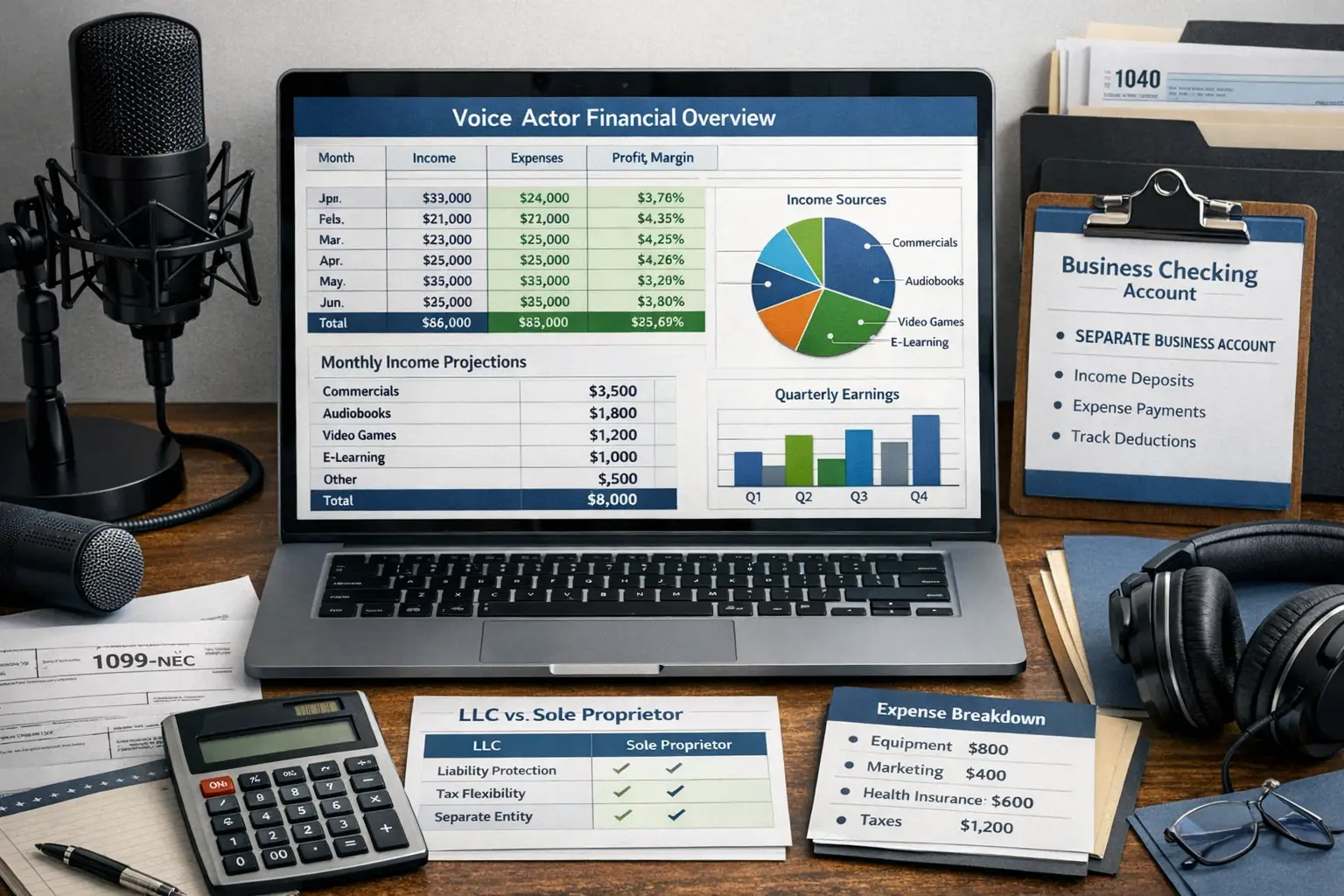
Every voice actor needs a dedicated business checking account separate from personal finances[1]. This isn’t optional—it’s fundamental. Here’s why: when tax season arrives (or if you’re ever audited), having clearly separated business and personal expenses saves you hours of headaches and potentially thousands in accounting fees.
Business structure decisions between LLC and sole proprietor status require careful planning based on individual circumstances[1]. Let me break this down in plain English:
| Business Structure | Advantages | Disadvantages | Best For |
|---|---|---|---|
| Sole Proprietor | Simple setup, minimal paperwork, all profits are yours | Personal liability exposure, harder to separate business/personal | Starting out, testing the waters, under $30K annual revenue |
| LLC | Liability protection, professional credibility, potential tax benefits | Setup costs, annual fees, more paperwork | Serious professionals, $30K+ revenue, those with significant assets to protect |
I started as a sole proprietor and switched to an LLC after my second year when my income crossed $50,000. The peace of mind knowing my personal assets were protected from business liabilities was worth every penny of the setup cost.
Creating Realistic Financial Projections
Here’s a sample monthly budget framework for a mid-level voice actor targeting $60,000 annual income in 2026:
Revenue Projections (Monthly):
- Commercial work: $2,000 (4-5 regional spots)
- Audiobook narration: $1,500 (1.5 books at $1,000 PFH)
- Corporate/E-learning: $1,000 (2-3 projects)
- Miscellaneous (coaching, workshops, licensing): $500
- Total Monthly Target: $5,000
Expense Budget (Monthly):
- Studio/Equipment: $200 (maintenance, upgrades, acoustic treatment)
- Marketing: $300 (website hosting, demos, advertising, networking)
- Professional Development: $150 (coaching, classes, workshops)
- Software/Subscriptions: $100 (DAW, editing tools, casting platforms)
- Health Insurance: $400-$600 (critical planning item)[1]
- Taxes (Estimated Quarterly): $1,000-$1,250 (25% of gross)
- Business Services: $150 (accounting, legal, professional memberships)
- Emergency Fund Contribution: $200
- Retirement Savings: $300 (6% of gross minimum)
Net Monthly Income: $1,500-$1,700
Notice something? Even at $60,000 gross annual income, you’re netting around $18,000-$20,000 after business expenses, taxes, health insurance, and savings. This is why that 75% of voice actors making under $40,000 annually[2] statistic is so concerning—many are barely scraping by.
Tax Planning Strategies That Actually Work
I’m not a tax professional (consult one!), but here are strategies that have saved me thousands over the years:
🎯 Quarterly Estimated Taxes: Don’t wait until April 15th. Set aside 25-30% of every payment immediately and pay quarterly estimates. The penalties for underpayment hurt.
📊 Track Everything: Every microphone cable, every mile driven to a recording session, every industry magazine subscription—it’s all potentially deductible. Use accounting software (QuartzyBooks, FreshBooks, Wave) or hire a bookkeeper.
🏠 Home Office Deduction: If you have a dedicated space for your studio, calculate the square footage deduction. It’s legitimate and valuable.
💼 Equipment Depreciation: Major equipment purchases can be depreciated over time or potentially deducted fully in the year of purchase under Section 179.
🎓 Education Expenses: Coaching, workshops, classes directly related to improving your voice acting skills are business expenses.
Health Insurance: The Budget Killer You Must Plan For
Health insurance budgeting is critical for freelancers, requiring advance financial planning[1]. This is non-negotiable. I’ve watched talented actors skip health insurance to save money, only to face medical emergencies that bankrupted them.
Options to explore:
- Marketplace plans (Healthcare.gov or state exchanges)
- Professional associations (SAG-AFTRA if you qualify, Freelancers Union)
- Spouse’s employer plan (if applicable)
- Health sharing ministries (research carefully)
Budget $400-$800 monthly depending on your age, location, and coverage needs. Yes, it’s expensive. Yes, it’s essential.
Marketing and Business Development: Bridging the Gap in Building Your Voice Actor Business Plan for 2026
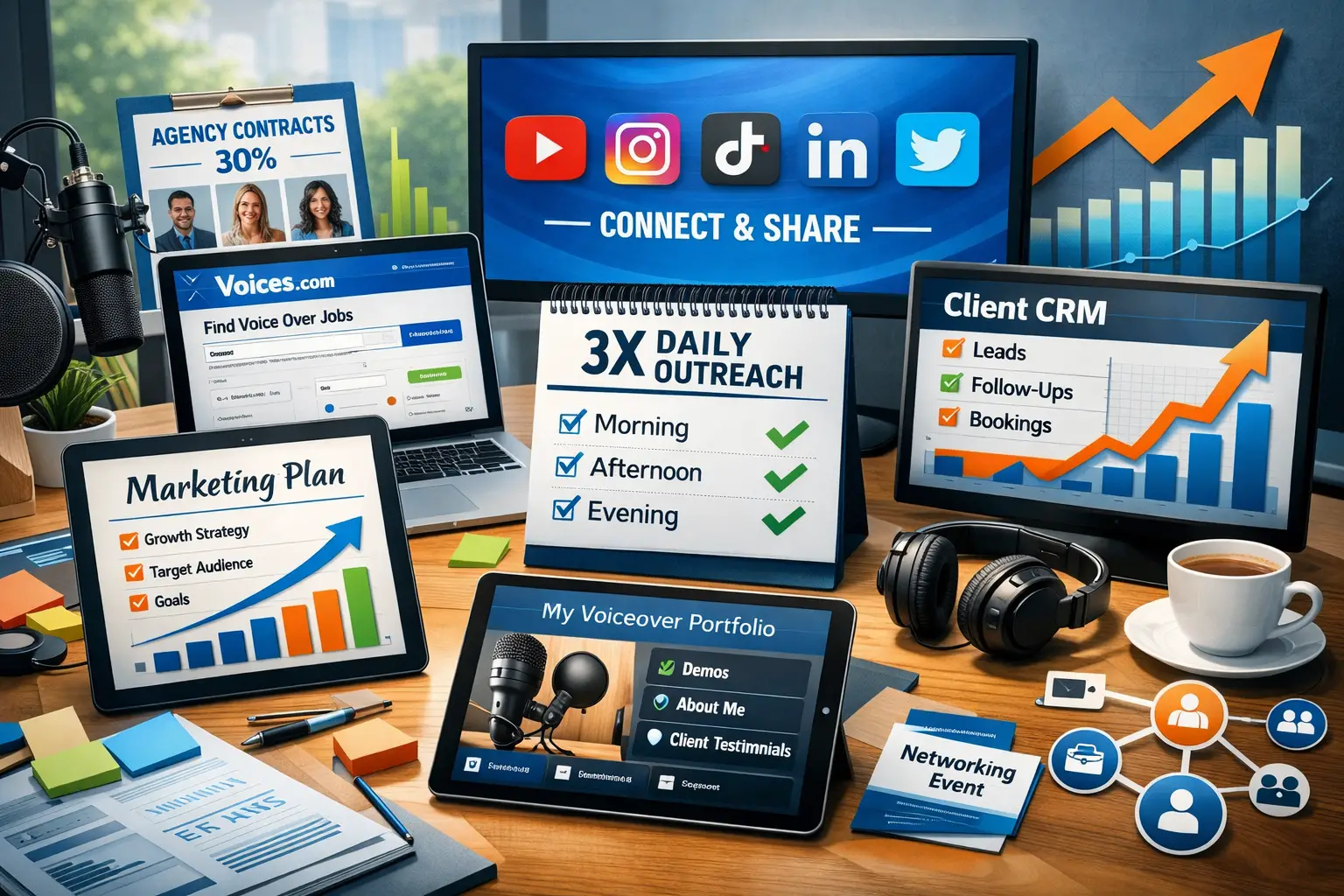
Here’s a sobering statistic: 75% of voice actors reach out to market their services less than three times daily[2]. Meanwhile, a marketing plan is critical but most voice actors lack one, a sales strategy, or business development direction[2].
Let that sink in. The majority of voice actors are waiting for work to find them rather than actively pursuing opportunities. That’s like being a fisherman who sits on the dock hoping fish jump into the boat.
Creating Your Marketing Plan
A solid marketing plan doesn’t require an MBA—it requires consistency and strategy. Here’s the framework I’ve used successfully:
Daily Marketing Activities (30-60 minutes):
- 3-5 personalized outreach emails to potential clients (production companies, ad agencies, corporate marketing departments)
- Social media engagement (not just posting—actually engaging with potential clients and industry professionals)
- One networking conversation (phone call, coffee meeting, or video chat)
Weekly Marketing Activities (2-3 hours):
- Content creation (blog posts, video tips, social media content demonstrating expertise)
- Portfolio updates (adding new demos, refreshing website, updating profiles on casting platforms)
- Industry research (identifying new potential clients, market trends, competitor analysis)
Monthly Marketing Activities (4-6 hours):
- Demo production or updates (keeping your samples fresh and relevant)
- Strategic planning (reviewing what’s working, adjusting approaches)
- Professional development (attending workshops, webinars, networking events)
Leveraging Online Platforms Strategically
Online marketplaces like Voices.com serve as major talent hubs with over 4 million voice actors across 160 countries[4]. That’s massive opportunity and massive competition simultaneously.
Platform strategy tips:
- Don’t rely exclusively on any single platform (diversification applies to client acquisition too)
- Optimize your profiles completely (professional photos, comprehensive samples, detailed descriptions)
- Respond quickly (many platforms reward fast response times with better visibility)
- Price strategically (race to the bottom helps nobody, including clients who equate low prices with low quality)
I use platforms for approximately 30% of my business while dedicating 70% of marketing efforts to direct client relationships. Direct clients typically pay better rates and provide more consistent work.
Building Client Relationships That Last
The voice actors earning six figures aren’t constantly chasing new clients—they’re nurturing relationships that generate repeat business. Here’s the secret: make your clients’ lives easier.
Relationship-building tactics:
- Deliver early (if the deadline is Friday, deliver Wednesday)
- Provide options (give them 2-3 takes with different interpretations)
- Communicate proactively (if something’s delayed, tell them immediately)
- Add unexpected value (suggest script improvements, offer rush delivery at no extra charge occasionally)
- Follow up thoughtfully (not “do you have more work?” but “how did that campaign perform?”)
One corporate client I landed in 2018 has provided $15,000-$20,000 annually in steady work simply because I’m reliable, easy to work with, and consistently deliver quality ahead of schedule. That relationship is worth more than any single large project.
Sustainable Growth: Scaling Your Voice Acting Business Beyond 2026
Building Your Voice Actor Business Plan for 2026: Financial Projections, Tax Planning, and Sustainable Income Streams isn’t just about surviving this year—it’s about creating a foundation for long-term career sustainability.
Investing in Your Business Growth
Experienced professionals with strong reputations and diverse portfolios can command premium rates[4], but getting there requires strategic investment. Here’s where to allocate growth capital:
🎙️ Equipment Upgrades: Your first microphone won’t be your last. As your skills and client base grow, investing in better equipment (within reason) improves your competitive position. But remember: a $5,000 microphone won’t fix poor technique or bad acoustics.
🎓 Ongoing Education: The best investment I’ve made consistently is coaching and training. Budget $1,500-$3,000 annually for workshops, private coaching, and skill development. The industry evolves constantly—your skills must too.
💻 Technology and Software: Professional editing software, noise reduction tools, file delivery systems, and project management platforms aren’t luxuries—they’re necessities for efficient operation.
🎬 Demo Production: A professionally produced demo costs $500-$2,000 depending on complexity, but it’s your primary sales tool. Budget for demo updates every 18-24 months as your skills improve and market trends shift.
Planning for Income Variability
Voice acting income fluctuates—wildly sometimes. December might bring $8,000 while February delivers $2,000. This variability destroys unprepared actors financially.
Strategies for managing irregular income:
📊 The Baseline Method: Calculate your minimum monthly expenses (rent, utilities, insurance, food, business basics). This is your baseline. Any month you earn above baseline, set aside the excess in a business savings account. When lean months hit, you draw from savings to meet baseline needs.
💰 The Percentage System: From every payment received, immediately allocate percentages:
- 25-30% to taxes
- 15-20% to business savings/emergency fund
- 10-15% to retirement
- Remainder for living expenses and discretionary spending
📅 The Annual Budget Approach: Project annual income conservatively, divide by 12, and pay yourself that “salary” monthly from your business account. This smooths income variability and makes personal budgeting manageable.
I use a combination of all three methods, which sounds complicated but becomes second nature after a few months.
Retirement Planning for the Self-Employed
Nobody’s matching your 401(k) contributions or providing a pension. Retirement planning falls entirely on your shoulders, and it’s easy to postpone when you’re worried about this month’s bills.
Don’t make that mistake.
Options for voice actors:
- Solo 401(k): Allows contributions up to $66,000 annually (2024 limits) with both employee and employer contributions
- SEP IRA: Simpler than Solo 401(k), allows contributions up to 25% of net self-employment income
- Traditional or Roth IRA: Lower contribution limits ($6,500-$7,000 annually) but accessible and straightforward
Start with whatever you can afford—even $100 monthly. The compounding effect over 20-30 years is remarkable, and you’re building the financial security that allows you to be selective about projects later in your career.
Building Your Team
As your business grows, recognize when to delegate. I resisted this for years, thinking I couldn’t afford help. The reality? I couldn’t afford NOT to get help.
Consider adding:
- Accountant/Bookkeeper: Saves time, reduces tax liability, prevents costly mistakes
- Agent/Manager: Opens doors to opportunities you wouldn’t access independently (worth the commission for the right representation)
- Virtual Assistant: Handles administrative tasks, scheduling, basic editing, freeing you for income-generating activities
- Marketing Consultant: Provides expertise you may lack, accelerates business growth
The key is ensuring each team member generates more value than their cost. A bookkeeper costing $200 monthly who saves you $500 in taxes and 10 hours of time is a bargain.
Adapting to Industry Changes and Future-Proofing Your Business
The voice-over industry in 2026 looks different than it did in 2020, and it’ll look different again in 2030. Successful voice actors aren’t just talented—they’re adaptable.
Embracing Technological Change
AI, remote direction technology, virtual reality, interactive media—these aren’t threats if you position yourself strategically. The actors who thrive are those who ask “how can I use this?” rather than “how do I fight this?”
Practical applications:
- Learn remote recording protocols (Source Connect, SessionLinkPRO, Zoom recording)
- Understand AI voice licensing (new revenue stream if approached strategically)
- Explore emerging media (podcast advertising, interactive gaming, virtual events)
- Master self-direction (clients increasingly expect broadcast-ready audio without expensive studio time)
Diversifying Beyond Voice Acting
Many successful voice actors develop complementary revenue streams that leverage their expertise:
- Coaching other voice actors ($75-$200 per hour)
- Demo production services ($500-$2,000 per demo)
- Studio rental (if you have professional space)
- Industry consulting (helping businesses understand voice-over procurement)
- Content creation (YouTube channels, podcasts, courses about voice acting)
These aren’t distractions from voice acting—they’re strategic diversification that stabilizes income and positions you as an industry authority.
Measuring Success Beyond Income
Here’s something I wish someone had told me 30 years ago: financial success matters, but it’s not the only metric. Building Your Voice Actor Business Plan for 2026 should include qualitative goals alongside quantitative ones.
Holistic success metrics:
- Client satisfaction and retention rates
- Work-life balance and schedule flexibility
- Creative fulfillment from projects
- Industry reputation and peer respect
- Personal growth and skill development
- Community contribution and mentorship
The most miserable voice actor I know earns $200,000+ annually but hates every project, works 70-hour weeks, and has burned countless professional bridges. The happiest earns $65,000 but works 25 hours weekly on projects she loves, travels frequently, and maintains strong industry relationships.
Define success on your terms, then build a business plan that achieves it.
Conclusion: Your Action Plan for Building a Thriving Voice Acting Business in 2026
Let’s bring this home. Building Your Voice Actor Business Plan for 2026: Financial Projections, Tax Planning, and Sustainable Income Streams isn’t about becoming a spreadsheet warrior who loses touch with the artistry that drew you to voice acting. It’s about creating the financial foundation that allows your creativity to flourish without constant anxiety.
The voice-over market is growing at 9% annually[4], companies are actively seeking human voice talent despite AI developments, and opportunities span commercials, audiobooks, corporate work, and emerging media. The potential is absolutely there. The question is: will you position yourself to capture it?
Your immediate action steps:
This week: Open a dedicated business checking account and establish clear separation between personal and business finances[1]
This month: Decide on your business structure (LLC vs. sole proprietor) based on your income level and risk tolerance, consulting with a tax professional if needed[1]
This quarter: Develop a comprehensive marketing plan with daily outreach goals, addressing the gap where most voice actors market less than three times daily[2]
This year: Diversify your revenue streams across at least three categories (commercial, audiobook, corporate, brand partnerships, etc.) to create financial stability
Ongoing: Track every expense, set aside 25-30% of income for taxes, budget for health insurance, and contribute regularly to retirement savings
Remember, 75% of voice actors earn under $40,000 annually[2]—not because they lack talent, but because they lack business strategy. You now have the framework to be in the 25% who build sustainable, thriving careers.
The microphone is your instrument, but your business plan is your sheet music. Master both, and you’ll create a career that’s not just financially successful but personally fulfilling for years to come.
Now stop reading and start building. Your 2026 voice acting business awaits. 🎙️💼
References
[1] Watch – https://www.youtube.com/watch?v=LstppwGRYW4
[2] A Marketing Plan Is Critical – http://vopro.pro/blog/a-marketing-plan-is-critical
[3] Voice Acting In 2025 2026 Trends Insights And The Future – https://www.gravyforthebrain.com/voice-acting-in-2025-2026-trends-insights-and-the-future/
[4] Voice Over Industry Growth And Future – https://www.provoiceactor.co.uk/blog/voice-over-industry-growth-and-future/
[5] The State Of The Voice Over Industry In 2025 Trends And Insights – https://www.outspokenvoices.com/blog/the-state-of-the-voice-over-industry-in-2025-trends-and-insights
[6] Amplified 2026 The State Of Voice Report – https://www.voices.com/blog/amplified-2026-the-state-of-voice-report/