

Here’s something I learned after three decades in this business: the voice actors who build sustainable, lucrative careers aren’t necessarily the ones with the most impressive demo reels. They’re the ones who understand that brands don’t just want a voice—they want a voice system. In 2026, companies are increasingly seeking one signature sound across ads, apps, podcasts, and customer service. Building Consistent Brand Voice Across Platforms: Becoming the Go-To Voice for Long-Term Corporate Partnerships isn’t just a fancy phrase—it’s the difference between being a hired gun and becoming indispensable.
Think about it like this: Would you rather be the actor who gets called in for a single commercial, or the voice that becomes synonymous with a brand’s entire identity? The latter doesn’t just pay better—it creates career stability that most actors only dream about. And the best part? The opportunity has never been bigger. Companies maintaining a consistent brand voice across touchpoints achieve revenue increases between 23% and 33%[6], which means they’re willing to invest serious money in the right voice talent.
Key Takeaways
- Revenue-driven demand: Brands see 23-33% revenue increases from consistent voice across platforms[6], making voice system providers highly valuable
- Trust equals loyalty: 65% of consumers trust companies more when they maintain consistent brand voice[1], positioning you as a trust-building asset
- Long-term beats transactional: Seasonal collaborations and ongoing relationships drive stronger engagement than one-off posts[4], creating partnership opportunities
- Documentation is power: Brands with documented voice guidelines see higher engagement[2]—help create them and you become irreplaceable
- Human touch wins: Despite 62% of brands investing in AI for communication[1], authentic human nuance remains essential for credibility
Understanding Why Brands Need Voice Consistency in 2026
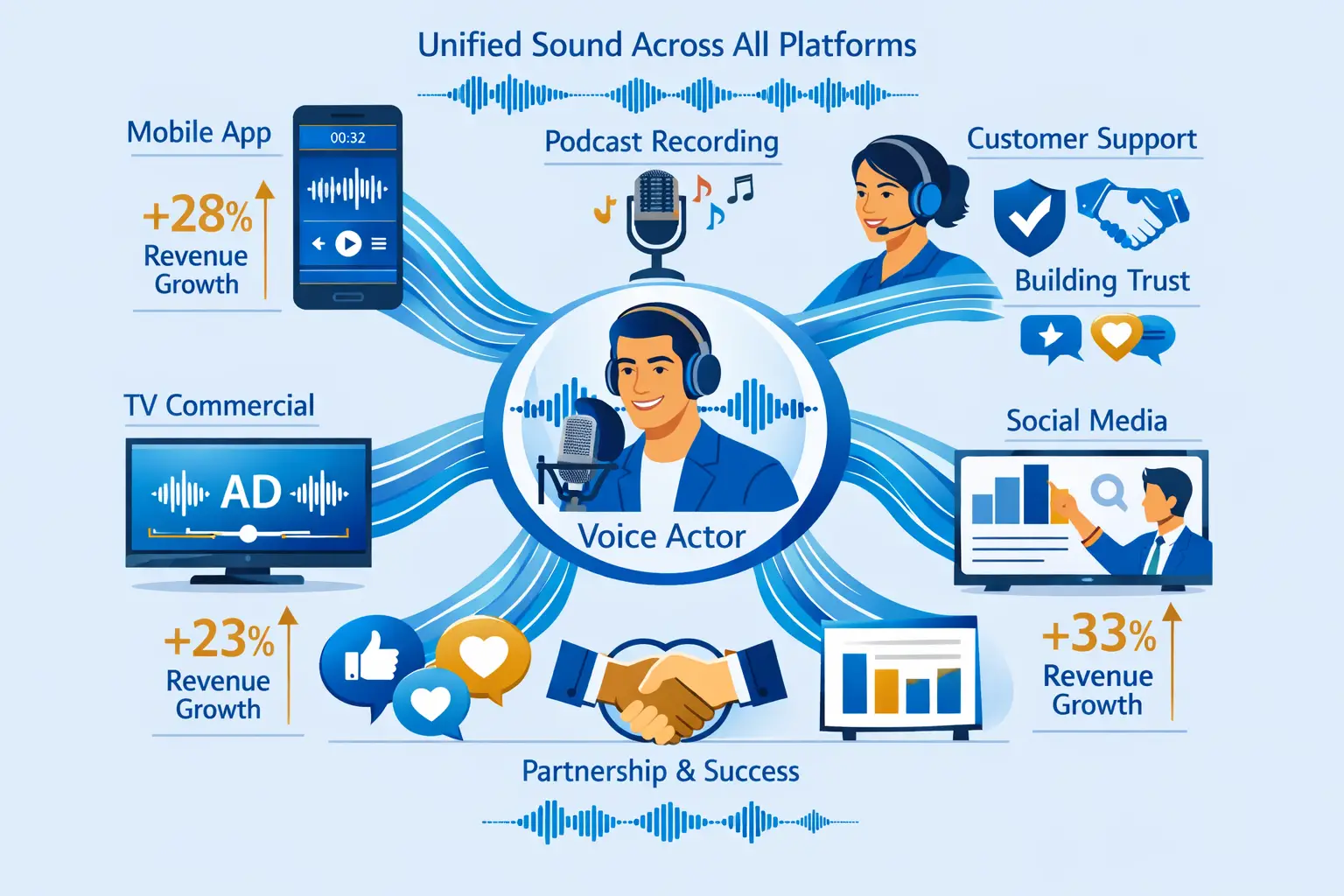
Let’s talk about what’s really happening in the corporate world right now. Brands are facing a crisis of authenticity. Consumers are savvier than ever, and they can smell inconsistency from a mile away. When a company sounds professional and buttoned-up on their website, then suddenly casual and slangy on Instagram, then robotic in customer service calls—it creates cognitive dissonance. It makes people wonder: “Who are you, really?”
Here’s the kicker: 65% of consumers say a consistent brand voice makes them trust a company more[1]. Trust isn’t just a warm fuzzy feeling—it translates directly into purchase decisions, customer loyalty, and brand advocacy. And here’s where it gets even more interesting for us as voice actors: 78% of consumers prefer brands that “sound human”[1]. Not corporate. Not overly polished. Human.
This creates a beautiful opportunity. Brands need someone who can deliver that human authenticity consistently across every single touchpoint. That’s not just reading scripts—that’s becoming the living embodiment of their brand personality.
The Omnichannel Reality
Your voice needs to work everywhere. And I mean everywhere:
- 📱 Mobile apps (navigation, notifications, tutorials)
- 🎙️ Podcasts (branded content, sponsored segments)
- 📺 Video ads (TV, YouTube, streaming platforms)
- ☎️ Customer service (IVR systems, on-hold messaging)
- 💻 Websites (explainer videos, product demos)
- 📧 Email campaigns (video messages, audio newsletters)
- 🎮 Interactive experiences (AR/VR, gaming integrations)
- 🏢 Corporate communications (training videos, internal messaging)
Brand voice must remain consistent across all these customer touchpoints[1]. Inconsistent tone makes brands feel unreliable or inauthentic—and that’s exactly what you’re helping them avoid.
The Business Case for Building Consistent Brand Voice Across Platforms
Let me share something that changed my perspective completely. Early in my career, I landed a great commercial gig for a regional bank. One day, done. Nice paycheck, moved on. Years later, I watched another voice actor become the voice of a national insurance company. Every platform. Every message. Every customer interaction. That actor didn’t just make more money—they built a relationship that lasted over a decade.
The data backs this up beautifully. According to Harvard Business Review analysis, 93% of brands that tightly integrate brand strategy with marketing execution see stronger long-term performance and higher customer loyalty[2]. When you help a brand achieve that integration through your voice, you’re not providing a service—you’re driving measurable business outcomes.
The Revenue Connection
Here’s what gets executives excited: companies maintaining consistent brand voice achieve revenue increases between 23% and 33%[6]. When you walk into a pitch meeting armed with this statistic, you’re not just another voice actor—you’re a revenue-generating strategic partner.
Think about what that means for your value proposition. If a mid-sized company does $50 million in annual revenue, and your consistent voice across platforms contributes to even a 20% increase, you’ve helped generate $10 million in additional revenue. Suddenly, your fee structure looks like an incredibly smart investment rather than an expense.
Recognition Without Visual Branding
Here’s a fascinating benchmark: your brand voice should be recognizable even without visual branding elements[2]. Can people identify the brand just by hearing the voice, even with their eyes closed? That’s the gold standard—and it’s exactly what you’re aiming to create.
I love using the analogy of a radio show. Loyal listeners can identify their favorite host within two words, not because of what they’re saying, but because of how they say it. That’s the level of distinctiveness brands are seeking.
Becoming a Voice System Provider vs. a One-Off Hire
This is where the mindset shift happens. Stop thinking like a freelancer who books individual gigs. Start thinking like a voice system architect who builds comprehensive solutions.
What Makes a Voice System?
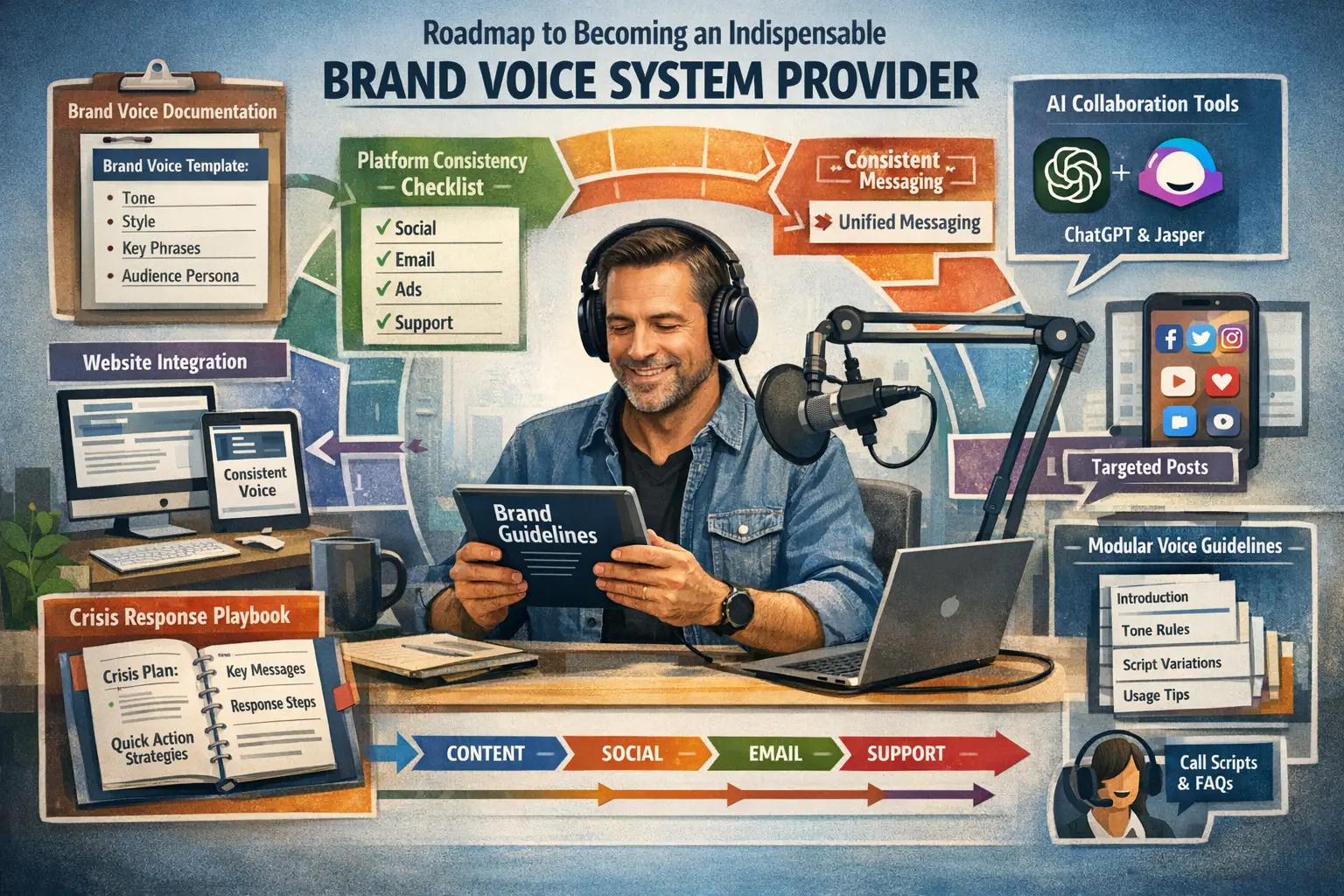
A true voice system includes:
Documented voice guidelines 📋
- Tone characteristics (warm, authoritative, playful, etc.)
- Pace and rhythm specifications
- Pronunciation guides for brand-specific terms
- Emotional range parameters
- Do’s and don’ts for different contexts
Platform-specific adaptations 🎯
- How the voice adjusts for 15-second ads vs. 3-minute explainers
- Formal vs. casual contexts
- Crisis communication protocols
- Seasonal variations while maintaining core identity
Scalability frameworks 📈
- Recording templates for common use cases
- AI voice cloning guidelines (with your oversight)
- Training materials for internal teams
- Quality control processes
Crisis response protocols 🚨
- Pre-approved messaging frameworks
- Tone adjustments for sensitive situations
- Speed-to-market procedures
Leading brands like Shopify employ modular voice guidelines that can be localized or tailored for global teams while maintaining unified, authentic presence[1]. You can offer the same systematic approach.
The Long-Term Partnership Model
Here’s what the research tells us: seasonal collaborations and long-term creator relationships drove stronger engagement and credibility than one-off posts[4]. This isn’t just about influencer marketing—it applies directly to voice partnerships.
Audiences increasingly value trust and alignment over transactional brand moments[4]. When they hear the same authentic voice consistently, they build a relationship not just with the brand, but with you. You become part of the brand’s identity.
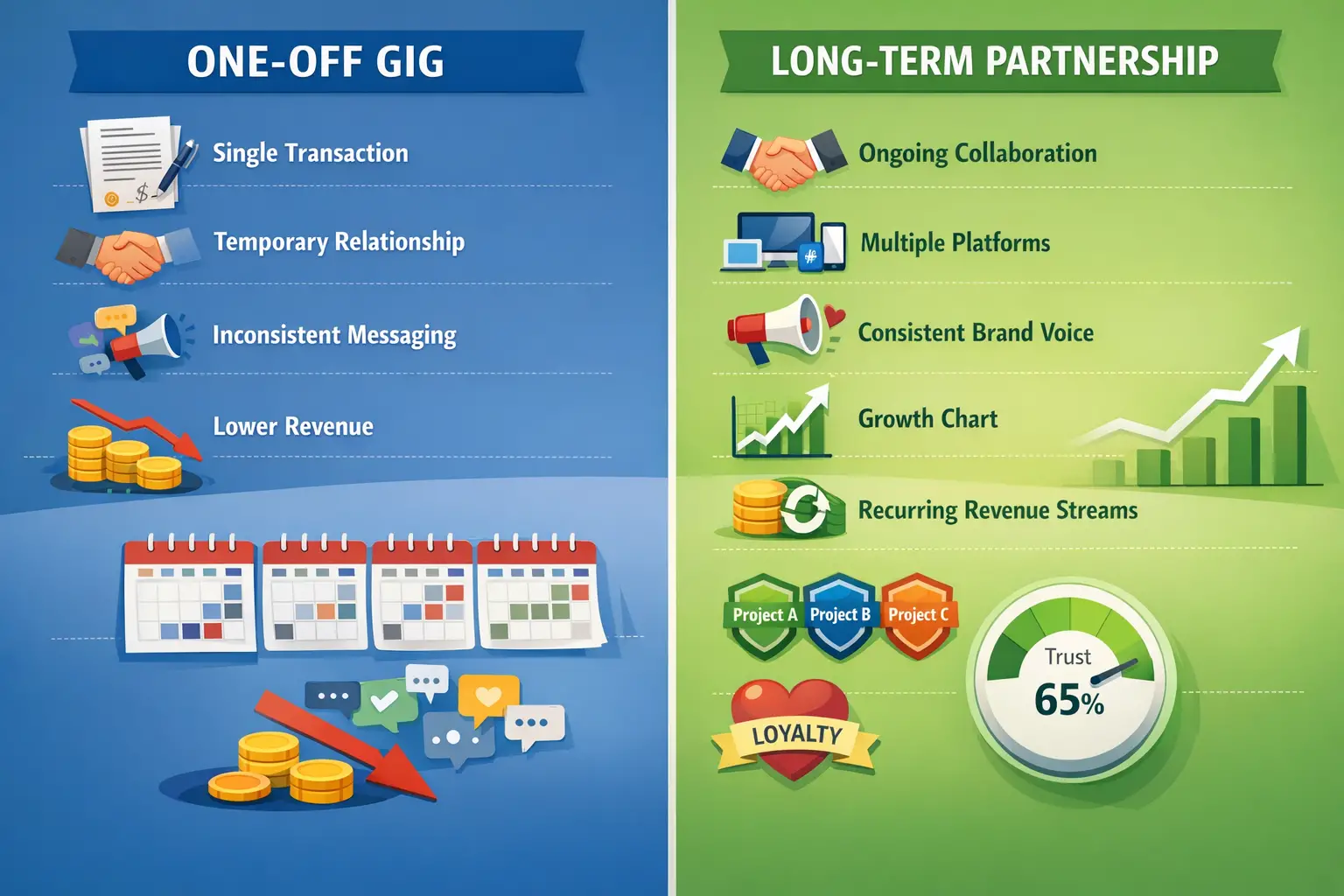
Compare these two scenarios:
| One-Off Hire | Long-Term Partnership |
|---|---|
| Single project scope | Ongoing collaboration across platforms |
| Price negotiation each time | Retainer or package pricing |
| No brand intimacy | Deep understanding of brand values |
| Replaceable | Indispensable |
| Transactional relationship | Strategic partnership |
| Limited revenue potential | Recurring, scalable income |
Which would you rather be?
Practical Strategies for Building Consistent Brand Voice Across Platforms: Becoming the Go-To Voice for Long-Term Corporate Partnerships
Alright, let’s get tactical. How do you actually position yourself as a voice system provider and land these long-term partnerships?
Step 1: Develop Your Voice Consistency Framework
Before you can offer consistency to brands, you need to demonstrate it yourself. Create a personal voice brand that’s recognizable and distinct. This means:
- Identify your signature qualities: What makes your voice uniquely yours? Is it warmth? Authority? Relatability? Playfulness? Get specific.
- Document your range: Create a style guide for yourself showing how your voice adapts across different contexts while maintaining core identity.
- Build platform-specific demos: Don’t just have a commercial demo. Have samples showing your voice across podcast hosting, customer service, app navigation, corporate narration, etc.
Here’s a pro tip from my years in the trenches: Record yourself reading the same script in five different emotional contexts (excited, serious, empathetic, urgent, casual). Then listen back and identify what remains consistent. That’s your signature sound—your brand DNA.
Step 2: Position Yourself as a Strategic Partner
Stop selling voice work. Start selling brand voice solutions. This means:
- Lead with business outcomes: Talk about trust-building (65% of consumers trust consistent brands more[1]), revenue impact (23-33% increases[6]), and customer loyalty (93% of integrated brands see stronger performance[2]).
- Offer voice audits: Provide free or low-cost assessments of a brand’s current voice consistency across platforms. Identify gaps and inconsistencies.
- Create comprehensive proposals: Don’t just quote a per-project rate. Propose annual partnerships with defined deliverables across platforms.
I remember landing my first major corporate partnership by doing exactly this. Instead of responding to their request for a single training video voice, I sent back a detailed analysis of their voice across their website, social media, and existing videos. I pointed out inconsistencies and proposed a comprehensive solution. They hired me on the spot—not for one video, but for everything.
Step 3: Master the Documentation Process
Gartner predicts that brands with a documented and consistently applied brand voice will see higher engagement and stronger brand equity[2]. Here’s your opportunity: help them create that documentation.
Offer to develop:
- Brand voice charters: Written documents defining personality, tone, and values
- Voice style guides: Practical examples showing how the voice sounds in different scenarios
- Recording templates: Standardized approaches for common use cases
- Quality benchmarks: Clear criteria for evaluating voice consistency
This documentation serves two purposes: it makes you invaluable (you’re the one who created it), and it ensures consistency even when you’re working with their internal teams or scaling through AI tools.
Step 4: Navigate the AI Integration Landscape
Here’s something that makes a lot of voice actors nervous: 62% of brands plan to invest in AI for communication by 2026[1], using tools like ChatGPT and Jasper to maintain voice consistency at scale.
But here’s the thing—and this is crucial—human oversight remains essential to preserve authentic nuances. AI can help with scale, but it can’t replace the human touch that 78% of consumers prefer[1].
Position yourself as the human-AI collaboration specialist:
- Offer to train AI voice models using your recordings
- Provide quality control and refinement for AI-generated content
- Handle high-stakes, nuanced communications that require human judgment
- Create the emotional baseline that AI can reference but not replicate
Think of it like this: You’re the master chef creating the signature recipes. AI is the kitchen staff that can follow those recipes for everyday meals. But when it’s time for the special occasions, the chef comes back to the kitchen.
Step 5: Build Crisis Response Capabilities
This is huge in 2026. Crisis response now defines brand trust, with silence serving as a liability and speed, transparency, and values-driven messaging emerging as non-negotiable elements[4].
Brands need a voice they can trust when things go wrong. If you’re already the established voice of the brand, you’re the natural choice for crisis communications. This means:
- Pre-record crisis templates: Create a library of adaptable crisis response recordings
- Establish rapid-response protocols: Be available on short notice
- Demonstrate emotional intelligence: Show you can navigate sensitive topics with appropriate tone
- Align with brand values: Understand what the brand stands for and communicate accordingly
I once had a corporate client face a product recall. Because I was already their established voice and understood their brand values deeply, I was able to record empathetic, transparent messaging within hours. That crisis response cemented our relationship for years to come.
Creating Your Platform Consistency Playbook
Let’s get really practical. Here’s how to ensure your voice remains consistent across different platforms while adapting appropriately to each context.
The Consistency-Flexibility Balance
This is the art of it all. You need to be recognizably you (or recognizably the brand) while adapting to platform requirements. Think of it like an actor playing the same character in different situations—the character’s core personality remains consistent, but their behavior adapts to context.
Core elements that NEVER change:
- Fundamental tone (warm, authoritative, friendly, etc.)
- Pace and rhythm signature
- Emotional authenticity
- Values alignment
Elements that ADAPT by platform:
- Formality level (LinkedIn vs. TikTok)
- Energy intensity (podcast vs. customer service hold)
- Length and pacing (15-second ad vs. 10-minute tutorial)
- Technical delivery (intimate podcast mic vs. broadcast commercial)
Platform-Specific Guidelines
Here’s a framework I’ve developed over the years:
📱 Mobile Apps & Digital Interfaces
- Conversational, helpful tone
- Clear, concise delivery
- Friendly but not overly casual
- Anticipate user needs
🎙️ Podcasts & Long-Form Audio
- Natural, authentic delivery
- Allow personality to shine
- Comfortable pacing—not rushed
- Build relationship with listener
📺 Video Ads (TV/Streaming)
- Energetic, engaging
- Clear call-to-action delivery
- Emotional connection in limited time
- Professional polish
☎️ Customer Service & IVR
- Patient, empathetic tone
- Clear enunciation
- Reassuring presence
- Respectful of customer’s time/frustration
💻 Corporate & Training
- Authoritative but approachable
- Educational without being condescending
- Professional but human
- Engaging enough to maintain attention
The Voice Consistency Checklist
Before delivering any recording, run through this checklist:
✅ Does this sound like it came from the same person/brand as other recordings?
✅ Would someone recognize the brand without seeing the logo?
✅ Does the tone align with brand values?
✅ Is the energy level appropriate for the platform?
✅ Does it sound authentic and human (not robotic or overly scripted)?
✅ Would this build trust with the target audience?
✅ Does it maintain consistency while adapting appropriately to context?
Pitching Long-Term Partnerships: What Actually Works
After 30 years, I’ve learned that landing long-term corporate partnerships requires a completely different approach than booking individual gigs. Here’s what actually works.
The Value Proposition Framework
Your pitch should answer three questions:
What business problem are you solving?
- Inconsistent brand voice across platforms
- Lack of trust and authenticity
- Inability to scale while maintaining quality
What measurable outcomes can you deliver?
- Increased brand recognition
- Higher customer trust (reference the 65% statistic[1])
- Revenue impact (reference the 23-33% increase[6])
- Stronger customer loyalty
Why are you uniquely qualified?
- Your voice consistency framework
- Your platform expertise
- Your understanding of their industry/audience
- Your strategic partnership approach
The Proposal Structure
Here’s a template that’s worked for me:
Phase 1: Discovery & Audit (Weeks 1-2)
- Analyze current voice across all platforms
- Identify inconsistencies and opportunities
- Interview key stakeholders
- Define brand voice characteristics
Phase 2: Development (Weeks 3-4)
- Create comprehensive voice guidelines
- Develop platform-specific adaptations
- Record baseline examples
- Establish quality benchmarks
Phase 3: Implementation (Months 2-3)
- Record priority platform content
- Train internal teams
- Establish workflow processes
- Create template library
Phase 4: Ongoing Partnership (Month 4+)
- Monthly retainer for ongoing needs
- Quarterly voice consistency audits
- Platform expansion as needed
- Crisis response availability
Pricing for Partnerships vs. Projects
This is where a lot of actors leave money on the table. Don’t price long-term partnerships like a collection of individual projects. Price them as comprehensive solutions with ongoing value.
Consider structures like:
- Annual retainers: Monthly fee covering defined deliverables plus on-call availability
- Platform packages: Bundled pricing for voice across multiple touchpoints
- Usage-based models: Base fee plus additional compensation for expanded use
- Performance bonuses: Incentives tied to measurable brand outcomes
The key is creating pricing that reflects the strategic value you’re providing, not just the hours you’re recording.
Maintaining Authenticity While Scaling
Here’s a challenge you’ll face as you build these partnerships: How do you maintain the authentic, human quality that makes your voice valuable while meeting the scaling demands of large brands?
This is where the 78% of consumers who prefer brands that “sound human”[1] becomes your North Star. No matter how much you scale, never sacrifice authenticity.
The Authenticity Checklist
🎯 Stay connected to the brand’s mission: Regularly revisit why the brand exists and who it serves
🎯 Bring your genuine self: Don’t create a “character”—be a version of yourself that aligns with brand values
🎯 Maintain emotional honesty: If a script feels inauthentic, speak up and collaborate on improvements
🎯 Avoid over-polishing: Perfect isn’t always better—sometimes a slight imperfection sounds more human
🎯 Stay current with the audience: Understand who you’re speaking to and what matters to them
Working with AI Without Losing Your Soul
Since 62% of brands are investing in AI for communication[1], you need a strategy for collaboration that preserves what makes you valuable.
Do:
- ✅ Train AI models with your best, most authentic recordings
- ✅ Establish clear guidelines for when AI is appropriate vs. when human recording is required
- ✅ Maintain quality control over AI-generated content
- ✅ Use AI for scaling routine communications while handling high-stakes messaging yourself
Don’t:
- ❌ Let AI replace the human nuance in sensitive communications
- ❌ Allow AI to drift from established brand voice without oversight
- ❌ Sacrifice quality for efficiency
- ❌ Lose the personal relationship with the brand team
“The brands that will win in 2026 aren’t the ones with the most advanced AI—they’re the ones that use AI to amplify human authenticity, not replace it.”
Real-World Success Stories and Lessons Learned
Let me share some experiences that illustrate these principles in action.
The Regional Bank That Went National
Early in my career, I worked with a regional bank expanding to multiple states. They initially hired me for a single commercial campaign. But I proposed something different: a comprehensive voice system that would work across their branches, phone systems, online banking, and advertising.
I created detailed voice guidelines showing how to sound trustworthy and approachable (their core values) across formal and informal contexts. I recorded everything from ATM instructions to radio spots to on-hold messaging.
The result? They kept me on retainer for eight years. When they eventually merged with a larger institution, the acquiring company actually kept the voice system we’d built because customers had such strong positive associations with it.
Lesson learned: Solve the bigger problem, not just the immediate need.
The Tech Startup That Scaled
I worked with a tech startup that grew from 50 employees to 5,000 in three years. Their challenge was maintaining brand voice consistency as they expanded globally.
We created modular voice guidelines (similar to Shopify’s approach[1]) that could be adapted for different markets while maintaining core identity. I trained regional voice actors to deliver the brand voice in their local languages, maintaining quality control through detailed documentation and regular audits.
Lesson learned: Build systems that scale beyond your personal capacity while maintaining your strategic oversight.
The Crisis That Built Trust
A consumer goods client faced a contamination scare. Because I was already their established voice and understood their values deeply, I was able to record transparent, empathetic crisis communications within three hours of the incident.
The speed, transparency, and values-driven messaging[4] we delivered turned a potential disaster into a trust-building moment. Customer loyalty actually increased after the crisis because of how authentically we handled it.
Lesson learned: Crisis response capabilities make you indispensable.
Your Action Plan: Next Steps for Building Long-Term Partnerships
Alright, let’s bring this home with concrete actions you can take starting today.
Immediate Actions (This Week)
- Audit your own voice consistency: Record yourself reading the same script in different contexts and identify your signature qualities
- Create a voice system demo: Record samples showing your voice across at least five different platforms
- Research target brands: Identify 10 companies whose values align with your voice and who could benefit from consistency
- Develop your value proposition: Write out how you solve business problems, not just provide voice work
Short-Term Actions (This Month)
- Build your documentation template: Create a sample brand voice guideline document you can customize
- Offer free voice audits: Reach out to 3-5 target brands offering complimentary consistency assessments
- Develop platform-specific expertise: Study best practices for voice across different platforms
- Create partnership proposal template: Build a reusable framework for pitching long-term collaborations
Long-Term Actions (This Quarter)
- Land your first partnership: Focus on converting one client from project work to ongoing relationship
- Build your case studies: Document the results and value you’re delivering
- Expand your platform capabilities: Add new platform expertise (podcast hosting, AR/VR, etc.)
- Develop AI collaboration skills: Learn how to work with AI voice tools as a complement to your work
Ongoing Practices
- 📊 Track industry trends: Stay current on brand communication shifts
- 🎓 Invest in business skills: Learn about brand strategy, marketing, and business development
- 🤝 Build relationships: Network with brand managers, marketing directors, and agency executives
- 📈 Measure and communicate value: Regularly demonstrate the business impact of your work
Conclusion: From Voice Actor to Voice System Architect
Here’s what I want you to take away from everything we’ve covered: Building Consistent Brand Voice Across Platforms: Becoming the Go-To Voice for Long-Term Corporate Partnerships isn’t about being the most talented voice actor in the room. It’s about understanding that brands need comprehensive solutions, not just individual performances.
The opportunity is massive. Companies are seeing real revenue increases from voice consistency[6]. Consumers are demanding authenticity[1]. Brands are investing heavily in communication tools[1]. And most voice actors are still thinking transactionally rather than strategically.
That’s your opening.
When you position yourself as a voice system provider who can deliver consistency across platforms, maintain authenticity at scale, navigate AI integration, and handle crisis communications—you become irreplaceable. You’re not just a vendor; you’re a strategic partner driving measurable business outcomes.
The brands that will thrive in 2026 and beyond are those that build genuine trust through consistent, authentic communication. And the voice actors who will thrive are those who help them do it.
So here’s my challenge to you: Stop chasing the next audition. Start building the next partnership. Create your voice consistency framework. Develop your documentation. Identify brands whose values align with yours. And pitch them a solution that’s bigger than a single project.
The work is there. The demand is proven. The revenue impact is documented. Now it’s time to step up and claim your place as the go-to voice for long-term corporate partnerships.
After 30 years in this business, I can tell you with absolute certainty: The voice actors who think like strategic partners rather than freelancers are the ones who build sustainable, fulfilling, lucrative careers.
Your voice is your instrument. But your strategic thinking? That’s what makes you indispensable.
Now go build something that lasts. 🎙️
References
[1] Tone Of Voice Brands – https://www.kedraco.com/blogs/tone-of-voice-brands
[2] 2026 Branding Trends – https://www.elevateitnow.com/2026-branding-trends/
[4] Five Shifts Redefining Brand Communications 2026 – https://www.odwyerpr.com/story/public/24104/2026-01-07/five-shifts-redefining-brand-communications-2026.html
[6] Brand Voice Consistency Statistics In Ecommerce – https://www.envive.ai/post/brand-voice-consistency-statistics-in-ecommerce