



Last updated: March 10, 2026
Key Takeaways
• Uta Hagen’s six steps provide a streamlined framework for deep character development that works for stage, film, and television
• Start with identity – “Who am I?” forms the foundation for all character choices and behaviors
• Circumstances matter – Understanding your character’s immediate situation drives authentic reactions
• Relationships fuel drama – Your connections to people, places, and objects create emotional stakes
• Clear objectives create urgency and purpose in every scene you perform
• Obstacles generate conflict – What stands in your way creates the tension that audiences crave
• Actions reveal character – What you do to get what you want shows who you really are
• This method works best when you dig deeper than surface-level answers and find personal connections
• Practice regularly – Use these steps for every role, from leads to small parts, to build your analytical muscle
Quick Review Of The Method

Uta Hagen’s six steps character analysis for actors is a systematic approach to building authentic, three-dimensional characters through six essential questions:
Who am I?
What are my circumstances?
What are my relationships?
What do I want?
What’s my obstacle?
What do I do to get what I want? [3]
This method, refined from her original nine questions, gives actors a practical roadmap to create believable, compelling performances by understanding their character’s identity, situation, connections, goals, challenges, and actions.
After many years working in this business, I can tell you that character analysis separates the amateurs from the professionals. I’ve seen talented actors fall flat because they skipped the homework, and I’ve watched average performers shine because they did the deep work. That’s exactly what Uta Hagen six steps character analysis for actors gives you – a proven system that transforms good actors into unforgettable ones.
What Is Uta Hagen’s Six Steps Character Analysis Method?
Uta Hagen’s six steps character analysis for actors is a condensed version of her famous nine questions technique, designed to help performers build authentic characters quickly and effectively. [1] This approach focuses on six core areas that define any character: identity, circumstances, relationships, objectives, obstacles, and actions.
Hagen developed this streamlined method because she realized actors needed a more practical framework they could use consistently, whether they had weeks or days to prepare. [3] The six steps dig into the psychological, emotional, and physical aspects of character without getting bogged down in unnecessary details.
Here’s what makes this method special: It forces you to think like your character, not about your character. Instead of describing someone from the outside, you’re building them from the inside out. That’s the difference between indicating and truly inhabiting a role.
I remember working with a young actor who was struggling with a small but crucial role as a grieving father. He kept playing “sad” instead of playing a man trying to hold his family together. Once we walked through Hagen’s steps, he discovered his character’s real objective wasn’t to grieve – it was to protect his remaining loved ones. That shift changed everything.
How Do You Apply Step One: Who Am I?
Step one asks you to define your character’s core identity in the present moment of the scene. [2] This isn’t about creating a biography – it’s about understanding who you are right now, in this specific moment of the story.
Start with these essential elements:
• Physical state – How do you feel in your body? Tired, energetic, sick, strong?
• Emotional state – What’s your baseline mood entering this scene?
• Mental state – Are you focused, distracted, overwhelmed, clear-headed?
• Social identity – How do you see yourself in relation to others?
• Self-perception – What do you believe about your own worth and capabilities?
Common mistake: Actors often confuse character background with present identity. Your character might be a doctor, but in this scene, are you a confident healer or a exhausted human being who happens to have medical training? The distinction matters enormously.
I once played a successful businessman who’d just lost everything. My mistake in early rehearsals was playing “successful businessman” instead of “man in denial about his failures.” The first choice was about his past; the second was about his present reality.
What Are My Circumstances: Understanding Your Character’s World?
Step two examines the immediate circumstances surrounding your character. [4] These circumstances include time, place, weather, social environment, and the specific events that brought you to this moment.
Break down circumstances into categories:
• Physical environment – Where are you and how does it affect you?
• Time factors – What time of day, season, or historical period?
• Social context – Who else is present or expected?
• Immediate events – What just happened before this scene?
• Future expectations – What do you think will happen next?
The key insight: Circumstances aren’t just background information – they’re active forces shaping your character’s choices. A conversation in a crowded restaurant plays differently than the same conversation in an empty house at midnight.
Pro tip: Always ask how the circumstances make you feel unsafe, comfortable, rushed, or relaxed. These feelings drive your behavior more than the facts themselves.
How Do Relationships Shape Your Character Development?
Step three explores your character’s relationships with people, places, objects, and events in the story. [1] This step often reveals the emotional core of your performance because relationships create the stakes that matter to your character.
Map your relationship connections:
| Relationship Type | Questions to Ask | Impact on Performance |
|---|---|---|
| People | How do I feel about each person? What’s our history? | Drives dialogue choices and physical behavior |
| Places | What memories do I have here? Do I belong? | Affects comfort level and movement |
| Objects | What significance do these items hold? | Creates opportunities for meaningful business |
| Events | How do past experiences influence this moment? | Informs subtext and emotional reactions |
Here’s what I’ve learned: The strongest relationships aren’t always the obvious ones. Sometimes your character’s relationship with a childhood home matters more than their relationship with their spouse. Sometimes a watch inherited from a grandfather carries more emotional weight than the person trying to take it away.
Practical exercise: Write one sentence describing how your character feels about each important relationship in the scene. Use active, emotional language: “I adore him but don’t trust him” rather than “We’re friends but complicated.”
What Do I Want: Defining Clear Character Objectives?
Step four identifies your character’s objective – what you want to achieve in the scene. [3] This want must be specific, achievable through action, and directed toward another person when possible.
Strong objectives have these qualities:
• Specific and concrete – “To get John to forgive me” not “to feel better”
• Urgent and important – Something you need, not just prefer
• Achievable through action – You can do something about it right now
• Directed at someone – Most powerful when focused on another character
Weak vs. Strong Objective Examples:
Weak: “I want to be happy” Strong: “I want to convince my sister to let me move back home”
Weak: “I want people to understand me”
Strong: “I want my boss to give me a second chance”
The game-changer: Your objective should make you slightly uncomfortable. If it’s easy to achieve, there’s no drama. If it’s impossible, there’s no hope. The sweet spot is something difficult but possible – that’s where compelling performances live.
What’s My Obstacle: Identifying Character Conflicts?
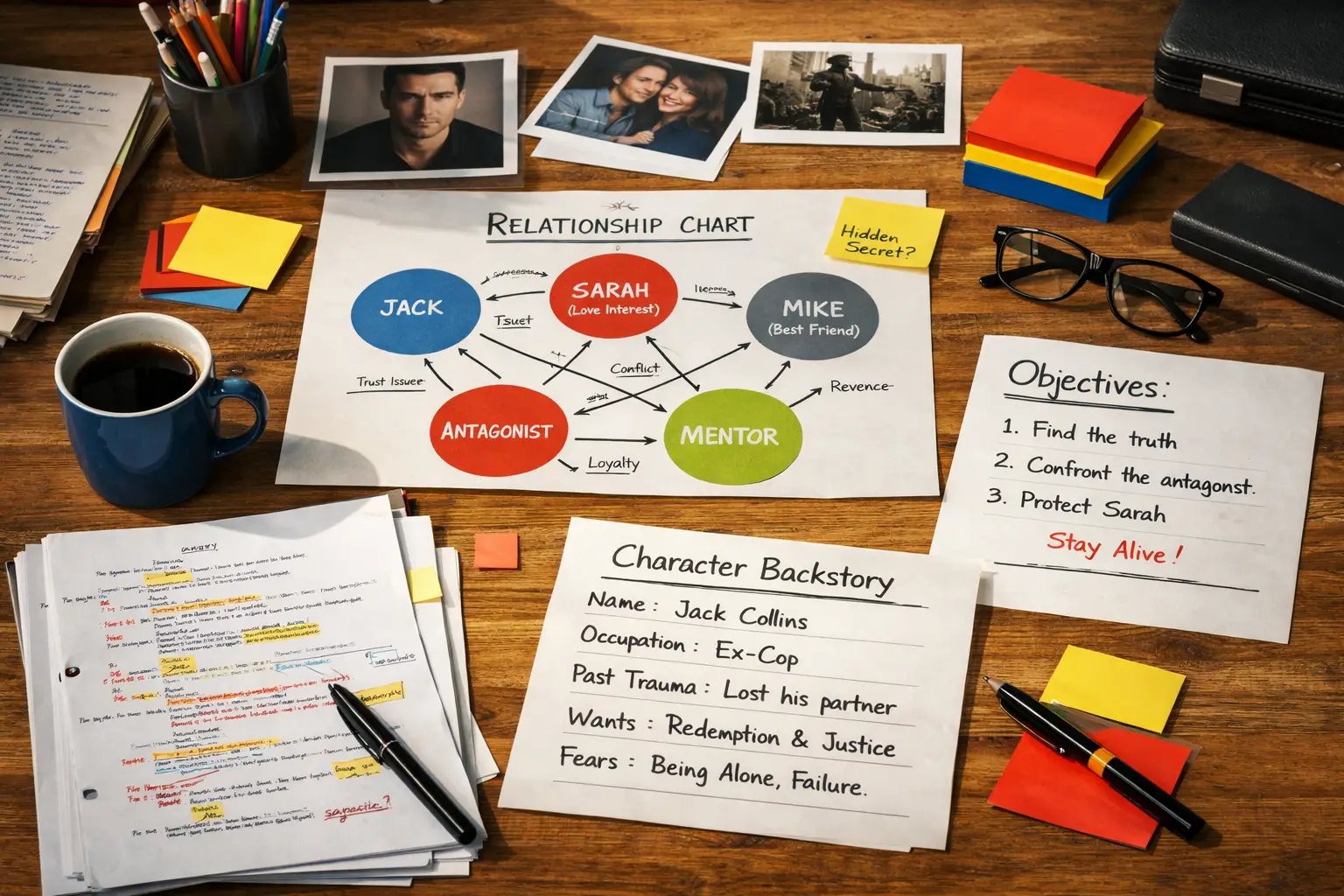
Step five examines what stands between your character and their objective. [2] Obstacles create the conflict that drives dramatic action and reveals character through how you choose to fight for what you want.
Types of obstacles to consider:
• Other people – Someone actively opposing you or unintentionally blocking you
• Circumstances – Time pressure, location limits, social expectations
• Internal conflicts – Fear, guilt, conflicting desires, moral dilemmas
• Physical limitations – Injury, exhaustion, environmental barriers
• Information gaps – What you don’t know that affects your choices
The secret sauce: The best obstacles aren’t obvious villains – they’re complicated situations where everyone has valid reasons for their position. When your scene partner isn’t evil, just pursuing their own legitimate objective, you get richer, more human conflict.
Personal example: I once played a father trying to convince his adult son to visit his dying mother. The obstacle wasn’t that the son was cruel – it was that he was protecting himself from more pain. Understanding that made my character’s tactics more varied and desperate, because logic alone wouldn’t work.
What Do I Do: Choosing Effective Character Actions?
Step six focuses on the specific actions you take to overcome obstacles and achieve your objective. [4] These actions should be concrete, playable, and varied enough to create interesting, dynamic scenes.
Effective actions are:
• Specific verbs – “To seduce,” “to intimidate,” “to comfort” rather than “to convince”
• Physically playable – You can do something with your body and voice
• Varied in tactics – Multiple approaches when the first attempt fails
• Responsive to feedback – Change based on how others react
Action Categories That Work:
Aggressive actions: Attack, demand, challenge, confront, pressure
Seductive actions: Charm, flatter, entice, tempt, woo
Protective actions: Shield, comfort, reassure, guide, support
Manipulative actions: Guilt, bribe, trick, bargain, blackmail
The professional difference: Amateur actors play emotions. Professional actors play actions that create emotions in themselves and others. When you focus on what you’re doing to your scene partner, the feelings take care of themselves.
Practical tip: Write your actions as “to [verb] him/her into [desired response].” For example: “To guilt her into staying” or “to inspire him to take the risk.” This keeps your focus on affecting the other person, not on your own internal state.
How Do You Practice Uta Hagen Six Steps Character Analysis for Actors?
Start by using this method on small roles and familiar material before applying it to major auditions or performances. [6] The six steps work best when they become second nature, not something you’re figuring out under pressure.
Practice routine that works:
- Choose a simple scene from a play or film you know well
- Work through each step in order, writing brief answers
- Read the scene aloud with your new understanding
- Notice what changed in your interpretation and delivery
- Repeat with different material until the process becomes automatic
Common beginner mistakes to avoid:
• Rushing through steps – Each question deserves real thought and specific answers
• Making choices too safe – Bold, specific choices are more interesting than generic ones
• Ignoring your instincts – If an answer feels right emotionally, trust it over logical analysis
• Forgetting to connect – Your answers should relate to each other and build a complete picture
Advanced application: Once you’re comfortable with the basics, start using the six steps to analyze real people in your life. Understanding why your barista seems distracted or what your neighbor really wants when they complain about noise will sharpen your character analysis skills for any role.
FAQ
Q: How long should it take to complete Uta Hagen’s six steps for one character? A: For a single scene, plan 30-60 minutes of focused work. For a full role, you might spend several hours over multiple sessions, revisiting and refining your answers as you discover more about the character.
Q: Can I use this method for film and television, or just theater? A: The six steps work for any acting medium. Film and TV actors often have less rehearsal time, making this systematic approach even more valuable for quick character development.
Q: What if I disagree with the director’s interpretation after doing my analysis? A: Use your analysis as a starting point for discussion, not a final answer. Good directors appreciate actors who come prepared with choices, even if those choices need adjustment.
Q: Should I write down my answers or just think through them? A: Write them down, especially when learning the method. Written answers are more specific and help you remember your choices during performance.
Q: How detailed should my answers be for smaller roles? A: Even small roles benefit from this analysis. A one-scene character still needs clear objectives and obstacles to create a memorable performance.
Q: What if some steps don’t seem relevant to my character or scene? A: Every step applies to every character, but some may be more important than others. A character alone on stage still has relationships (to absent people, to objects, to memories) that influence their behavior.
Q: Can I change my analysis choices during rehearsal or performance? A: Absolutely. The six steps provide a foundation that should evolve as you discover more about your character through rehearsal and collaboration with other actors.
Q: How do I know if my character analysis is working? A: Your performance should feel more specific, purposeful, and connected to your scene partners. If you’re making stronger, clearer choices that surprise and delight you, the analysis is working.
Conclusion
Uta Hagen six steps character analysis for actors isn’t just an academic exercise – it’s a practical toolkit that transforms how you approach every role. After thirty years in this business, I’ve seen this method rescue struggling performances and elevate good ones to greatness.
The beauty of Hagen’s approach lies in its simplicity and completeness. Six questions give you everything you need to build a living, breathing character who feels real to audiences because they feel real to you first.
Your next steps:
• Choose a monologue or scene you’re working on right now
• Work through all six steps with specific, written answers
• Perform the material and notice what feels different
• Apply this method to your next audition or role
Remember, great acting isn’t about talent alone – it’s about preparation meeting opportunity. When you walk into that audition room or onto that stage with a character built through Hagen’s six steps, you’re not just hoping for magic. You’re creating the conditions where magic becomes inevitable.
The actors who book the jobs and build lasting careers are the ones who do the work that others skip. Make character analysis your competitive advantage, and watch how it changes not just your performances, but your entire relationship with the craft we love.
References
[1] What Is Uta Hagens Acting Technique 77742 – https://www.starnow.com/uk/magazine/article/what-is-uta-hagens-acting-technique-77742/
[3] Uta Hagens Acting Technique Explained 78452 – https://www.mandy.com/magazine/article/uta-hagens-acting-technique-explained-78452/
[4] Uta Hagen Six Steps – https://www.scribd.com/document/839276210/Uta-Hagen-Six-Steps
[6] Acting Exercises Writers Can Use To Flesh Out Their Characters – https://pipelineartists.com/acting-exercises-writers-can-use-to-flesh-out-their-characters/