
Listen, friend—after three decades in this business, from Shakespeare in regional theater to selling everything from cars to cereal in voiceover booths, I never thought I’d be writing about protecting actors from themselves. But here we are in 2026, and the landscape has shifted beneath our feet faster than a stage trap door.
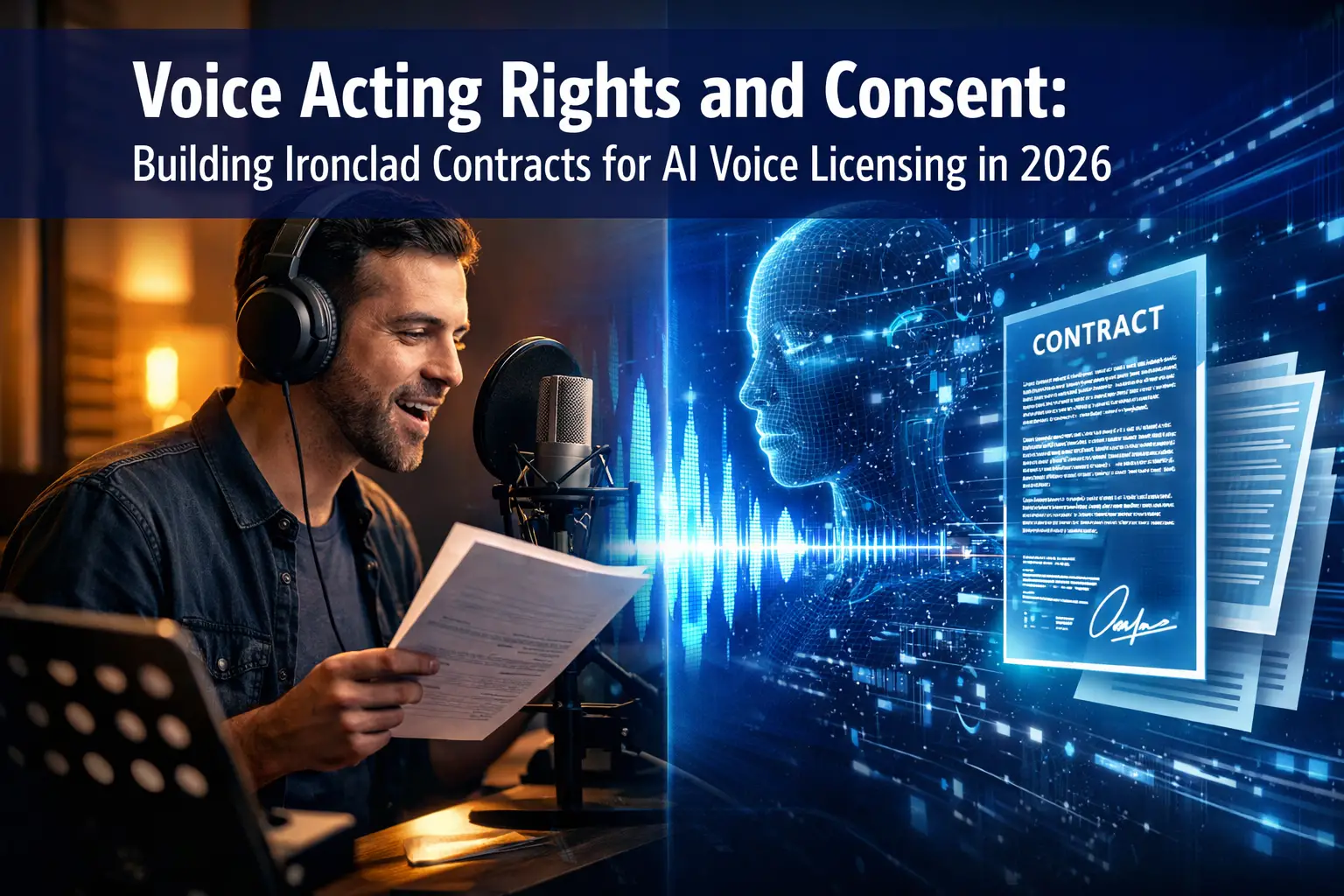
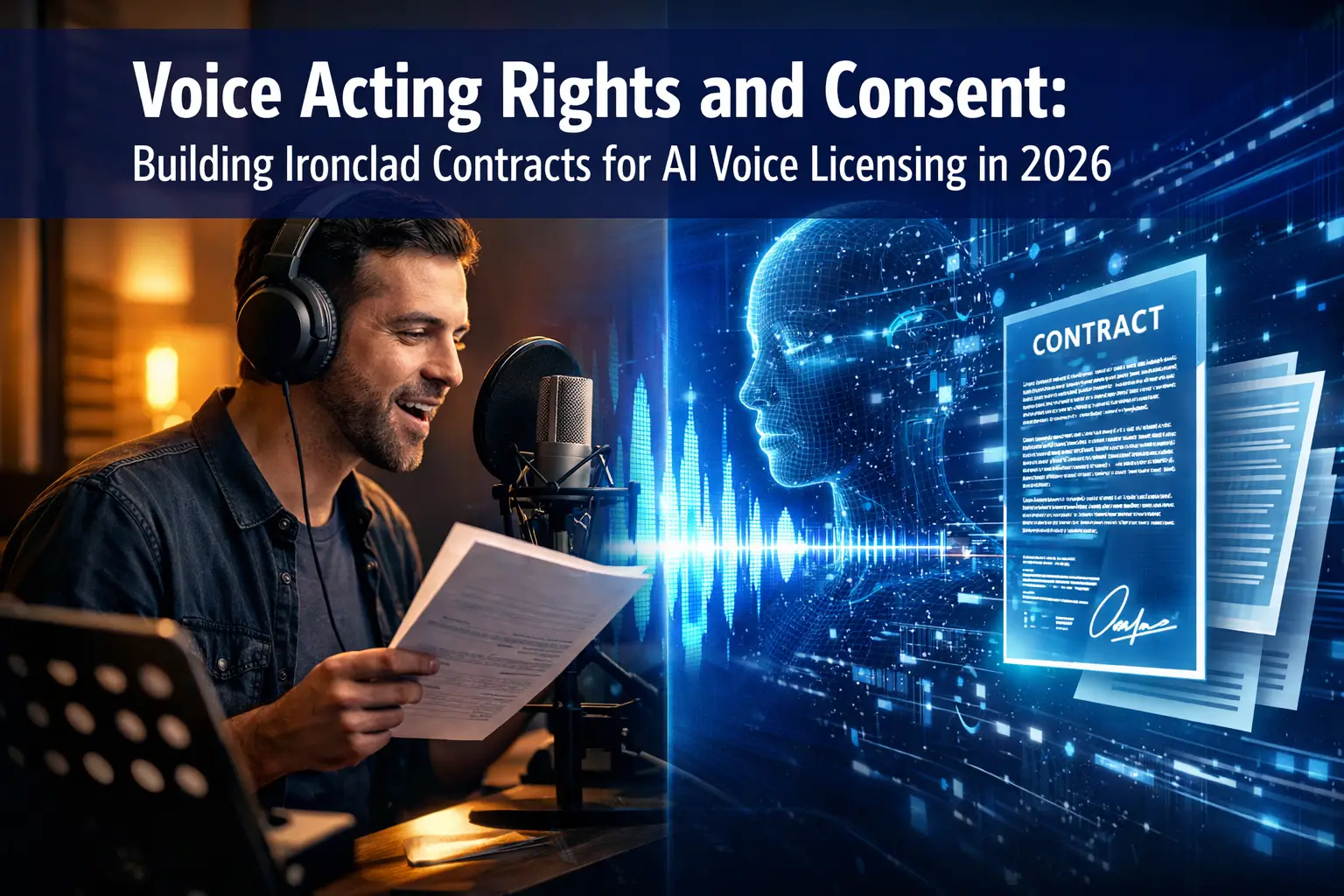
Voice Acting Rights and Consent: Building Ironclad Contracts for AI Voice Licensing in 2026 isn’t just some legal mumbo-jumbo—it’s the difference between controlling your vocal identity and watching an AI version of “you” sell products you’d never endorse, star in projects you’d never accept, and work 24/7 without seeing a dime. The game has changed, and if you’re still signing contracts like it’s 2015, you’re essentially handing over the keys to your career.
Here’s the reality: voice actors are increasingly negotiating per-usage payments instead of flat fees when AI versions of their voices are involved. This isn’t about being difficult or paranoid—it’s about understanding that your voice, once digitized, can work infinitely without rest, and you deserve compensation that reflects that reality.
Key Takeaways
- 🎯 SAG-AFTRA’s 2024 agreements with Replica Studios and other companies established the first industry-standard framework for ethical AI voice licensing, requiring informed consent, per-use negotiation, and fair compensation[1][2]
- 📜 Tennessee’s ELVIS Act became the first state law criminalizing unauthorized voice replication, with California, New York, Illinois, and Texas following with similar protections[4]
- 💰 Modern contracts must include separate compensation for digital replica creation, per-usage fees for AI-generated performances, and clear restrictions on training data use[4]
- ⚖️ Legacy contracts without AI clauses create dangerous legal gaps, leaving performers vulnerable to unauthorized synthetic voice exploitation
- 🔒 Essential protections include opt-out rights, usage scope limitations, term limits, and explicit consent requirements for each new project using your digital voice[1][3]
Understanding the New Landscape: Why Voice Acting Rights and Consent Matter More Than Ever in 2026
Think of your voice like a master recording. In the old days, someone could make copies of that recording, but they needed the physical master. Now? They can create an infinite number of “masters” that sound exactly like you, perform exactly like you, and work without breaks, unions, or health insurance.
That’s both terrifying and—if you play it right—potentially lucrative.
The Groundbreaking SAG-AFTRA Framework
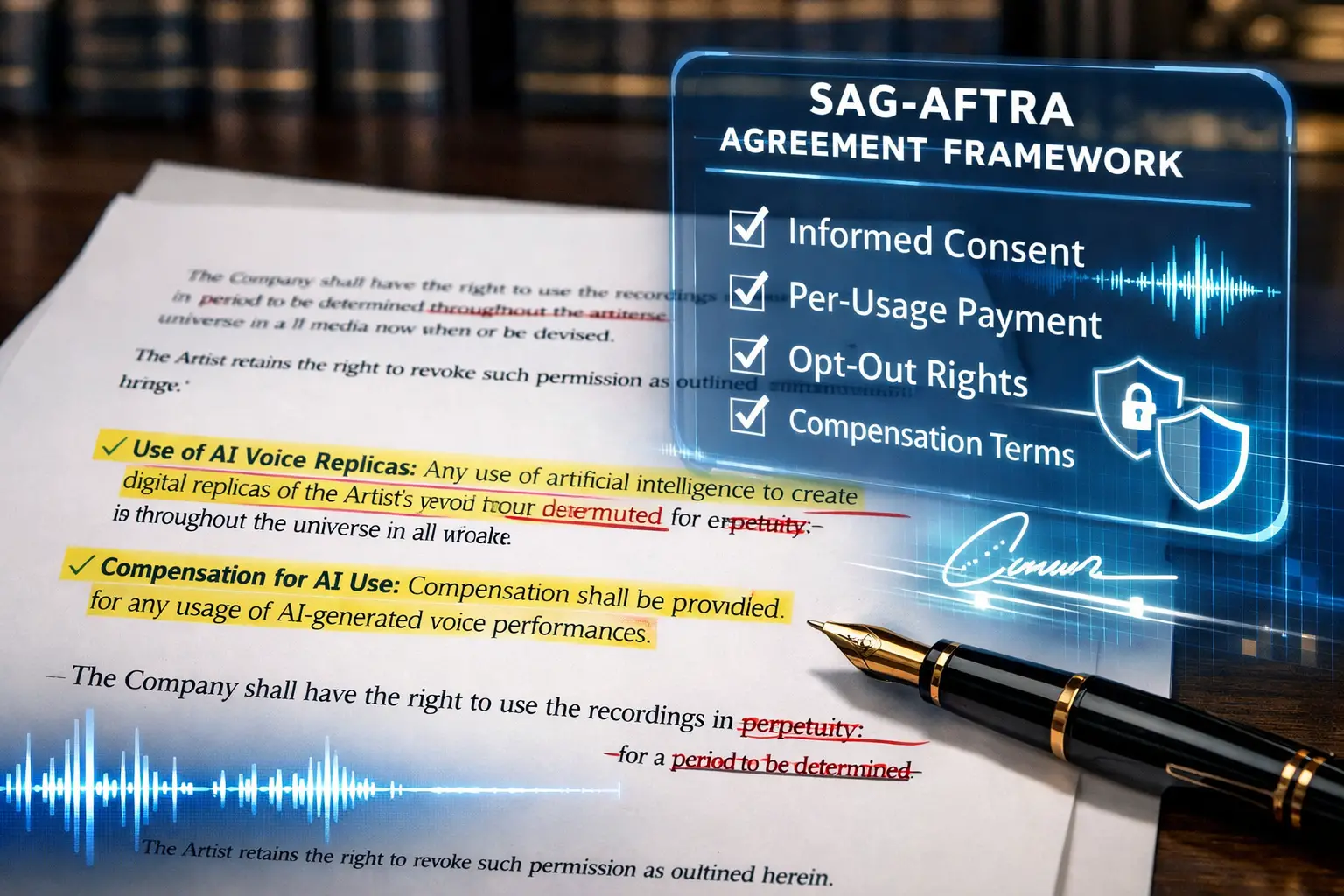
In January 2024, SAG-AFTRA and Replica Studios did something remarkable: they created the first major template for how this should work. This wasn’t some handshake deal or vague understanding—it was a fully negotiated agreement that established four non-negotiable pillars[1]:
- Fully informed performer consent before creating any digital replica
- Separate negotiation and consent for each new use of your digital voice
- The right to opt out of continued use in new works
- Minimum compensation requirements specifically designed for AI technology
This agreement specifically covers video game development and interactive media, which makes sense—these are projects where your character might need to say thousands of lines, respond to player choices, and exist in ways traditional voice work never contemplated[1].
“The SAG-AFTRA-Replica agreement represents a fundamental shift: your consent isn’t a one-time checkbox—it’s an ongoing conversation for every new project.”
Why Traditional Contracts Are Dangerously Outdated
Here’s where I’ve seen actors—even experienced ones—get burned. They sign a standard voiceover contract from 2018 or 2020, do a great session, get paid their day rate, and think that’s the end of it.
Wrong.
Traditional talent agreements almost never address[4]:
- Rights to create or prevent digital doubles
- Ownership or control of AI-generated performances
- Duration and geographic scope of synthetic media use
- Compensation structures for automated reproduction
- Downstream exploitation across multiple projects
It’s like signing away mineral rights to your property without realizing there’s oil underneath. You got paid for the surface land, but someone else is drilling for black gold.
The State-Level Protection Wave
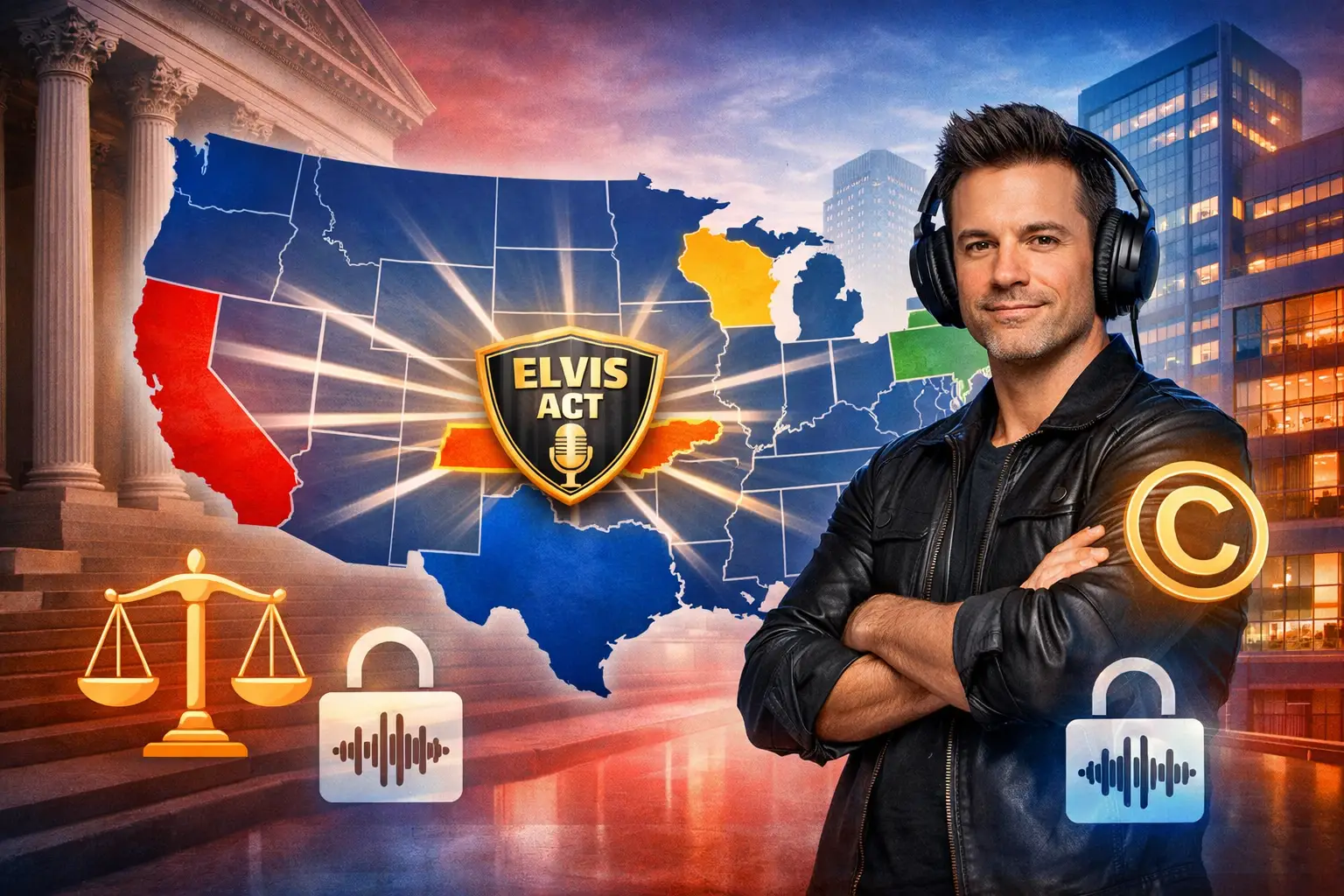
Tennessee didn’t wait for federal action. In March 2024, they passed the ELVIS Act (Ensuring Likeness, Voice, and Image Security)—and yes, the acronym is intentional given Tennessee’s musical heritage. This law made it the first state to expressly criminalize unauthorized digital voice replication and provide civil remedies for infringement[4].
Since then, California, New York, Texas, and Illinois have introduced or strengthened their own statutes. Illinois specifically updated its name/image/voice/likeness law for digital replicas in August 2024[2][4]. This patchwork of state laws means you need to understand not just what protections exist, but where they apply.
Building Your Ironclad Contract: Essential Clauses for Voice Acting Rights and Consent in AI Licensing
Alright, let’s get practical. You’re sitting across from a producer, agent, or tech company representative, and they’re offering you money to create a digital version of your voice. What should be in that contract?
The Informed Consent Clause
This is your foundation—everything else builds on this. Modern agreements require clear, informed, written consent for[4]:
- Voice cloning and digital replica creation
- Use of your likeness in AI tools
- Training models on your voice or image
- Each specific project or use case
The key word here is “informed.” You need to understand exactly what they’re creating, how it will be used, and what limitations exist. I always tell actors: if you can’t explain the deal to your grandmother in two minutes, you don’t understand it well enough to sign it.
Example clause language: “Performer grants consent for the creation of a digital voice replica solely for use in [SPECIFIC PROJECT NAME]. This consent does not extend to any other projects, uses, or applications without separate written agreement and compensation. Performer retains the right to review and approve any use of the digital replica before implementation.”
Scope of Use Limitations
Remember the SAG-AFTRA-Replica agreement? It restricted licensed voices to video game development and interactive media projects from pre-production to final release[1]. That’s specific. That’s limited. That’s what you want.
Your contract should explicitly state:
| Must Include | Why It Matters |
|---|---|
| Specific media types (games, ads, audiobooks, etc.) | Prevents unauthorized use in different formats |
| Geographic limitations | Controls where your digital voice can be used |
| Time limitations/term limits | Ensures the agreement doesn’t last forever |
| Project-specific restrictions | Requires new consent for each new project |
| Exclusivity parameters | Clarifies if you can license to competitors |
Red flag warning: If someone wants “all media, in perpetuity, throughout the universe”—run. That’s not a licensing agreement; that’s a hostile takeover of your vocal identity.
Compensation Structures: Getting Paid What You’re Worth
Here’s where Voice Acting Rights and Consent: Building Ironclad Contracts for AI Voice Licensing in 2026 gets really interesting from a business perspective. The old model was simple: show up, perform, get paid, go home. The new model recognizes that your digital voice is an asset that generates ongoing value.
Modern compensation typically includes three components[4]:
1. Creation Fee This is your payment for the initial recording session that creates the digital replica. Think of it as the “master recording” fee. This should be substantial—you’re not just performing; you’re providing the raw material for potentially unlimited future performances.
2. Per-Usage Fees This is the game-changer. Every time your digital voice is used in a new project, campaign, or product, you get paid. The SAG-AFTRA agreements with Replica Studios, Narrativ (for audio ads), and others have established this as the new standard[1][2].
3. Royalties or Revenue-Sharing When your synthetic voice is used across multiple projects or generates ongoing revenue (like a video game that sells for years), you should participate in that success. This might be structured as:
- Percentage of gross revenue
- Per-unit royalties (per game sold, per ad impression, etc.)
- Milestone payments tied to project success
Example compensation structure:
- Initial creation session: $5,000-$15,000 (depending on scope)
- Per-project licensing fee: $2,500-$7,500 per new use
- Royalty: 2-5% of net revenue generated by products using the digital voice
- Annual renewal fee: $1,000-$3,000 to maintain license
Training Data Restrictions: Protecting Your Voice from Becoming a Teaching Tool
This is the clause most actors don’t think about—and it’s absolutely critical. When you record your voice for a digital replica, those recordings become training data. The question is: training data for what?
Your contract must explicitly address whether your voice can be used to[4]:
- ✅ Create a replica for the specific agreed-upon project
- ❌ Train the company’s internal AI models generally
- ❌ Train third-party or vendor AI systems
- ❌ Generate derivative content not directly controlled by the original producer
- ❌ Improve the AI’s ability to replicate other voices
Think of it this way: you wouldn’t let a director film your performance and then use that footage to teach other actors how to copy your style without permission. The same principle applies to AI training.
Recommended clause: “Performer’s voice recordings may only be used to create the specific digital replica for [PROJECT NAME]. Voice data shall not be used to train general AI models, improve voice synthesis technology, or generate voices other than Performer’s authorized replica. Producer agrees to implement technical safeguards to prevent unauthorized training data use and will provide annual certification of compliance.”
Opt-Out and Termination Rights
Life changes. Your career evolves. Your brand shifts. Maybe you get sober and don’t want your voice selling alcohol anymore. Maybe you become a children’s advocate and don’t want your digital voice in violent video games.
You need the right to opt out[1][3].
The SAG-AFTRA framework established this as a core protection: you can refuse continued use in new works. But you need to make sure your individual contract includes:
- Termination rights with reasonable notice (30-90 days is typical)
- Moral rights protections allowing you to object to uses that harm your reputation
- Reversion clauses that return full rights to you after a certain period
- Change of control provisions that let you renegotiate if the company is sold
I learned this lesson the hard way early in my career when a commercial I’d done for a local business got sold to a national chain I disagreed with philosophically. I had no recourse because I’d signed away all rights. Don’t make my mistake with something as permanent as your digital voice.
Advanced Protections: Voice Acting Rights and Consent Strategies for Experienced Performers
If you’ve been in the business a while, you know that the standard contract is just the starting point. Here’s where you can really protect yourself and maximize value.
The Approval Rights Clause
Never give up approval rights. I don’t care how much they’re paying you. Your digital voice should not appear in any project without your explicit approval of:
- The final script or dialogue
- The context and creative content
- Marketing and promotional uses
- Any modifications or alterations to the voice quality
- Associated visuals, characters, or branding
This isn’t about being difficult—it’s about protecting your reputation. Remember, once your digital voice says something publicly, you said it in the public’s mind.
Storage, Security, and Tracking Requirements
Your voice data is valuable intellectual property. The contract should specify:
Storage requirements:
- Encrypted storage on secure servers
- Limited access to authorized personnel only
- Geographic restrictions on data storage (some actors require US-only storage)
- Regular security audits
Tracking obligations:
- Detailed logs of every use of your digital voice
- Quarterly or annual reports showing all deployments
- Watermarking or fingerprinting technology to track unauthorized use
- Right to audit the company’s use records
Think of this like royalty audits in the music industry—you can’t verify you’re being paid correctly if you can’t verify how your asset is being used.
The “Deepfake Protection” Clause
This is 2026-specific language that didn’t exist in contracts even two years ago. With the rise of sophisticated voice cloning technology, you need explicit protections against unauthorized deepfakes.
Recommended language: “Producer acknowledges that unauthorized use of Performer’s voice or creation of unauthorized voice replicas constitutes both breach of contract and violation of Performer’s rights of publicity under [STATE] law. Producer agrees to: (1) implement reasonable technical measures to prevent unauthorized voice cloning; (2) pursue legal action against third parties who create unauthorized replicas; (3) indemnify Performer for damages resulting from Producer’s failure to protect voice data; and (4) pay liquidated damages of $[AMOUNT] per unauthorized use discovered.”
Multi-Project and Franchise Considerations
If you’re voicing a character that might appear across multiple games, sequels, or franchise expansions, you need special provisions:
Option structure: Rather than granting unlimited rights, grant the producer options to license your voice for future projects at pre-negotiated rates. This gives them planning certainty while ensuring you participate in franchise success.
Example:
- Initial game: $10,000 creation fee + $5,000 project fee
- Sequel option: $7,500 per sequel (producer has 90 days after prior release to exercise)
- DLC/expansion option: $3,000 per expansion
- Maximum option period: 5 years from initial release
The Sound Recording Code Standards
In April 2024, SAG-AFTRA members ratified the Sound Recording Code, which established AI-specific standards requiring[2]:
- Clear and conspicuous consent
- Minimum compensation levels
- Specific details of intended use before release
- Critical specification that “artist,” “singer,” and “royalty artist” only include humans
If you’re doing any recording work that might be used for AI purposes, insist that your contract meets or exceeds Sound Recording Code standards, even if you’re not a SAG-AFTRA member. These represent industry best practices developed through extensive negotiation.
Real-World Application: Negotiating Your Agreement in 2026
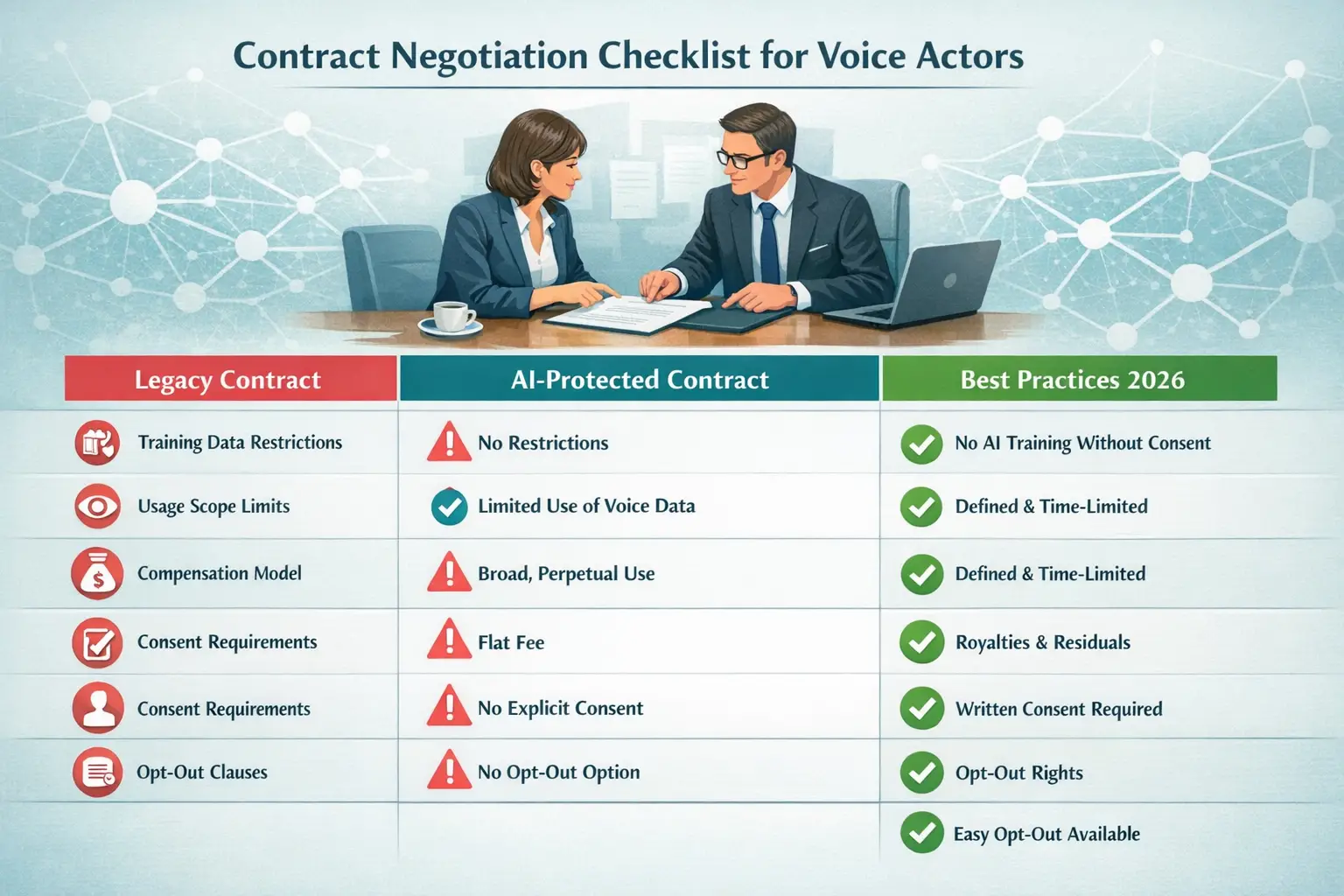
Theory is great, but let’s talk about what happens when you’re actually sitting in that meeting.
Know Your Leverage
Your negotiating power depends on several factors:
High leverage situations:
- You have a distinctive, recognizable voice
- You’re established in a particular niche (video games, audiobooks, commercials)
- The project specifically needs your voice (character continuity, brand association)
- You’re represented by strong agents or attorneys
- You’re a SAG-AFTRA member with union backing
Lower leverage situations:
- You’re new to the industry
- Your voice is more “generic” or easily replaced
- It’s a one-off project with no franchise potential
- You’re non-union without representation
Even with lower leverage, you can still negotiate meaningful protections—you just need to be strategic about which points matter most.
The Negotiation Priority List
You probably won’t get everything you want. Here’s how I’d prioritize:
Non-negotiable (walk away if you can’t get these):
- Written informed consent requirement
- Project-specific scope limitations
- Right to approve final uses
- Basic compensation for creation and usage
Highly desirable (push hard for these): 5. Per-usage payment structure 6. Opt-out and termination rights 7. Training data restrictions 8. Moral rights protections
Nice to have (accept if offered, don’t die on these hills): 9. Revenue sharing or royalties 10. Approval of modifications 11. Geographic restrictions 12. Exclusive audit rights
Common Negotiation Tactics (and Counters)
They say: “This is our standard agreement; we can’t change it.”
You say: “I understand you have a standard form, but AI voice licensing isn’t standard—it’s new territory. Given the unique nature of digital voice rights, I need these specific protections. Can we add them as a rider or amendment?”
They say: “We’re paying you a premium rate, so we need broad rights.”
You say: “I appreciate the premium rate for the creation session. I’m happy to grant broad rights for this specific project. For additional projects or uses, let’s structure options at favorable rates so you have planning certainty and I’m fairly compensated for ongoing use.”
They say: “We need to use your voice data to improve our AI technology.”
You say: “I’m comfortable with you using my voice to create the replica for our project. For broader AI training purposes, that’s a separate value proposition. Let’s discuss additional compensation for training data licensing, or we can exclude that from this agreement.”
When to Bring in Professional Help
Look, I’m all for actors being business-savvy and handling their own affairs. But there are times when you need to bring in the professionals:
- Entertainment attorney: When the deal is worth more than $10,000, involves multi-year commitments, or includes complex IP provisions
- Agent or manager: When you’re negotiating with major studios, established tech companies, or franchise opportunities
- SAG-AFTRA representation: When you’re a union member—use your union resources!
- IP specialist: When the agreement involves training data licensing or technology you don’t fully understand
The cost of professional representation is almost always less than the cost of a bad deal.
The Multiple Industry Agreements: Learning from Precedent
Since the groundbreaking SAG-AFTRA-Replica agreement, we’ve seen several other major deals that provide templates for your own negotiations.
SAG-AFTRA and Narrativ (August 2024)
This agreement specifically addressed audio advertising, allowing members to safely license digital voice replicas for ads[2]. Key provisions included:
- Separate consent for each advertising campaign
- Higher per-use fees reflecting the commercial nature of ads
- Strict limitations on ad content (no controversial products without explicit consent)
- Short-term licenses (typically 6-12 months) rather than perpetual rights
Lesson for actors: Advertising use should command premium rates and shorter license terms than entertainment use.
Animation Agreement Enhancements (March 2024)
SAG-AFTRA members ratified enhanced voice replica protections in the Animation Agreement[2]. This is particularly relevant because animated characters often span multiple seasons, films, and franchise extensions.
Key innovation: The concept of “character continuity compensation”—recognizing that your digital voice maintains character consistency across productions and deserves ongoing payment.
Lesson for actors: Character work deserves special consideration in AI licensing, including franchise participation rights.
Nickelodeon Tentative Agreement (May 2025)
This agreement included substantial AI protections for voice actors working on children’s content[2]. Given the sensitive nature of children’s media, protections included:
- Enhanced moral rights allowing actors to object to content changes
- Restrictions on using children’s character voices for non-children’s content
- Parental/guardian consent requirements for minor performers
- Strict limitations on training data use
Lesson for actors: The nature of the content matters—children’s media, educational content, and other sensitive categories warrant enhanced protections.
Protecting Yourself Beyond the Contract
A great contract is essential, but it’s not sufficient. Here’s what else you need to do:
Document Everything
- Keep copies of all recording sessions
- Maintain logs of when and where you granted consent
- Screenshot or save all communications about AI voice use
- Create a “digital voice portfolio” tracking all licensed uses
Monitor Your Digital Presence
Set up Google Alerts for your name plus terms like “AI voice,” “voice clone,” or “digital replica.” Regularly search for unauthorized uses of your voice. There are also emerging services that scan for unauthorized voice clones—consider subscribing to one.
Build Your Legal War Chest
If you’re regularly licensing your voice for AI use, set aside 10-15% of your AI-related income for potential legal expenses. Enforcement of these new rights often requires legal action, and you need resources to protect yourself.
Stay Informed on Legislative Changes
Voice protection laws are evolving rapidly. Follow:
- SAG-AFTRA updates and bulletins
- State legislature activity in your state
- Industry publications covering AI and entertainment law
- Professional organizations like NAVA (National Association of Voice Actors)[3]
Network with Other Performers
Join communities of voice actors dealing with AI issues. Share information about which companies honor their agreements, which try to push boundaries, and which outright violate contracts. Collective knowledge is powerful protection.
Looking Ahead: The Future of Voice Acting Rights and Consent
Here’s what I see coming based on current trends and conversations with industry insiders:
Federal Legislation Likely by 2027-2028
The patchwork of state laws is creating compliance headaches for producers and protection gaps for performers. Expect federal legislation addressing digital voice rights, likely modeled on Tennessee’s ELVIS Act but with broader scope[4][6].
Blockchain-Based Rights Management
Several companies are developing blockchain systems to track AI voice usage, automate royalty payments, and create immutable records of consent. This technology could solve many enforcement challenges.
AI Voice “Unions” and Collectives
Just as musicians have performance rights organizations (ASCAP, BMI), expect to see organizations that collectively license and monitor AI voice usage, ensuring performers are paid when their digital voices are used.
Standardized Contract Templates
Industry groups are working on standardized contract templates for different use cases (advertising, gaming, audiobooks, etc.). These will provide baseline protections while allowing customization for specific deals.
Enhanced Detection Technology
As AI voice cloning becomes more sophisticated, so does detection technology. Expect tools that can identify unauthorized voice clones and trace them back to their source, making enforcement more practical.
Conclusion: Your Voice, Your Rights, Your Future
Listen—Voice Acting Rights and Consent: Building Ironclad Contracts for AI Voice Licensing in 2026 isn’t just about protecting yourself from bad deals. It’s about embracing the future while ensuring you’re compensated fairly for the value you create.
I’ve seen too many talented performers get exploited over my three decades in this business—from actors who signed away their image rights for a pittance to voice actors whose work was used in ways they never imagined or approved. The AI revolution amplifies these risks exponentially, but it also creates unprecedented opportunities for those who approach it strategically.
Your voice is unique. It’s the product of your training, your experience, your instrument, and your artistry. When you license it for AI use, you’re not just selling a performance—you’re licensing an asset that can generate value indefinitely.
Your Action Plan
This week:
- Review any existing contracts you’ve signed—do they have AI provisions?
- Consult with an entertainment attorney if you have any active AI voice licensing
- Join SAG-AFTRA if you’re eligible, or NAVA if you’re not[3]
This month: 4. Create your “ideal contract” template incorporating the protections discussed here 5. Set up monitoring systems for unauthorized voice use 6. Network with other voice actors navigating AI licensing
This year: 7. Negotiate at least one AI voice licensing deal using these principles 8. Build relationships with attorneys and agents who understand AI voice rights 9. Stay current on legislative changes in your state and federally
The technology isn’t going away. AI voice synthesis will only become more sophisticated, more accessible, and more ubiquitous. But that doesn’t mean you have to be a victim of it. With the right knowledge, the right contract protections, and the right advocacy, you can thrive in this new landscape.
Your voice has carried you this far in your career. Make sure it continues to work for you, not against you, as we move deeper into the AI age.
Now get out there, protect your instrument, and negotiate like your career depends on it—because it does. 🎭🎙️
References
[1] Sag Aftra And Replica Studios Introduce Groundbreaking Ai Voice Agreement Ces – https://www.sagaftra.org/sag-aftra-and-replica-studios-introduce-groundbreaking-ai-voice-agreement-ces
[2] Sag Aftra Ai Bargaining And – https://www.sagaftra.org/contracts-industry-resources/member-resources/artificial-intelligence/sag-aftra-ai-bargaining-and
[3] Synth Ai – https://navavoices.org/synth-ai/
[4] Synthetic Media Voice Cloning And The New Right Of Publicity Risk Map For 2026 – https://holonlaw.com/entertainment-law/synthetic-media-voice-cloning-and-the-new-right-of-publicity-risk-map-for-2026/
[5] Will Ai Replace Voice Actors – https://www.respeecher.com/blog/will-ai-replace-voice-actors
[6] 2026 Ai Legal Forecast From Innovation To Compliance – https://www.bakerdonelson.com/2026-ai-legal-forecast-from-innovation-to-compliance
[7] Ai Clauses Entertainment Contracts – https://rodriqueslaw.com/blog/ai-clauses-entertainment-contracts/