
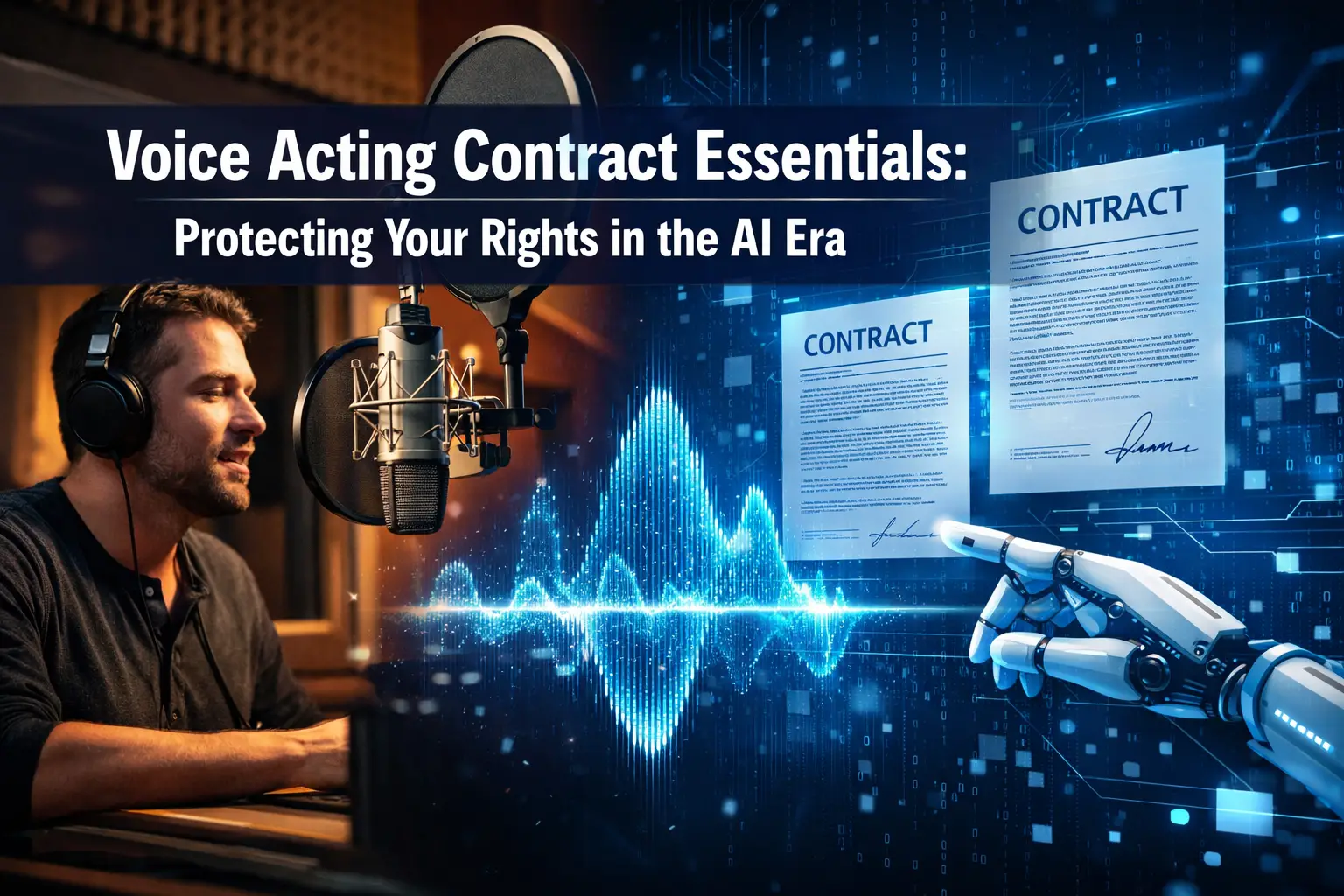
The voice acting industry stands at a crossroads in 2026. While technology opens unprecedented opportunities for performers, it also introduces complex challenges that demand immediate attention. Voice Acting Contract Essentials: Protecting Your Rights and Negotiating Fair Compensation in the AI Era has become more critical than ever as artificial intelligence capabilities expand, threatening to use performer identities without proper authorization or payment. The contracts signed today will determine whether voice actors maintain control over their careers or lose their most valuable asset—their unique vocal identity.
Key Takeaways
- AI voice usage requires explicit written consent in modern contracts, with specific clauses defining how, when, and for what duration voice synthesis can occur
- Three core protections—informed consent, fair compensation, and creative control—form the foundation of ethical AI voice licensing agreements in 2026
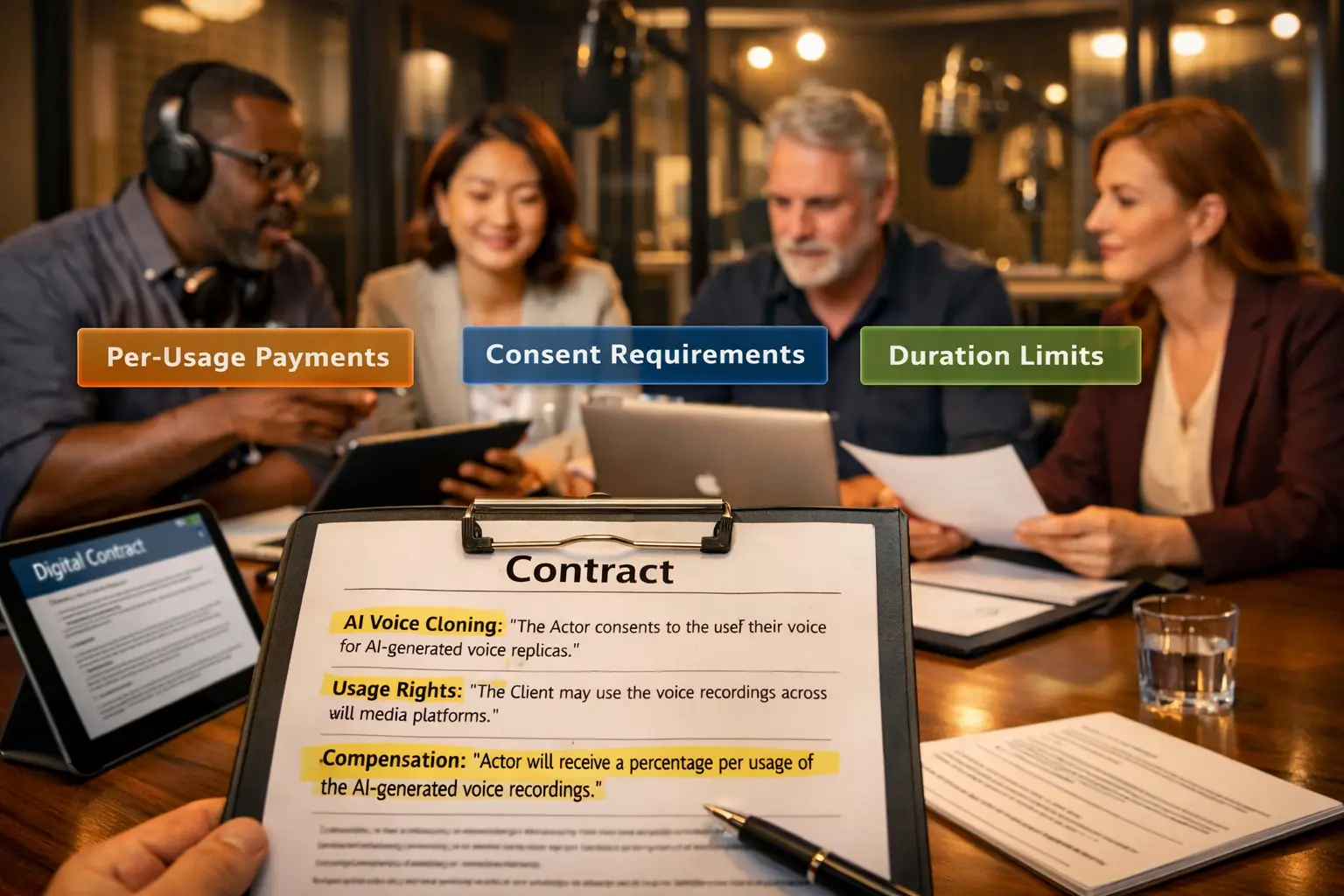
- Per-usage payment models and revenue sharing arrangements ensure voice actors receive ongoing compensation when AI clones of their voices generate work
- State-level legislation now provides baseline protections for voice and likeness rights, independent of union membership status
- Human voice actors remain in high demand for emotionally-driven content, with more than half of companies planning to use real performers for brand marketing
Understanding the New Landscape of Voice Acting Contracts
The entertainment industry has undergone seismic shifts since AI voice synthesis technology became commercially viable. What once seemed like science fiction—creating perfect replicas of human voices—now represents standard capabilities for major production companies. This technological leap forward demands equally sophisticated legal protections.
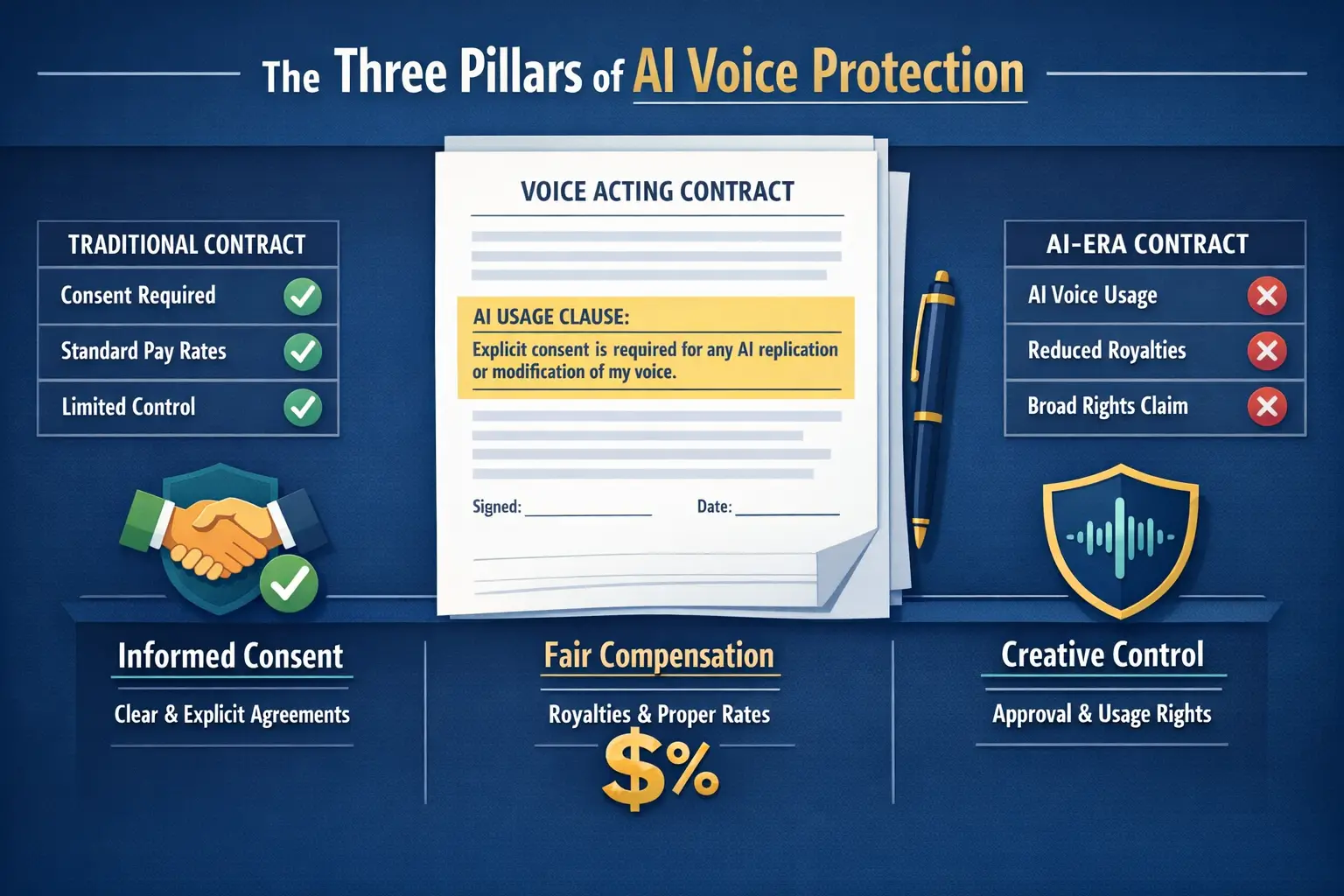
Traditional voice acting contracts focused primarily on usage rights, payment terms, and credit attribution. These elements remain important, but they no longer provide adequate protection. Modern agreements must address an entirely new category of concerns: what happens to a performer’s voice after the initial recording session ends.
The Three Pillars of AI Voice Protection
SAG-AFTRA established formal AI guardrails requiring three core protections that have become industry standards: informed consent, compensation, and control over voice and likeness use. Companies like Ethovox that agree to these standards enable union performers to participate in AI voice licensing while maintaining protections.[3]
These pillars work together to create a comprehensive safety net:
Informed Consent means performers must understand exactly how their voice will be used before signing any agreement. Vague language like “future technologies” or “derivative works” no longer suffices. Contracts must specify whether producers can use an actor’s voice to generate synthetic performances.[4]
Fair Compensation ensures performers receive payment proportional to how their voice is used. A single recording session cannot grant unlimited future use without additional payment.
Creative Control allows performers to approve or reject specific uses of their AI voice clone, protecting against brand misalignment or offensive content.
Essential Contract Clauses Voice Actors Must Demand
Voice Acting Contract Essentials: Protecting Your Rights and Negotiating Fair Compensation in the AI Era begins with understanding which specific contract provisions provide meaningful protection. The following clauses represent non-negotiable elements that every voice actor should insist upon in 2026.
AI Usage Specification Clauses
Three contract elements now define AI voice protections in emerging industry standards: AI usage clauses specifying how and when synthesis can occur, revenue share models for AI-generated work using performer identity, and duration limits setting time-based boundaries on voice use after authorization.[1]
An effective AI usage clause should include:
- Explicit permission requirements for creating voice models or clones
- Specific project limitations defining which productions can use the AI voice
- Technical restrictions on how the voice can be modified or combined with other elements
- Approval rights for each new use of the AI-generated voice
- Prohibition against third-party licensing without additional consent
💼 Sample Language: “Producer may create a digital voice model of Performer’s voice solely for use in the podcast series ‘Tech Tomorrow’ Season 1, Episodes 1-12. Any use of said voice model beyond these specified episodes requires separate written authorization and compensation negotiation.”
Per-Usage Payment and Revenue Sharing Models
The traditional “buyout” model—where performers receive a single payment for unlimited use—proves particularly problematic in the AI era. A single recording session could theoretically generate infinite content, making one-time payments grossly inadequate.
Modern compensation structures should include:
| Compensation Model | Description | Best For |
|---|---|---|
| Per-Episode Fee | Fixed payment each time AI voice appears | Serialized content (podcasts, series) |
| Revenue Percentage | 2-5% of gross revenue from AI-voiced content | Commercial advertising, branded content |
| Hybrid Model | Base fee plus performance bonuses | High-visibility projects with uncertain reach |
| Annual Licensing Fee | Yearly payment for ongoing AI voice access | Long-term brand partnerships |
| Usage Tier System | Escalating fees based on distribution scope | Projects with expanding audiences |
Real human voice actors remain in high demand despite AI advances. More than half of companies surveyed in 2025 planned to use real human voice actors for brand marketing, with nearly half still requiring them for animation, broadcast, and television production.[2] This continued demand strengthens negotiating positions for fair compensation.
Duration and Termination Provisions
Time-based limitations represent one of the most powerful protections voice actors can negotiate. Without explicit duration limits, companies might claim perpetual rights to voice models.
Essential duration provisions include:
✅ Fixed term lengths (e.g., “This authorization expires 24 months from the date of signature”)
✅ Renewal requirements mandating renegotiation for continued use
✅ Termination rights allowing performers to revoke AI voice permissions
✅ Model destruction clauses requiring deletion of voice models upon contract expiration
✅ Sunset provisions that automatically terminate rights if not actively used within specified timeframes
Matthew McConaughey’s investment in voice AI company ElevenLabs signals an industry pivot, with his public stance emphasizing that “AI innovations are welcome, but only with authorization,” reflecting broader creator demand for transparent consent protocols, smart licensing structures, and creative control over identity representation.[1]
Modification Triggers and Renegotiation Rights
If AI editing affects credit or compensation, contracts should now include clauses triggering renegotiation discussions. Performers may grant limited AI permissions for color correction or dialogue smoothing but retain protection against facial substitution or age modification.[4]
Modification trigger clauses should specify:
- What degree of AI alteration requires additional approval
- How compensation adjusts when AI significantly changes performance
- Credit requirements when AI substantially modifies original work
- Rights to withdraw consent if modifications exceed agreed parameters
🎯 Example Scenario: A voice actor records dialogue for a video game character. The producer later wants to use AI to create additional dialogue in different languages, or age the character’s voice for flashback sequences. Without modification triggers, the original contract might inadvertently grant these rights. With proper clauses, each significant change requires new negotiation.
Protecting Against Unauthorized AI Training and Data Mining
One of the most insidious threats facing voice actors in 2026 involves the unauthorized use of their performances as training data for AI systems. Companies have attempted to bury broad permissions within standard distribution agreements.
Machine Learning Exclusion Clauses
Streaming and machine-learning clauses require explicit exclusions. Modern distribution agreements increasingly contain “machine-learning” clauses granting distributors rights to analyze engagement data. Filmmakers and performers must now explicitly exclude film content from use as AI training material.[4]
Voice actors should insist on language such as:
📋 “Performer’s voice recordings and performances may not be used, in whole or in part, to train artificial intelligence systems, machine learning algorithms, voice synthesis models, or any similar technology without separate written agreement and compensation.”
Data Use Restrictions and Ethical AI Provisions
Beyond preventing training data exploitation, performers should demand ethical AI use provisions that align with their values:
- No deepfake creation for misleading or deceptive purposes
- Prohibition against offensive content generation using performer’s voice
- Brand safety requirements preventing association with controversial products or messages
- Transparency obligations requiring disclosure when AI voices are used
- Audit rights allowing performers to verify compliance with restrictions
State-level legislation codified voice and likeness protections between 2023 and 2025, with states from California to New York enacting specific legal protections previously left to contract or case law. This legislative foundation now forms baseline protections independent of union status.[4]
Voice Acting Contract Essentials: Special Considerations for Emerging Markets
The globalization of content and emergence of new media formats create additional contract complexities that voice actors must address.
Multilingual and Localization Rights
Multilingual voice work faces new opportunities and protections. Spanish, French, German, Chinese, and Hindi remain key growth languages for voice content. Speech-to-speech translation advances create international opportunities, requiring voice actors and producers to implement cross-cultural contract clauses protecting localization rights and compensation.[2]
Key multilingual provisions should address:
- Whether AI can translate the performer’s voice into other languages
- Compensation structures for each language version created
- Cultural sensitivity review processes
- Rights to approve translated content before release
- Separate negotiations for high-value markets
Immersive Media and VR/AR Contracts
New immersive media formats (VR/AR) created unexpected voice acting growth. Virtual reality and augmented reality content, used for training, entertainment, and wellness, generated new voice acting roles in 2025-2026, with performers commanding premium rates for 360-degree performance work.[2]
These emerging formats require specialized contract provisions:
🎮 Interactive Content Clauses: Address how voice is used in user-driven narratives where dialogue order and frequency vary
🥽 Spatial Audio Rights: Define compensation for 3D audio implementations that require additional technical processing
♾️ Perpetual Interaction Scenarios: Protect against unlimited AI-generated responses in virtual assistant or gaming applications
Negotiation Strategies for Fair Compensation
Understanding what to demand represents only half the battle. Voice actors must also develop effective negotiation strategies to secure these protections.
Leveraging Market Position and Demand
AI voice quality remains a limiting factor for replacement. The top consideration when selecting AI voices is how closely output resembles human performance—a capability most systems currently lack. Cost and turnaround are secondary factors, suggesting AI adoption will be gradual for quality-sensitive projects.[2]
This quality gap provides negotiating leverage:
💪 Emphasize unique qualities that AI cannot replicate (emotional range, improvisation, character development)
💪 Highlight project-specific value such as established audience relationships or brand recognition
💪 Reference industry standards established by SAG-AFTRA and other professional organizations
💪 Present alternative compensation models rather than simply rejecting producer proposals
💪 Build coalition power by coordinating with other performers on shared projects
When to Walk Away
Not every contract can be salvaged through negotiation. Voice actors must recognize red flags that indicate fundamentally problematic agreements:
🚩 Refusal to specify AI usage limitations
🚩 Demands for perpetual, unlimited rights
🚩 Resistance to any revenue sharing or ongoing compensation
🚩 Unwillingness to include termination provisions
🚩 Vague language that resists clarification attempts
🚩 Pressure tactics or artificial urgency to sign quickly
Industry analysis confirms that as AI voices become more common, human warmth and nuance function as primary differentiators. Some filmmakers and advertisers explicitly market content as “AI-free” to signal commitment to human talent and authenticity.[2] This trend strengthens the position of performers willing to hold firm on contract standards.
Building Long-Term Relationships with Ethical Producers
The most successful voice actors in 2026 focus on cultivating relationships with producers who respect performer rights. These partnerships prove more valuable than any single contract.
Strategies for identifying ethical partners include:
✨ Researching company AI policies before auditions or negotiations
✨ Requesting references from other performers who have worked with the producer
✨ Evaluating contract proposals as indicators of company values
✨ Prioritizing repeat business with proven ethical partners
✨ Participating in industry organizations that maintain ethical producer directories
Union Protections and Individual Contracts
While union membership provides significant advantages, many voice actors work as independent contractors. Understanding the relationship between collective bargaining agreements and individual contracts proves essential.
SAG-AFTRA Standards and Minimum Terms
The 2026 contract negotiations between SAG-AFTRA and major studios will establish baseline protections that ripple throughout the industry.[5] Even non-union performers benefit from these standards, as they establish industry norms that ethical producers typically follow.
Union agreements typically provide:
- Minimum compensation rates for various project types
- Standard AI protection clauses that can be incorporated into individual contracts
- Grievance procedures for contract violations
- Health and pension contributions based on earnings
- Collective bargaining power that individual performers cannot match
Adapting Union Standards for Independent Work
Non-union voice actors can strengthen their contracts by adapting union language to independent agreements:
- Review current SAG-AFTRA agreements to understand standard protections
- Extract relevant clauses applicable to specific project types
- Modify language to fit independent contractor relationships
- Present adapted provisions as industry-standard expectations
- Emphasize mutual benefit of clear, fair agreements
Practical Steps for Implementation
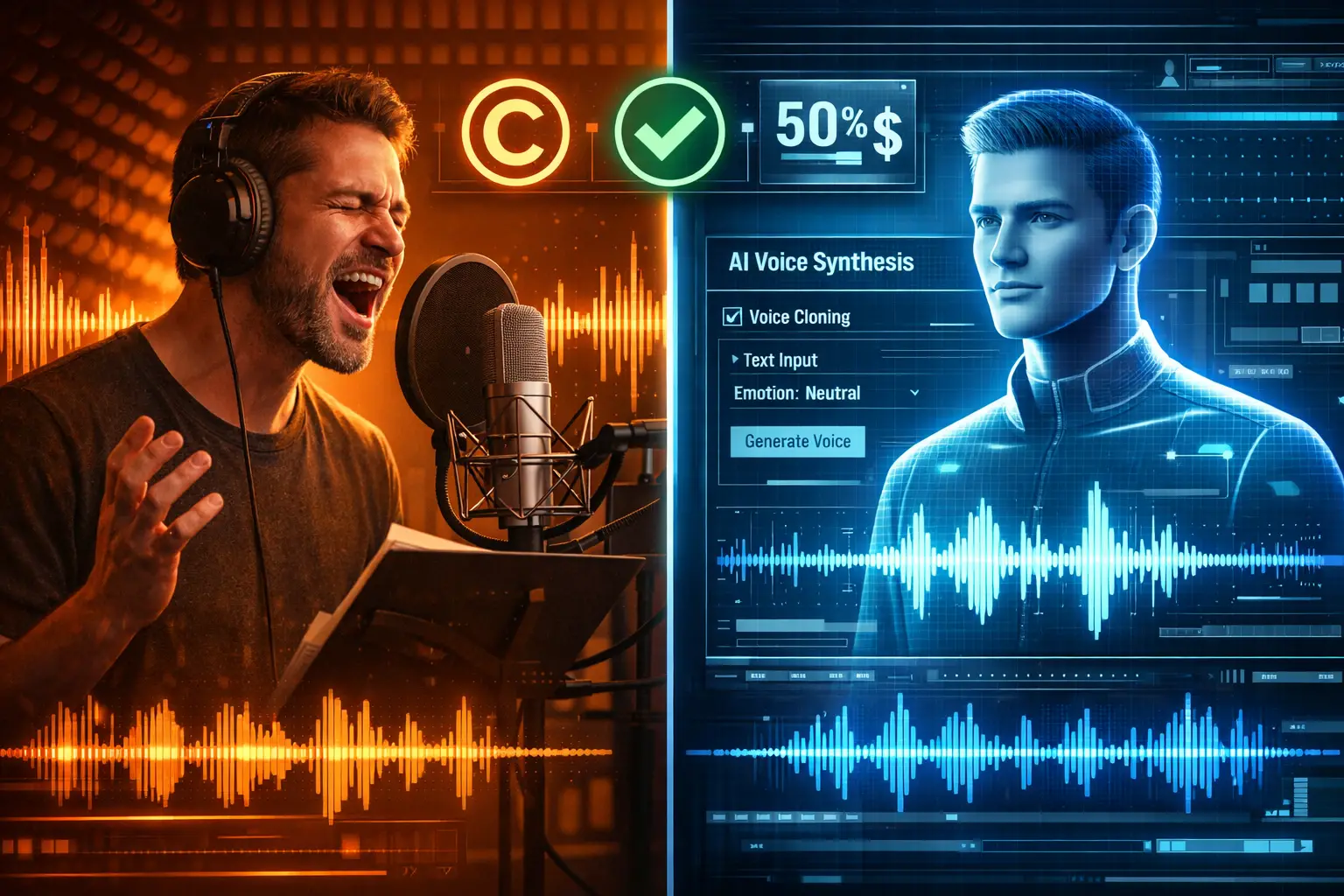
Voice Acting Contract Essentials: Protecting Your Rights and Negotiating Fair Compensation in the AI Era requires action, not just knowledge. The following implementation steps help voice actors put these principles into practice.
Contract Review Checklist
Before signing any voice acting agreement in 2026, review against this comprehensive checklist:
AI Usage Provisions:
- Explicit consent required for voice model creation
- Specific projects and uses clearly defined
- Approval rights for each new AI voice application
- Prohibition against unauthorized third-party licensing
- Technical restrictions on voice modification
Compensation Structure:
- Clear payment amounts and timing specified
- Revenue sharing or per-usage fees for AI-generated content
- Escalation clauses for expanded use
- Payment tracking and audit rights
- Currency and payment method defined
Duration and Termination:
- Fixed term length specified
- Renewal requirements clearly stated
- Performer termination rights included
- Voice model destruction upon expiration
- Sunset provisions for inactive use
Data Protection:
- Machine learning training explicitly prohibited
- Ethical AI use restrictions included
- Brand safety requirements specified
- Audit and verification rights granted
- Transparency obligations for AI disclosure
Special Provisions:
- Multilingual and localization rights addressed
- Modification triggers and renegotiation rights
- Credit and attribution requirements
- Dispute resolution procedures
- Governing law and jurisdiction specified
Resources for Legal Support
Contract review often requires professional legal assistance. Voice actors should consider:
Entertainment Attorneys: Specialists in performer rights and AI issues provide the most sophisticated guidance, though at premium rates.
Legal Clinics: Many bar associations offer reduced-fee or pro bono services for artists and performers.
Union Resources: SAG-AFTRA and other unions provide contract review services for members.
Peer Networks: Professional voice acting communities often share contract templates and negotiation experiences.
Online Platforms: Services like Volunteer Lawyers for the Arts connect performers with legal professionals.
Building Your Contract Template Library
Rather than negotiating from scratch for each project, successful voice actors develop template libraries containing:
📁 Standard AI protection clauses ready to insert into producer agreements
📁 Alternative compensation models for different project types
📁 Modification and amendment language for existing contracts
📁 Termination and exit provisions protecting long-term interests
📁 Special provisions for emerging technologies and formats
These templates accelerate negotiations and ensure consistent protection across all projects.
The Future of Voice Acting Contracts
As 2026 progresses, the voice acting industry continues evolving. Contract standards established today will shape the profession for decades.
Emerging Trends to Monitor
Several developments warrant close attention:
Blockchain-Based Rights Management: Smart contracts on blockchain platforms may automate usage tracking and compensation distribution, ensuring performers receive payment whenever their AI voice generates content.
Standardized Licensing Platforms: Industry-wide platforms similar to music licensing services may emerge, creating transparent marketplaces for AI voice rights.
Enhanced Detection Technology: New tools that identify unauthorized AI voice use will strengthen enforcement of contract provisions.
International Harmonization: As voice content crosses borders, international standards for AI voice rights may develop, requiring contract provisions that address multiple jurisdictions.
Collective Licensing Models: Voice actors may form collectives that negotiate group licensing agreements, similar to music performance rights organizations.
Maintaining Relevance in an AI-Augmented Industry
AI will not fully replace human voices in emotionally-driven content. Industry analysis confirms that as AI voices become more common, human warmth and nuance function as primary differentiators.[2]
Voice actors who thrive in this environment will:
🎭 Emphasize irreplaceable human qualities like emotional authenticity and creative interpretation
🎭 Develop specialized skills that AI cannot easily replicate
🎭 Build personal brands that audiences specifically seek out
🎭 Maintain strict contract standards that preserve the value of human performance
🎭 Collaborate with ethical AI companies on mutually beneficial terms
Conclusion: Taking Control of Your Voice Acting Career
Voice Acting Contract Essentials: Protecting Your Rights and Negotiating Fair Compensation in the AI Era represents more than legal technicalities—it determines whether voice actors maintain professional dignity and fair compensation in an industry transformed by technology. The contracts signed today will either protect performers’ livelihoods or allow exploitation of their most valuable asset.
The power dynamic between performers and producers remains unequal, but knowledge and solidarity provide leverage. By understanding essential contract provisions, demanding fair compensation structures, and refusing to accept inadequate protections, voice actors collectively establish industry standards that benefit all performers.
Actionable Next Steps
Immediate Actions (This Week):
- Review all current contracts for AI-related provisions and identify gaps
- Create a checklist based on this article for evaluating future agreements
- Join professional organizations like SAG-AFTRA or voice acting communities
- Research entertainment attorneys or legal resources in your area
Short-Term Actions (This Month):
- Develop template contract clauses for AI protection, compensation, and duration limits
- Network with other voice actors to share contract experiences and negotiation strategies
- Educate yourself on state-level voice and likeness protection laws in your jurisdiction
- Begin conversations with current clients about updating existing agreements
Long-Term Actions (This Year):
- Build relationships with ethical producers who respect performer rights
- Develop specialized skills that differentiate your work from AI-generated voices
- Participate in industry advocacy for stronger legal protections
- Create a sustainable business model that doesn’t depend on exploitative contract terms
The voice acting profession stands at a critical juncture. Technology offers remarkable opportunities for those who approach it with clear boundaries and fair agreements. By demanding contracts that respect performer rights, ensure fair compensation, and maintain creative control, voice actors can embrace AI innovations while preserving the human artistry that makes their work irreplaceable.
The choice is clear: accept inadequate protections and watch the profession deteriorate, or stand firm on contract essentials that preserve both livelihood and artistic integrity. The future of voice acting depends on the contracts signed today.
References
[1] Matthew Mcconaughey And The Ai Frontier Consent Control And The Future Of Voice In Entertainment – https://resident.com/tech-and-gear/2026/01/21/matthew-mcconaughey-and-the-ai-frontier-consent-control-and-the-future-of-voice-in-entertainment
[2] Voice Acting In 2025 2026 Trends Insights And The Future – https://www.gravyforthebrain.com/voice-acting-in-2025-2026-trends-insights-and-the-future/
[3] Sag Aftra X Ethovox – https://www.sagaftra.org/sag-aftra-x-ethovox
[4] Ai Clauses Entertainment Contracts – https://rodriqueslaw.com/blog/ai-clauses-entertainment-contracts/
[5] Why Sag Aftras 2026 Contract Talks Matter For Los Angeles And The Business Of Hollywood – https://lamag.com/arts-and-entertainment/why-sag-aftras-2026-contract-talks-matter-for-los-angeles-and-the-business-of-hollywood/