



Let me tell you something after three decades in this business: the most talented actor in the room isn’t always the one who books the job—it’s often the one who knows how to negotiate their worth. As we navigate the Business of Acting 2026: Contract Negotiation and Rate Setting for Emerging Screen Roles, the landscape has shifted dramatically. With SAG-AFTRA back at the negotiating table with studios as of February 17, 2026, and the current agreement expiring June 30, 2026[1][3], understanding contract negotiation and rate setting isn’t just helpful—it’s essential survival knowledge for your acting career.
The entertainment industry in 2026 looks vastly different from when I started. We’re dealing with streaming platforms, AI-generated actors, and budget tiers that can make your head spin faster than a bad audition callback. But here’s the good news: once you understand the framework, you’ll negotiate with confidence whether you’re landing your first indie film or stepping into a series regular role.
Key Takeaways
- SAG-AFTRA rates in 2026 range from $249/day for ultra low-budget productions to $1,246/day for standard theatrical work, with specific tiers based on production budgets[2]
- AI protections and streaming residuals are top priorities in current union negotiations, directly impacting how emerging actors structure deals[1][3]
- Understanding budget tiers is critical: Independent films operate under different rate structures (20%-65% of standard rates) that significantly affect your compensation[2]
- New media and creator partnerships require specialized contract knowledge, with rates varying based on platform budget and distribution plans[2]
- Practical negotiation skills and contract templates empower actors to advocate for fair compensation while building sustainable careers
Understanding the 2026 Rate Landscape for Screen Actors
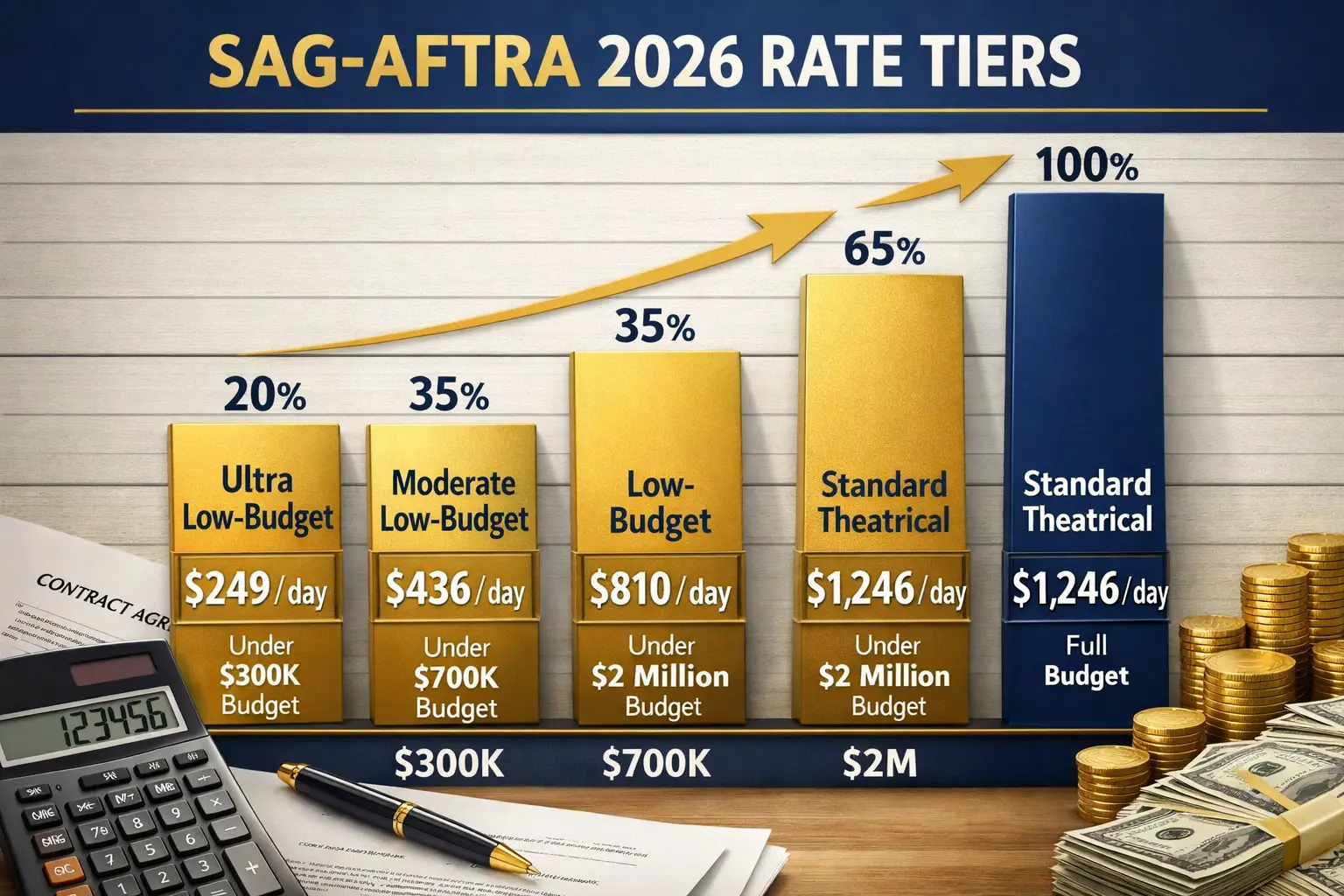
Think of SAG-AFTRA rates like a ladder—each rung represents a different budget tier, and knowing which rung you’re standing on determines your negotiating power. The union represents approximately 160,000 members in film and television[3], and these rates protect all of us from being undervalued.
Current SAG-AFTRA Rate Structure
As of July 1, 2025 through June 30, 2026, here’s what the rate sheet looks like for principal performers[2]:
| Production Type | Day Rate | Weekly Rate | Budget Range |
|---|---|---|---|
| Standard Theatrical | $1,246 | $4,326 | $2M+ |
| Low-Budget Film | $810 | $2,812 | $700K-$2M |
| Moderate Low-Budget | $436 | $1,514 | $300K-$700K |
| Ultra Low-Budget | $249 | No weekly scale | Under $300K |
Here’s the reality check: most emerging actors will work primarily in the low-budget and moderate low-budget categories. These aren’t “lesser” projects—they’re your training ground, your reel builders, and often where the most creative storytelling happens. I’ve seen actors turn down ultra low-budget indie films that later screened at Sundance because they didn’t understand the strategic value beyond the day rate.
Television and Streaming Rates
Television operates on a different scale entirely. Guest star rates for 2026 sit at $6,853/week for half-hour programs and $10,965/week for hour-long shows[2]. That’s substantial money, but here’s what they don’t tell you in acting class: guest star roles often require intense preparation for what might be three days of actual shooting.
For series regulars on half-hour programs, the compensation structure looks like this[2]:
- All episodes: $4,326/week
- More than six episodes: $4,952/week
- Exactly six episodes: $5,774/week
Notice the inverse relationship? Fewer guaranteed episodes actually pay more per week because you’re taking on more uncertainty. It’s like being paid a premium for flexibility—a concept that applies across contract negotiation in 2026.
New Media and Creator Partnership Rates
This is where the Business of Acting 2026: Contract Negotiation and Rate Setting for Emerging Screen Roles gets really interesting. New media platforms—think YouTube Premium, streaming service originals, and creator-driven content—operate under modified agreements.
Productions budgeted between $300,000-$700,000 pay 35% of standard TV agreement rates, while those budgeted $700,000-$1,000,000 pay 65% of TV rates for principal performers[2].
Here’s a real-world example: You’re offered a role in a web series produced by an established YouTube creator with a $500,000 budget. Instead of the standard guest star rate of $6,853, you’d be looking at approximately $2,398 (35% of standard). Knowing this prevents you from walking into that negotiation with unrealistic expectations—or worse, accepting less than you’re entitled to.
Navigating Contract Negotiations in the AI and Streaming Era
Remember when our biggest concern was whether we’d get a callback? In 2026, we’re negotiating contracts that include clauses about AI-generated replicas of our likeness. The introduction of Tilly Norwood, Hollywood’s first AI actor in late 2025, changed everything[3].
AI Protections: The New Frontier
SAG-AFTRA is prioritizing AI protections in current negotiations, including proposals for a “Tilly tax”—a fee studios would pay for using AI-generated characters[3]. For emerging actors, this isn’t some distant concern. It’s about protecting your image, your voice, and your future earning potential.
When reviewing any contract in 2026, look for these AI-related clauses:
✅ Digital replica consent requirements
✅ Compensation for AI-generated performances using your likeness
✅ Time limitations on AI usage rights
✅ Approval rights for how your digital replica is used
✅ Separate compensation for voice replication in dubbed versions
I’ve seen actors sign away their digital likeness for a single day rate, only to watch their AI replica appear in sequels, video games, and international markets without additional compensation. Don’t be that actor.
“The union is focusing on streaming residuals and funding deficits for health and pension plans alongside AI protections.”[1][3]
Streaming Residuals: Understanding Your Long-Term Value
Here’s an analogy: Traditional broadcast residuals are like rental income from a property you own. Streaming residuals in 2026? They’re more like a complex investment portfolio that requires constant monitoring.
The current residual structure for streaming doesn’t adequately compensate actors for content that lives indefinitely on platforms and gets watched repeatedly. This is why streaming residuals remain a top negotiation priority[1][3].
When negotiating a streaming project, consider:
- Subscriber-based vs. ad-supported platforms (different residual structures)
- Exclusivity periods (how long before the content can appear elsewhere)
- International distribution rights (your work might be huge in markets you never considered)
- Residual triggers (views, downloads, or time-based payments)
Contract Duration and Flexibility
Studios are pushing for five-year contracts instead of the standard three-year agreements[3]—a proposal that’s meeting resistance from industry leaders including Directors Guild President Christopher Nolan. For emerging actors, this matters enormously.
Imagine booking a series regular role with a five-year commitment at 2026 rates. Sounds great, right? But what happens when you blow up and become the breakout star by season two? You’re locked into rates negotiated when you were unknown. Conversely, that security might be exactly what you need to build financial stability.
The negotiation sweet spot often involves escalator clauses—predetermined rate increases based on performance metrics, renewals, or career milestones achieved during the contract period.
Practical Workshop Approach: Templates and Real-World Scenarios
After thirty years of making both brilliant deals and cringe-worthy mistakes, I’ve learned that knowledge without application is just trivia. Let’s get practical with the Business of Acting 2026: Contract Negotiation and Rate Setting for Emerging Screen Roles.
Template 1: Independent Film Deal Memo
You’ve been offered a supporting role in an independent film with a $650,000 budget. Here’s your negotiation template:
Production Budget: $650,000 (Moderate Low-Budget tier)
Applicable Rate: $436/day or $1,514/week (35% of theatrical basic agreement)[2]
Shooting Schedule: 8 days
Your Negotiation Points:
- Base Compensation: Start at weekly rate ($1,514 x 2 weeks = $3,028) rather than daily if possible—it’s more favorable
- Deferred Compensation: If budget is tight, negotiate for percentage points (0.5%-2% of net profits)
- Festival Screening Rights: Ensure you can use footage for your reel immediately
- Travel and Accommodation: Per diem rates, transportation, hotel (often negotiable even on low budgets)
- Credit Placement: Position in credits (first supporting, second billing, etc.)
Red Flags to Watch:
- ❌ Requests to work as “deferred only” with no upfront payment
- ❌ Unlimited usage rights without additional compensation
- ❌ No meal penalties or overtime provisions
- ❌ Vague language about “profit participation” without defined accounting methods
Template 2: Creator Partnership Agreement
A YouTube creator with 2 million subscribers wants you for their scripted series. Budget: $450,000 for the season.
Applicable Rate: 35% of TV agreement rates[2]
Standard Guest Star (half-hour): $6,853
Your Modified Rate: ~$2,398/week
Negotiation Strategy:
Since new media rates are lower, negotiate for additional value:
- Social Media Promotion Rights: Can you promote your involvement on your platforms?
- Revenue Sharing: Percentage of ad revenue or sponsorship deals
- Ownership Stakes: Small equity in the production company or series IP
- Creative Input: Story consultation or producer credit
- Cross-Promotion: Access to their audience for your projects
This is where emerging actors in 2026 can get creative. The creator economy operates differently than traditional studios. A $2,000 upfront payment plus 5% of ad revenue might ultimately pay more than a $5,000 flat fee.
Template 3: TV Guest Star Negotiation
You’re offered a guest star role on an established hour-long drama. Standard rate: $10,965/week[2].
Beyond the Base Rate, Negotiate:
- Episode Guarantee: Minimum number of episodes (even if they’re not all written yet)
- Recurring Character Option: First right of refusal for future appearances
- Upgrade Clause: Automatic rate increase if promoted to series regular
- Publicity Participation: Compensation for press junkets, premieres, Comic-Con appearances
- Wardrobe and Hair: Per diem for maintaining specific looks between episodes
Pro Tip: On established shows, there’s often more money available than the initial offer suggests. The first number is rarely the final number—but you have to ask.
Workshop Exercise: Role-Playing Negotiations
Here’s what I recommend for actors serious about mastering the Business of Acting 2026: Contract Negotiation and Rate Setting for Emerging Screen Roles:
Exercise 1: The Uncomfortable Ask
Partner with another actor. One plays the producer, one the actor. Practice asking for 20% above the initial offer. Feel the discomfort. Sit with it. Learn that silence after your counter-offer isn’t rejection—it’s consideration.
Exercise 2: Walking Away
Identify your minimum acceptable terms before entering any negotiation. Practice saying, “I appreciate the offer, but I can’t accept those terms” out loud. The power to walk away is the foundation of all negotiation leverage.
Exercise 3: Value Stacking
List ten forms of value beyond day rate (credit, creative input, back-end participation, travel class, per diem, wardrobe allowance, etc.). Practice requesting three of these in a single negotiation conversation.
Health, Pension, and Long-Term Career Planning

The funding deficits for health and pension plans are a major focus of 2026 negotiations[1][3], and for good reason. This isn’t sexy stuff—nobody dreams of pension contributions when they’re studying Meisner—but it’s what separates career actors from hobbyists.
Understanding Your Benefits Eligibility
SAG-AFTRA health insurance requires earning $26,470 in covered earnings during the base earnings period. That’s roughly 21 days at standard theatrical rates, or 61 days at ultra low-budget rates. See how budget tiers affect not just your immediate income but your healthcare access?
Strategic Planning:
- Track your earnings quarterly, not just annually
- Understand which projects contribute to pension vs. health plan earnings
- Consider taking a lower-paying SAG project over a higher-paying non-union job if it gets you to benefits threshold
- Budget for health insurance gaps (COBRA, private insurance, or marketplace plans)
Building Sustainable Income Streams
The reality of the Business of Acting 2026: Contract Negotiation and Rate Setting for Emerging Screen Roles is that most actors need multiple income streams. Your negotiation strategy should reflect this.
Consider this framework:
Tier 1: Performance Income (on-camera work, voice-over, theatre)
Tier 2: Royalties and Residuals (ongoing payments from past work)
Tier 3: Teaching and Coaching (classes, workshops, private coaching)
Tier 4: Content Creation (YouTube, podcasts, online courses)
Tier 5: Related Services (consulting, script coverage, casting assistance)
Each tier requires different negotiation approaches. Your day rate negotiation for Tier 1 work should factor in how it supports Tiers 2-5. A lower-paying but high-profile project might be worth it if it builds your platform for Tier 4 income.
Avoiding Common Negotiation Pitfalls
Let me share some painful lessons learned—mistakes that cost me money, opportunities, and sleep over three decades.
Pitfall #1: Negotiating Against Yourself
The Mistake: “I know the rate is $1,246, but I’d be willing to do it for $800 since I’m new.”
Why It Hurts: You just gave away $446 per day before they even countered. Producers have budgets. If they’re signatory to SAG-AFTRA, they’ve already budgeted for union rates.
The Fix: State your rate (or the applicable union minimum) and wait. Let them tell you what they can offer.
Pitfall #2: Focusing Only on Day Rate
The Mistake: Accepting $1,500/day without discussing overtime, meal penalties, travel days, or usage rights.
Why It Hurts: You might work 14-hour days with no overtime, spend $200 on cabs to set, and watch your performance used in perpetuity across all media.
The Fix: Negotiate the complete package. Sometimes a $1,200/day rate with great terms beats $1,500/day with terrible ones.
Pitfall #3: Verbal Agreements
The Mistake: “They promised me a producer credit and backend participation, but it’s not in the contract. They said they’d add it later.”
Why It Hurts: If it’s not in writing, it doesn’t exist. Period.
The Fix: Everything goes in the contract. Every promise, every accommodation, every special term. No exceptions.
Pitfall #4: Not Reading the Fine Print
The Mistake: Signing a 12-page contract after only reading page one.
Why It Hurts: Page 9 might contain a non-compete clause preventing you from working on similar projects for two years. Page 11 might grant unlimited usage rights to your image and likeness.
The Fix: Read every word. If you don’t understand something, ask. Better yet, have an entertainment attorney review contracts over $10,000 or multi-year commitments.
Pitfall #5: Letting Desperation Drive Decisions
The Mistake: Accepting terrible terms because rent is due and you haven’t worked in three months.
Why It Hurts: Bad contracts can haunt you for years. That ultra low-budget film you did for $100/day with full buyout rights? It’s now streaming on Netflix, and you’ll never see another dollar.
The Fix: Build a financial cushion (3-6 months expenses) so you can negotiate from strength, not desperation. This might mean survival jobs, but it preserves your negotiating power.
The Future of Acting Contracts: What’s Coming
As we watch the 2026 negotiations unfold between SAG-AFTRA and the AMPTP, several trends are reshaping the Business of Acting 2026: Contract Negotiation and Rate Setting for Emerging Screen Roles:
Trend 1: Individualized AI Licensing
Expect to see contracts that separate your physical performance from your digital likeness, voice, and AI-generated performances. This might mean negotiating three separate fee structures for a single role.
Trend 2: Performance-Based Escalators
Streaming metrics are becoming more transparent. Future contracts will likely include bonuses tied to viewership milestones—if your episode hits 10 million streams, you get an additional payment.
Trend 3: Creator Economy Integration
The line between traditional production and creator-driven content is blurring. Actors who understand both worlds—and can negotiate hybrid deals—will have significant advantages.
Trend 4: Global Rights Management
Your work appears simultaneously in 190 countries. Contracts are evolving to address territorial rights, currency fluctuations, and international residual structures.
Trend 5: Sustainability Clauses
Environmental considerations are entering contracts—green production commitments, carbon offset provisions, and sustainable practice requirements.
Building Your Negotiation Team
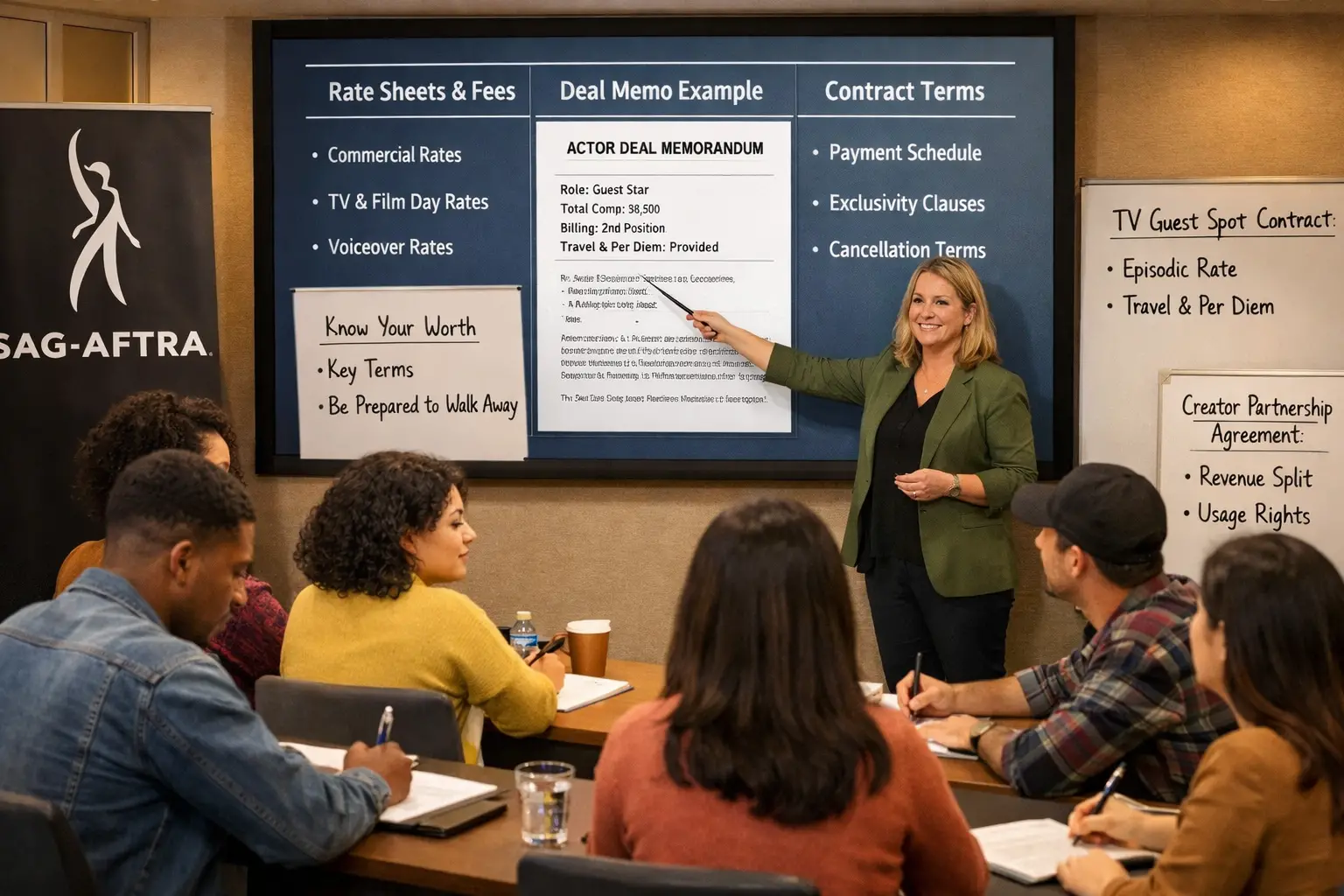
You don’t negotiate alone. Here’s your essential team:
Entertainment Attorney ($300-$500/hour, worth every penny for major contracts)
- Reviews contracts
- Identifies problematic clauses
- Negotiates legal terms
Agent (10% commission, negotiates deals and finds opportunities)
- Secures auditions
- Handles initial rate negotiations
- Maintains industry relationships
Manager (10-15% commission, guides career strategy)
- Long-term career planning
- Package deals
- Brand development
Accountant (Essential once you’re earning $50K+/year)
- Tax planning
- Quarterly estimated taxes
- Deduction optimization
For Emerging Actors: You might not have all these team members yet. That’s okay. Start with an entertainment attorney for contract review on significant deals, and build your team as your career grows.
Conclusion: Your Action Plan for Contract Mastery
The Business of Acting 2026: Contract Negotiation and Rate Setting for Emerging Screen Roles isn’t just about knowing the numbers—it’s about understanding your value, protecting your rights, and building a sustainable career in an industry that’s evolving faster than ever.
Here’s your immediate action plan:
This Week:
- Download current SAG-AFTRA rate sheets from sagaftra.org
- Create a spreadsheet tracking all applicable rates for your career level
- Review your last three contracts and identify what you could have negotiated better
This Month: 4. Find a negotiation partner and practice the workshop exercises above 5. Consult with an entertainment attorney (many offer free initial consultations) 6. Join SAG-AFTRA if you’re eligible, or work toward eligibility if you’re not
This Quarter: 7. Build your 3-6 month financial cushion 8. Create contract templates for common scenarios you encounter 9. Attend a union workshop on contract negotiation (they’re free for members)
This Year: 10. Track every negotiation outcome—what worked, what didn’t 11. Build relationships with agents and managers who prioritize fair contracts 12. Mentor another emerging actor on what you’ve learned
Remember: every actor who commands top dollar today started exactly where you are—uncertain, learning, making mistakes. The difference is they treated the business side of acting with the same dedication they brought to their craft.
The 2026 negotiations happening right now will shape your career for the next three to five years. Stay informed. Know your worth. Negotiate fearlessly. And never, ever sign anything you don’t fully understand.
You’ve spent years training your instrument. Now it’s time to protect it, value it, and get paid what you’re worth. That’s not being difficult—that’s being professional.
Now go book that job and negotiate like the business professional you are. Break a leg! 🎭
References
[1] Sag Aftra And Studios Embark On Critical 2026 Contract Talks – https://blockreeldao.com/blog/sag-aftra-and-studios-embark-on-critical-2026-contract-talks
[2] Essential Guide Sag Rates – https://www.wrapbook.com/blog/essential-guide-sag-rates
[3] Sag Aftra Starts Negotiations With Studios For New Contract – https://www.latimes.com/entertainment-arts/business/story/2026-02-09/sag-aftra-starts-negotiations-with-studios-for-new-contract