

The acting industry has fundamentally transformed. Traditional career milestones—pilot season bookings, agency signings, series regular roles—no longer follow predictable patterns. With production volume significantly lower than pre-streaming levels and only 4-5 pilots per network compared to previous standards[2], the old playbook for building an acting career has become obsolete. Building Momentum Over Goals: Sustainable Acting Career Strategies for 2026 offers a paradigm shift: instead of fixating on distant achievements, successful actors are now creating sustainable careers through daily momentum-building practices that adapt to an industry in constant flux.
This approach challenges the traditional New Year’s resolution mindset that dominates career planning. Rather than setting rigid annual goals that may become irrelevant as the industry shifts, working actors are implementing small, consistent actions that compound over time, creating resilience and adaptability in an unpredictable marketplace.
Key Takeaways
- Momentum beats goals: Daily consistent actions create sustainable career progress more effectively than rigid annual targets in today’s volatile acting market
- Geographic expansion is essential: Tax incentive-driven production has expanded viable markets beyond LA and NYC, creating opportunities for actors with ties to emerging production states[1]
- Multi-channel diversification protects careers: Working across TV, film, commercials, voiceover, and self-generated content provides financial stability as overall production volume remains constrained[1]
- Clear casting brands reduce uncertainty: Producers prioritize actors with recognizable, well-defined types in a leaner production pipeline with less margin for error[1]
- Self-tape excellence is non-negotiable: Technical proficiency and quick turnaround on quality self-tapes have become critical evaluation criteria for casting professionals[1]
Understanding the 2026 Acting Landscape

The Production Reality Check
The entertainment industry of 2026 looks dramatically different from the boom years of peak streaming expansion. Overall production volume remains significantly lower than pre-streaming era levels, with studios and streamers making fewer shows and films while relying heavily on tax credits and cost-efficient production models[1]. This contraction creates more competition per available role, particularly for series regular and recurring positions that provide meaningful career advancement[1].
The Bureau of Labor Statistics projects little or no change in actor employment from 2024 to 2034, with approximately 6,300 openings projected annually—mostly from worker replacement rather than industry growth[3]. These sobering statistics underscore why traditional goal-setting approaches often fail: the external opportunities simply aren’t expanding at rates that support conventional career trajectories.
Income Inequality and Career Sustainability
The financial reality for actors remains stark. Only 12.08% of SAG-AFTRA members earn more than $1,000 annually from acting work, with unemployment rates across the union reaching 90%[2]. The median hourly wage for actors was $23.33 in May 2024[3], but this figure masks extreme inequality between working actors and those struggling to gain traction.
Perhaps most telling: the average working actor age is 42 years old[2], reflecting the significant time investment required to establish sustainable careers. This statistic challenges the myth of overnight success and validates the momentum-building approach—sustainable careers are built through years of consistent effort, not single breakthrough moments.
Tax Incentives Reshape Geographic Opportunities
Tax incentives are now the primary driver of production location decisions, with studios and streamers prioritizing financial deals over traditional casting hubs[1]. This shift has fundamentally altered where actors can build viable careers.
Production activity in New York is forecasted to grow 5-12% in 2026 specifically due to incentive-driven opportunities[1]. However, the definition of viable markets has expanded dramatically:
Expanded Market Definitions:
| Traditional Market | 2026 Expanded Market Region |
|---|---|
| New York City | NYC + New Jersey + Parts of Pennsylvania + Parts of Connecticut |
| Los Angeles | LA County + Incentivized California Areas |
| Emerging Markets | New Mexico, Texas, Illinois, Ohio (with strong local-hire advantages) |
Actors with existing ties to New Jersey, New Mexico, Texas, Illinois, and Ohio can leverage these regions as significant career advantages, as productions increasingly hire locally to satisfy tax incentive requirements[1]. This geographic expansion represents a concrete opportunity for momentum-building strategies that don’t require relocation to traditional hubs.
Why Momentum Trumps Goals in Building Momentum Over Goals: Sustainable Acting Career Strategies for 2026
The Problem with Traditional Goal-Setting
Traditional acting career goals often follow predictable patterns:
- “Book a series regular role this year”
- “Sign with a top-tier agency by June”
- “Land three co-star roles”
- “Get cast in a pilot during pilot season”
These goals share a critical flaw: they depend on external factors largely outside an actor’s control. With traditional pilot season collapsed to historic lows and networks favoring straight-to-series orders[2], the entire framework that supported these goals has fundamentally changed.
When external opportunities contract—as they have in 2026—goal-oriented actors experience constant frustration and perceived failure, even when executing excellent work. This creates a psychological drain that undermines long-term career sustainability.
The Momentum-Building Alternative
Momentum-building focuses on controllable daily actions that compound over time:
✅ Daily practice: 30 minutes of script analysis or scene work
✅ Consistent self-tape submissions: Quality over quantity, with technical excellence
✅ Regular content creation: Short-form pieces showcasing casting type and range
✅ Relationship cultivation: Genuine connections with industry professionals
✅ Skill development: Voice work, dialects, physical training, on-camera technique
✅ Market awareness: Staying informed about production trends and opportunities
These actions remain valuable regardless of immediate booking outcomes. They build skills, visibility, relationships, and professional reputation—the actual foundations of sustainable careers.
“The most successful actors in 2026 aren’t those who set the biggest goals, but those who maintain the most consistent daily practices that position them for opportunities when they arise.”
Implementing Building Momentum Over Goals: Sustainable Acting Career Strategies for 2026
Daily Routines for Sustainable Career Building
Morning Foundation (60-90 minutes)
🌅 Physical preparation (20-30 minutes): Movement, yoga, or exercise that connects mind and body—essential for embodied performance work
📖 Script analysis or reading (20-30 minutes): Analyze one scene from current television or film, identifying character objectives, obstacles, and tactics. This keeps analytical skills sharp and familiarity with contemporary writing current.
🎯 Casting platform review (10-15 minutes): Check submissions, respond to audition requests, update profiles and materials
💻 Industry news scan (10-15 minutes): Stay current on production announcements, casting trends, and market shifts[1][4][5]
Afternoon Skill Development (60-120 minutes)
🎭 Active training: Class attendance, coaching sessions, or self-directed scene work with partners
🎬 Self-tape practice: Even without active auditions, practicing self-tape technique maintains technical proficiency—critical as casting directors place greater emphasis on excellent self-tape execution[1]
🎤 Voice work: Dialect practice, voiceover training, or commercial copy reading. Multi-channel career diversification now includes voiceover as an essential revenue stream[1][7]
Evening Relationship Building (30-60 minutes)
🤝 Genuine networking: Reaching out to one industry contact, attending industry events, or participating in online communities
📱 Content creation: Short-form content and self-generated projects have gained substantial legitimacy as career-building tools[1]. Creating proof-of-concept pieces showcases casting type while building an audience.
✍️ Reflection and planning: Brief review of daily actions and preparation for tomorrow’s priorities
Weekly Momentum Checkpoints
Rather than monthly or quarterly goal reviews, momentum-building requires weekly assessment:
Monday Planning:
- Identify 3-5 priority actions for the week
- Schedule specific time blocks for training, submissions, and content creation
- Review upcoming auditions and prepare materials
Friday Reflection:
- What consistent actions were maintained?
- What skills improved, even incrementally?
- What relationships were strengthened?
- What was learned about the current market?
This weekly rhythm creates accountability without rigidity, allowing adaptation to industry changes while maintaining forward progress.
Building a Clear Casting Brand
With fewer projects and tighter pipelines, producers prioritize actors with clearly defined, recognizabletypes that reduce casting uncertainty[1]. Building momentum around a clear casting brand involves:
Brand Clarity Actions:
Honest self-assessment: What roles do you authentically embody? What’s your competitive advantage?
Consistent presentation: Headshots, reels, social media, and self-generated content should all reinforce the same casting brand
Targeted submissions: Focus on roles that align with your brand rather than submitting broadly
Strategic training: Develop skills that strengthen your competitive position within your type
Market research: Study actors working in similar casting categories and analyze their career paths
This focused approach creates efficiency in a constrained market—you become the obvious choice for specific roles rather than a generic option for many.
Multi-Channel Diversification: Essential Components of Building Momentum Over Goals: Sustainable Acting Career Strategies for 2026
The Diversification Imperative
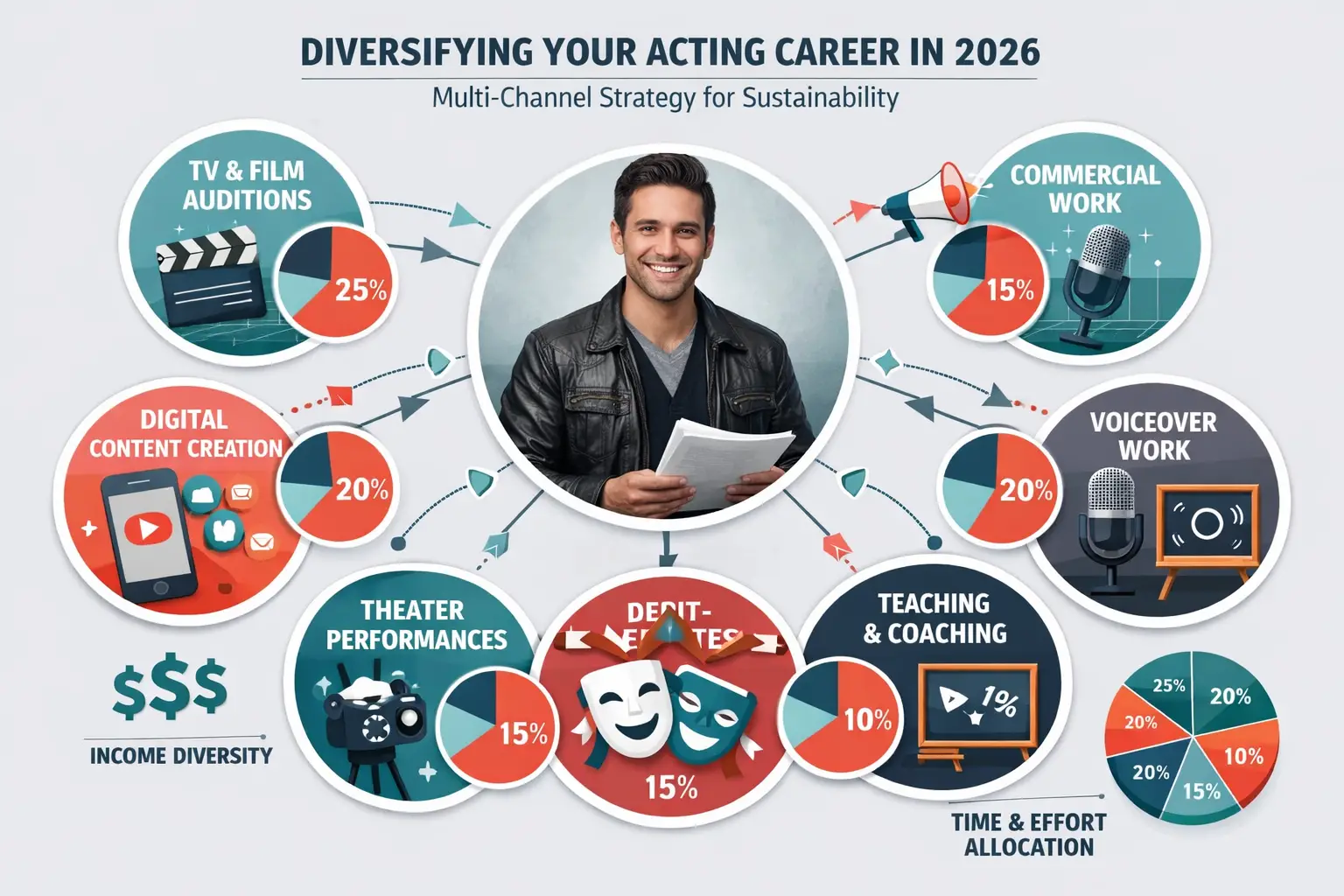
Multi-channel career diversification is now essential for resilience, with the most sustainable strategies involving work across TV, film, commercials, voiceover, and new media[1]. This isn’t about diluting focus—it’s about creating multiple revenue streams and skill sets that reinforce each other.
Channel-Specific Momentum Strategies
Traditional TV/Film:
- Maintain active profiles on all major casting platforms
- Develop self-tape technical excellence (lighting, framing, audio, editing)
- Build relationships with casting directors through workshops and showcases
- Stay current on production trends and emerging opportunities[1][4]
Commercial Work:
- Develop authentic, conversational commercial style
- Maintain commercial-specific headshots and reel
- Build relationships with commercial agents and casting directors
- Practice improvisation and quick character choices
Voiceover:
- Invest in quality home recording setup
- Develop range across commercial, narration, animation, and video game styles
- Create professional voiceover demos
- Build presence on voiceover casting platforms
- Voice acting continues to show growth potential in 2026[7]
Short-Form and Self-Generated Content:
- Create regular content showcasing casting type and range
- Use platforms like TikTok, Instagram Reels, and YouTube Shorts
- Develop editing and production skills
- Build audience and industry visibility
- These pieces now carry substantial legitimacy with casting professionals[1]
Teaching and Coaching:
- Share expertise through workshops or private coaching
- Create additional income while deepening your own understanding
- Build professional reputation and network
- Provide stability during slower booking periods
Time Allocation Framework
A sustainable multi-channel approach requires intentional time management:
| Channel | Weekly Time Investment | Primary Focus |
|---|---|---|
| Traditional TV/Film | 30-40% | Auditions, self-tapes, relationship building |
| Commercial | 15-20% | Submissions, technique practice, agent communication |
| Voiceover | 15-20% | Training, demos, platform presence, auditions |
| Self-Generated Content | 15-20% | Creation, posting, audience engagement |
| Teaching/Coaching | 10-15% | Session delivery, curriculum development |
These percentages shift based on active opportunities, but maintaining presence across channels creates resilience when any single channel contracts.
Mindset Shifts for Sustainable Career Building

From Scarcity to Abundance
The statistics are sobering—90% unemployment in SAG-AFTRA, declining production volume, intense competition[2]. Yet sustainable careers require an abundance mindset focused on what’s controllable:
❌ Scarcity thinking: “There aren’t enough roles for everyone”
✅ Abundance thinking: “I’m building skills and relationships that position me for opportunities”
❌ Scarcity thinking: “I’m too old/young/wrong type for this market”
✅ Abundance thinking: “I’m developing a clear brand that makes me the obvious choice for specific roles”
❌ Scarcity thinking: “I need to book immediately or my career is over”
✅ Abundance thinking: “Each audition, class, and connection builds momentum toward sustainable success”
From Outcome to Process
Traditional goals focus on outcomes: “Book a series regular.” Momentum-building focuses on process: “Deliver excellent work in every audition and self-tape.”
This shift is psychologically protective. You control your preparation, not the booking. When process becomes the priority, each day offers opportunities for success through consistent action, regardless of booking outcomes.
From Comparison to Personal Progress
Social media amplifies comparison—seeing peers’ bookings while experiencing your own dry spells. Momentum-building requires personal progress metrics:
- Am I better at cold reading than last month?
- Have my self-tapes improved technically?
- Are my relationships with industry professionals deeper?
- Is my understanding of the market more sophisticated?
- Have I created content that showcases my abilities?
These questions focus attention on controllable improvement rather than external validation.
From Rigid to Adaptive
The industry changes constantly—production locations shift based on tax incentives[1], casting trends evolve, new platforms emerge[5]. Rigid goal-setting creates brittleness; momentum-building creates adaptive capacity.
When straight-to-series orders replaced traditional pilot season[2], goal-oriented actors who planned around pilot season faced disruption. Momentum-oriented actors who focused on consistent skill-building and relationship cultivation adapted seamlessly to the new model.
Advanced Momentum Strategies for 2026
Leveraging Geographic Advantages
With production increasingly driven by tax incentives[1], actors can build momentum by strategically positioning themselves in emerging markets:
If you have ties to New Jersey, New Mexico, Texas, Illinois, or Ohio:
- Establish residency or maintain strong connections
- Build relationships with local casting directors
- Understand local production incentive requirements
- Position yourself for local-hire advantages
- Market yourself as a local resource to productions
If you’re in traditional hubs (LA/NYC):
- Understand the expanded market definitions (NY market now includes NJ, PA, CT)[1]
- Consider strategic positioning in incentivized zones
- Build relationships with casting directors serving expanded regions
- Stay informed about production migration patterns
Self-Tape Excellence as Competitive Advantage
Self-tape and callback execution is now critically evaluated, as the leaner production pipeline means casting directors have less margin for error[1]. Building momentum in self-tape technique creates measurable competitive advantage:
Technical Excellence Checklist:
- ✅ Professional lighting setup (key, fill, backlight)
- ✅ Clean audio with minimal background noise
- ✅ Appropriate framing and background
- ✅ Quick turnaround without sacrificing quality
- ✅ Strong reader or off-camera technique
- ✅ Multiple take options showing range
- ✅ Professional file formatting and delivery
Practice Routine:
- Weekly self-tape practice with new material
- Technical review and improvement
- Feedback from coaches or peers
- Equipment upgrades as budget allows
- Staying current on platform requirements
Content Creation as Casting Tool
Short-form content serves multiple momentum-building functions:
Visibility Building:
- Showcases your type and range
- Demonstrates production skills
- Creates shareable material for industry contacts
- Builds audience that can support future projects
Skill Development:
- Improves on-camera comfort
- Develops editing and production knowledge
- Enhances understanding of storytelling
- Provides performance laboratory for experimentation
Industry Credibility:
- Demonstrates initiative and professionalism
- Creates proof-of-concept for original ideas
- Shows casting directors your work in context
- Builds legitimacy that now equals traditional credits[1]
Relationship Cultivation Systems
Sustainable careers are built on genuine professional relationships, not transactional networking. Momentum-building approaches to relationships include:
Monthly Touchpoints:
- Reach out to 3-5 industry contacts with genuine value (interesting article, congratulations on project, thoughtful question)
- Attend 1-2 industry events focused on connection over promotion
- Participate authentically in online communities
Value-First Approach:
- How can you help others before asking for help?
- What expertise or resources can you share?
- How can you make others’ work easier or better?
Long-Term Perspective:
- Relationships compound over years, not weeks
- Consistency matters more than intensity
- Genuine interest creates lasting connections
Measuring Momentum Without Traditional Goals
Leading vs. Lagging Indicators
Traditional goals focus on lagging indicators—outcomes that reflect past actions:
- Bookings
- Agent signings
- Callback ratios
Momentum-building focuses on leading indicators—actions that predict future success:
- Training hours completed
- Self-tapes submitted
- Industry relationships cultivated
- Skills improved
- Content created
- Market knowledge deepened
Leading indicators are controllable and measurable daily, providing consistent feedback and motivation.
The Momentum Scorecard
Create a simple weekly scorecard tracking leading indicators:
Weekly Momentum Tracker:
| Category | Target | Actual | Notes |
|---|---|---|---|
| Training hours | 8-10 | ___ | Classes, coaching, practice |
| Self-tape submissions | 3-5 | ___ | Quality over quantity |
| Industry connections | 3-5 | ___ | Genuine touchpoints |
| Content created | 1-2 pieces | ___ | Short-form or self-generated |
| Market research | 2-3 hours | ___ | Industry news, trends, analysis |
| Voice work | 2-3 hours | ___ | Training, practice, submissions |
This scorecard provides weekly wins regardless of booking outcomes, maintaining motivation and direction.
Quarterly Momentum Reviews
Every 90 days, conduct a comprehensive momentum review:
Skills Assessment:
- What skills have measurably improved?
- What training investments paid dividends?
- Where do gaps remain?
Relationship Inventory:
- Which industry relationships deepened?
- What new connections were made?
- How can existing relationships be strengthened?
Market Positioning:
- Is your casting brand clearer than 90 days ago?
- Have you adapted to market changes?
- Are you positioned for emerging opportunities?
Multi-Channel Health:
- Are all revenue channels receiving attention?
- Which channels show momentum?
- Where should focus shift?
This quarterly rhythm allows strategic adaptation while maintaining daily momentum focus.
Overcoming Momentum Obstacles
The Booking Drought Challenge
Extended periods without bookings test momentum-building commitment. Strategies for maintaining momentum during dry spells:
Reframe the Narrative:
- Each audition is skill practice, not just booking opportunity
- Relationships built during droughts pay off when opportunities surge
- Content created during downtime showcases abilities to future collaborators
Double Down on Controllables:
- Increase training intensity
- Deepen skill development
- Expand content creation
- Strengthen industry relationships
- Improve self-tape technical execution
Diversify Revenue:
- Lean into voiceover, commercial, or teaching channels
- Create financial stability that reduces booking pressure
- Develop skills that strengthen overall career positioning
The Comparison Trap
Social media makes others’ successes highly visible while your momentum-building work remains largely invisible. Combat comparison with:
Curated Social Media Consumption:
- Limit time on platforms that trigger comparison
- Follow accounts that inspire rather than discourage
- Focus on learning from others’ successes rather than envying them
Personal Progress Documentation:
- Keep a private journal of improvements and achievements
- Review past self-tapes to see measurable progress
- Celebrate process wins, not just outcome wins
Community Over Competition:
- Build genuine friendships with fellow actors
- Create accountability partnerships
- Share resources and support
The Motivation Fluctuation
Daily momentum requires consistent action, but motivation naturally fluctuates. Systems that outlast motivation include:
Habit Stacking:
- Attach new practices to existing routines
- “After morning coffee, I do 20 minutes of script analysis”
- “Before dinner, I record one voiceover practice take”
Environmental Design:
- Keep self-tape equipment set up and ready
- Place scripts and sides in visible locations
- Create dedicated practice space
Accountability Structures:
- Training partners or practice groups
- Coaches or mentors with regular check-ins
- Public commitments to content creation schedules
Minimum Viable Practice:
- On low-motivation days, commit to minimum versions
- “I’ll just read one scene” often leads to full practice
- Maintaining the streak matters more than intensity
The Future-Proof Acting Career
Adapting to Continued Industry Evolution
The entertainment industry will continue evolving beyond 2026. Production models will shift, new platforms will emerge, and opportunities will migrate[4][5]. Momentum-building creates adaptive capacity that goal-setting cannot:
- Skills compound: Training investments pay dividends across changing contexts
- Relationships transfer: Industry connections remain valuable as people move between companies and projects
- Brand clarity adapts: A clear casting type remains valuable regardless of platform shifts
- Multi-channel resilience: Diversified revenue streams protect against single-channel disruptions
Building Momentum Over Goals: Sustainable Acting Career Strategies for 2026 as Lifelong Practice
The momentum-building approach isn’t a temporary strategy—it’s a career-long practice that creates:
Professional Sustainability:
- Consistent income across multiple channels
- Resilience during industry contractions
- Adaptability to market changes
- Long-term skill development
Psychological Health:
- Reduced anxiety about outcomes
- Increased sense of agency and control
- Daily wins that maintain motivation
- Protection against comparison and scarcity thinking
Artistic Growth:
- Continuous skill refinement
- Deeper understanding of craft
- Expanded range and capabilities
- Authentic creative expression
Industry Positioning:
- Clear, recognizable casting brand
- Strong professional relationships
- Reputation for excellence and reliability
- Visibility across multiple channels
Conclusion: Your Momentum Action Plan
The acting industry of 2026 rewards consistency over intensity, process over outcome, and momentum over goals. While production volume remains constrained[1], employment outlook stays flat[3], and competition intensifies, actors who implement sustainable momentum-building strategies create viable, resilient careers.
Immediate Next Steps
This Week:
- Conduct an honest assessment of your current casting brand and competitive positioning
- Create your momentum scorecard with leading indicators you’ll track weekly
- Establish one daily practice that builds skills regardless of booking outcomes
- Identify your geographic advantages and research production opportunities in your region[1]
- Audit your multi-channel presence across TV/film, commercial, voiceover, and content creation
This Month:
- Invest in self-tape technical excellence—upgrade equipment or training as needed
- Create one piece of self-generated content that showcases your casting type
- Reach out to 10-15 industry contacts with genuine, value-first communication
- Attend at least one training session in an area outside your comfort zone
- Research tax incentive opportunities in emerging production markets[1]
This Quarter:
- Develop a clear voiceover presence with professional demos and platform profiles[7]
- Create a content calendar for regular short-form pieces
- Deepen 3-5 industry relationships through consistent, authentic engagement
- Conduct your first quarterly momentum review assessing skills, relationships, and positioning
- Adjust your multi-channel time allocation based on where opportunities and momentum appear
The Momentum Mindset
Remember: Building Momentum Over Goals: Sustainable Acting Career Strategies for 2026 isn’t about lowering ambitions—it’s about creating a sustainable path to achieve them. The actors who thrive in this challenging landscape are those who:
- ✨ Focus on controllable daily actions rather than unpredictable outcomes
- ✨ Build skills consistently across multiple revenue channels
- ✨ Cultivate genuine industry relationships over transactional networking
- ✨ Adapt quickly to geographic and market shifts
- ✨ Maintain technical excellence in self-tape and digital presentation
- ✨ Create content that showcases their unique value
- ✨ Measure success through leading indicators they control
The average working actor is 42 years old[2]—sustainable careers are marathons, not sprints. By implementing momentum-building strategies today, you’re investing in a career that can weather industry changes, adapt to new opportunities, and provide both artistic fulfillment and financial sustainability for decades to come.
Start small. Stay consistent. Build momentum. The compound effects will surprise you.
References
[1] Casting Trends Production Shifts To Watch In 2026 – https://uptodateactor.com/blogs/post/casting-trends-production-shifts-to-watch-in-2026/
[2] Hollywood Acting Industry Statistics – https://bernardhiller.com/hollywood-acting-industry-statistics/
[3] Actors – https://www.bls.gov/ooh/entertainment-and-sports/actors.htm
[4] Outlook For Entertainment And Media Leaders In 2026 – https://www.ghjadvisors.com/ghj-insights/outlook-for-entertainment-and-media-leaders-in-2026
[5] Media In Motion What 2026 Holds For Entertainment Trends – https://allthingsinsights.com/content/media-in-motion-what-2026-holds-for-entertainment-trends/
[6] Actor Roles Future Workforce Evolution – https://morganhr.com/blog/actor-roles-future-workforce-evolution/
[7] Voice Acting In 2025 2026 Trends Insights And The Future – https://www.gravyforthebrain.com/voice-acting-in-2025-2026-trends-insights-and-the-future/