

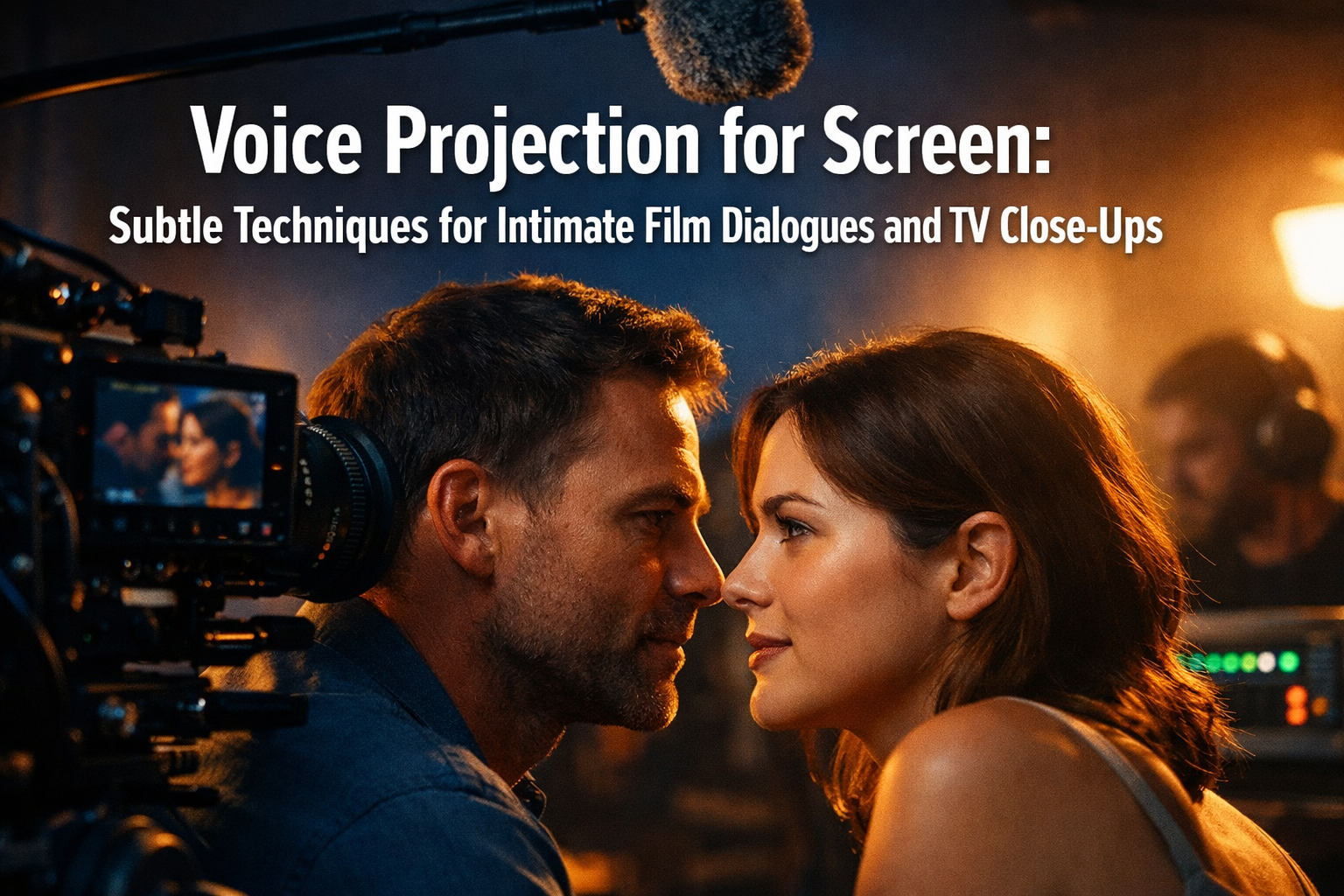

Look, after three decades of working in this business—from bellowing Shakespeare to the back row of a 500-seat theater to whispering sweet nothings (and not-so-sweet nothings) into a camera lens three inches from my face—I can tell you this: Voice Projection for Screen: Subtle Techniques for Intimate Film Dialogues and TV Close-Ups is one of the most misunderstood skills in our craft. Too many talented actors walk onto a film set with their stage training and wonder why the sound mixer is wincing or the director keeps asking them to “bring it down… no, more… even more than that.”
Here’s the truth: the microphone is your best friend and your harshest critic. It picks up everything—the breath, the emotion, the subtle crack in your voice that reveals vulnerability. But it also amplifies every mistake, every moment of tension, every bit of unnecessary projection that reads as “theatrical” instead of “truthful.” In 2026, with audiences demanding increasingly realistic performances and technology capturing every nuance, mastering Voice Projection for Screen: Subtle Techniques for Intimate Film Dialogues and TV Close-Ups isn’t just helpful—it’s essential for your career.
Key Takeaways
- Screen acting requires controlled breath support without theatrical projection—the microphone does the heavy lifting, allowing you to focus on emotional truth and nuance
- Understanding microphone proximity and camera distance fundamentally changes how you use your voice, with close-ups demanding whisper-level intimacy while maintaining clarity
- Diaphragmatic breathing remains essential but is applied differently for screen work, providing power and consistency without volume[2][4]
- Articulation and diction become even more critical at lower volumes, as mumbling destroys intimate moments that audiences strain to understand[5]
- Adapting stage-trained voices to camera intimacy requires specific drills and exercises that retrain muscle memory for subtle, microphone-friendly delivery
Understanding the Fundamental Difference: Stage vs. Screen Voice Work

Let me paint you a picture. You’re in a 300-seat black box theater. The person in the last row paid good money to hear every word of your performance. You need to project—not yell, but definitely fill the space with your voice. Your diaphragm is working overtime, your consonants are crisp enough to cut glass, and your vocal energy is radiating outward like a lighthouse beam.
Now, cut to a film set. The camera is positioned for an extreme close-up. The boom microphone is hovering about two feet above your head, and there’s probably a lavalier mic clipped to your costume. The other actor is right there, close enough that you can see the flecks of color in their eyes. The scene is intimate—a confession, a secret, a moment of vulnerability.
If you project like you’re on stage, you’ve just destroyed the scene.
This is the core challenge that Voice Projection for Screen: Subtle Techniques for Intimate Film Dialogues and TV Close-Ups addresses. Film voice work requires different intensity than theater, and it depends heavily on microphone proximity and camera distance[5]. The microphone amplifies your voice, meaning you can speak at conversational levels—or even below—and still be heard perfectly in the final mix.
The Microphone Changes Everything
Here’s an analogy that helped me when I was making the transition: Think of your voice on stage as sunlight. It needs to be bright enough to reach everyone in the room. But on camera, think of your voice as a candle flame. The microphone is a magnifying glass that makes that small flame visible to thousands. You don’t need a bigger flame; you need to tend the one you have with precision and care.
The technical reality is this: professional film and television production uses highly sensitive microphones that can pick up a whisper from several feet away. Sound engineers can adjust levels in post-production, but they can’t fix a performance that’s tonally wrong. Your job is to give them authentic, emotionally truthful sound at the appropriate level.
The Foundation: Breath Control and Support for Camera Work
Now, before you think “great, I can just mumble my way through film work,” let me stop you right there. Voice Projection for Screen: Subtle Techniques for Intimate Film Dialogues and TV Close-Ups still requires excellent breath control and support—it’s just applied differently.
Projecting your voice effectively starts with proper breathing technique, specifically diaphragmatic breathing[2]. This remains absolutely true for screen work. The difference is what you do with that breath support.
Diaphragmatic Breathing: The Screen Actor’s Secret Weapon
Your diaphragm is a muscle located below your lungs. When you breathe properly, it expands downward, allowing your lungs to fill completely. This gives you:
- Consistent vocal power without straining your throat
- Control over breath release for long takes and emotional moments
- Stability and calm that translates to authentic performance
- The ability to whisper with clarity (yes, this is a thing!)
Here’s a drill I learned from a brilliant voice coach early in my film career:
The Sustained Whisper Exercise:
- Place one hand on your abdomen, just below your ribcage
- Breathe in deeply through your nose, feeling your belly expand (not your chest)
- On the exhale, whisper a line of dialogue while maintaining that abdominal support
- Your whisper should be clear, sustained, and controlled—not breathy or weak
- Repeat until you can whisper an entire monologue with consistent clarity
This exercise teaches you that breath support isn’t about volume—it’s about control and consistency[4]. On camera, especially in close-ups, you need that rock-solid foundation to deliver lines at intimate levels without your voice wavering, cracking, or fading.
Posture Matters (Even Sitting Down)
Good posture is essential for effective voice projection[4]. On stage, we learn to stand tall with shoulders back. On camera, you might be lying in bed, slumped in a chair, or contorted into whatever position the scene requires.
The challenge: Maintain breath support in any physical position.
I once did a scene where my character was supposed to deliver a crucial emotional revelation while lying flat on his back on a couch. Try breathing properly in that position! The solution was engaging my core muscles (thank you, Pilates) and finding micro-adjustments in my positioning that the camera couldn’t see but that gave my diaphragm room to work.
Pro tip: During blocking rehearsals, always check your breath. If a position makes it hard to breathe, it’ll make it hard to act. Work with your director to find adjustments that serve both the shot and your performance.
Mastering Articulation and Diction at Intimate Volumes
Here’s where a lot of actors trip up: they correctly lower their volume for the camera, but they also get lazy with their articulation. The result? Mumbling. And mumbling is the enemy of good screen acting.
Articulation and diction are crucial for actors because they ensure that dialogue is delivered clearly and effectively, allowing the audience to understand and connect with the performance[5]. At intimate volumes, this becomes even more critical.
The Clarity Paradox
Think about it: when you speak quietly in real life—really quietly—do you mumble? Not if you want to be understood. You actually tend to articulate more carefully. You might slow down slightly. You make sure your consonants are crisp.
This is exactly what you need to do for intimate film dialogues and TV close-ups.
The paradox is that you’re speaking more softly but with greater precision. Your lips, tongue, and jaw need to be active and engaged, forming each sound clearly without the theatrical exaggeration that would look ridiculous on camera.
Articulation Drills for Screen Work
Here are some exercises that have saved my bacon more times than I can count:
The Whispered Tongue Twister:
- Choose a classic tongue twister (“Red leather, yellow leather” or “Unique New York”)
- Whisper it at the volume you’d use for an intimate close-up
- Focus on making every consonant crisp and clear
- Gradually increase speed while maintaining clarity
- This trains your articulators to work precisely at low volumes
The Microphone Test:
- Record yourself on your phone speaking lines at various volumes
- Listen back critically—can you understand every word?
- Note where you lose clarity (it’s usually consonants at the ends of words)
- Practice those specific sounds until they’re clear even at whisper level
The Emotional Whisper:
- Take a highly emotional monologue
- Deliver it at intimate volume levels
- Maintain full emotional commitment and energy
- Keep articulation crystal clear
- This teaches you that emotional intensity and vocal volume are not the same thing
I learned this lesson the hard way during a film where I played a character confronting his dying father. The scene was shot in extreme close-up, and I kept wanting to “push” emotionally by increasing volume. The director finally said, “Your face is going to be ten feet tall on screen. The audience will see every tear. You don’t need to shout at me to show me you’re upset.” Game-changer.
Voice Projection for Screen: Adapting Stage Techniques to Camera Intimacy
Alright, let’s talk about the specific challenge many of us face: you’ve been trained for the stage, and now you need to work on camera. Your instincts are telling you to project, to fill the space, to make sure the person in the back row can hear you. But there is no back row. There’s a camera lens and a microphone, and they’re right there.
Retraining Your Instrument
The good news is that your stage training isn’t wasted—it’s actually given you a strong foundation. You understand breath support, you know how to use your resonators, and you’ve developed vocal stamina[2]. Now you need to refine these tools for a different medium.
Think of it like this: A concert pianist and a jazz pianist both have excellent technique, but they apply it differently. Same instrument, different approach. That’s you moving from stage to screen.
The Volume Dial Exercise
This is one of my favorite drills for helping stage-trained actors adapt to screen work:
- Choose a scene with emotional range and important dialogue
- Perform it at full stage projection (10 out of 10 on the volume dial)
- Perform it at 7 out of 10—still projected, but pulled back
- Perform it at 5 out of 10—conversational volume
- Perform it at 3 out of 10—intimate, close-up volume
- Perform it at 1 out of 10—barely above a whisper
The key is maintaining the same emotional intensity and commitment at every level. Your energy doesn’t decrease; your volume does. This is the essence of Voice Projection for Screen: Subtle Techniques for Intimate Film Dialogues and TV Close-Ups.
Understanding Camera Distance and Vocal Adjustment
Different shots require different vocal approaches. Here’s a quick reference guide I keep in my acting journal:
| Shot Type | Camera Distance | Vocal Approach | Key Considerations |
|---|---|---|---|
| Extreme Close-Up | Lens very close to face | Whisper to soft conversation | Maximum intimacy; microphone very close; articulation critical |
| Close-Up | Head and shoulders | Conversational | Natural, relaxed; like talking to a friend |
| Medium Shot | Waist up | Conversational to slightly elevated | Room for slight increase if scene demands |
| Wide Shot | Full body or more | Conversational to moderate | Can project more, but still not stage levels |
The beautiful thing about film is that the camera does the work of bringing the audience close to you. Even in a wide shot, the audience isn’t sitting in a theater 50 feet away—they’re watching on a screen where they can see your face clearly[7].
The Proximity Effect: Your New Best Friend
Here’s a technical tidbit that’ll make you sound smart at parties: microphones exhibit something called the “proximity effect.” The closer you are to the microphone, the more it emphasizes lower frequencies in your voice, creating warmth and intimacy.
This means that in close-up scenes, you can actually use a slightly lower, warmer tone than you might naturally, and it’ll sound rich and intimate. Experiment with this in self-tapes or practice sessions. Find that sweet spot where your voice sounds warm and connected without being artificially deep.
Advanced Techniques: Emotional Truth at Low Volumes

Here’s where we separate the good screen actors from the great ones: maintaining full emotional commitment while speaking at intimate volumes. This is advanced stuff, but if you’re serious about screen work in 2026, you need to master it.
The Energy-Volume Disconnect
In everyday life, we tend to get louder when we get more emotional. We shout when we’re angry, we might raise our voice when we’re excited. But some of the most powerful emotional moments are quiet.
Think about the last time you had a truly serious conversation with someone you loved. Maybe it was a breakup, a confession, or sharing devastating news. Chances are, you didn’t yell. You might have spoken very quietly, with intense emotion packed into every word.
That’s what the camera loves.
Exercises for Emotional Intimacy
The Subtext Whisper:
- Take a scene with strong subtext (what’s not being said is as important as what is)
- Perform it at intimate volume levels
- Focus on what your character is really feeling beneath the words
- Let that emotional truth power your performance, not vocal volume
- This teaches you to find emotional intensity in restraint
The Listening Exercise:
- Work with a scene partner on an emotional two-person scene
- Both actors speak at close-up appropriate volumes
- Focus intensely on listening and reacting
- Notice how much power comes from connection, not projection
- This is gold for realistic screen acting
I remember doing a TV pilot where my character received news that his daughter was missing. The director wanted the moment played in a single close-up. My instinct was to build vocally, to show the panic rising. But what we discovered was that the most powerful choice was to go quieter, almost to a whisper, as the reality sank in. The camera caught every micro-expression, every breath, every moment of dawning horror. It was more powerful than any amount of vocal projection could have been.
Breath as Emotion
Here’s something I wish someone had told me 30 years ago: on camera, your breath is part of your performance.
The microphone picks up:
- The sharp intake of breath when you’re shocked
- The shaky exhale when you’re trying not to cry
- The held breath of anticipation
- The sigh of relief or resignation
These aren’t mistakes to be eliminated—they’re tools for authentic performance. Learn to use them intentionally. A well-placed breath can communicate more than a paragraph of dialogue.
Technical Considerations: Working with Sound Equipment
Let’s get practical for a moment. Understanding the technical side of sound recording will make you a better screen actor and a favorite of sound departments everywhere.
Types of Microphones You’ll Encounter
Boom Microphones:
- Positioned above or below the frame
- Highly directional (pointed at you)
- Pick up sound from several feet away
- You generally don’t need to worry about them—just act
Lavalier (Lav) Microphones:
- Small mics clipped to your clothing
- Very close to your body
- Pick up everything (including clothing rustle—be aware!)
- Speak naturally; they’re designed for conversational levels
Plant Microphones:
- Hidden on set (in props, furniture, etc.)
- You might not even know where they are
- Trust that sound has it covered
Working with Sound Mixers
Sound mixers are your allies. They want you to sound great. Here’s how to make their lives easier (and yours better):
✅ Do:
- Ask about microphone placement during rehearsal
- Mention if you have a particularly quiet or loud moment coming up
- Stay consistent in your volume levels between takes
- Speak up if you hear technical issues (like a mic rubbing on clothing)
❌ Don’t:
- Adjust your lav mic yourself (unless asked to)
- Assume you need to project more than feels natural
- Ignore the sound mixer’s feedback
- Rustle papers, tap surfaces, or make unnecessary noise during takes
I once worked with a sound mixer who told me, “The best actors are the ones who trust us to do our job. You act; we’ll make sure you’re heard.” That’s stuck with me. Your job is authentic performance at appropriate levels. Their job is capturing it beautifully.
Common Mistakes and How to Fix Them
After three decades, I’ve seen (and made) every mistake in the book. Let me save you some embarrassment and wasted takes:
Mistake #1: The Stage Whisper
You know what I’m talking about—that theatrical “whisper” that’s actually just speaking with a breathy quality at moderate volume. It reads as fake on camera.
Fix: Practice actual whispering. Real whispers use the same articulation as normal speech but without engaging the vocal cords fully. They should be clear but genuinely quiet.
Mistake #2: Dropping the Ends of Words
When actors lower their volume, they often let the ends of sentences trail off into inaudibility. This is death for screen work because those final words often carry crucial meaning.
Fix: Maintain breath support all the way through the last syllable of every sentence. Think of your breath as an arrow that needs to hit the target at the end of the line, not fall short.
Mistake #3: Tension in the Throat
Trying to control volume by tensing your throat is a recipe for vocal strain and poor sound quality[2].
Fix: All control comes from breath support. Your throat should feel open and relaxed, even when speaking quietly. If you feel tension, stop and reset with some deep breaths.
Mistake #4: Forgetting About Resonance
Just because you’re speaking quietly doesn’t mean you abandon resonance. A resonant voice carries better and sounds richer, even at low volumes[4].
Fix: Practice humming exercises to find your natural resonance. Feel the vibration in your chest, face, and head. Maintain that connection to your resonators even in intimate scenes.
Mistake #5: Ignoring the Emotional Arc
Getting so focused on technical vocal control that you forget to act. I’ve been guilty of this one!
Fix: Do your technical work in rehearsal and practice. When the camera rolls, trust your preparation and focus on the truth of the moment. Your technique should be invisible.
Practical Drills and Exercises for Daily Practice
Alright, let’s get you some homework. These are exercises I still do regularly to keep my screen voice in shape:
Daily Warm-Up Routine (15 minutes)
Minutes 1-5: Breath Work
- Lie on your back with a book on your abdomen
- Breathe deeply, watching the book rise and fall
- Focus on smooth, controlled breaths
- This centers you and engages proper breath support
Minutes 6-10: Resonance and Range
- Gentle humming, feeling vibration in your face and chest
- Slide from low to high pitch and back
- Whisper “mmm-hmm” at various pitches
- This warms up your voice without strain
Minutes 11-15: Articulation at Low Volumes
- Whisper tongue twisters with crisp articulation
- Read dialogue from a script at intimate volumes
- Record and listen back for clarity
- This trains precision at screen-appropriate levels
Weekly Scene Study
Choose a scene each week specifically for screen technique practice:
- Analyze the scene for emotional beats and subtext
- Determine shot sizes (imagine how it would be filmed)
- Adjust your vocal approach for each imagined shot
- Record yourself on your phone or camera
- Watch and critique with an eye toward vocal authenticity
- Adjust and re-record until it feels natural
Partner Work
If you have an acting partner or class, try this exercise:
- Sit facing each other, knees almost touching (intimate distance)
- Perform a two-person scene at the volume you’d actually use at this distance
- Have someone record it from a few feet away (simulating a close-up)
- Play it back—this is what the audience should hear
- Notice how much emotion comes through without projection
Adapting to Different Genres and Styles

Not all screen work demands the same approach. Voice Projection for Screen: Subtle Techniques for Intimate Film Dialogues and TV Close-Ups varies by genre:
Naturalistic Drama
This is where intimate vocal technique shines. Think prestige TV dramas, independent films, character studies. The goal is absolute authenticity. Your voice should sound like real people having real conversations.
Key approach: Conversational to whisper-level volumes, maximum emotional truth, subtle articulation.
Comedy
Comedy often allows for slightly more energy and projection, even in close-ups, because comedic timing sometimes requires a bit more “pop.”
Key approach: Still screen-appropriate volumes, but with sharper consonants and more dynamic range for comedic effect.
Period Pieces
These often require more formal speech patterns and sometimes slightly elevated language, but still at screen-appropriate volumes.
Key approach: Heightened articulation and diction, but resist the urge to project theatrically. Think “refined conversation” not “stage declamation.”
Action/Thriller
Even in intense scenes, the microphone is there. Shouting should be motivated by the scene (you’re across a room, there’s background noise), not by emotional intensity.
Key approach: Trust that intensity comes through in your commitment and physicality, not volume.
The Business Side: Why This Skill Gets You Cast
Let me put on my business hat for a moment. In 2026, the actors who consistently book screen work are the ones who make everyone’s job easier. When you walk onto set with solid screen vocal technique, you:
- Require fewer takes because your volume is consistent and appropriate
- Make the sound department happy (and they have the director’s ear)
- Look like a professional who understands the medium
- Deliver usable footage that editors can work with
- Create authentic performances that directors love
Casting directors talk to each other. Directors remember actors who nail it on the first day. Sound mixers recommend actors who make their lives easier. Your reputation for solid screen technique opens doors.
I can’t tell you how many times I’ve been brought back for additional projects because someone on the crew said, “Get that guy—he knows what he’s doing with the mic.” That’s the kind of reputation you want.
Continuing Your Education
The craft of acting is never finished. Here are ways to keep developing your screen vocal technique:
On-Camera Classes
Take classes specifically focused on on-camera acting. Not general acting classes—ones where you’re being filmed and getting feedback on your screen technique. The camera doesn’t lie, and seeing yourself is the fastest way to improve.
Voice Coaching
Work with a voice coach who understands both stage and screen work. They can help you identify habits from stage training that need adjustment for camera work[3].
Watch and Learn
Study great screen actors, especially in intimate scenes. Watch with the sound on, then watch again with subtitles but no sound. Notice:
- How little their mouths move (compared to stage actors)
- How much emotion comes through their eyes and face
- How natural their vocal delivery sounds
- How they use breath and pauses
Some actors I recommend studying for excellent screen vocal technique: Viola Davis, Oscar Isaac, Frances McDormand, Michael B. Jordan, Tilda Swinton. Watch their close-up work and learn.
Self-Tape Practice
Self-taping for auditions is now standard practice. Use this as free practice time:
- Set up your phone or camera at close-up distance
- Record scenes using proper screen vocal technique
- Watch back critically
- Adjust and improve
Every self-tape is a chance to refine your craft.
Conclusion: Your Voice, Your Career
Look, I’m going to level with you. Voice Projection for Screen: Subtle Techniques for Intimate Film Dialogues and TV Close-Ups isn’t the most glamorous topic in acting. It’s not as sexy as talking about “finding your truth” or “living in the moment.” But it’s absolutely essential.
In 2026, with the demand for realistic performances higher than ever, audiences can smell theatrical artifice a mile away. They want to feel like they’re eavesdropping on real moments, real conversations, real emotions. Your voice is a crucial tool in creating that authenticity.
The beautiful thing is that once you master these techniques, they become second nature. You stop thinking about the microphone and the camera and the technical aspects. You just act—truthfully, powerfully, intimately—and the technology captures it beautifully.
Your Action Steps
Here’s what to do starting today:
- Practice diaphragmatic breathing daily until it’s your default
- Record yourself performing scenes at various volumes and listen critically
- Work on articulation exercises specifically at intimate volume levels
- Take an on-camera acting class if you haven’t already
- Study great screen actors and analyze their vocal choices
- Be patient with yourself—this is a skill that develops over time
Remember, every successful screen actor has gone through this process. The ones who make it look effortless have put in the work to make the technique invisible. That can be you.
After 30 years in this business, I can tell you that the actors who succeed are the ones who never stop learning, never stop refining their craft, and never stop adapting to the demands of the medium. Screen acting is different from stage acting, and that’s okay. It’s not better or worse—it’s different. And now you have the tools to excel at it.
So get out there, practice these techniques, and book that close-up. The camera is waiting, and so is the microphone. They’re ready to capture your authentic, powerful, intimate performance.
Break a leg—quietly. 😊
References
[1] Watch – https://www.youtube.com/watch?v=_dk250_m2gc
[2] Projecting Your Voice Without Yelling – https://www.theatrefolk.com/blog/projecting-your-voice-without-yelling
[3] Tips For Speaking Loudly Clearly As An Actor 73193 – https://www.backstage.com/magazine/article/tips-for-speaking-loudly-clearly-as-an-actor-73193/
[4] Voice Projection The Key To Confident Communication – https://www.yellowbrick.co/blog/arts/voice-projection-the-key-to-confident-communication
[5] The Importance Of Learning Voice Projection Articulation And Diction – https://castingfrontier.com/blog/the-importance-of-learning-voice-projection-articulation-and-diction/
[6] Watch – https://www.youtube.com/watch?v=9ei27vHCOVo
[7] How To Act For Film Vs Theatre A Complete Guide For Actors – https://www.stagemilk.com/how-to-act-for-film-vs-theatre-a-complete-guide-for-actors/