

Look, I’ve been in this business for three decades, and I’ve seen technology shake up our industry more times than I can count. But here’s something that should make every voice actor sit up and pay attention: in 2026, 79% of business leaders are choosing authentic voice actors over synthetic voices—and it’s not just about nostalgia or tradition. It’s about something far more valuable: trust.
The Voice AI Trust Gap: Why 79% of Business Leaders Prioritize Authentic Voice Actors Over Synthetic Voices represents the most significant opportunity for voice talent since the digital revolution transformed how we record and deliver our work. While AI voice technology has flooded the market with cheap alternatives, something fascinating is happening: the companies that matter most are running in the opposite direction, straight toward the real human voices that build genuine connections with audiences.
Think of it like this: anyone can buy a microwave dinner, but people still pack restaurants for a meal cooked by a real chef. The difference? One fills you up; the other creates an experience worth remembering and paying for.
Key Takeaways
- 79% of business leaders actively prioritize authentic voice actors over synthetic alternatives, creating unprecedented demand for skilled voice talent who understand trust-building[4]
- Voice AI funding reached $2.1 billion in 2024-2025, yet only 29% of companies have deployed customer-facing voice AI, revealing a massive opportunity gap for voice actors to position themselves as the quality solution[1][4]
- Speech recognition accuracy and voice clarity are now primary trust determinants, with over 80% of users abandoning interactions that feel slow or unclear—making professional voice talent essential for conversion success[2]
- Emotional intelligence in voice systems reduces customer service escalations by up to 25%, a capability only authentic voice actors can deliver consistently[3]
- Voice actors who position themselves as trust-building partners rather than commodity service providers can command premium rates in an industry where quality differentiation is becoming the critical competitive advantage
Understanding The Voice AI Trust Gap: What the Numbers Really Tell Us
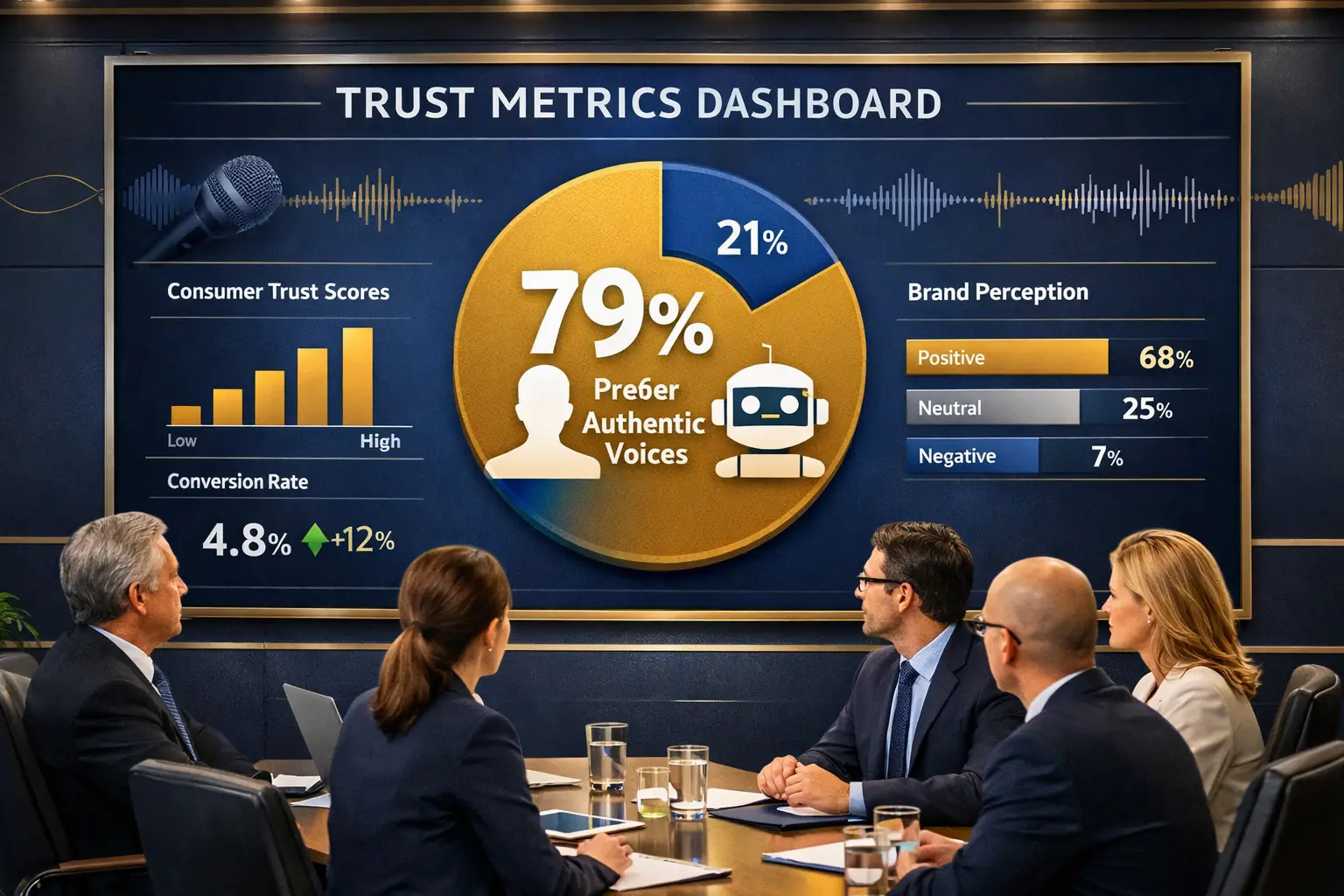
Here’s where it gets interesting for those of us who make our living behind the microphone. The Voice AI Trust Gap isn’t just a catchy phrase—it’s a measurable phenomenon that’s reshaping how businesses think about voice implementation.
97% of enterprises have adopted some form of voice AI technology, with 67% considering it foundational to their operations[3]. You might think, “Well, that’s it then—we’re done for.” But hold on. Here’s the plot twist that changes everything: while nearly everyone has adopted voice AI, only 29% have actually deployed customer-facing voice AI[4].
Let me break that down in terms we can all understand. It’s like everyone bought a guitar, but only three out of ten are willing to perform in public with it. Why? Because when it matters—when real customers are listening—businesses know that quality and authenticity become non-negotiable.
The Investment Paradox
Voice AI funding reached $2.1 billion in 2024-2025, jumping nearly seven times from $315 million in 2022[1][3]. That’s serious money flowing into the sector. But here’s what that investment is revealing: the more companies experiment with synthetic voices, the more they appreciate what authentic voices deliver.
An additional 32% of companies remain in pilot or testing phases[4], which means the majority of enterprises haven’t made final deployment decisions about voice implementation and quality standards. Translation? The game is still wide open, and voice actors who understand how to position themselves as the solution to the trust gap have an incredible window of opportunity.
What Business Leaders Actually Care About
According to Voices CEO Jay O’Connor in the February 2026 report: “An actor-powered voice in voice AI isn’t a nice-to-have anymore. It’s how brands protect trust and stand out.”[4]
Read that again. This isn’t coming from a voice acting coach trying to make you feel better—it’s coming from the CEO of one of the industry’s largest platforms, reporting what business leaders are telling him. Actor-powered voice AI is emerging as a critical quality differentiator as voice technology becomes commoditized[4].
Think about what happens when something becomes commoditized. Remember when everyone and their cousin started offering “professional photography” because they bought a decent camera? The market got flooded, prices dropped, and then something interesting happened: the clients who cared about quality started paying more for photographers who could deliver artistry, not just adequate images. We’re watching the same pattern unfold in voice work.
Why The Voice AI Trust Gap Exists: The Science Behind Authentic Voices
Let me share something I learned the hard way early in my career. I once lost a major commercial gig because I was technically perfect but emotionally flat. The director told me, “You’re saying all the right words, but I don’t believe you care about this product.” That lesson cost me about $15,000, but it taught me something invaluable: technical accuracy without authentic emotion is worthless in voice work.
The data backs this up in ways that should excite every voice actor reading this.
The Trust-Conversion Connection
Companies are discovering that voice naturalness directly correlates with user trust and conversion rates[3]. This isn’t subjective—it’s measurable. Better voices equal better conversion rates, period. When you can demonstrate that your authentic voice performance increases a client’s bottom line, you’re no longer selling a service; you’re offering a profit center.
Emotional intelligence in voice systems reduces escalations by up to 25%[3]. Now, here’s the kicker: AI can simulate emotion, but it can’t genuinely feel it or adapt it with the nuance that three decades of human experience brings to a performance. When a customer is frustrated, confused, or delighted, an authentic voice actor brings layers of understanding that no algorithm can replicate—at least not yet, and probably not ever in ways that truly matter.
The First Impression Factor
In Telnyx’s January 2026 Consumer Insights Panel, researchers found that speech recognition accuracy is now a primary determinant of trust. A strong majority of respondents indicated they trust phone systems more when they understand users on the first attempt without requiring repetition[2].
But here’s what’s even more revealing: clarity has become the primary driver of trust in voice interactions. Users evaluate voice AI based on intelligibility rather than realism or novelty. More than four out of five respondents indicated they abandon interactions when systems feel slow or laggy[2].
What does this mean for you? It means that the skills you’ve developed—clear articulation, proper pacing, emotional intelligence, and adaptability—are exactly what businesses need to prevent customer abandonment. Every customer who abandons an interaction is lost revenue. Every frustrated caller who escalates to a supervisor costs the company money. Your authentic voice prevents both.
Language as a Trust Signal
Here’s something that surprised me when I first saw the data: language support is a first-order trust signal formed before conversation begins. A strong majority indicated they’re more likely to trust companies that support their preferred language from the start of the call, with credibility established immediately upon greeting rather than after problem-solving[2].
For voice actors who speak multiple languages or specialize in particular dialects, this is gold. The trust you build in the first three seconds of a greeting can determine whether a customer stays engaged or hangs up. That’s not something AI does well—it’s something trained, experienced voice talent excels at.
How Voice Actors Can Position Themselves as the Trust Solution
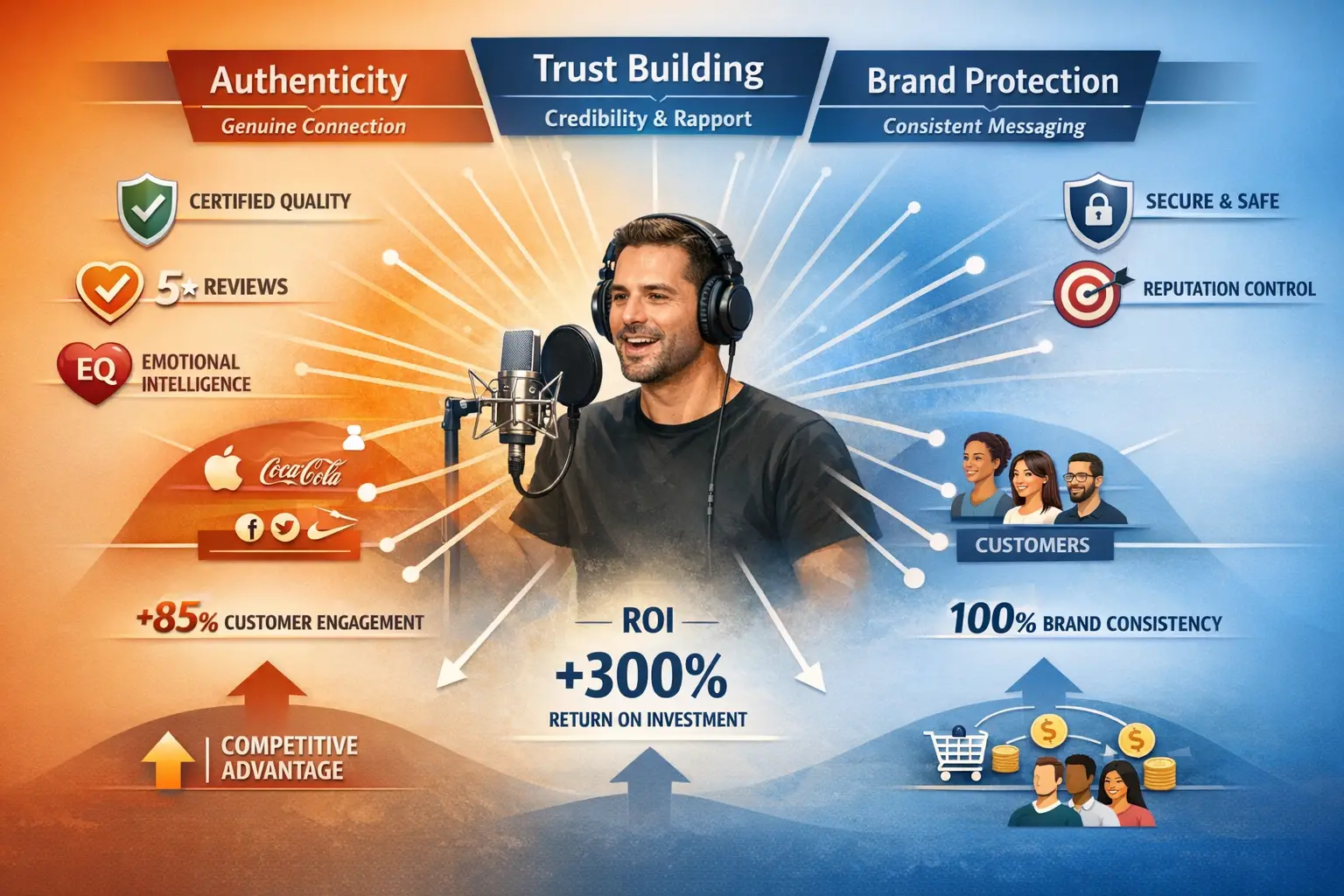
Alright, here’s where we get practical. Understanding The Voice AI Trust Gap: Why 79% of Business Leaders Prioritize Authentic Voice Actors Over Synthetic Voices is great, but what do you actually do with this information?
Reframe Your Value Proposition
Stop selling “voice acting services.” Start selling trust protection and conversion optimization.
When you approach a potential client, your pitch shouldn’t be “I have a great voice and professional equipment.” It should be “I help companies protect customer trust and increase conversion rates through authentic voice performance that builds genuine emotional connections.”
See the difference? One positions you as a commodity that can be replaced by cheaper AI. The other positions you as a strategic partner who solves expensive business problems.
Here’s a script I’ve used successfully: “I noticed you’re implementing voice AI for customer interactions. The research shows that 79% of business leaders prioritize authentic voices because they directly impact trust and conversion. I specialize in creating voice performances that reduce customer escalations by up to 25% while building the emotional connection that keeps customers engaged. Can we discuss how that might impact your bottom line?”
Build Your Trust-Building Portfolio
Your demo reel needs to evolve. Don’t just showcase range and technical ability—showcase emotional intelligence and trust-building capability.
Include samples that demonstrate:
- Clarity under complexity: Handle technical information with warmth and accessibility
- Emotional range: Show you can adapt tone based on customer emotion and context
- Cultural competence: If you speak multiple languages or dialects, feature that prominently
- Problem-solving voice: Demonstrate how you sound when helping someone through frustration
- Brand alignment: Show you can embody different brand personalities authentically
Create case studies (with client permission) that include metrics: “This voice performance for [Client X] improved their IVR completion rate by 18%” or “Customer satisfaction scores increased 23% after implementing this authentic voice greeting.”
Develop Your AI-Era Skill Set
The voice represents the most significant interface shift since smartphones[4], which means the skills that made you successful in traditional voice work need to expand.
Learn the technology: Understand how voice AI systems work, what their limitations are, and where human performance creates the most value. You don’t need to become a programmer, but you should understand terms like natural language processing, emotional AI, and voice cloning so you can speak intelligently with technical decision-makers.
Master micro-performance: AI implementation often requires voice actors to record thousands of variations for different scenarios. Develop the stamina and consistency to deliver authentic emotion across extensive recording sessions while maintaining quality.
Become a brand voice consultant: Position yourself as someone who doesn’t just perform—you help companies define what their voice should be. What emotional tone builds trust with their specific audience? What pacing and energy level aligns with their brand values? This consultative approach commands premium rates.
Target the Right Opportunities
With 55% of consumers now using voice as their primary interface for AI interactions[4], but only 29% of companies having deployed customer-facing voice AI, there’s a massive gap between consumer demand and business readiness.
Focus your marketing on:
- Companies in pilot or testing phases (32% of the market)[4] who haven’t yet committed to voice quality standards
- Premium brands that can’t afford to compromise on trust and authenticity
- Industries where trust is critical: Financial services, healthcare, legal services, customer support
- Companies expanding to new languages or markets where cultural authenticity matters
Price for Value, Not Hours
Here’s some tough love from someone who underpriced their services for years: if you’re charging by the hour or by the word, you’re leaving massive amounts of money on the table.
When you deliver a voice performance that increases conversion rates, reduces customer escalations, and protects brand trust, the value you provide is worth far more than the time you spend recording.
Price based on:
- Business impact: What’s the value of a 15% improvement in conversion rates for this client?
- Usage and reach: How many people will hear this performance? What’s the lifetime value?
- Expertise premium: Your decades of experience and emotional intelligence aren’t commodities
- Trust protection: What would it cost the client if customers abandoned interactions or lost trust in their brand?
I’ve seen voice actors charge $500 for a project that generates $50,000 in additional revenue for the client. That’s not smart pricing—that’s leaving money on the table that you earned through the value you delivered.
The Competitive Advantage of Authentic Voice Performance
Let me tell you about a turning point in my career. I was competing for a major corporate training project against both other voice actors and AI voice solutions. The AI option was literally one-tenth my price. I thought I’d lost before I started.
But I did something different. Instead of submitting a standard audition, I researched the company’s brand values, studied their customer complaints, and created a sample that specifically addressed their trust-building challenges. I included a one-page analysis of how authentic voice performance would reduce their training completion dropout rate.
I won the project at triple my normal rate. Why? Because I demonstrated that I understood their business problem, not just voice acting technique.
What Makes Authentic Voices Irreplaceable
Voice quality and authenticity separate premium brands from generic implementations, with authentic voices positioned as essential to protecting trust rather than as a premium feature[4]. Let that sink in. We’ve moved from “nice to have” to “essential for trust protection.”
AI voices can replicate tone, pacing, and even some emotional inflection. What they can’t replicate is:
Genuine empathy: The ability to truly understand and respond to human emotion with authentic care Cultural nuance: The subtle variations in language, humor, and reference that build connection with specific audiences Adaptive intelligence: Real-time adjustment based on context, audience response, and situational demands Creative interpretation: The artistic choices that transform a script from words into an experience Trust credibility: The intangible quality that makes listeners believe you genuinely care about helping them
Positioning Strategies That Work
Strategy 1: The Trust Specialist Position yourself as an expert in building customer trust through voice performance. Develop case studies, learn the psychology of trust-building, and speak the language of business metrics.
Strategy 2: The Brand Voice Architect Help companies define and maintain consistent brand voice across all customer touchpoints. This consultative role commands premium rates and creates long-term client relationships.
Strategy 3: The Hybrid Specialist Become an expert in working with AI systems—providing the authentic core voice that AI then adapts for scale. This positions you as tech-forward rather than tech-resistant.
Strategy 4: The Emotional Intelligence Expert Specialize in the high-stakes, emotionally complex scenarios where AI falls short: crisis communication, sensitive customer service, healthcare interactions, financial advisory content.
Building Long-Term Client Relationships
The businesses that understand The Voice AI Trust Gap aren’t looking for one-off voice recordings—they’re looking for ongoing partnerships with voice talent who help them maintain trust and authenticity as they scale.
Create retainer relationships by offering:
- Ongoingvoice updates as products and services evolve
- Quality assurance for voice implementations
- Brand voice consistency across multiple platforms and use cases
- Performance optimization based on customer feedback and conversion data
One retainer client is worth ten one-off projects, both financially and professionally.
The Future Belongs to Voice Actors Who Adapt
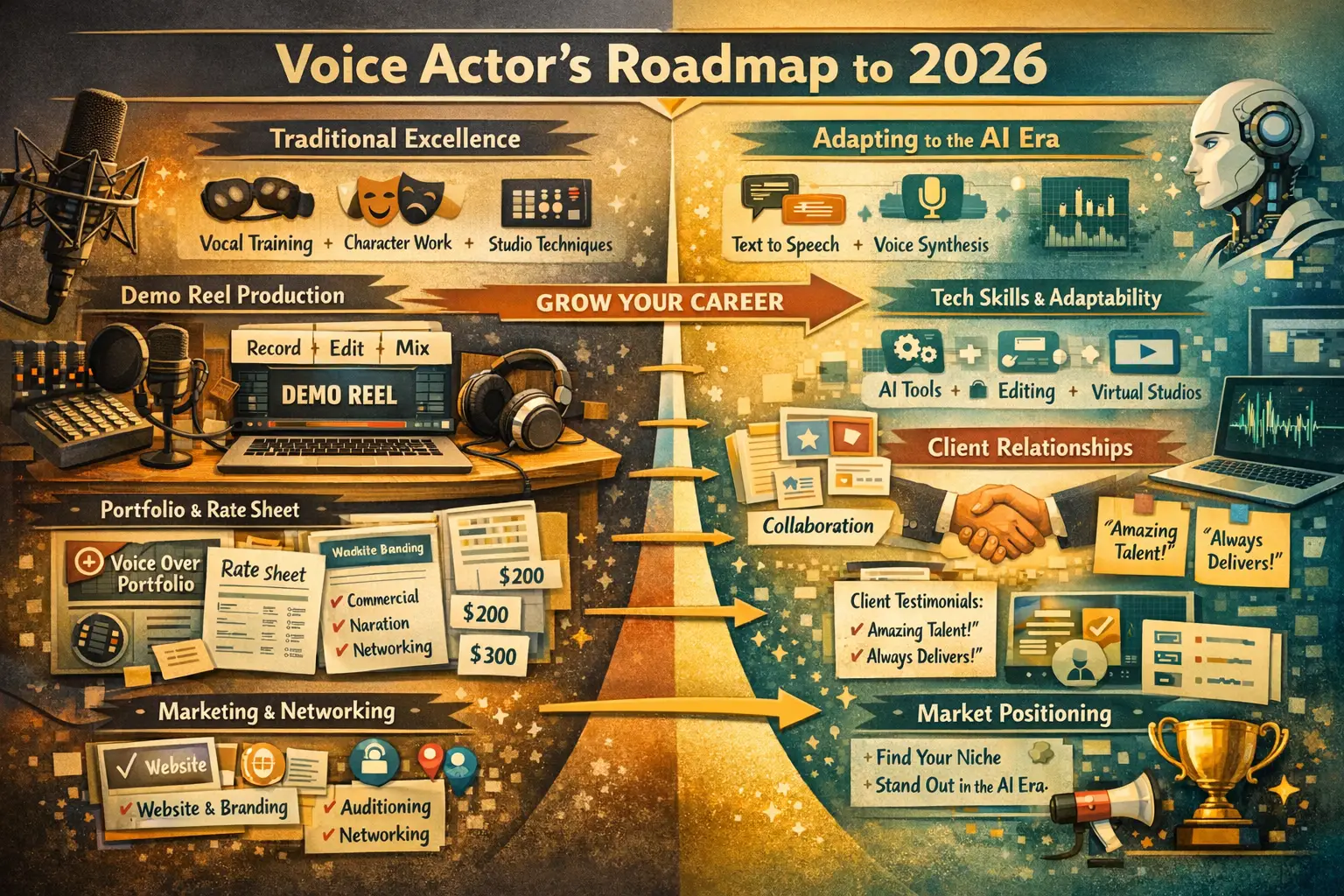
I’ve watched a lot of talented performers resist industry changes over my three decades in this business. Some refused to embrace digital recording. Others dismissed online casting platforms. Many ignored social media marketing. The ones who thrived weren’t necessarily the most talented—they were the ones who adapted fastest while maintaining their artistic integrity.
The Voice AI revolution is no different. The question isn’t whether AI will change our industry—it already has. The question is whether you’ll position yourself as the irreplaceable human element that makes AI implementations actually work.
Skills to Develop in 2026 and Beyond
Technical proficiency: Understanding AI voice systems, recording for machine learning, delivering consistent performances across thousands of variations
Business acumen: Speaking the language of ROI, conversion rates, customer lifetime value, and brand equity
Emotional intelligence: Deepening your ability to read and respond to human emotion in increasingly nuanced ways
Cultural competence: Expanding your understanding of diverse audiences and authentic representation
Marketing sophistication: Positioning yourself strategically in a market that’s rapidly evolving
Collaborative mindset: Working effectively with AI developers, UX designers, and business strategists
Your Action Plan for Capitalizing on the Trust Gap
Immediate actions (this week):
- Audit your current marketing materials—do they position you as a trust-building partner or a commodity service provider?
- Research three companies in pilot or testing phases for voice AI implementation
- Update your demo reel to include trust-building and emotional intelligence examples
- Calculate the business value of your voice work for at least one existing client
Short-term actions (this month):
- Develop a case study that includes business metrics and client results
- Create a consultative pitch that addresses The Voice AI Trust Gap specifically
- Identify your unique positioning—what makes your authentic voice irreplaceable?
- Reach out to five potential clients with your new value-based positioning
- Invest in understanding voice AI technology through courses or research
Long-term actions (this quarter):
- Build retainer relationships with at least two clients who value ongoing voice partnership
- Develop specialized expertise in one high-value niche (healthcare, finance, customer service, etc.)
- Create thought leadership content demonstrating your understanding of voice AI and trust-building
- Network with AI developers, UX designers, and business leaders who make voice implementation decisions
- Establish pricing structures based on value and business impact rather than time or word count
Conclusion: Your Authentic Voice Is Your Competitive Advantage
Here’s what I want you to remember from this article: The Voice AI Trust Gap: Why 79% of Business Leaders Prioritize Authentic Voice Actors Over Synthetic Voices isn’t a threat to your career—it’s the biggest opportunity you’ve had in years.
While AI has commoditized basic voice work, it’s simultaneously elevated the value of authentic, emotionally intelligent voice performance. The businesses that matter—the ones with budgets, brand standards, and customer bases worth protecting—are actively seeking voice actors who understand how to build trust and drive business results.
You’ve spent years developing your craft, understanding human emotion, and perfecting your ability to connect with audiences. Those skills aren’t being replaced by AI—they’re becoming more valuable as businesses discover that synthetic voices can’t deliver the trust and conversion rates their bottom lines demand.
The actors who will thrive in this new landscape aren’t the ones with the best voices (though that helps). They’re the ones who position themselves as strategic partners who solve expensive business problems. They’re the ones who speak the language of trust, conversion, and brand protection. They’re the ones who adapt their skills while maintaining their authentic humanity.
Your next steps are clear:
✅ Reposition yourself as a trust-building specialist, not a voice service provider
✅ Develop business acumen that lets you speak to decision-makers about ROI and conversion
✅ Create a portfolio that demonstrates emotional intelligence and brand alignment
✅ Price based on the value you deliver, not the time you spend
✅ Target companies in the 61% who haven’t yet deployed customer-facing voice AI
The trust gap is real. The opportunity is massive. The time to act is now.
After thirty years in this business, I can tell you with absolute certainty: the voice actors who understand and capitalize on this moment will look back on 2026 as the year everything changed—for the better.
Now get out there and show these businesses why 79% of their peers are choosing authentic voices. Because when it comes to building trust, protecting brands, and connecting with real human beings, there’s no substitute for the real thing.
And that real thing? That’s you. 🎤
References
[1] Voice Ai In 2026 9 Numbers That Signal Whats Next – https://www.speechmatics.com/company/articles-and-news/voice-ai-in-2026-9-numbers-that-signal-whats-next
[2] State Of Voice Ai Trust Execution 2026 – https://telnyx.com/resources/state-of-voice-ai-trust-execution-2026
[3] Voice Ai In 2026 Series 1 – https://www.assemblyai.com/blog/voice-ai-in-2026-series-1
[4] Amplified State Of Voice 2026 – https://www.voices.com/company/press/press-releases/amplified-state-of-voice-2026