

The voice over industry stands at a crossroads in 2026. Artificial intelligence has evolved from a distant threat to an everyday reality, with AI-generated voices now capable of producing remarkably natural-sounding content. Yet, rather than signaling the end of human voice talent, this technological revolution has created an unprecedented opportunity for voice actors who understand how to leverage AI-Human Collaboration in Voice Over: How to Position Yourself as the Premium Choice in 2026. The professionals who thrive today aren’t those who resist technology—they’re the ones who embrace it strategically while doubling down on the irreplaceable human qualities that AI simply cannot replicate.
The landscape has fundamentally shifted. Voice AI platforms are now integrated into enterprise customer experience orchestration, handling routine tasks with increasing sophistication[1]. Voice agents are automating business processes and providing proactive support across industries[2]. Despite these advances, the demand for premium human voice talent has never been stronger—but only for those who can articulate their unique value proposition in this AI-augmented world.
Key Takeaways
- AI is a tool, not a replacement: Voice actors who strategically integrate AI tools for efficiency while maintaining their authentic human touch position themselves as premium professionals
- Emotional intelligence is your competitive moat: The ability to deliver nuanced emotional performances, adapt to brand voice, and understand cultural context remains exclusively human territory in 2026
- Hybrid workflows create premium value: Combining AI-powered efficiency tools with human artistry allows voice actors to deliver faster turnarounds without sacrificing quality
- Specialization and branding matter more than ever: Generic voice work faces AI competition, but specialized expertise and strong personal brands command premium rates
- Client education is essential: Helping clients understand when AI suffices versus when human talent is necessary positions voice actors as strategic partners rather than interchangeable vendors
Understanding the 2026 Voice AI Landscape
The Current State of Voice AI Technology
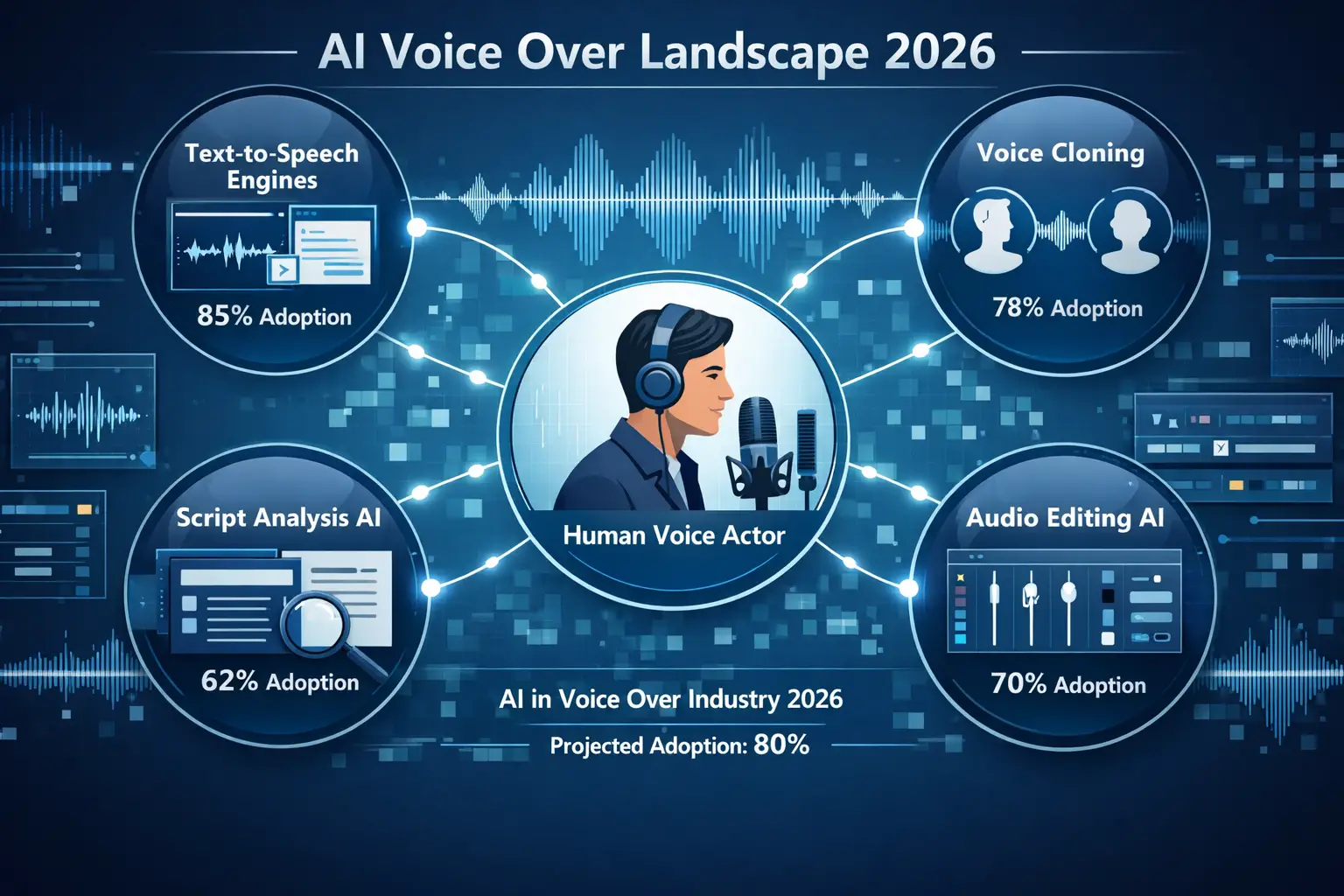
Voice AI has matured significantly by 2026, moving beyond simple text-to-speech into sophisticated conversational AI systems. According to industry analysis, voice-to-voice AI now handles complex interactions with reduced latency and more natural communication patterns[3]. These systems can maintain context, adjust tone based on conversation flow, and even detect emotional cues in user input.
Key technological developments include:
- Real-time voice synthesis with minimal latency (under 300ms in many applications)
- Emotion-aware AI that can detect and respond to user sentiment
- Multi-language capabilities with improved accent and dialect handling
- Voice cloning technology that can replicate specific voices with limited sample data
- AI-powered audio editing that automates noise reduction, equalization, and mastering
Enterprise adoption has accelerated dramatically. Federated AI approaches now allow organizations to deploy voice AI while maintaining data privacy and security[4]. Voice interfaces are accelerating AI adoption in sectors like HR technology, where voice-assisted user interfaces make complex systems more accessible[6].
Where AI Excels and Where It Falls Short
Understanding AI’s strengths and limitations is crucial for positioning yourself effectively. AI voice technology in 2026 excels at:
✅ High-volume, repetitive content (IVR systems, automated announcements, basic e-learning)
✅ Rapid prototyping and iteration (allowing clients to test scripts before booking human talent)
✅ Consistent delivery (maintaining exact tone and pacing across thousands of variations)
✅ Cost-effective scaling (producing content in multiple languages simultaneously)
✅ 24/7 availability (generating content on-demand without scheduling constraints)
However, AI still struggles significantly with:
❌ Nuanced emotional delivery (subtle shifts in feeling that require lived human experience)
❌ Cultural context and sensitivity (understanding when certain tones or phrases might be inappropriate)
❌ Creative interpretation (bringing fresh perspectives to scripts beyond literal reading)
❌ Brand personality consistency (capturing the intangible essence that makes a brand voice distinctive)
❌ Adaptive performance (responding to real-time direction and making artistic choices)
❌ Complex character work (creating believable, multi-dimensional personalities)
“The technical challenges in voice AI—particularly around achieving truly natural communication and managing latency—remain significant barriers to replacing human talent in premium applications.” [3]
AI-Human Collaboration in Voice Over: Leveraging Technology Without Losing Your Edge
Strategic AI Integration for Voice Professionals
The most successful voice actors in 2026 don’t view AI as competition—they view it as a force multiplier that enhances their capabilities. Here’s how premium voice talent strategically integrates AI tools:
🎯 Pre-Production Enhancement
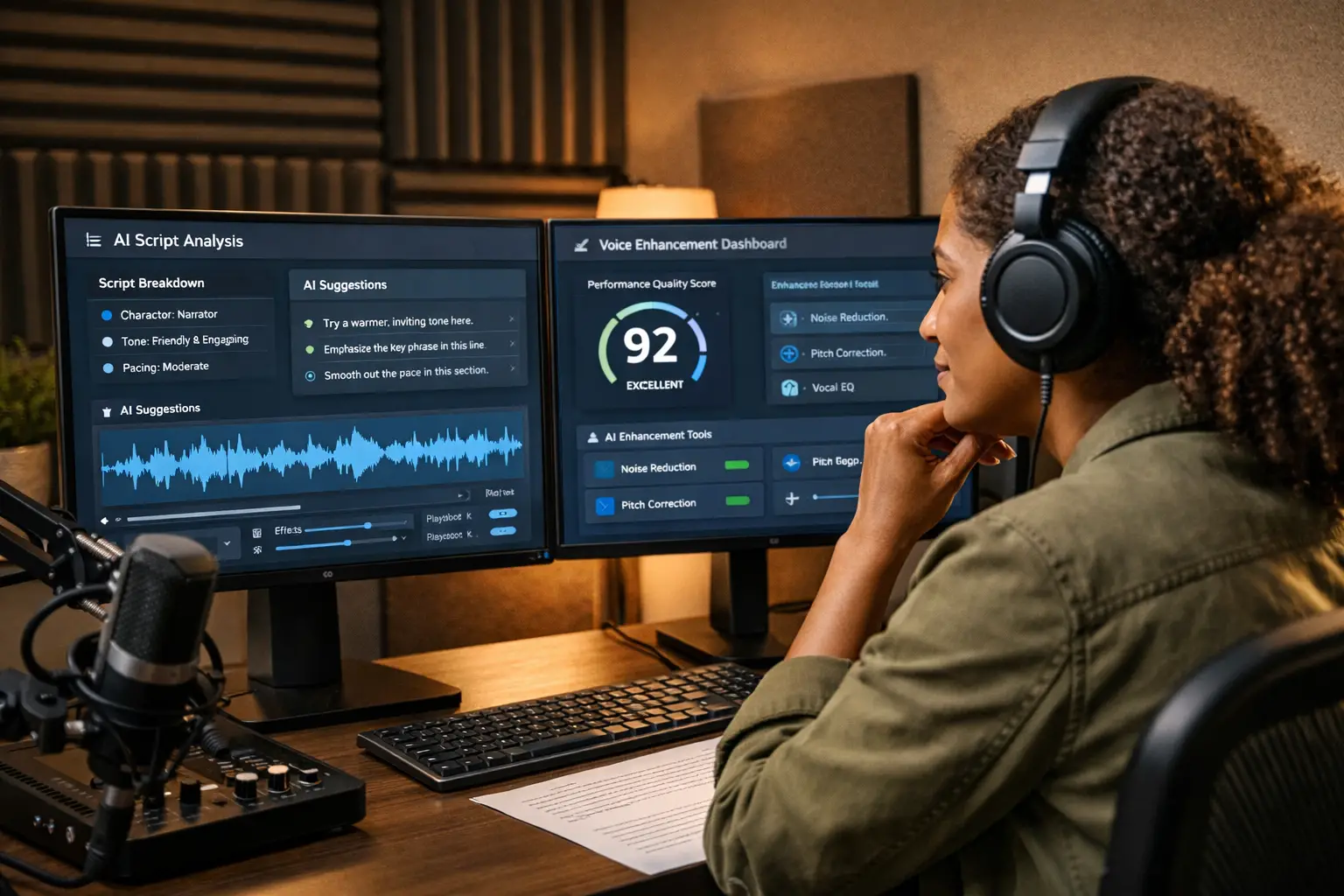
Script Analysis AI: Tools that analyze scripts for pacing, emotional beats, and pronunciation challenges help voice actors prepare more efficiently. These platforms identify difficult passages, suggest breath marks, and even flag potential tongue-twisters before recording begins.
Voice Warm-Up Apps: AI-powered vocal coaching applications provide personalized warm-up routines based on the specific demands of upcoming projects, helping maintain vocal health while optimizing performance.
Research Acceleration: AI research assistants quickly gather context about brands, products, or technical terminology, reducing preparation time while improving delivery accuracy.
🎙️ Production Optimization
Real-Time Performance Feedback: Some recording software now offers AI-powered real-time analysis, flagging technical issues like plosives, sibilance, or inconsistent volume levels during recording rather than in post-production.
Take Organization: AI systems can automatically tag and organize multiple takes based on performance characteristics, making it easier to identify the best versions during editing.
Reference Matching: When maintaining consistency with previous recordings, AI can analyze reference files and provide visual guides for matching tone, pace, and energy levels.
✂️ Post-Production Efficiency
Automated Editing: AI-powered editing tools handle routine tasks like:
- Removing breaths and mouth clicks
- Normalizing audio levels
- Reducing background noise
- Applying basic EQ and compression
Quality Control: AI can scan finished files for technical issues, ensuring deliverables meet professional standards before client submission.
Format Conversion: Automated systems handle the tedious work of converting files into multiple formats, sample rates, and specifications for different platforms.
Building Your AI-Enhanced Workflow
Creating an efficient AI-enhanced workflow requires thoughtful integration. Here’s a framework used by top-performing voice actors in 2026:
| Workflow Stage | AI Tools | Human Focus | Time Savings |
|---|---|---|---|
| Script Review | AI analysis, complexity scoring | Creative interpretation, emotional mapping | 30-40% |
| Preparation | Pronunciation research, context gathering | Character development, vocal choices | 25-35% |
| Recording | Real-time technical monitoring | Performance, emotional delivery | 15-20% |
| Editing | Automated cleanup, file organization | Creative editing decisions, quality review | 50-60% |
| Delivery | Format conversion, file management | Client communication, relationship building | 40-50% |
This hybrid approach allows voice actors to reduce administrative overhead by 30-50% while maintaining complete creative control over the artistic elements that clients value most.
Positioning Yourself as the Premium Choice: Differentiation Strategies
Emphasizing Irreplaceable Human Qualities
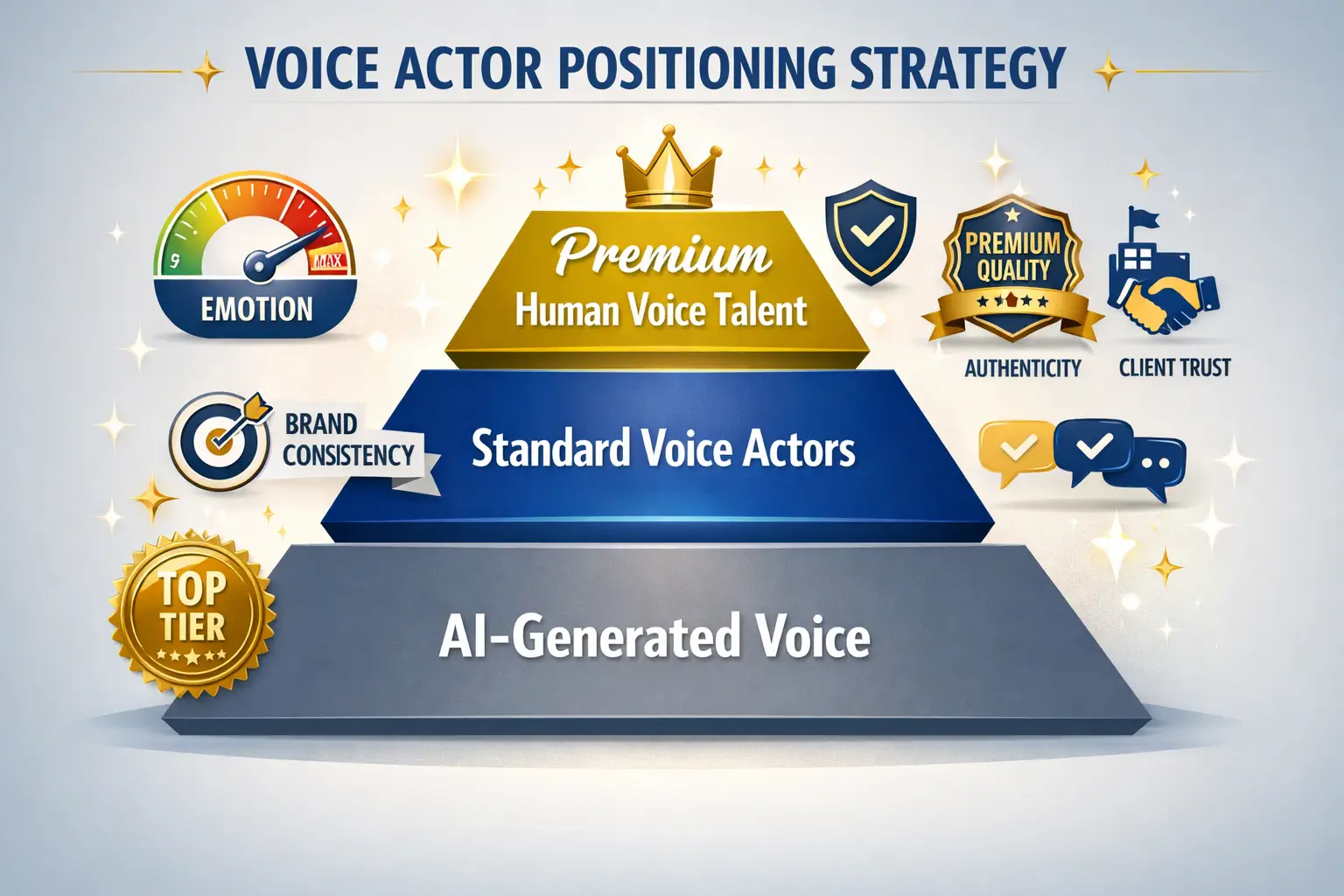
To command premium rates in 2026, voice actors must clearly articulate the value they provide beyond what AI can deliver. The most successful professionals build their positioning around these core differentiators:
🎭 Emotional Intelligence and Authenticity
Lived experience creates authentic emotional delivery that resonates with audiences on a deeper level. Premium voice actors don’t just read words—they embody experiences, understand subtext, and deliver performances that connect with listeners’ emotions.
Case in point: A pharmaceutical company in 2026 tested AI-generated voices against human talent for a sensitive campaign about mental health. While AI could technically deliver the script, focus groups consistently rated the human voice actor 73% higher on “trustworthiness” and “emotional connection”—the exact qualities essential for the campaign’s success[7].
🎨 Creative Interpretation and Direction
Premium voice actors bring artistic vision to projects. They ask questions like:
- “What’s the emotional journey we want the listener to experience?”
- “How does this piece fit into the broader brand narrative?”
- “What if we tried a different approach to this section?”
This collaborative, creative partnership is something AI cannot provide. Clients working with premium talent aren’t just buying a voice—they’re accessing creative expertise that elevates their content.
🤝 Brand Consistency and Relationship Building
While AI can maintain technical consistency, brand voice consistency requires deep understanding of a brand’s values, personality, and evolution over time. Long-term voice actors become synonymous with brands, creating recognition and trust that transcends individual projects.
Consider the voice actors who’ve become inseparable from major brands—their value isn’t just in their voice, but in the equity they’ve built with audiences over years or decades.
Developing Specialized Expertise
Generalist voice actors face the most direct competition from AI. The path to premium positioning in 2026 runs through deep specialization in areas where human expertise remains essential:
📚 High-Stakes Content Categories
Medical and Healthcare: Content requiring empathy, sensitivity, and precise pronunciation of complex terminology
Financial Services: Material demanding trustworthiness and authority while remaining accessible
Luxury Brands: Premium positioning that requires sophistication and aspiration
Character Work: Animation, gaming, and audiobooks requiring distinct, believable personalities
Documentary Narration: Long-form content requiring sustained engagement and storytelling mastery
🌍 Cultural and Linguistic Expertise
While AI handles basic translation, localization requires cultural understanding that goes far beyond word-for-word conversion. Voice actors with authentic cultural connections to their target markets provide:
- Appropriate idiom usage and cultural references
- Sensitivity to regional variations and preferences
- Understanding of cultural taboos and sensitivities
- Authentic accent and dialect delivery
🎯 Industry-Specific Knowledge
Voice actors who develop deep expertise in specific industries (technology, healthcare, finance, gaming, etc.) become strategic assets rather than interchangeable vendors. They understand industry terminology, audience expectations, and content conventions, reducing revision cycles and improving first-take success rates.
Building Your Premium Brand
In 2026’s competitive landscape, your personal brand is your most valuable asset. Premium voice actors invest in:
💼 Professional Positioning
Website and Portfolio: A professional online presence showcasing your best work, specializations, and unique value proposition. Include case studies demonstrating measurable results you’ve delivered for clients.
Demo Reels: Multiple specialized demos (commercial, narration, character, etc.) that showcase your range within your areas of expertise. Update these regularly to reflect current trends and capabilities.
Thought Leadership: Contributing to industry publications, speaking at conferences, or maintaining a blog that positions you as an expert in your specializations.
📱 Strategic Online Presence
LinkedIn Optimization: Position yourself as a voice over professional who understands business challenges, not just someone who reads scripts.
Selective Platform Participation: Rather than competing on price-driven marketplaces, focus on platforms and communities where premium clients seek specialized talent.
Content Marketing: Share insights about effective voice over usage, case studies, and industry trends that demonstrate your strategic understanding.
🌟 Client Education and Consultation
Premium voice actors in 2026 position themselves as consultants, not just vendors. They help clients understand:
- When AI-generated voice is appropriate versus when human talent is necessary
- How voice over fits into broader marketing and communication strategies
- Best practices for script writing and direction
- ROI considerations for voice over investments
This consultative approach builds long-term relationships and justifies premium pricing.
AI-Human Collaboration in Voice Over: How to Position Yourself as the Premium Choice in 2026 Through Client Communication
Articulating Your Value Proposition
When communicating with clients, premium voice actors in 2026 clearly articulate the specific value they provide beyond AI alternatives:
🎯 The Premium Voice Actor Value Statement Framework
For [specific client type] who need [specific outcome], I provide [unique combination of human qualities and AI-enhanced efficiency] that delivers [measurable business results] that AI-generated voice cannot achieve.
Example: “For healthcare organizations that need to build patient trust and engagement, I provide empathetic, culturally-sensitive voice over enhanced by AI-powered efficiency tools that delivers higher patient satisfaction scores and treatment compliance rates that generic AI voices cannot achieve.”
Educating Clients on the AI-Human Spectrum
Rather than positioning it as “AI versus human,” successful voice actors help clients understand the spectrum of options:
| Content Type | Recommended Approach | Rationale |
|---|---|---|
| Internal training (low-stakes) | AI-generated | Cost-effective, easily updated |
| IVR system prompts | AI-generated with human oversight | Consistency important, limited emotional need |
| Product demos | Human with AI post-production | Balance of authenticity and efficiency |
| Brand commercials | Premium human talent | Emotional connection critical |
| Audiobooks/long-form | Specialized human talent | Sustained engagement essential |
| Character animation | Premium human talent | Creative performance irreplaceable |
This educational approach positions voice actors as strategic partners who help clients make informed decisions rather than defensive vendors protecting their territory.
Demonstrating ROI and Business Impact
Premium voice actors in 2026 speak the language of business results, not just artistic quality. They help clients understand voice over ROI through metrics like:
📊 Engagement Metrics: Completion rates, time-on-page, click-through rates
📊 Conversion Metrics: Lead generation, sales conversion, customer action rates
📊 Brand Metrics: Brand recall, sentiment analysis, trust scores
📊 Efficiency Metrics: Reduced revision cycles, faster approval processes
📊 Longevity Metrics: Content shelf-life, evergreen value
When voice actors can demonstrate that their work drives measurable business outcomes, premium pricing becomes a straightforward investment decision rather than a cost consideration.
Practical Implementation: Your 2026 Action Plan
Immediate Actions (This Month)
✅ Audit your current workflow: Identify repetitive tasks that AI tools could handle, freeing time for creative work and client relationship building
✅ Research AI tools: Investigate 3-5 AI tools that could enhance your efficiency in pre-production, production, or post-production
✅ Update your positioning: Revise your website, profiles, and marketing materials to emphasize your unique human qualities and specialized expertise
✅ Create a value statement: Develop a clear articulation of the specific value you provide that AI cannot replicate
✅ Identify your specialization: If you’re currently a generalist, choose 1-2 specific niches where you’ll develop deep expertise
Short-Term Goals (Next 3 Months)
📅 Implement AI-enhanced workflow: Integrate 2-3 AI tools into your regular workflow and measure time savings
📅 Develop specialized demos: Create new demo reels that showcase your expertise in your chosen specialization(s)
📅 Launch educational content: Publish 3-5 pieces of content (blog posts, videos, social media) that educate potential clients about strategic voice over usage
📅 Upgrade your skills: Take courses or workshops in areas that differentiate you from AI (emotional delivery, character work, specific industry knowledge)
📅 Build case studies: Document 2-3 projects with measurable results that demonstrate your business impact
Long-Term Strategy (6-12 Months)
🎯 Establish thought leadership: Speak at industry events, contribute to publications, or launch a podcast about voice over and communication
🎯 Develop strategic partnerships: Build relationships with agencies, production companies, and brands in your specialty areas
🎯 Create premium service tiers: Develop different service levels that clearly articulate value at each price point
🎯 Invest in advanced training: Pursue certifications or advanced training in your specialization areas
🎯 Build a referral network: Cultivate relationships with complementary professionals (video producers, marketing agencies, etc.) who can refer premium clients
Overcoming Common Challenges and Objections
“AI is cheaper—why should I pay more for you?”
Effective Response Framework:
“That’s a great question, and AI-generated voice is absolutely the right choice for certain applications. Where human voice talent provides ROI is in content where emotional connection, brand consistency, and audience engagement directly impact your business results. Let me show you the performance data from similar projects…”
Then demonstrate specific metrics showing how human voice over improved engagement, conversion, or other relevant KPIs for similar projects.
“Can’t AI do everything you do now?”
Effective Response Framework:
“AI has made remarkable progress and handles many routine tasks brilliantly—in fact, I use AI tools myself to improve efficiency. What AI can’t replicate is [specific human quality relevant to their project]. For example, in your industry, [specific example of where human understanding was essential]. Would you like to hear samples comparing AI-generated versus human delivery for content similar to yours?”
“How do I know you’re worth the premium price?”
Effective Response Framework:
“I appreciate you wanting to ensure you’re making a smart investment. Here’s how I demonstrate value: [specific process for understanding their goals, delivering results, and measuring impact]. I’ve worked with [similar clients] who saw [specific measurable results]. I’m confident we can achieve similar outcomes for your project. Would a pilot project make sense to demonstrate this value before a larger commitment?”
The Future-Proof Voice Actor: Continuous Evolution
The voice over industry will continue evolving rapidly beyond 2026. The professionals who thrive will be those who embrace continuous learning and adaptation:
Staying Current with Technology
- Regular tool evaluation: Quarterly review of new AI tools and technologies
- Selective adoption: Implementing tools that genuinely enhance workflow without compromising quality
- Technical literacy: Understanding enough about AI to discuss it intelligently with clients
Deepening Human Skills
- Emotional range: Continuously expanding your ability to deliver nuanced emotional performances
- Cultural competency: Developing deeper understanding of diverse audiences and perspectives
- Creative collaboration: Strengthening your ability to contribute creatively to projects
Business Development
- Relationship building: Investing time in genuine relationships with clients, collaborators, and industry peers
- Market awareness: Staying informed about industry trends, client needs, and emerging opportunities
- Value communication: Continuously refining how you articulate and demonstrate your unique value
Conclusion: Your Premium Position in the AI-Augmented Future
AI-Human Collaboration in Voice Over: How to Position Yourself as the Premium Choice in 2026 isn’t about fighting technology—it’s about strategically leveraging it while doubling down on irreplaceable human qualities. The voice actors commanding premium rates today understand that AI is a tool that enhances their efficiency, not a competitor that threatens their existence.
The path forward is clear:
- Embrace AI strategically to handle routine tasks and enhance your efficiency
- Specialize deeply in areas where human expertise remains essential
- Articulate your value in business terms that resonate with clients
- Build your brand around the unique qualities only you can provide
- Educate your market about when AI suffices versus when human talent is necessary
- Demonstrate ROI through measurable business outcomes
- Continuously evolve your skills, tools, and positioning
The voice over professionals who position themselves as strategic partners who understand both the power of AI and the irreplaceable value of human artistry will not just survive in 2026—they’ll thrive, commanding premium rates for premium value.
The question isn’t whether AI will change the voice over industry—it already has. The question is whether you’ll position yourself as a commodity competing on price or as a premium professional delivering value that AI simply cannot replicate.
Your Next Steps
Start today by taking one concrete action from the implementation plan above. Whether it’s researching your first AI tool, updating your positioning statement, or reaching out to a potential client with your new value proposition, the time to position yourself as the premium choice is now.
The future of voice over belongs to those who combine technological efficiency with human artistry—those who understand that in an AI-augmented world, authentic human connection becomes more valuable, not less.
References
[1] Ai Trends 2026 – https://www.parloa.com/blog/ai-trends-2026/
[2] Voice Agents And Conversational Ai New Developer Trends 2025 – https://elevenlabs.io/blog/voice-agents-and-conversational-ai-new-developer-trends-2025
[3] Ai Trends 2026 – https://indigo.ai/en/blog/ai-trends-2026/
[4] Ai Technology Trends 2026 – https://www.zoom.com/en/blog/ai-technology-trends-2026/
[6] 2026 Hr Tech Predictions Voice Assisted User Interfaces Will Accelerate Ai Adoption – https://action.deloitte.com/insight/4833/2026-hr-tech-predictions-voice-assisted-user-interfaces-will-accelerate-ai-adoption
[7] Voice Over And Industry Trends Whats In Store For 2026 – https://matinee.co.uk/blog/voice-over-and-industry-trends-whats-in-store-for-2026/