
The audiobook industry is experiencing explosive growth, with U.S. sales revenue reaching $2.22 billion in 2024 and projections soaring to $13.3 billion by 2030[2]. Yet as this market expands, a critical divide is emerging between those who simply read words aloud and those who master the craft of voice acting. In 2026, achieving Audiobook Narration Mastery: Positioning Yourself as a Professional Voice Artist, Not Just a Reader has become the defining factor that separates successful narrators from the growing crowd of competitors—including both human amateurs and AI alternatives.
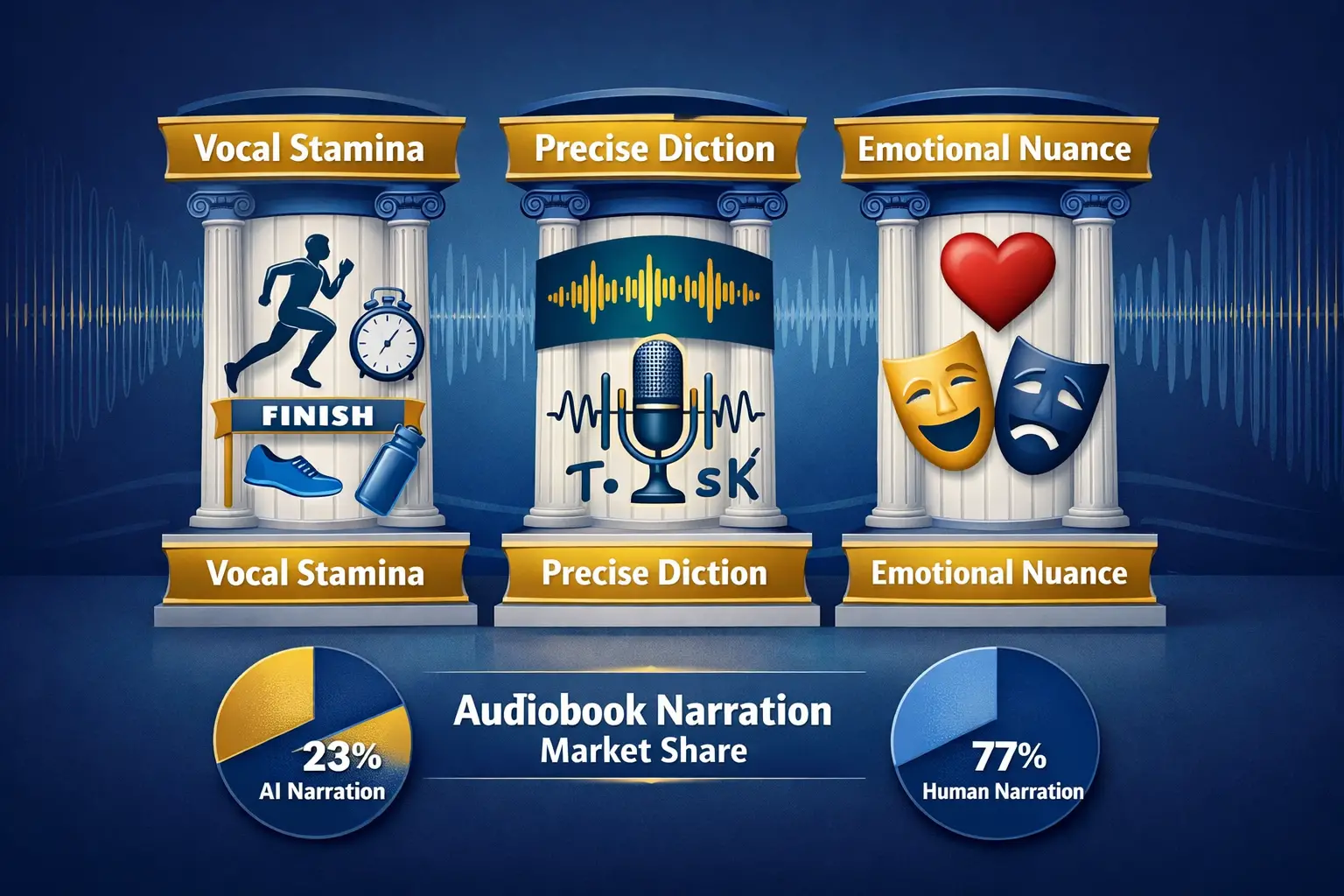
The rise of artificial intelligence in audiobook production might seem threatening at first glance. However, consumer skepticism toward AI narration is actually growing, with only 70% of consumers willing to try AI-narrated audiobooks in 2025, down from 77% in 2023[2]. This trend creates a competitive advantage for human professionals who can demonstrate genuine artistry. While AI-narrated audiobooks grew 36% year-over-year between 2023-2025, they still account for only 23% of new releases as of January 2026[2], leaving substantial demand for skilled human narrators.
The message is clear: readers are abundant, but voice artists are rare and increasingly valuable. 🎙️
Key Takeaways
- Professional narration requires voice acting skills: Interpretation, character development, and pacing distinguish artists from readers in the competitive audiobook market
- Human narrators maintain competitive advantages: Consumer skepticism toward AI narration is growing, creating opportunities for professionals who master emotional nuance and storytelling craft
- Top-tier professionals demonstrate three core competencies: Vocal stamina, precise diction, and emotional nuance characterize the top 1% of audiobook talent
- The market rewards specialized expertise: Genre-specific knowledge and narrator continuity build listener loyalty and long-term career sustainability
- Professional positioning accelerates hiring: Vetted talent platforms now facilitate 24-48 hour hiring timelines for narrators who demonstrate mastery-level skills
Understanding the Distinction: Reader vs. Voice Artist
What Makes Someone “Just a Reader”
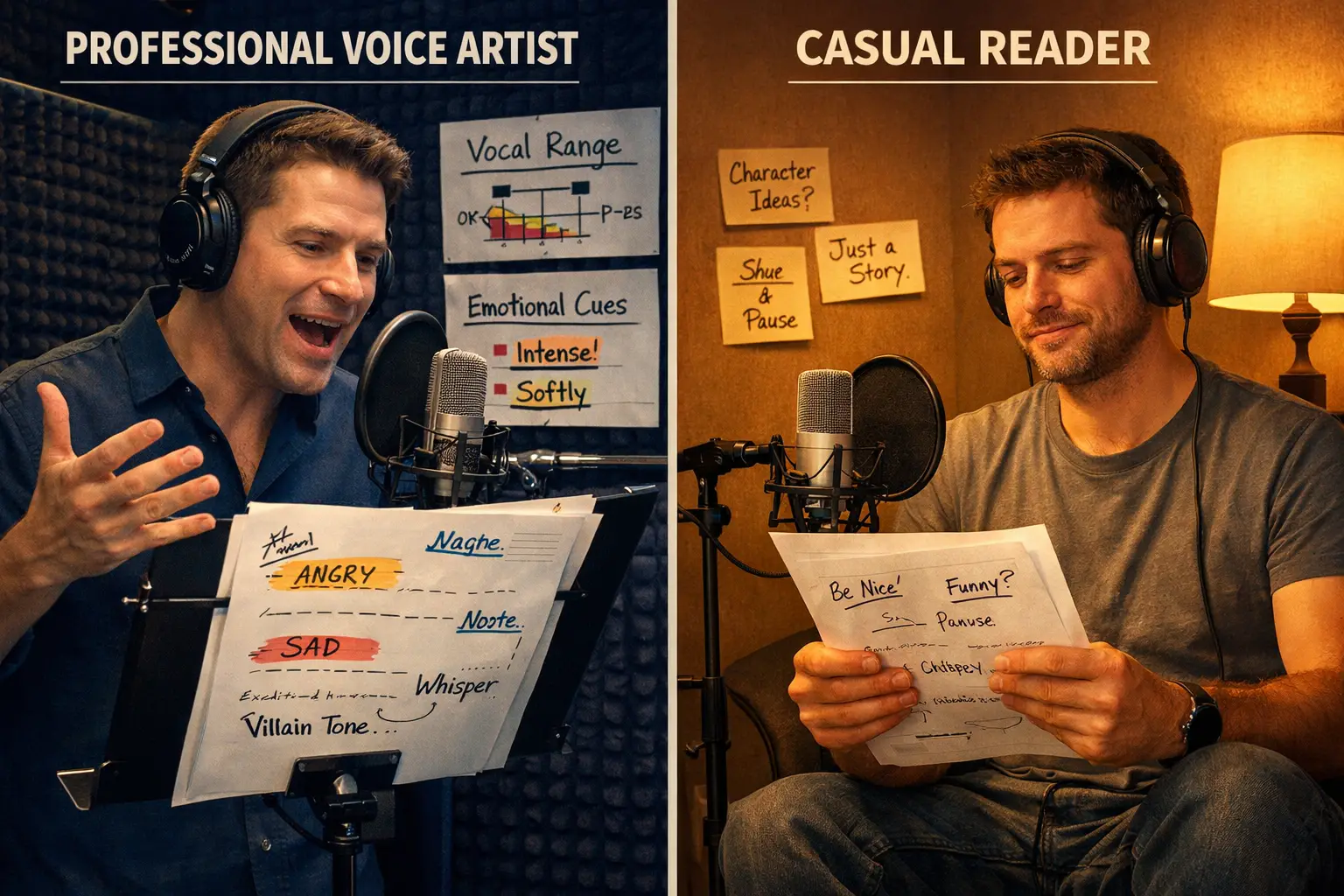
A reader approaches an audiobook as a mechanical task—converting written words into spoken sounds. This approach treats narration as a transcription service rather than a performance art. Readers typically:
- Maintain a monotone or limited vocal range
- Ignore character distinctions and emotional context
- Focus on pronunciation without interpretation
- Treat dialogue and narrative prose identically
- Miss opportunities for pacing and dramatic timing
In the current market, this approach no longer meets listener expectations. As the quality bar for audiobooks has risen significantly, immersive sound design and skilled narration now differentiate successful titles in an increasingly crowded marketplace[1].
The Professional Voice Artist Approach
Professional voice artists understand that audiobook narration is a performance discipline requiring the same skills as stage acting, film work, or radio drama. They approach each project with:
- Character analysis and development for every speaking role
- Emotional arc mapping throughout the narrative
- Vocal variety and characterization that brings text to life
- Pacing strategies that match story tension and reader engagement
- Technical excellence in breath control, diction, and stamina
This distinction matters more than ever. Professional narrators can convey the emotion and nuance of stories in ways that help audiobooks stand out in a sea of increasingly AI-driven narrations[2]. The human element—when executed with mastery—creates irreplaceable value.
Audiobook Narration Mastery: Core Competencies That Define Professionals
Vocal Stamina and Endurance
Recording an audiobook is a marathon, not a sprint. Professional projects often require 6-8 hours of recording time for every finished hour of audio, with sessions lasting multiple hours across several days or weeks.
Top-tier professionals demonstrate superior vocal stamina[5], which includes:
- Breath control techniques that prevent audible gasping or vocal fatigue
- Hydration and vocal health protocols to maintain consistency across sessions
- Proper microphone technique that reduces strain and retakes
- Session planning that accounts for vocal limitations and recovery time
Without vocal stamina, narrators experience:
| Issue | Impact on Production |
|---|---|
| Voice fatigue | Inconsistent character voices across chapters |
| Decreased clarity | Increased editing time and retakes |
| Vocal strain | Project delays and potential injury |
| Energy loss | Flat, uninspired performance in later sessions |
Developing vocal stamina requires consistent practice and proper technique—treating your voice as an athlete treats their body.
Precise Diction and Technical Excellence
Listeners expect crystal-clear articulation without distracting mouth sounds, breathing, or pronunciation errors. Precise diction[5] represents one of the three core competencies that characterize the top 1% of audiobook narration talent as of February 2026.
Professional diction involves:
- Articulation exercises that strengthen tongue, lip, and jaw muscles
- Pronunciation research for character names, locations, and specialized terminology
- Microphone awareness to minimize plosives (p, b sounds) and sibilance (s, sh sounds)
- Editing knowledge to deliver clean takes that require minimal post-production
Many aspiring narrators underestimate the technical aspects of audiobook recording. Professional voice artists invest in:
- Quality recording equipment and acoustically treated spaces
- Ongoing training in vocal technique and performance
- Relationships with audio engineers and producers
- Continuous improvement through feedback and self-evaluation
Emotional Nuance and Character Development
This competency separates competent narrators from exceptional ones. The ability to convey emotional nuance across diverse content types[5] requires deep interpretive skills that go far beyond reading comprehension.
Professional voice artists approach character development systematically:
- Character profiling: Creating distinct voices, accents, and mannerisms for each character
- Emotional mapping: Identifying the emotional journey throughout the narrative
- Relationship dynamics: Understanding how characters relate to each other and adjusting performance accordingly
- Subtext interpretation: Conveying what characters mean beyond their literal words
- Narrative perspective: Distinguishing between narrator voice and character voices
“Professional narrators can convey the emotion and nuance of stories in ways that help audiobooks stand out in a sea of increasingly AI-driven narrations.” [2]
This emotional authenticity creates listener attachment to specific voices[5], driving long-term value for both narrators and publishers. When listeners develop preferences for particular narrators, they actively seek out new titles performed by those artists—creating a sustainable career foundation.
Building Your Professional Voice Artist Identity
Developing Genre Expertise
Authors evaluating audiobook strategies must consider genre and listener expectations when choosing between AI and professional narration[2]. This reality creates opportunities for specialists who can demonstrate genre-specific expertise.
Different genres require distinct narration approaches:
Fiction Genres:
- Romance: Emotional intimacy, sensual pacing, distinct male/female character voices
- Thriller/Mystery: Tension building, pacing variation, suspenseful delivery
- Fantasy/Sci-Fi: World-building through vocal texture, complex character ensembles
- Literary Fiction: Nuanced interpretation, sophisticated emotional range
Non-Fiction Genres:
- Business/Self-Help: Authoritative yet accessible tone, clarity over drama
- Memoir: Authentic emotional connection, first-person intimacy
- History/Biography: Narrative engagement without fictional dramatization
- Educational: Clear articulation, appropriate pacing for information retention
Positioning yourself as a genre specialist rather than a generalist can accelerate your career growth. Publishers and authors seeking narrator continuity for series work particularly value demonstrated expertise in their specific genre.
Creating a Professional Demo Reel
Your demo reel serves as your audition for every potential client. With vetted audiobook narration platforms offering faster hiring capabilities (24-48 hours versus 7-14 days)[5], having a compelling demo ready is essential.
Professional demo reels should:
- Showcase range: Include 3-5 distinct samples demonstrating different genres, tones, and character types
- Highlight technical quality: Professional recording quality with no background noise or audio issues
- Demonstrate versatility: Show both narrative prose and character dialogue
- Stay concise: 2-3 minutes total length—decision-makers won’t listen longer
- Lead with strength: Place your best, most distinctive work first
Avoid these common demo reel mistakes:
❌ Including too many samples (quality over quantity)
❌ Poor audio quality or inconsistent volume levels
❌ Samples that sound too similar to each other
❌ Outdated or amateur-sounding material
❌ Excessive length that tests listener patience
Establishing Your Professional Presence
Professional hiring timelines are accelerating[5], but this speed benefits narrators who have already established credibility. Building your professional presence requires:
Online Portfolio Development:
- Professional website with demo reel, bio, and contact information
- Active profiles on narrator-specific platforms (ACX, Findaway Voices, Author’s Republic)
- Social media presence showcasing behind-the-scenes content and completed projects
- Video content demonstrating your process and personality
Industry Networking:
- Membership in professional organizations (Screen Actors Guild, Voice and Speech Trainers Association)
- Attendance at audiobook industry conferences and workshops
- Relationships with publishers, authors, and audio production companies
- Collaboration with other voice artists for knowledge sharing
Continuous Skill Development:
- Regular coaching with voice acting professionals
- Workshops in specific techniques (accent work, character development, vocal health)
- Acting classes to strengthen performance skills
- Technical training in audio engineering and home studio optimization
Audiobook Narration Mastery: Positioning Strategies
Leveraging the Human Advantage in an AI-Influenced Market
The audiobook industry is experiencing significant technological disruption. ElevenLabs, valued at $11 billion, has consolidated its audiobook production services under the new brand “Audiobooks in ElevenCreative”[7], reflecting the industry’s maturation and focus on audiobook-specific solutions.
However, this AI growth creates positioning opportunities for human professionals rather than threats. Professional narrator services like Author’s Republic and similar platforms featuring human professional voice actors are experiencing increased adoption as authors seek to preserve the unique human element of their stories[2].
Strategic positioning approaches include:
- Emphasize irreplaceable qualities: Market your ability to deliver emotional authenticity, creative interpretation, and genuine human connection
- Target quality-conscious clients: Focus on authors and publishers who prioritize listener experience over production cost
- Highlight collaboration value: Position yourself as a creative partner who enhances the author’s vision, not just a service provider
- Demonstrate ROI: Show how professional narration increases listener engagement, reviews, and repeat purchases
Building Long-Term Client Relationships
Establishing relationships with professional narrators creates consistency and efficiency, particularly for publishers managing multiple titles annually who benefit from reduced onboarding and production delays[5].
Relationship-building strategies:
- Deliver exceptional first projects: Exceed expectations to secure repeat business
- Communicate proactively: Keep clients informed throughout production
- Meet deadlines consistently: Reliability builds trust and preference
- Offer series continuity: Position yourself as the voice of a character universe
- Provide flexible collaboration: Adapt to different author/publisher working styles
Long-term partnerships create operational efficiency for both parties. Publishers reduce time spent auditioning and onboarding new narrators, while voice artists gain predictable income and reduced marketing costs.
Pricing Your Services Professionally
Professional pricing reflects your value as a voice artist, not just a reader. Pricing strategies should account for:
Finished Hour Rate (FHR):
- Entry-level professionals: $100-200 per finished hour
- Mid-career specialists: $200-400 per finished hour
- Established professionals with following: $400-600+ per finished hour
Factors affecting rates:
- Your experience level and completed project portfolio
- Genre complexity and character count
- Production timeline and rush fees
- Rights granted (exclusive vs. non-exclusive, royalty share vs. flat fee)
- Client type (independent author vs. major publisher)
Royalty share considerations:
- Only accept for projects with strong commercial potential
- Require approval of cover, marketing plan, and author platform
- Negotiate minimum guarantee when possible
- Track performance and renegotiate for series continuity
Never undervalue your services to compete with AI or amateur narrators. Quality-conscious clients will pay professional rates for professional results.
Practical Steps to Achieve Audiobook Narration Mastery
Invest in Professional Training
Voice acting is a learnable skill that improves with dedicated practice and expert guidance. Professional training accelerates your development and helps you avoid common pitfalls.
Training priorities:
- Voice acting classes: Focus on character development, emotional range, and performance technique
- Vocal coaching: Work with specialists on breath control, diction, and vocal health
- Accent and dialect training: Expand your range for diverse character work
- Audio engineering basics: Understand recording, editing, and production fundamentals
- Business skills: Learn contracts, negotiation, marketing, and client management
Many successful narrators invest 10-20% of their annual income in ongoing training and professional development. This investment compounds over time, enabling you to command higher rates and attract better projects.
Create a Professional Home Studio
With the overall audiobook market experiencing unprecedented expansion—projections to reach $13.3 billion by 2030 with more than 1.75 billion active users[2]—remote recording capabilities have become essential.
Essential equipment:
- Microphone: Professional condenser microphone ($200-500 for quality entry-level options)
- Audio interface: Clean preamp for digital conversion ($100-300)
- Headphones: Closed-back studio monitors for accurate playback ($100-200)
- Recording software: DAW (Digital Audio Workstation) like Audacity, Reaper, or Adobe Audition
- Acoustic treatment: Sound absorption panels, bass traps, and isolation ($200-500)
Space requirements:
- Quiet location away from traffic, HVAC noise, and household activity
- Small, treated space (closets often work well for vocal isolation)
- Consistent acoustic environment for multi-session projects
- Professional appearance for video calls with clients
Total startup investment typically ranges from $1,000-2,500 for a professional-quality home studio. This investment pays for itself quickly as you book paid projects.
Develop Your Audition Strategy
Even established professionals must audition for new clients and projects. Audition quality directly impacts booking rates and career trajectory.
Effective audition practices:
- Follow directions precisely: Demonstrate professionalism by meeting all specified requirements
- Research the project: Understand genre, target audience, and author’s previous work
- Make bold choices: Show your interpretive skills and distinctive voice
- Submit clean audio: Professional quality with no technical issues
- Respond promptly: Fast turnaround demonstrates reliability and interest
Common audition mistakes to avoid:
- Generic, safe performances that don’t stand out
- Technical issues (background noise, poor microphone technique)
- Ignoring character descriptions or tone specifications
- Submitting late or incomplete auditions
- Over-performing or under-performing the material
Track your audition-to-booking ratio and continuously refine your approach based on results. Successful professionals typically book 10-30% of auditions submitted.
The Future of Professional Audiobook Narration
Market Opportunities For Today and Beyond
The audiobook industry’s growth trajectory creates expanding opportunities for skilled professionals. Industry consolidation signals professionalization[7], with platforms and publishers increasingly seeking vetted, reliable talent.
Emerging opportunities:
- Series work and franchise narration: Long-term engagements with established authors
- Premium production projects: High-budget titles with enhanced sound design
- International markets: Growing demand for English-language narration globally
- Hybrid projects: Combining human narration with selective AI for production efficiency
- Direct-to-consumer platforms: Authors building proprietary audio content
Skills that will increase in value:
- Multi-voice characterization for ensemble casts
- Genre specialization with demonstrated expertise
- Technical proficiency for remote collaboration
- Marketing savvy to build personal narrator brands
- Adaptability to new formats and production workflows
Staying Competitive as Technology Evolves
AI narration will continue improving, but human artistry remains irreplaceable for quality-conscious creators and discerning listeners. Staying competitive requires:
Continuous improvement:
- Regular skill assessment and targeted training
- Staying current with industry trends and technology
- Building distinctive vocal signatures and specializations
- Expanding emotional range and interpretive depth
Strategic positioning:
- Emphasizing collaboration and creative partnership
- Targeting premium market segments
- Building loyal listener followings
- Demonstrating measurable value (reviews, sales impact, listener retention)
Professional community engagement:
- Mentoring emerging narrators
- Participating in industry advocacy
- Sharing knowledge and best practices
- Collaborating rather than competing with peers
The narrators who thrive will be those who embrace their humanity as a competitive advantage—bringing creativity, emotional intelligence, and artistic interpretation that technology cannot replicate.
Conclusion: Your Path to Audiobook Narration Mastery
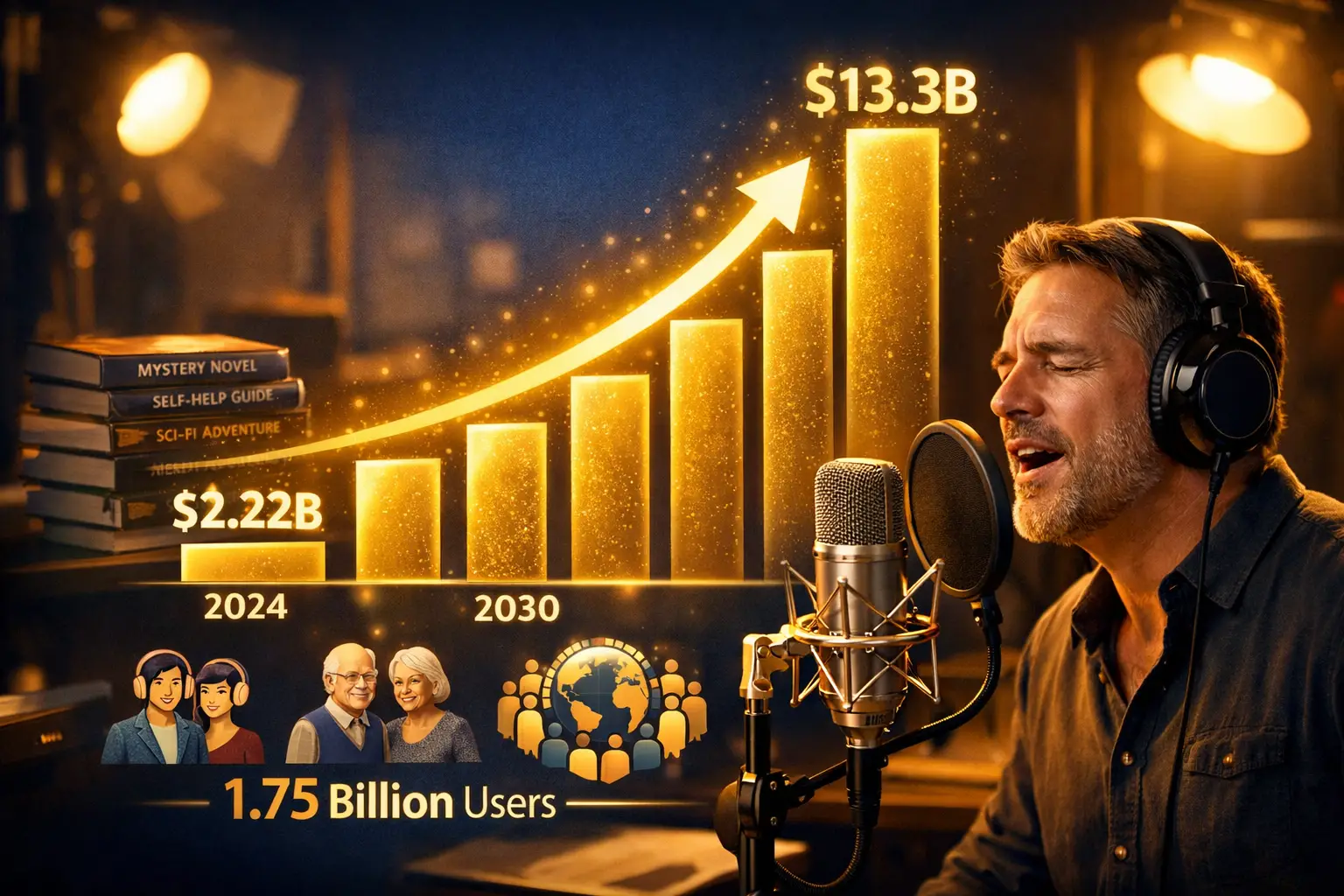
Audiobook Narration Mastery: Positioning Yourself as a Professional Voice Artist, Not Just a Reader represents more than a career strategy—it’s a commitment to craft excellence in a rapidly growing industry. As the audiobook market expands toward $13.3 billion by 2030, the opportunities for skilled professionals have never been greater.
The distinction between readers and voice artists will only sharpen in coming years. Consumer skepticism toward AI narration is growing, not shrinking, creating sustainable competitive advantages for human professionals who master their craft. With only 23% of new releases using AI narration as of January 2026[2], the vast majority of audiobook production still requires human artistry.
Your Next Steps
Immediate actions (this week):
- ✅ Assess your current skill level honestly across the three core competencies: vocal stamina, precise diction, and emotional nuance
- ✅ Record a practice chapter from a book in your target genre and critically evaluate your performance
- ✅ Research professional training options including voice acting classes, coaching, and workshops
- ✅ Evaluate your recording setup and identify necessary equipment upgrades
Short-term goals (this month):
- 📚 Invest in professional training with at least one voice acting coach or class
- 🎙️ Create or update your demo reel showcasing your best work across multiple genres
- 💼 Establish profiles on professional narrator platforms (ACX, Findaway Voices, Author’s Republic)
- 🔊 Complete yourhome studio setup with professional-quality equipment and acoustic treatment
Long-term development (this year):
- 🎯 Submit 50+ professional auditions to build experience and booking rate data
- 📖 Complete 5-10 paid projects to build your portfolio and refine your process
- 🌟 Develop genre specialization based on your strengths and market demand
- 🤝 Build industry relationships with authors, publishers, and fellow narrators
The audiobook industry’s unprecedented expansion creates room for dedicated professionals who approach narration as a performance art rather than a mechanical task. Listeners develop attachments to specific narrators[5], making your distinctive voice and interpretive skills valuable assets that appreciate over time.
Your voice is unique. Your interpretive abilities are irreplaceable. Your commitment to mastery will determine your success in this thriving industry. The question isn’t whether there’s room for professional voice artists —the market data confirms there is. The question is whether you’ll position yourself as a professional voice artist or remain just another reader.
The microphone is waiting. Your audience is growing. Your mastery journey begins now. 🎙️✨
References
[1] Future Audiobook Publishing Trends – https://www.podcastvideos.com/articles/future-audiobook-publishing-trends/
[2] 5 Audiobook Market Publishing Trends Set To D – https://www.authorsrepublic.com/learn/blog/127/5-audiobook-market-publishing-trends-set-to-d
[5] Scale Your Audiobook Production The 2026 Business Buyers Guide – https://nerdbot.com/2026/02/11/scale-your-audiobook-production-the-2026-business-buyers-guide/
[7] 99655 Elevenlabs Valued At 11b Doubles Down On Audiobooks – https://www.publishersweekly.com/pw/by-topic/digital/content-and-e-books/article/99655-elevenlabs-valued-at-11b-doubles-down-on-audiobooks.html