
Picture this: You’ve just crushed it in a community theater production. The audience loved you. Your fellow actors told you that you “owned that stage.” Now you’re ready to take on TV and film work. You record your first self-tape audition, hit send, and… crickets. What happened?
Here’s the truth from someone who’s been on both sides of this transition for three decades: From Theater to Screen: How Beginner Actors Can Adapt Their Skills for the Self-Tape Era isn’t just about pointing a camera at yourself and hoping for the best. It’s a complete recalibration of how you approach your craft. In 2026, self-tapes remain the dominant first-round tool for TV and commercial work, making this skill absolutely essential for anyone entering the industry.[1]
The good news? Your theater training is valuable—incredibly valuable. The emotional authenticity, text analysis, and character work you’ve developed on stage translate beautifully to screen. The challenge? You need to learn a completely new technical language while maintaining that artistic core. Think of it like being a fantastic singer who needs to learn a new instrument. The musicality is there; you just need to master the mechanics.
Key Takeaways
- Self-tapes are now the industry standard for first-round auditions, with algorithms pre-screening submissions before human review, making technical quality non-negotiable[1]
- Theater-trained emotional authenticity is your superpower when properly channeled for camera—casting directors value genuine connection over volume[1]
- Speed and technical proficiency create competitive advantage—actors who can deliver professional-quality self-tapes quickly receive significantly more opportunities[1]
- Your setup is your new stage—investing in reliable lighting, sound, and framing creates a repeatable professional baseline for all submissions[1]
- Category-specific preparation expands your marketability—having prepared samples across different tones (drama, single-cam, multi-cam comedy) demonstrates professional range[1]
Understanding the Self-Tape Revolution: Why Theater Training Needs Translation
Let’s get real about what’s happening in the industry right now. The self-tape isn’t a temporary pandemic workaround—it’s the new front door to professional acting work. And here’s something that might surprise you: algorithms now pre-screen self-tapes before human review.[1] That means your beautiful, emotionally rich performance needs to first pass a digital gatekeeper that’s checking technical specifications.
Think about that for a moment. Your tape needs to satisfy both a computer algorithm and a casting director’s artistic eye. It’s like auditioning for two completely different audiences simultaneously.
The Technical Reality Check
In theater, technical elements are largely handled by your production team. The lighting designer makes you look good. The sound engineer ensures you’re heard. The director tells you where to stand. In the self-tape era, you are the entire production team. You’re the actor, director, cinematographer, sound engineer, and editor all rolled into one.
Here’s what that means practically: clear sound, framing, and eye line are non-negotiable requirements.[1] Not “nice to have.” Not “we’ll overlook it if your performance is amazing.” Non-negotiable. A brilliant performance with muddy audio or incorrect framing won’t make it past the initial screening—digital or human.
The Speed Factor Nobody Talks About
Speed of delivery matters significantly in 2026’s casting landscape.[1] Actors who can produce high-quality self-tapes quickly receive more audition opportunities. Casting directors are emphasizing efficiency in the pipeline, which means the actor who can turn around a professional submission in 24 hours has a genuine competitive advantage over someone who takes three days to figure out their lighting setup.
This isn’t about rushing your performance—it’s about having systems in place so the technical aspects become second nature, freeing you to focus on what you do best: acting.
From Theater to Screen: How Beginner Actors Can Adapt Their Skills for the Self-Tape Era Through Technical Mastery
Alright, let’s talk about setting up your self-tape station. This is where many theater-trained actors stumble, and honestly, it’s completely understandable. You’ve spent years focusing on your instrument—your body, voice, and emotional availability. Now someone’s asking you to become a tech expert overnight.
But here’s the analogy that helped me: Think of your self-tape setup like your vocal warm-up routine. At first, it feels awkward and time-consuming. Eventually, it becomes automatic, and you can’t imagine performing without it.
Building Your Repeatable Setup
Treat self-tapes as professional screen tests, not casual submissions.[1] This mindset shift is crucial. You wouldn’t show up to a theater audition in your pajamas or without having memorized your sides. The same professional standards apply to self-tapes—they just manifest differently.
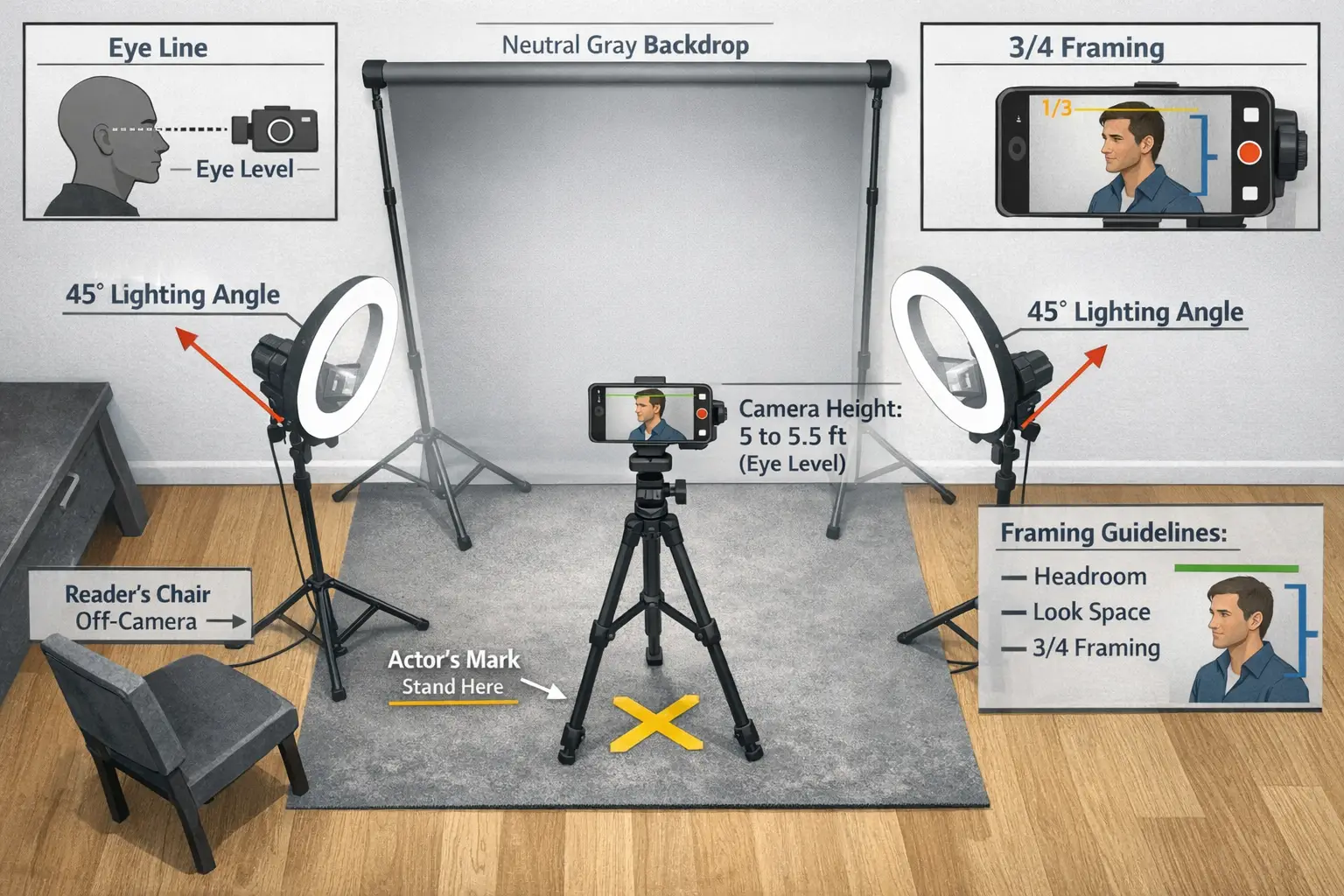
Your Essential Technical Checklist:
- 📱 Camera: A modern smartphone (iPhone 11 or newer, equivalent Android) is perfectly acceptable—you don’t need a $3,000 cinema camera
- 💡 Lighting: A ring light or two softbox lights positioned at 45-degree angles (the classic “key and fill” setup)
- 🎤 Sound: A lavalier microphone or shotgun mic—your phone’s built-in mic won’t cut it for professional submissions
- 🎨 Backdrop: A neutral gray or beige wall or backdrop that doesn’t compete with your performance
- 📏 Framing: Camera at eye level (not looking down or up at you), positioned to show from mid-chest up with appropriate headroom
- 👁️ Eye Line: Reader positioned just off-camera (not looking directly into the lens unless it’s a slate)
The Eye Line Translation
This is where theater actors often struggle most. On stage, you’re looking at your scene partner. In self-tapes, your “scene partner” (reader) needs to be positioned so your eye line reads naturally on camera while keeping your face visible.
Here’s the trick: Position your reader just beside the camera lens—about 6-12 inches to one side. This creates the illusion of connection while keeping your face in three-quarter view, which is infinitely more interesting than a full profile. Think of it like “cheating out” on stage, but much more subtle.
Sound: The Silent Career Killer
Let me share a hard truth: More self-tapes are rejected for poor sound quality than any other technical issue. You can have the performance of a lifetime, but if the casting director has to strain to hear you over your neighbor’s lawnmower, your tape is dead in the water.
Invest in a decent lavalier mic ($50-150 range). Hide it under your shirt. Test your levels. Record in a quiet space—closets work surprisingly well because clothes absorb echo. This single investment will put you ahead of 60% of your competition who think their phone’s microphone is “good enough.”
Translating Stage Presence to Camera Intimacy
Here’s where your theater training becomes your superpower—if you know how to channel it correctly. The emotional connection and specificity you’ve developed on stage are exactly what casting directors want. They consistently stress authentic emotional work over “content dumping” in self-tapes.[1]
The difference? Scale and internalization.
The 80/20 Rule for Camera Acting
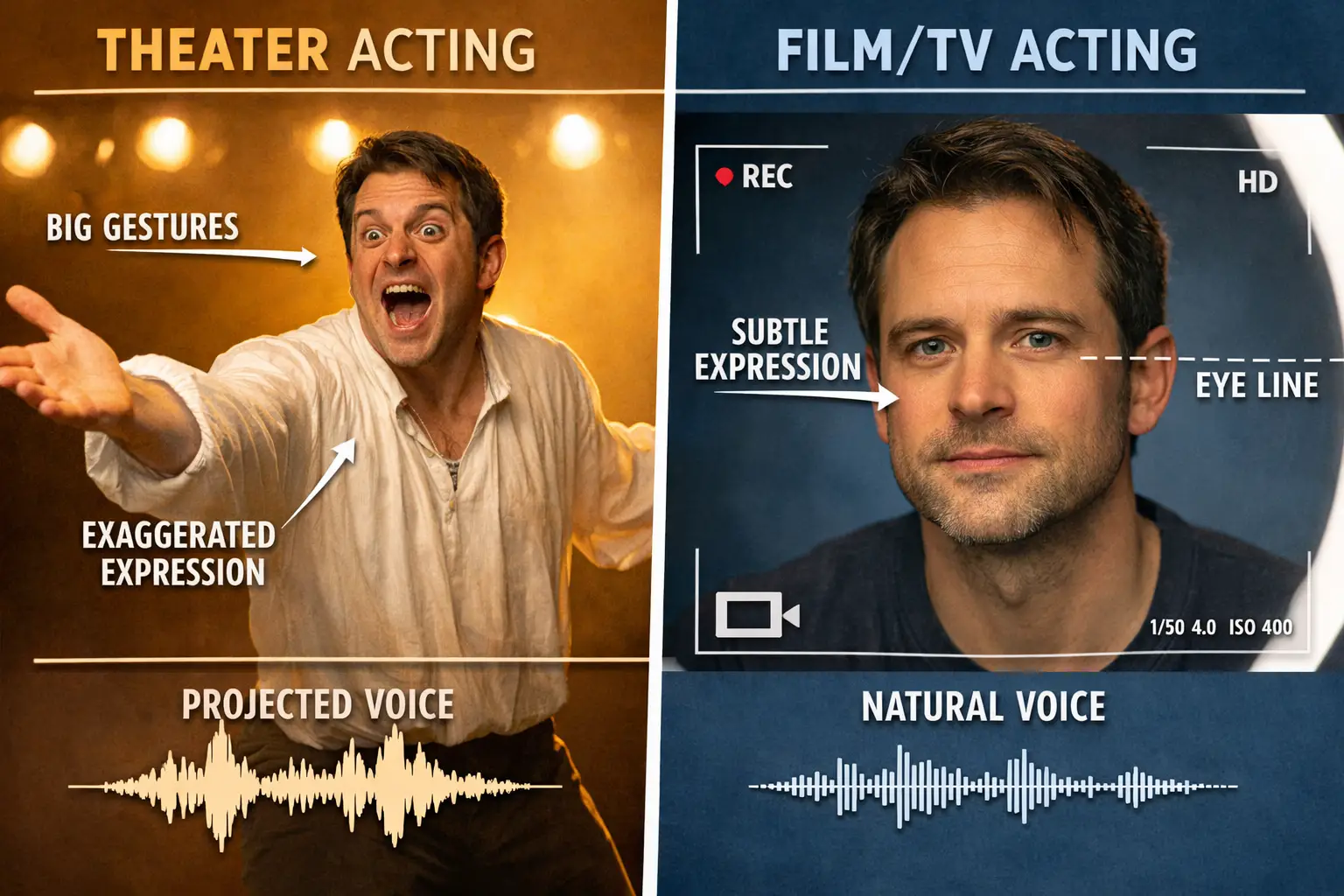
Think of your stage performance as 100% energy. For camera work, you’re delivering about 20% of that external energy while maintaining 100% of the internal emotional life. It’s not about “doing less”—it’s about doing the same emotional work while letting the camera come to you instead of projecting to the back row.
Here’s an exercise that helped me make this transition: Perform your monologue as you would on stage. Now, imagine the camera is a person sitting two feet from your face. You wouldn’t shout at someone two feet away, would you? You’d speak conversationally, but your eyes, your micro-expressions, your breath—all of that would still carry the full emotional weight.
The Subtlety Revolution
On stage, a raised eyebrow might not read past the fifth row. On camera, that same raised eyebrow is a billboard. Your job is to let the camera discover your performance rather than announcing it.
Theater vs. Screen Translation Guide:
| Theater Technique | Screen Adaptation |
|---|---|
| Project to back row | Speak conversationally to reader |
| Large physical gestures | Minimal, purposeful movement |
| Facial expressions visible from distance | Micro-expressions captured in close-up |
| Energy fills the space | Energy contained and focused |
| Playing to the house | Playing to one person (the camera) |
Emotional Authenticity: Your Competitive Edge
Here’s where I get passionate, because this is where theater-trained actors can absolutely dominate if they get the technical stuff right. With audition volume increasing 17% year-over-year in some markets,[2] there are more opportunities than ever—but also more competition per role.[1]
Your ability to access genuine emotion, to make specific choices, to understand subtext—these skills developed in theater training are gold. The actors who succeed in the self-tape era aren’t the ones with the fanciest equipment. They’re the ones who combine technical competence with emotional truth.
“The camera doesn’t lie, but it also doesn’t exaggerate. It reveals. Your job is to give it something worth revealing.”
From Theater to Screen: How Beginner Actors Can Adapt Their Skills for the Self-Tape Era With Strategic Preparation
Let’s talk strategy, because knowing how to record a self-tape is only half the battle. The other half is being prepared for what the industry actually needs from you in 2026.
Category-Specific Preparation
Category-specific self-tape samples should be prepared across different tones and formats.[1] This isn’t about being a chameleon with no identity—it’s about demonstrating your range within your casting type.
Prepare samples in these categories:
- Grounded Drama: Think prestige TV, streaming dramas, emotionally complex material
- Single-Cam Comedy: Modern sitcoms, dramedies, naturalistic humor
- Multi-Cam Comedy: Broader, more theatrical comedy that still works on camera
- Commercial: Friendly, authentic, conversational selling
Why? Because when a casting director sees your work and thinks, “I wonder if they could handle comedy,” you want to immediately send them a sample that answers that question. Speed of response creates opportunities.
Building Your Self-Tape Library
Here’s a pro tip that’s saved me countless times: Maintain a library of pre-recorded samples that showcase your range. Not full auditions—those should always be fresh and specific to the role—but general samples that demonstrate your abilities across different genres.
When you’re between auditions, record yourself performing:
- A dramatic monologue (1 minute)
- A comedic scene (1 minute)
- A commercial-style “about me” (30 seconds)
- A naturalistic conversation scene (1-2 minutes)
Keep these updated annually. They’re your calling cards, your proof of concept, your “here’s what I can do” portfolio.
The Reader Solution
Working with another actor beforehand in person before in-person auditions significantly improves performance quality.[2] The same principle applies to self-tapes, but with a twist: you need a reliable reader who understands their role.
Your reader isn’t performing. They’re feeding you lines in a neutral, supportive way that allows you to shine. They’re positioned correctly for eye line. They’re consistent across multiple takes.
Reader options:
- Another actor friend (ideal—you can trade services)
- A supportive partner or family member you’ve trained
- Professional reader services ($25-75 per session)
- In a pinch: recorded lines played back (not ideal, but better than nothing)
Navigating the 2026 Casting Landscape
The industry is evolving rapidly, and understanding where it’s heading helps you prepare strategically. Production activity in New York could grow 5–12% in 2026,[1] suggesting increased episodic co-star and guest star opportunities for actors building credits in major markets.
But here’s the reality check: there’s also more competition per role, particularly for series regular and recurring positions.[1] This places a premium on actors with clear casting brands—meaning the industry knows exactly where to position you.
Your Casting Brand
Think of your casting brand as your “type” but more sophisticated. It’s not just about your age and look—it’s about the specific energy, tone, and character types you embody most authentically.
Ask yourself:
- What roles do I get called in for most often?
- What characters do I connect with most deeply?
- What’s my natural energy—quirky, authoritative, vulnerable, comedic?
- Where do I fit in the current TV landscape?
Your self-tape technique should support and showcase this brand consistently. Every technical choice—from your backdrop color to your wardrobe to your slate energy—should reinforce who you are as an artist.
The Short-Form Opportunity
Here’s something many theater actors overlook: short-form and vertical content skills are increasingly valuable.[1] Comfort with tight, efficient takes and comedy-focused shorter formats expands your marketability beyond traditional TV and film.
This doesn’t mean abandoning your artistic integrity to make TikToks (though if that’s your jam, go for it). It means understanding that the industry increasingly values actors who can deliver compelling performances in condensed formats. Your ability to make a strong choice quickly, to be interesting in 15 seconds, to hook an audience immediately—these are self-tape skills that translate to broader opportunities.
Advanced Self-Tape Techniques for Theater-Trained Actors
Once you’ve mastered the basics, these advanced techniques will set you apart from the competition.
The Pre-Slate Mindset Shift
Your slate (the introduction where you state your name and sometimes other information) is your first impression. Theater actors often approach this too casually or, conversely, too performatively.
The sweet spot? Friendly, professional, authentic you. Not character you. Not “I’m auditioning” you. Just you, as if you’re meeting the casting director for coffee and introducing yourself.
Slate best practices:
- Look directly at camera (this is the only time you do this)
- Smile genuinely—think of someone you love just off-camera
- State your name clearly with energy (not shouting, just alive)
- Follow any specific instructions (profiles, turns, etc.) smoothly
- Transition into character thoughtfully—take a breath, reset
The Multiple Take Strategy
Here’s where your theater training might actually work against you. In theater, you get one shot per performance. In self-tapes, you can record multiple takes and submit your best work.
But here’s the trap: perfectionism. I’ve seen actors record 47 takes trying to nail every moment, and by take 47, they’re exhausted and overthinking everything.
The three-take rule:
- Take 1: Your instinctive, prepared choice—usually your best work
- Take 2: An adjustment—try a different tactic or tone
- Take 3: Your safety—a solid, reliable version
Review all three. Submit the one with the most life, even if it has a tiny technical imperfection. Casting directors would rather see alive and slightly imperfect than technically perfect and dead.
Lighting for Emotional Tone
Advanced technique: Adjust your lighting slightly based on the material’s tone. Softer, more diffused light for intimate drama. Slightly brighter, more even light for comedy. This is subtle—we’re talking small adjustments, not dramatic changes—but it subconsciously supports the material.
Common Pitfalls and How to Avoid Them
Let me share the mistakes I see most often from theater-trained actors transitioning to self-tapes, along with the solutions that actually work.
❌ Pitfall #1: Over-Projecting
The mistake: Treating the camera like the back row of the theater.
The fix: Imagine you’re sharing a secret with someone three feet away. Your energy stays high, but your volume and physical scale adjust to the intimacy of the medium.
❌ Pitfall #2: Dead Space
The mistake: Taking long, theatrical pauses that feel endless on camera.
The fix: Your internal process stays the same, but the external manifestation compresses. Think in half-beats instead of full beats. The camera captures your thinking—you don’t need to “show” it with time.
❌ Pitfall #3: Inconsistent Technical Quality
The mistake: Great lighting for one audition, terrible sound for the next, because you’re setting up fresh each time.
The fix: Create a permanent or semi-permanent self-tape space. Mark your positions with tape. Take photos of your setup. Make it repeatable so technical quality is never a variable.
❌ Pitfall #4: Ignoring the Business Side
The mistake: Treating self-tapes as artistic exercises rather than business submissions.
The fix: File names matter. “JohnSmith_CommercialAudition_Jan15.mov” is professional. “Audition_FINAL_FINAL_v3.mov” is not. Submit exactly what’s requested, in the format requested, by the deadline. This is basic professionalism that many actors overlook.
❌ Pitfall #5: Neglecting Continuous Improvement
The mistake: Recording your self-tape, submitting it, and never watching it again.
The fix: Review your submitted tapes with a critical but compassionate eye. What worked? What didn’t? How can you improve? Treat each self-tape as a learning opportunity. Keep a journal of insights. This is how you grow.
Creating Your Self-Tape Success System
Success in the self-tape era isn’t about talent alone—it’s about systems. Here’s how to build yours.
The 24-Hour Turnaround System
Hour 0-2: Receive audition, read sides multiple times, research show/project, make character choices
Hour 2-4: Memorize sides (yes, memorize—even if they say you can use the script, memorization allows for genuine connection)
Hour 4-6: Break if needed, let material marinate
Hour 6-8: Set up technical elements, do a practice run, adjust as needed
Hour 8-10: Record takes (remember: three-take rule)
Hour 10-12: Review, select best take, edit if needed (simple top and tail only), export
Hour 12-24: Submit with professional file naming, double-check all requirements, send
This system ensures quality without sacrificing speed. Adjust timing based on the complexity of the material, but the sequence remains consistent.
The Continuous Learning Approach
The industry evolves. Technology improves. Casting preferences shift. Your commitment to continuous learning is what keeps you competitive.
Monthly practices:
- Watch current TV shows in your casting range—study the acting style
- Record yourself performing sides from shows you love—compare to the aired version
- Experiment with one new technical element (different lighting angle, new mic position)
- Connect with other actors to trade reader services and feedback
Quarterly practices:
- Update your self-tape samples
- Assess your technical setup—is anything outdated or needing replacement?
- Review your submitted self-tapes from the past three months—identify patterns and areas for improvement
- Research new shows in development that fit your brand
The Mental Game
Here’s the thing nobody tells you: self-tapes can feel isolating in a way theater never does. You’re performing alone, in your apartment, talking to a camera. There’s no audience energy, no fellow actors, no immediate feedback.
This is where your mental resilience matters. Develop rituals that help you access performance energy:
- Play music that gets you in the emotional space
- Do a physical warm-up even though you’re only on camera from the chest up
- Call a friend beforehand to get your energy up
- Remind yourself: this is still acting, still your craft, still meaningful work
The Future-Proof Actor: Hybrid Skills for Hybrid Workflows
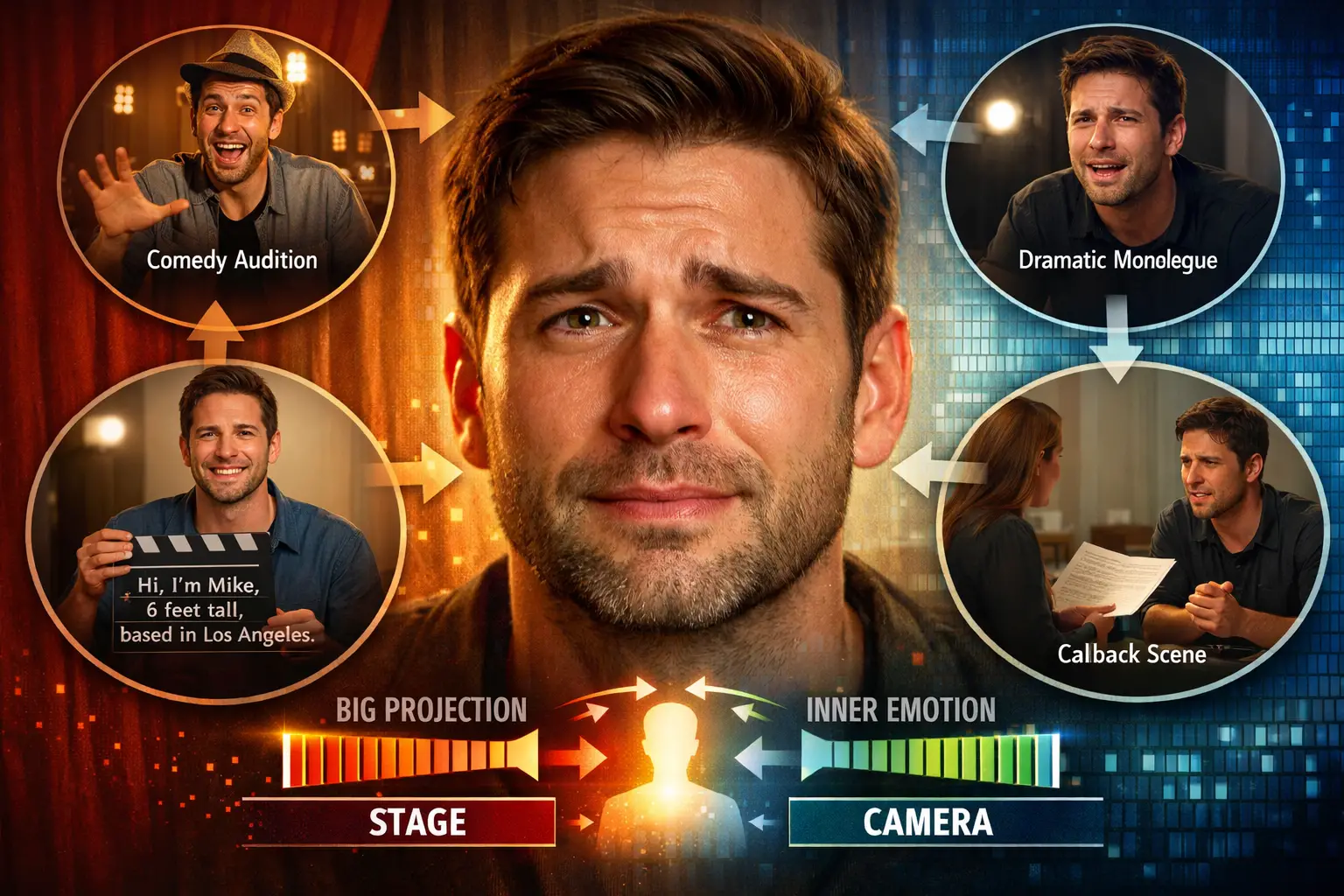
Looking ahead, the most successful actors will be those who excel in both self-tape and in-person auditions. The industry isn’t abandoning in-person callbacks—it’s using self-tapes as the efficient first filter, then bringing in the strongest candidates for live sessions.
This means you need to maintain your in-person audition skills while mastering self-tape technique. Don’t let one atrophy while developing the other.
The In-Person Callback After Self-Tape Success
When your self-tape advances you to an in-person callback, remember: they’ve already seen your work. They know you can act. Now they’re checking:
- Do you take direction well?
- What’s your energy like in person?
- How do you collaborate?
- Do you match what we saw on tape?
This is where your theater training shines. Your comfort with live performance, your ability to adjust in the moment, your collaborative spirit—these are theater skills that translate directly.
Staying Adaptable in an Evolving Industry
The actors who thrive long-term are those who view change as opportunity rather than threat. Self-tapes seemed scary when they first became standard. Now they’re just part of the job. Whatever comes next—AI-assisted casting, virtual reality auditions, holographic callbacks (who knows?)—your adaptability will determine your longevity.
Maintain your artistic core while staying flexible with the methods. Your emotional truth, your character analysis, your commitment to the craft—these don’t change. The delivery mechanisms evolve, and you evolve with them.
Conclusion: Your Action Plan for Self-Tape Excellence
From Theater to Screen: How Beginner Actors Can Adapt Their Skills for the Self-TapeEra is ultimately about honoring your theater training while embracing new technical skills. Your stage experience is valuable—incredibly valuable. The emotional availability, the text work, the character development, the performance stamina—all of these translate beautifully to screen work when properly channeled.
The actors who struggle aren’t those without talent. They’re those who resist the technical evolution of the industry or who abandon their artistic foundation in pursuit of technical perfection. The sweet spot is both: technical competence that serves artistic excellence.
Your Next Steps (Start Today):
Assess your current setup – What do you have? What do you need? Make a realistic investment plan for essential equipment (start with sound, then lighting)
Create your self-tape space – Designate an area, set up your equipment, mark your positions, take reference photos
Record a practice self-tape – Use a monologue you know well, focus on technical quality, watch it back with honest eyes
Find your reader – Identify someone reliable who can help you, or budget for professional reader services
Build your sample library – Record category-specific samples that showcase your range within your brand
Establish your system – Create your personal workflow from receiving audition to submitting tape
Commit to continuous improvement – Schedule monthly practice sessions and quarterly assessments
Remember, every working actor you admire went through this same transition. They figured it out, and so will you. The difference between actors who make it and those who don’t isn’t talent—it’s persistence, adaptability, and the willingness to master new skills while staying true to their artistic core.
You’ve got the foundation from your theater training. Now you’re adding the technical tools that make you competitive in 2026’s industry landscape. That combination—artistic depth plus technical proficiency—is what creates a sustainable acting career.
The self-tape era isn’t something to survive. It’s something to master. And mastery, like any worthwhile skill, comes from consistent practice, honest self-assessment, and the courage to keep learning.
Now go set up that camera and show them what you’ve got. 🎬
References
[1] Casting Trends Production Shifts To Watch In 2026 – https://uptodateactor.com/blogs/post/casting-trends-production-shifts-to-watch-in-2026/
[2] Watch – https://www.youtube.com/watch?v=jPMMmYNya1E