
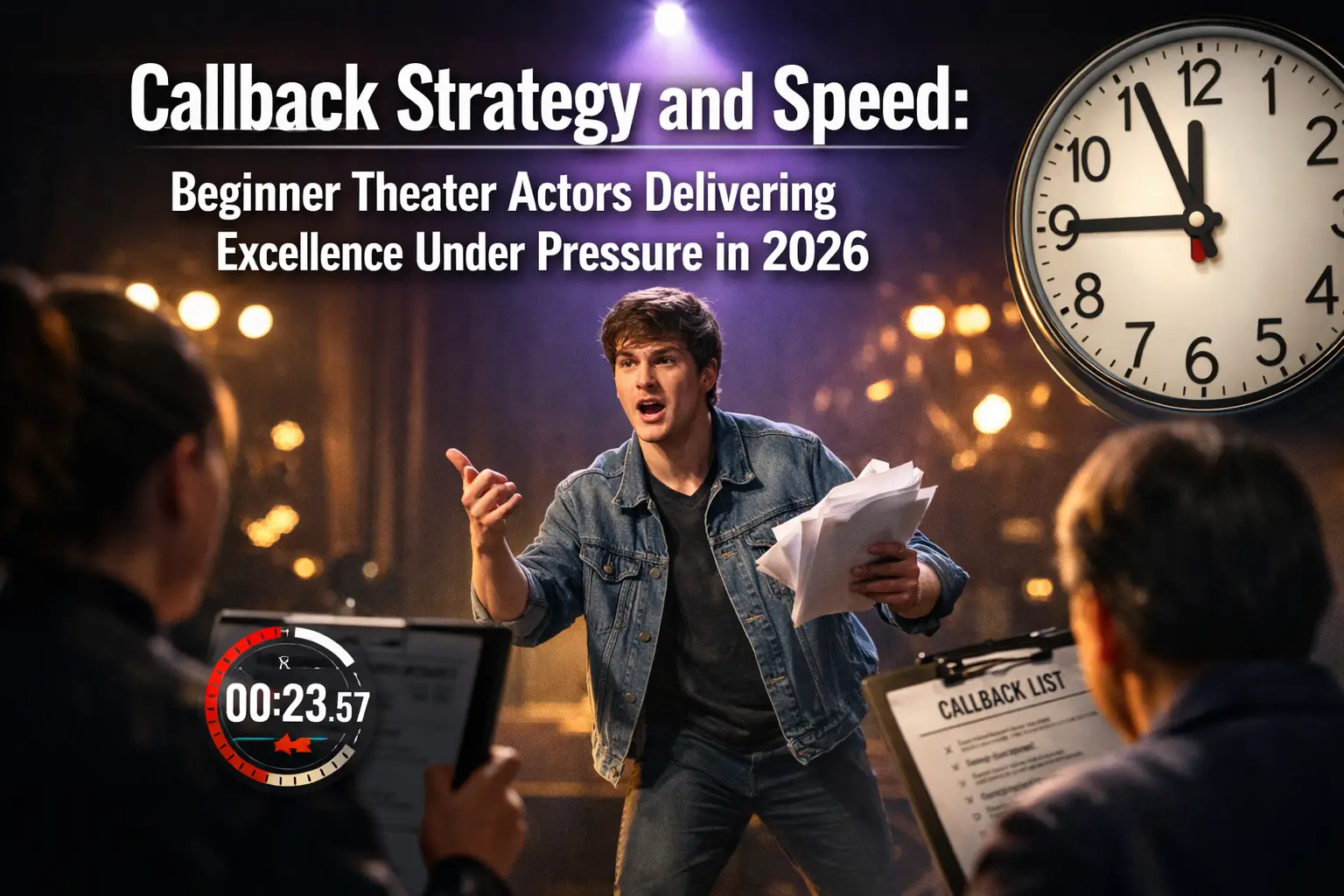
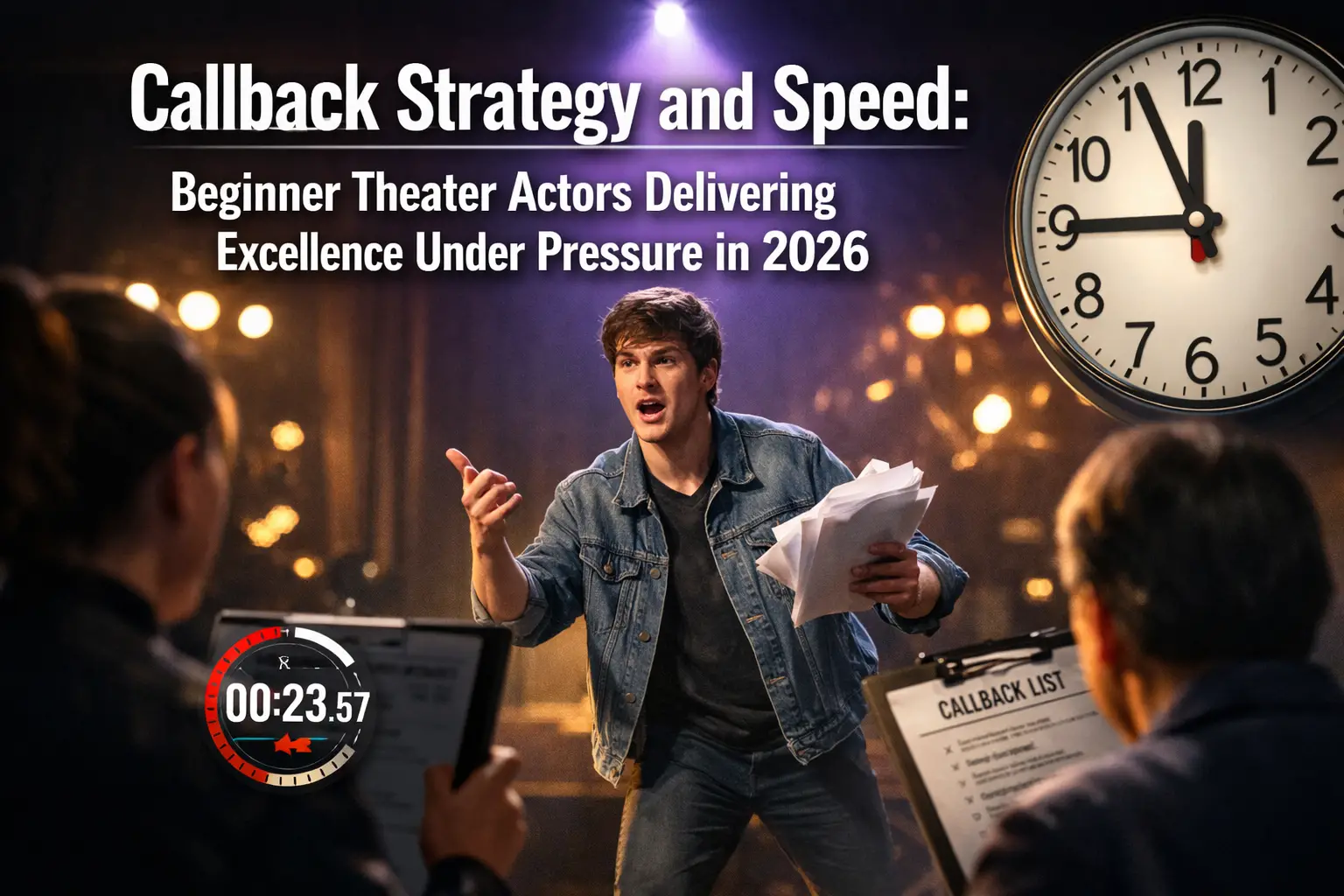
Picture this: You just got the email. The callback is tomorrow at 2 PM. You’ve got 24 hours to take your audition from “pretty good” to “absolutely unforgettable.” Your heart races. Your palms sweat. Welcome to theater in 2026, where leaner budgets mean tighter timelines, and casting directors need to see your best work fast.
After three decades in this business—from community theater stages to national commercials—I’ve seen the industry transform dramatically. But here’s the truth: Callback Strategy and Speed: How Beginner Theater Actors Can Deliver Excellence Under Pressure in Lean 2026 Casting Pipelines isn’t just about working faster. It’s about working smarter, preparing strategically, and showing up with confidence when the stakes are highest.
The 2026 theatrical landscape has shifted. Productions are running leaner. Callback sessions are shorter. Directors need actors who can deliver polished, professional work with minimal rehearsal time. For beginners, this can feel overwhelming. But with the right strategies, you can turn that pressure into your competitive advantage.
Key Takeaways
✅ Preparation is everything: Systematic script analysis and character breakdown before callbacks dramatically improves performance quality under time pressure
✅ Speed comes from structure: Developing repeatable preparation frameworks allows actors to deliver excellence quickly without sacrificing depth
✅ Adaptability wins roles: In lean casting pipelines, directors value actors who can pivot quickly and take direction with minimal repetition
✅ Self-tape mastery is non-negotiable: Technical proficiency with recording equipment and self-direction skills separate professionals from amateurs in 2026
✅ Mental resilience beats raw talent: Managing performance anxiety and maintaining consistency under pressure determines callback success
Understanding the 2026 Lean Casting Environment
Let’s talk about what’s actually happening in casting rooms right now. Theater companies are doing more with less. Where productions once scheduled three callback sessions over two weeks, they’re now condensing everything into one intensive afternoon. Where casting directors previously worked with unlimited time slots, they’re now seeing 8-10 actors per hour.
This isn’t a temporary trend—it’s the new normal.
Budget constraints, venue availability issues, and production timelines have created what industry insiders call “lean casting pipelines.” Think of it like this: casting used to be a leisurely dinner where directors could savor each course. Now it’s a food truck operation—fast, efficient, but still demanding exceptional quality.
What This Means for Beginner Actors
For newcomers to theater, this environment presents both challenges and opportunities:
The Challenges:
- Less room for “warming up” during callbacks
- Fewer chances to make adjustments
- Increased competition from experienced actors who work efficiently
- Higher expectations for self-direction and preparation
- Technical requirements for quality self-tapes
The Opportunities:
- Prepared actors stand out dramatically
- Quick learners get noticed immediately
- Strong preparation skills become your differentiator
- Less emphasis on “who you know,” more on “what you deliver”
I learned this lesson the hard way during a callback for a regional production of August: Osage County. I showed up thinking I’d have time to “find the character” in the room. Wrong. The director gave me one read, one adjustment, and made her decision. The actor who got the role? She walked in fully prepared, nailed the first take, and adapted instantly to direction. Speed met excellence, and she booked the job.
Mastering Callback Strategy and Speed: How Beginner Theater Actors Can Deliver Excellence Under Pressure Through Systematic Preparation
Here’s what separates actors who thrive in callbacks from those who crumble: systematic preparation. Not frantic last-minute cramming, but a repeatable framework that produces consistent results.
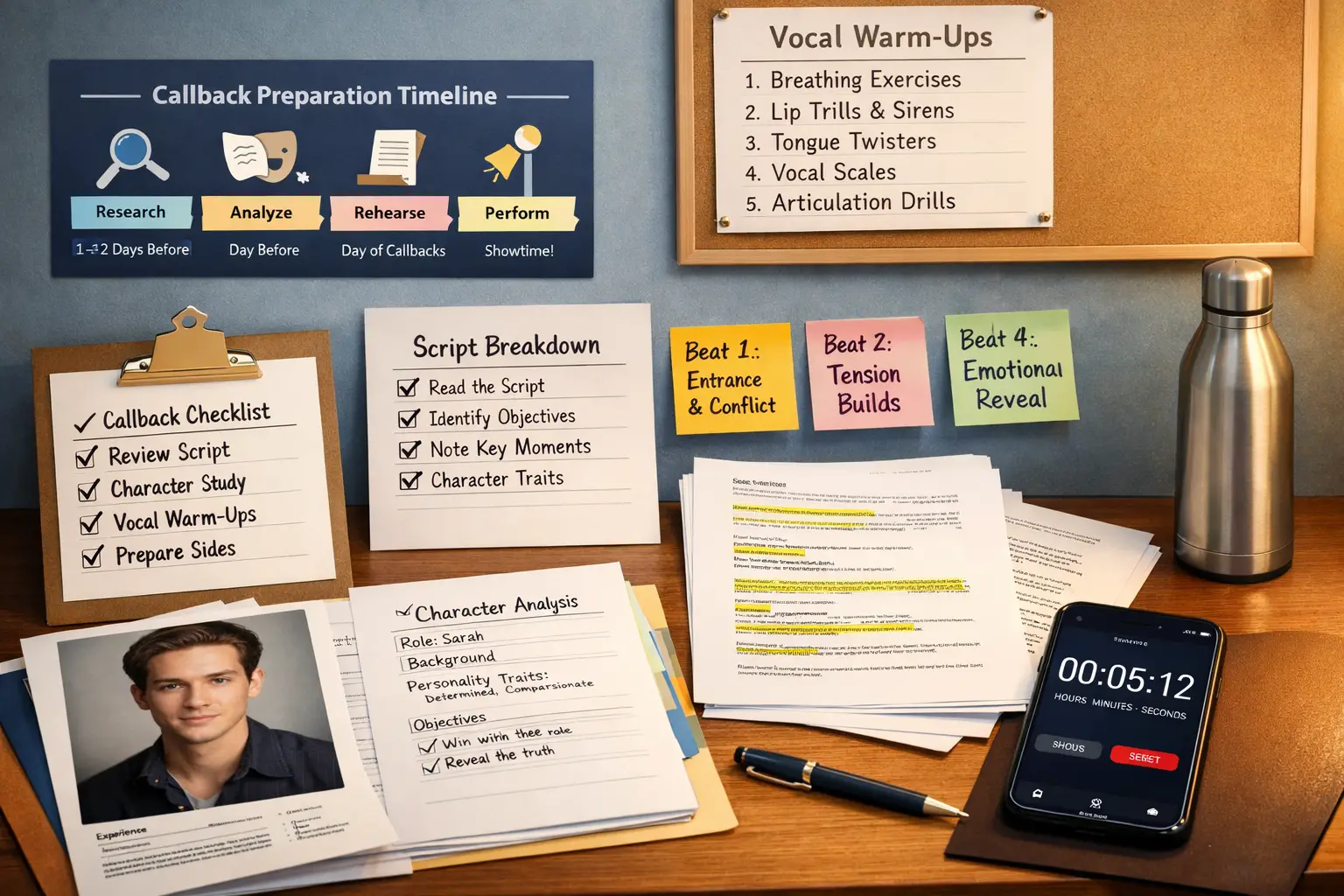
The 24-Hour Callback Preparation Framework
When that callback email arrives, here’s your battle plan:
Hours 1-3: Deep Script Analysis 📖
Don’t just read your sides—dissect them like a surgeon.
Create a character breakdown document that includes:
- Character’s objective in the scene (what do they want?)
- Obstacle preventing them from getting it (what’s in the way?)
- Tactics they use (how do they try to get it?)
- Relationship to other characters in the scene
- Emotional journey from beginning to end
- Key moments where something changes
I use a simple three-column chart: Beat | Action | Emotional Shift. This takes 90 minutes but saves hours of fumbling around later.
Hours 4-8: Physical Rehearsal and Memorization
Memorization isn’t just about knowing the words—it’s about embodying them so completely that you can focus entirely on connection and adjustment during the callback.
Effective memorization techniques:
- Write it out by hand (engages muscle memory)
- Record the other character’s lines with pauses for your responses
- Rehearse while moving (walking, doing dishes, exercising)
- Practice in different emotional states to build flexibility
Here’s a pro tip that’s saved me countless times: Memorize your first and last lines of each beat perfectly. If you blank mid-scene, these anchors help you recover without breaking character.
Hours 9-16: Rest and Mental Preparation 😴
Sleep is not optional—it’s part of your preparation. Your brain consolidates learning during sleep. Actors who pull all-nighters perform measurably worse than those who get 7-8 hours.
Use this time to also visualize success. Mental rehearsal activates the same neural pathways as physical practice. See yourself walking into that callback room with confidence, delivering your best work, and handling adjustments gracefully.
Hours 17-24: Technical Run-Through and Warm-Up
The morning of your callback, run your material 3-5 times maximum. Over-rehearsing creates staleness. Focus on:
- Vocal warm-ups (15 minutes of scales, tongue twisters, resonance exercises)
- Physical warm-ups (stretching, shaking out tension, grounding exercises)
- One full run at performance energy
- One run focusing only on listening and reacting to imagined scene partners
Then stop rehearsing. Trust your preparation. Arrive 15 minutes early, not 45. You want to be fresh, not frazzled.
The Power of Repeatable Systems
The reason this framework works is simple: it removes decision fatigue. When you have a system, you don’t waste mental energy wondering “What should I do next?” You just execute.
Think of it like a pilot’s pre-flight checklist. They don’t reinvent their preparation every time—they follow the proven system that ensures safety and success. Your callback preparation should work the same way.
Delivering Excellence Under Pressure: Performance Techniques for Lean 2026 Casting Pipelines
Okay, you’ve prepared brilliantly. Now you’re in the room (or in front of your self-tape camera). This is where Callback Strategy and Speed: How Beginner Theater Actors Can Deliver Excellence Under Pressure in Lean 2026 Casting Pipelines becomes real.
The First 30 Seconds Are Everything
Casting directors in lean pipelines make initial assessments incredibly quickly. Research in performance psychology shows that evaluators form strong impressions within 30 seconds that color everything that follows.
Your 30-second checklist:
- ✅ Enter with confident, grounded posture
- ✅ Make genuine eye contact and smile
- ✅ State your name clearly (they’re seeing many actors)
- ✅ Show readiness without nervous energy
- ✅ Demonstrate you’re a professional who respects their time
I once watched a director choose between two equally talented actors. The deciding factor? One walked in looking like she owned the space (not arrogant, just confident), while the other apologized for being there. Confidence is contagious—and so is insecurity.
Taking Direction at Speed
Here’s where beginners often struggle: taking adjustments quickly without overthinking.
When a director gives you a note, they’re not criticizing your choice—they’re testing your adaptability. In lean casting environments, they need to know you can incorporate direction efficiently during limited rehearsal time.
The Four-Step Direction Integration Method:
- Listen fully without planning your response
- Confirm understanding with one clarifying question maximum
- Integrate immediately without a complete re-rehearsal
- Commit fully to the new choice, even if it feels unfamiliar
Here’s the analogy I love: Think of direction like GPS recalculating your route. You don’t pull over, study a map, and debate the best path. You just take the next turn and keep driving. Same with acting adjustments—integrate and go.
Managing Performance Anxiety in High-Pressure Situations
Let’s be honest: callbacks are nerve-wracking. Your heart pounds. Your mouth goes dry. Your brilliant preparation seems to evaporate.
Physiological anxiety management techniques that actually work:
🫁 Box Breathing (4 counts in, 4 hold, 4 out, 4 hold)
- Activates parasympathetic nervous system
- Reduces cortisol levels
- Can be done discretely while waiting
💪 Progressive Muscle Relaxation
- Tense and release major muscle groups
- Releases physical tension that amplifies mental anxiety
- Takes 3-5 minutes before your slot
🎯 External Focus Technique
- Shift attention from “How am I doing?” to “What does my scene partner need?”
- Reduces self-consciousness
- Improves connection and authenticity
I used to get so nervous before callbacks that I’d forget my own name. Then a director friend told me: “Anxiety and excitement are physiologically identical. Your body doesn’t know the difference—only your brain does.” Now when my heart races, I tell myself “I’m excited” instead of “I’m nervous.” It sounds simple, but reframing changes everything.
The Self-Tape Excellence Standard
In 2026, self-tapes aren’t supplementary—they’re often the primary callback format. Lean pipelines mean directors review submissions remotely, making decisions without ever meeting you in person.
Non-negotiable self-tape requirements:
| Element | Standard | Why It Matters |
|---|---|---|
| Lighting | Three-point or ring light, no shadows on face | Poor lighting = instant rejection |
| Sound | External microphone, no echo or background noise | Directors need to hear every word clearly |
| Framing | Head to mid-chest, appropriate headroom | Professional framing shows you understand the medium |
| Background | Neutral, non-distracting (gray, beige, or blue) | Focus stays on your performance |
| Eye Line | Just off-camera, consistent throughout | Creates connection without breaking the fourth wall |
| File Format | MP4, H.264 codec, under 500MB | Technical issues = missed opportunities |
The self-tape setup I recommend for beginners:
- Smartphone camera (most modern phones are excellent)
- $30-50 ring light from Amazon
- $20 lavalier microphone
- Free tripod or phone stand
- Simple backdrop (even a blank wall works)
Total investment: Under $100 for professional-quality results.
Slate Delivery That Commands Attention
Your slate (the introduction before your scene) is your first impression. Make it count.
Effective slate formula:
- Name (clearly, at moderate pace)
- Role you’re reading for
- Brief personal connection to the character or play (10 seconds maximum)
- Confident pause before beginning
Example: “Hi, I’m Sarah Chen, reading for Juliet. I’ve always connected with her fierce intelligence and willingness to fight for what she believes in.” [Pause, transition into character]
What NOT to do: Apologize, over-explain, ramble about your resume, or make self-deprecating jokes. Lean pipelines mean directors are watching slates at 1.5x speed—respect their time.
Building Speed Without Sacrificing Depth: Advanced Callback Strategy and Speed Techniques
Now we’re getting into the advanced stuff—techniques that separate good callback performances from exceptional ones.
The Instant Character Access Method
Professional actors can “drop into” character immediately. Beginners often need several minutes to “find” the character. In lean casting environments, you don’t have several minutes.
Developing instant character access:
Create sensory anchors that trigger your character state immediately:
- Physical anchor: A specific posture, gesture, or tension pattern unique to the character
- Vocal anchor: A breath pattern, pitch, or resonance quality
- Emotional anchor: A personal memory that connects to the character’s emotional world
- Object anchor: A prop or piece of costume that triggers the transformation
I once played a character struggling with addiction. My anchor was a specific way of rubbing my temples combined with shallow chest breathing. The moment I did both, I was in character. It took weeks to develop, but once established, I could access that character in seconds.
Practice your anchors during preparation until they become automatic. Then, in the callback room, you simply activate your anchors and you’re ready.
Layering Technique for Rapid Depth
Here’s a secret from my voice-over work that applies perfectly to theater callbacks: layering.
Instead of trying to do everything at once, add layers sequentially:
Layer 1: Text and blocking (basic execution) Layer 2: Objective and tactics (what you want and how you’re getting it) Layer 3: Relationship dynamics (how you feel about the other character) Layer 4: Subtext and secrets (what you’re not saying) Layer 5: Physical life (how the character inhabits their body)
In preparation, rehearse each layer separately. In performance, they integrate automatically. This approach builds depth quickly without overwhelming your processing capacity.
The Pivot Principle: Adapting at Speed
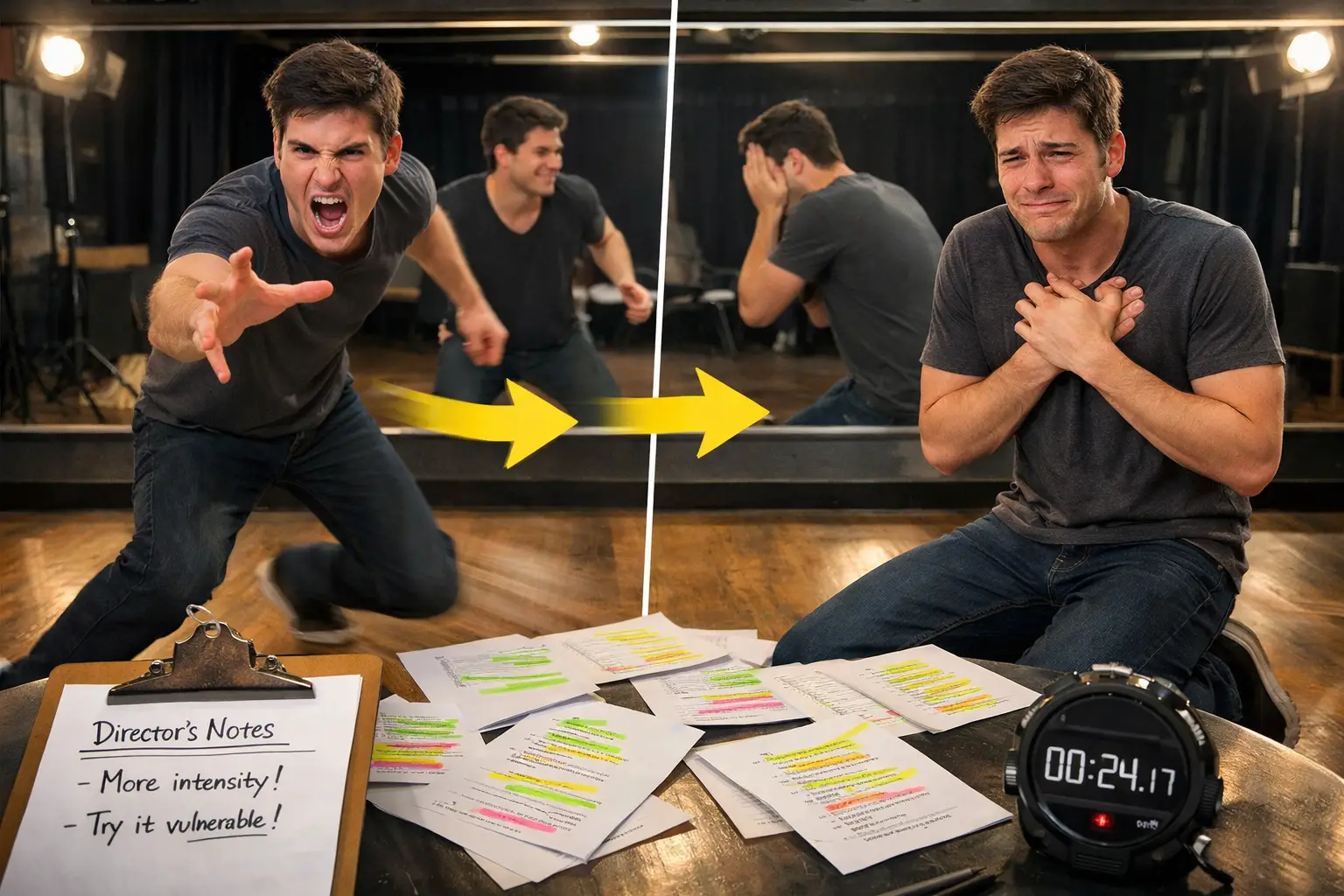
Directors in lean pipelines often give you wildly different directions to test your range: “Now do it like you’re terrified of them.” “Great, now like you’re seducing them.” “Perfect, now like you just found out they’re dying.”
The Pivot Principle helps you adapt without re-thinking everything:
- Keep your anchor (your core character remains consistent)
- Change only the tactic (how you’re trying to get what you want)
- Trust your preparation (don’t second-guess your choices)
- Commit immediately (hesitation reads as confusion)
Think of it like jazz improvisation. The chord progression stays the same, but the melody changes. Your character’s foundation remains solid while your tactics adapt.
Energy Management for Multiple Callbacks
Here’s something nobody tells beginners: You might have three callbacks in one day. Energy management becomes critical.
Sustainable performance energy strategies:
🥤 Hydration protocol: Sip water consistently, avoid caffeine crashes 🍎 Strategic nutrition: Protein and complex carbs, avoid sugar spikes ⚡ Energy cycling: Alternate high-intensity preparation with complete rest 🧘 Reset rituals: 5-minute grounding exercise between callbacks
I learned this during a brutal callback day with four different productions. By callback three, I was running on fumes and it showed. Now I treat callback days like athletic events—proper fuel, strategic rest, and mental reset between performances.
Technical Proficiency: The Hidden Advantage in 2026 Casting
Let’s talk about something that separates working actors from perpetual auditioners: technical proficiency.
Self-Direction Skills
In lean pipelines, you often won’t have a reader or scene partner. You’re performing to a camera or an empty chair. Self-direction skills become essential.
Developing effective self-direction:
📹 Record everything: Review your rehearsals objectively 🎭 Create imaginary scene partners: Give them specific physical locations and characteristics 🔄 Practice both sides: Rehearse the other character’s lines with full commitment 👁️ Develop objective self-assessment: Separate “how it felt” from “how it looked”
The best self-direction exercise I know: Record yourself, watch it without sound, and note what the performance communicates physically. Then watch with sound only (don’t look at the screen) and note what the vocal performance communicates. Finally, watch with both. You’ll discover disconnects you never noticed.
Equipment Troubleshooting
Nothing kills a self-tape faster than technical problems. Professional actors can troubleshoot on the fly.
Common issues and quick fixes:
| Problem | Solution | Prevention |
|---|---|---|
| Audio echo | Move closer to mic, add soft furnishings to room | Test audio in your space before callback day |
| Harsh shadows | Adjust light angle, add diffusion (even a white sheet works) | Set up lighting 24 hours early |
| File too large | Compress using HandBrake (free software) | Record at 1080p maximum, not 4K |
| Color looks wrong | Adjust white balance on camera | Use manual white balance, not auto |
| Out of focus | Lock focus on camera, ensure adequate lighting | Mark your position on floor with tape |
Spend $20 on a basic understanding of your equipment. Watch YouTube tutorials. Practice until setup takes 10 minutes, not 90.
Time Management Under Pressure
Lean casting pipelines mean tight deadlines. Self-tape due tomorrow at 10 AM? You need a system.
The 4-Hour Self-Tape Production Schedule:
- Hour 1: Script analysis and memorization review
- Hour 2: Equipment setup, lighting check, test recording
- Hour 3: Recording (expect 8-12 takes for 2-3 keepers)
- Hour 4: Selection, minor editing, file compression, submission
Build buffer time. If the deadline is 10 AM, plan to submit by 8 AM. Technical problems always take longer than expected.
Mental Game: The Ultimate Callback Strategy and Speed Multiplier
After 30 years in this business, I can tell you with absolute certainty: your mental game determines your success more than your talent.
Reframing Pressure as Opportunity
Pressure doesn’t have to be your enemy. Elite performers in every field—athletes, surgeons, actors—learn to reframe pressure as the environment where they do their best work.
Cognitive reframing techniques:
Instead of: “I’m so nervous, I might mess up” Try: “I’m energized and ready to show what I can do”
Instead of: “They’re judging everything I do” Try: “They’re hoping I’m the solution to their casting problem”
Instead of: “I only get one chance” Try: “I get to perform today—that’s a gift”
This isn’t toxic positivity—it’s strategic psychology. Your brain believes what you tell it. Choose empowering narratives.
Building Callback Resilience
You won’t book every role. In lean pipelines with higher competition, you’ll face more rejection. Resilience isn’t about not feeling disappointed—it’s about recovering quickly.
The 24-Hour Recovery Protocol:
- Allow yourself to feel it (30 minutes of genuine disappointment)
- Extract the lesson (What did I learn? What would I do differently?)
- Celebrate the attempt (I prepared well and showed up professionally)
- Shift focus forward (What’s my next opportunity?)
I keep a “callback wins” journal where I record something I did well in every callback, regardless of outcome. Over time, this builds a record of growth and competence that sustains confidence through dry spells.
Competitive Mindset in Collaborative Art
Here’s a paradox: Theater is collaborative art, but callbacks are competitive. How do you maintain artistic generosity while competing for roles?
The abundance mindset approach:
- There are enough roles for talented, prepared actors
- Another actor’s success doesn’t diminish your opportunities
- Casting directors remember professionalism and generosity
- Supporting other actors builds community that supports you back
The actors who thrive long-term aren’t the most cutthroat—they’re the most consistently excellent and pleasant to work with. Lean pipelines mean directors choose collaborators carefully. Be someone they want in the room.
Practical Action Plan: Implementing Your Callback Strategy Today

Theory is useless without implementation. Here’s your concrete action plan for mastering Callback Strategy and Speed: How Beginner Theater Actors Can Deliver Excellence Under Pressure in Lean 2026 Casting Pipelines.
Week 1: Foundation Building
Day 1-2: Set up your self-tape station
- Purchase necessary equipment
- Test lighting, sound, and framing
- Record a practice slate and monologue
- Identify technical issues to resolve
Day 3-4: Develop your preparation framework
- Create your character analysis template
- Build your memorization system
- Establish your warm-up routine
- Practice the 24-hour preparation timeline with a monologue
Day 5-7: Mental game development
- Identify your anxiety triggers
- Practice box breathing and progressive muscle relaxation
- Write your reframing statements
- Start your “callback wins” journal
Week 2-4: Skill Development
Practice callbacks with friends or acting partners:
- Simulate time pressure (limit preparation to 24 hours)
- Practice taking direction and pivoting quickly
- Record everything and review objectively
- Get feedback on both performance and process
Build your anchor library:
- Develop physical, vocal, and emotional anchors for different character types
- Practice instant character access
- Time yourself—can you drop into character in under 30 seconds?
Technical mastery:
- Record five self-tapes start to finish
- Troubleshoot every problem that arises
- Reduce your setup time to under 15 minutes
- Submit practice tapes to yourself to test the full process
Ongoing: Professional Development
📚 Study callbacks: Watch behind-the-scenes casting footage online 🎭 Attend workshops: Invest in callback-specific training 🤝 Join actor communities: Share strategies and support 📊 Track your progress: Note what works and what doesn’t 🔄 Iterate constantly: Refine your system based on results
Conclusion: Excellence Under Pressure Is a Learnable Skill
Here’s the truth that took me years to understand: Callback Strategy and Speed: How Beginner Theater Actors Can Deliver Excellence Under Pressure in Lean 2026 Casting Pipelines isn’t about being naturally talented under pressure. It’s about building systems that produce consistent excellence regardless of circumstances.
The 2026 casting environment is demanding. Lean pipelines mean less margin for error, tighter timelines, and higher expectations. But this environment also rewards preparation, professionalism, and strategic thinking—all skills you can develop.
You don’t need to be the most talented actor in the room. You need to be the most prepared, the most adaptable, and the most professional. When casting directors are making decisions quickly, they choose actors who make their jobs easier—actors who show up ready, take direction efficiently, and deliver quality work under time constraints.
Your Next Steps 🎯
- Implement the 24-hour preparation framework for your next audition or callback
- Set up your self-tape station this week—don’t wait for the “perfect” equipment
- Practice taking direction at speed with scene partners or acting classmates
- Develop your personal anchors for instant character access
- Start your callback wins journal today—build evidence of your competence
Remember: Every professional actor you admire started exactly where you are now. They learned these skills through practice, failure, adjustment, and persistence. The difference between actors who make it and those who don’t isn’t talent—it’s the willingness to develop professional systems and execute them consistently.
The callback room doesn’t have to be terrifying. With the right preparation, it becomes the place where you get to do what you love—perform. And when you walk in prepared, confident, and ready to deliver excellence under pressure, you’re not just another actor hoping for a break.
You’re a professional who’s ready to work.
Now go show them what you can do. 🎭