

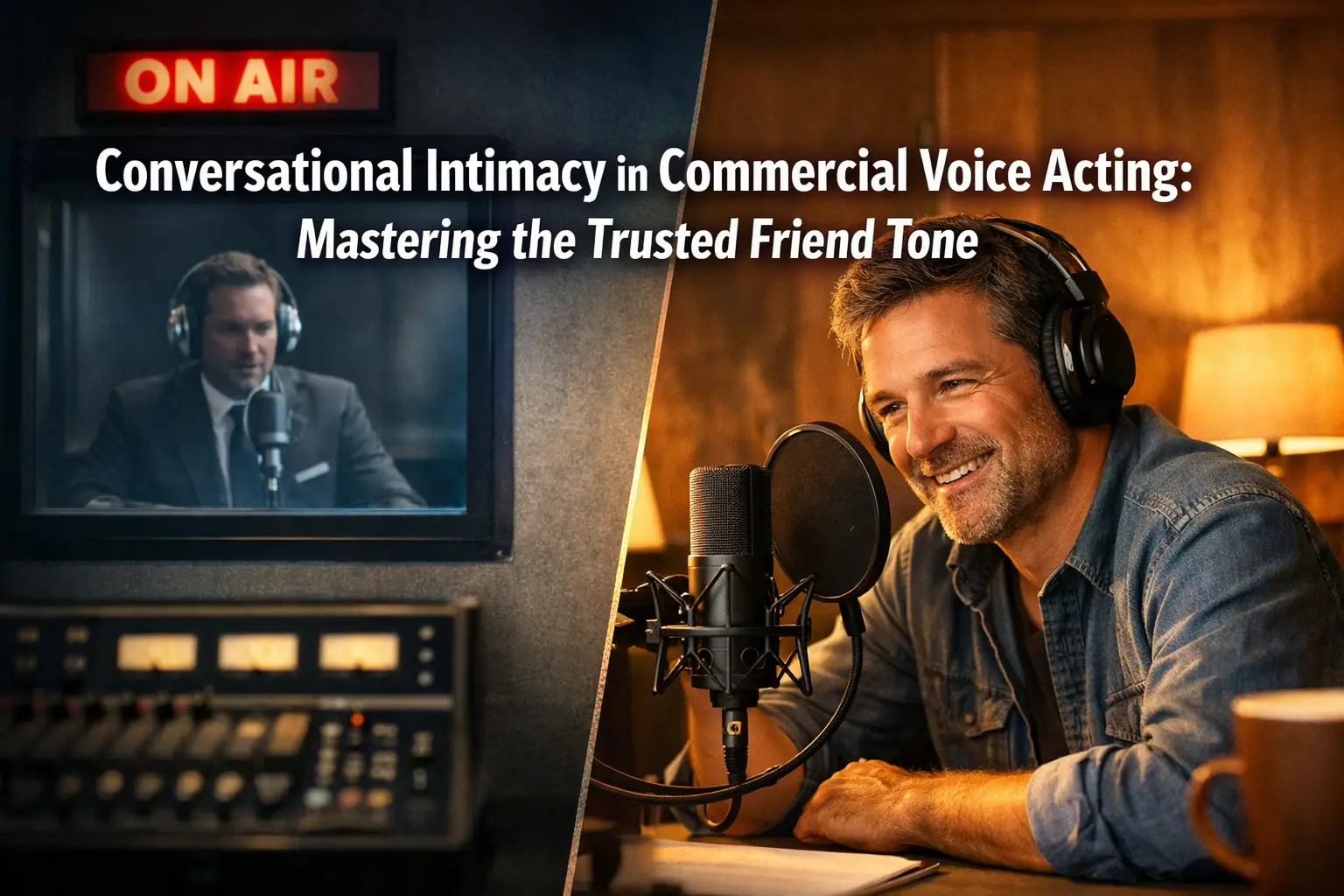
Picture this: You’re at a party, and someone corners you to deliver a perfectly rehearsed speech about their new car insurance. Now imagine your best friend casually mentioning over coffee how they just saved a bundle on their policy. Which one are you actually going to listen to?
That’s the seismic shift happening in commercial voice acting right now, and if you’re still clinging to that old-school announcer voice—you know, the one that sounds like you’re broadcasting from a mountaintop—you’re leaving money on the table.
Conversational Intimacy in Commercial Voice Acting: Mastering the Trusted Friend Tone That Outsells Traditional Announcer Reads isn’t just a trend; it’s a complete revolution in how brands connect with audiences in 2026. The traditional “posh” Received Pronunciation (RP) announcer style is dying faster than a dial-up modem, replaced by something far more powerful: the sound of a trusted advisor having a genuine conversation.[1]
After three decades in this business—from theatre stages to recording booths—I’ve watched this transformation firsthand. The actors who’ve adapted to this conversational approach aren’t just booking more work; they’re commanding premium rates and building long-term client relationships that the old “golden voice” crowd never dreamed possible.
Key Takeaways
- 🎯 Authenticity drives ROI: Human warmth and conversational delivery outperform traditional announcer reads for brand trust and conversion rates in 2026[1]
- 🗣️ Peer-to-peer is the new standard: Audiences respond to voices that sound like trusted friends or advisors, not stereotypical announcers[2]
- 💰 Premium positioning: Mastering conversational intimacy commands higher rates as brands recognize its competitive advantage over AI-generated content[3]
- 🎭 Emotional intelligence matters: The ability to deliver warmth, humor, empathy, and vulnerability separates professional voice actors from synthetic alternatives[3]
- 🔄 Strategic collaboration: Voice actors are now creative partners who shape interpretation and cultural authenticity, not just script readers[1][5]
The Death of the Traditional Announcer Voice (And Why That’s Great News)
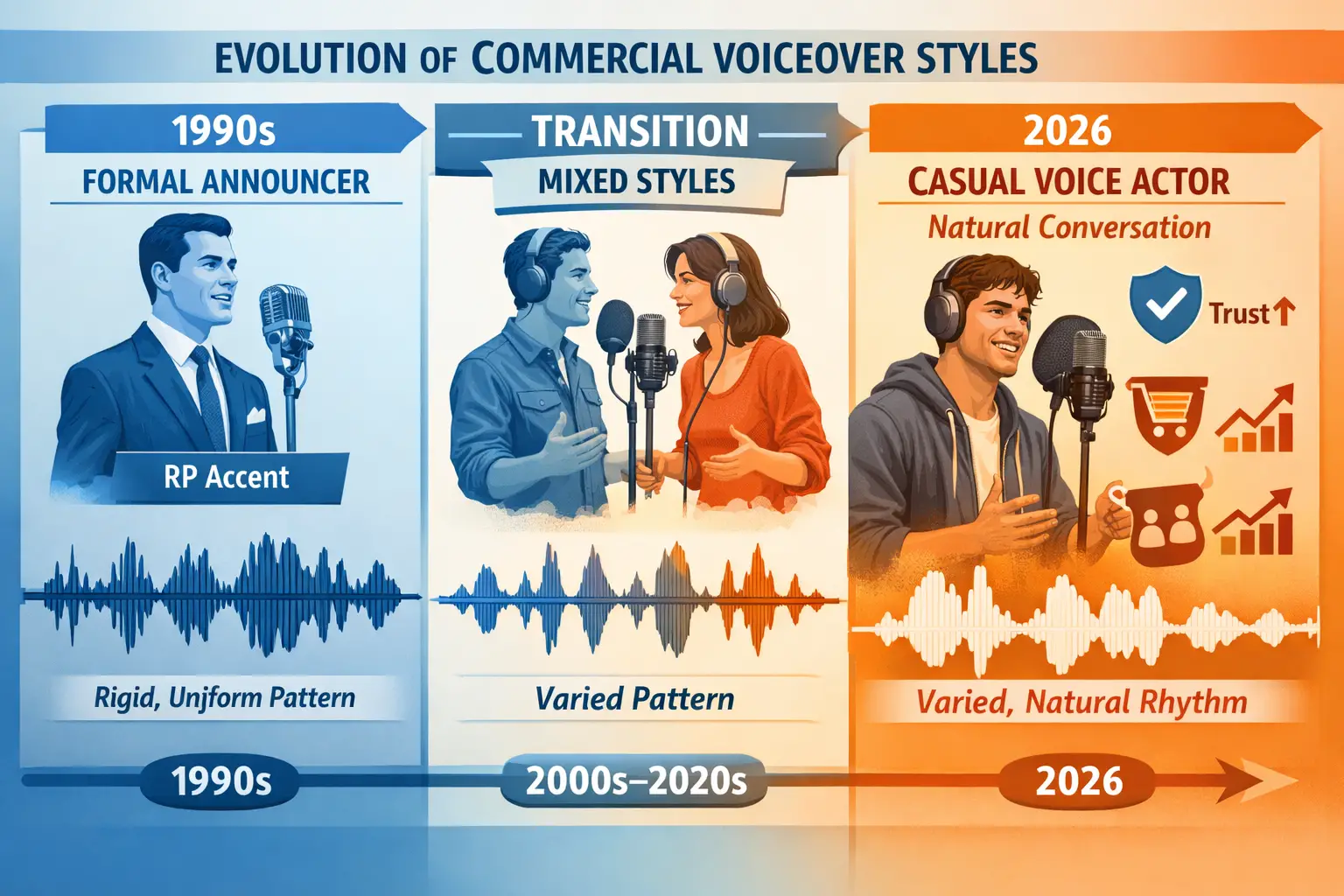
Let’s be honest about something: that classic announcer voice—the one that sounds like it’s selling you luxury sedans from 1987—has become the audio equivalent of a polyester leisure suit. Sure, it was impressive once, but now? It makes audiences reach for the skip button faster than you can say “Received Pronunciation.”
The traditional “posh RP” voice is in steep decline, replaced by what the industry now calls a neutral, conversational British commercial voiceover that sounds “less refined, more relaxed.”[1] This isn’t just happening in the UK, either. Across North America, Australia, and global markets, the shift is universal: formal is out, friendly is in.
Why Audiences Rejected the Announcer Approach
Think about how you consume media in 2026. You’re scrolling through content, listening to podcasts, watching streaming services where hosts talk to you, not at you. Your brain has been trained to trust conversational communication and to tune out anything that sounds like a sales pitch.
The old announcer style triggers what I call the “commercial defense mechanism”—that instant mental barrier that goes up the moment someone sounds like they’re performing rather than communicating. It’s the same reason people skip ads, mute commercials, and pay for ad-free subscriptions.
Here’s the beautiful irony: When you sound like you’re not trying to sell something—when you sound like a friend sharing helpful information—people actually listen. And they buy.
“Audiences respond better to voices that sound like a trusted friend or advisor rather than a stereotypical announcer.”[2]
This represents what the industry now calls “hyper-personalisation” in commercial voiceover[2]—and it’s completely changed the game for actors who can master it.
Understanding Conversational Intimacy in Commercial Voice Acting
So what exactly is conversational intimacy? It’s not just “reading casually” or “sounding relaxed.” Those are outcomes, not techniques. Real conversational intimacy in voice acting is about creating an authentic emotional connection that makes the listener feel like you’re speaking directly to them—and only them.
The Core Elements of Conversational Intimacy
After years of coaching actors and working in booths myself, I’ve identified the essential components that create genuine conversational intimacy:
1. Proximity and Presence 🎤
You’re not addressing a stadium; you’re talking to one person sitting across from you. This mental shift changes everything—your volume, your energy, your pacing. It’s the difference between projecting and confiding.
2. Authentic Emotional Investment
This is where emotional intelligence separates human voice actors from AI-generated content. Human voice actors deliver the “warmth, humour, empathy, vulnerability, and personality” that make messaging memorable—qualities that AI cannot yet replicate at scale.[3]
3. Natural Rhythm and Pacing
Real conversation has pauses, speed variations, moments of emphasis that feel organic rather than scripted. Think about how you actually talk when you’re excited about something versus when you’re explaining a complex idea. That variation is gold.
4. Relatable Imperfection
Here’s something that trips up classically trained actors: conversational delivery isn’t about perfection. A slight breath before an important point, a natural vocal inflection that shows you’re thinking—these “imperfections” actually increase authenticity and trust.
The Technical Foundations
Let me get practical for a moment, because technique matters. Here’s what conversational intimacy looks like in the booth:
| Traditional Announcer | Conversational Intimate |
|---|---|
| Consistent volume and projection | Dynamic volume with natural variation |
| Formal pronunciation and articulation | Relaxed, natural speech patterns |
| Scripted emphasis points | Organic emphasis based on meaning |
| Performance energy | Conversational energy |
| Broadcast distance | One-on-one proximity |
| Perfect technical execution | Authentic human delivery |
The shift isn’t about being sloppy or unprofessional—it’s about being human.
Mastering the Trusted Friend Tone That Outsells Traditional Announcer Reads
Now we get to the meat of it: how do you actually develop this trusted friend tone that clients are willing to pay premium rates for? Because make no mistake, specific vocal qualities now command premium rates: voice talent marketing emphasizes warm, conversational, friendly, trustworthy, natural, and authoritative tones.[3]
The “Coffee Shop Test”
Here’s an exercise I use with every actor I coach: Read your script like you’re explaining it to a friend at a coffee shop. Not performing it for them—explaining it. Notice what changes:
- Your volume drops to conversational levels
- You make more eye contact (even with an imaginary person)
- You use your hands naturally
- You pause to make sure they’re following
- You emphasize words based on meaning, not script formatting
- You smile when appropriate (yes, it changes your vocal tone)
This is your baseline for conversational intimacy. Everything else builds from here.
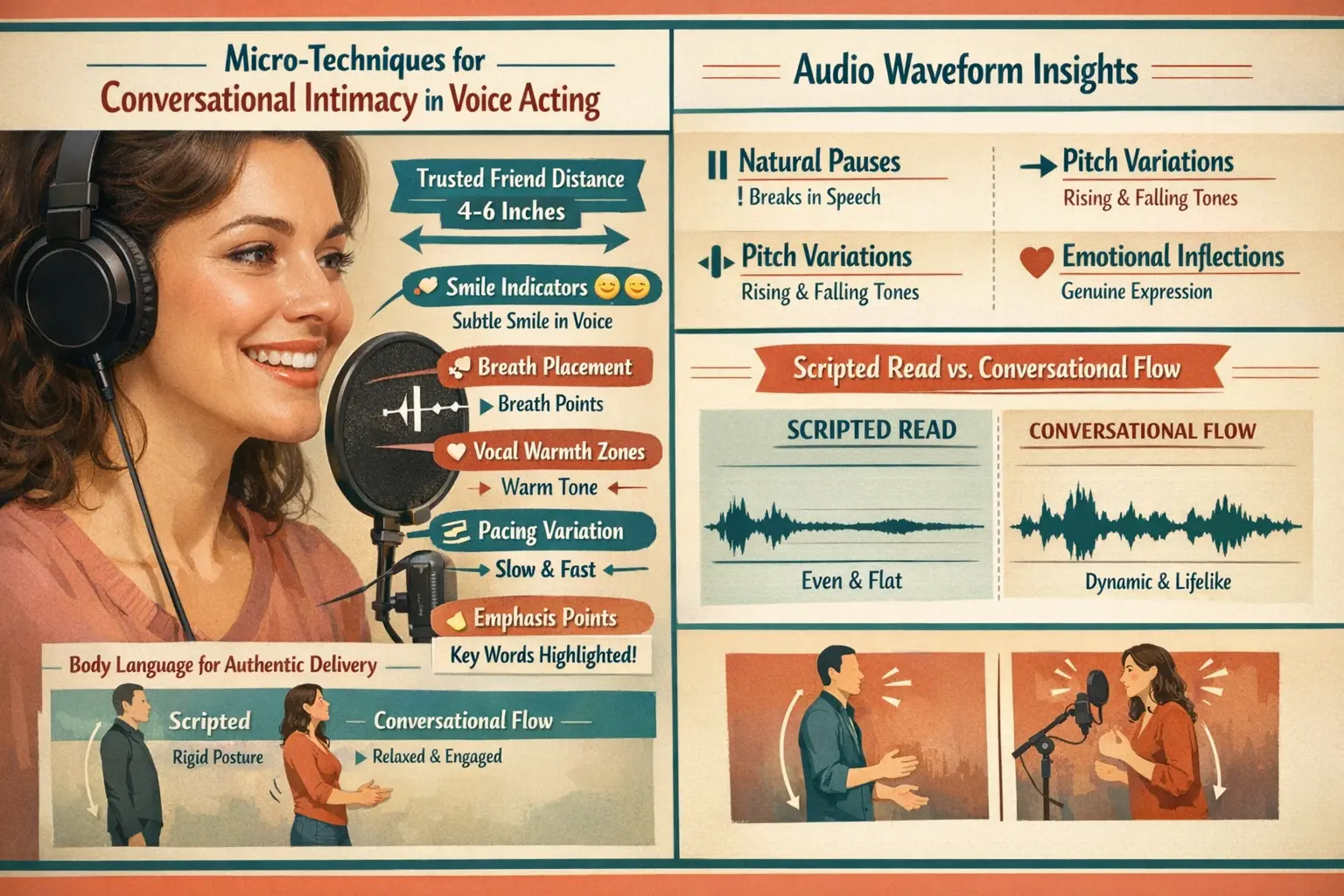
Micro-Techniques for Creating Intimacy
Let’s break down the specific techniques that create that trusted advisor quality:
Breath Placement 💨
In traditional announcing, you hide your breaths or place them technically. In conversational work, strategic breath placement adds intimacy. A small breath before an important phrase signals “listen to this” without saying it. It’s how real people talk when something matters to them.
Smile Delivery
Your listeners can hear when you’re smiling. It’s not about grinning like a game show host—it’s about genuine warmth. Try recording the same line with a neutral expression, then with a natural smile. The difference is remarkable, and clients hear it immediately.
Vocal Proximity
Think about adjusting your “vocal distance” the way a cinematographer adjusts camera distance. Some moments call for close-up intimacy; others need a bit more space. This variation keeps the read engaging and authentic.
Emphasis Through Meaning
Stop emphasizing words because they’re bold or underlined in the script. Emphasize them because they mean something to the person you’re talking to. This single shift will transform your reads from “professional” to “compelling.”
The Pause That Connects
Strategic pauses aren’t dead air—they’re moments of connection. They give your listener time to process, to feel, to connect with what you’re saying. Traditional announcers fear silence; conversational actors use it as a tool.
The Role Evolution: From Supplier to Strategic Partner
Here’s something that’s changed dramatically in the past few years: the voice actor role has evolved from supplier to collaborator. Professional voice talent is increasingly positioned as a strategic partner who shapes creative interpretation and cultural authenticity, rather than simply executing scripts.[1][5]
What does this mean practically? It means you’re not just reading words anymore. Clients expect you to:
- Offer interpretation suggestions that enhance authenticity
- Flag language that doesn’t sound conversational
- Bring cultural and demographic insights to the read
- Collaborate on pacing and emphasis for maximum impact
- Understand the brand strategy behind the message
This collaborative approach is one reason conversational voice actors command premium rates—they’re bringing strategic value, not just vocal skill.
The Business Case: Why Conversational Intimacy Outsells Traditional Reads
Let’s talk money, because that’s what “outsells” means. Why are brands willing to pay more for conversational reads? The answer comes down to one word: authenticity.
Authenticity as ROI Driver
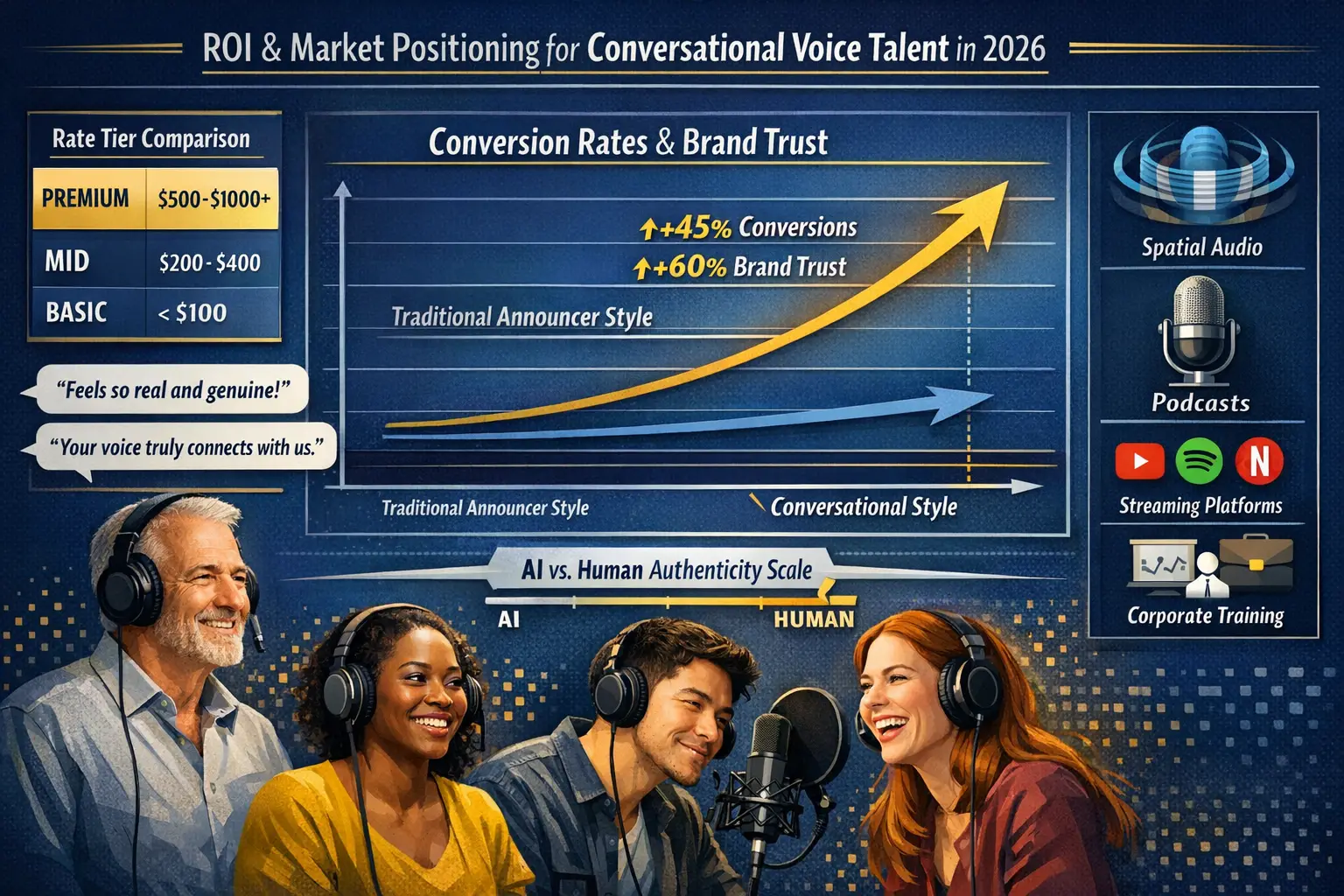
Authenticity is the primary ROI driver in 2026. Human emotion and warmth outperform AI-generated voices for brand trust and conversion rates, making authenticity “the new currency for brands.”[1]
Think about what brands are actually buying when they hire you. They’re not buying your voice—they’re buying the trust and connection that voice creates with their audience. A conversational, intimate delivery:
- Increases message retention: People remember conversations with friends, not announcements from strangers
- Drives higher conversion rates: Trust leads to action, and conversational delivery builds trust
- Enhances brand perception: Brands sound approachable, modern, and customer-focused
- Differentiates from AI content: Human warmth stands out in an increasingly synthetic audio landscape
The AI-Free Competitive Advantage
Here’s a trend that’s accelerating in 2026: AI-free marketing is becoming a competitive advantage. Some filmmakers and advertisers now explicitly market content as “AI-free” to signal authenticity and commitment to employing real human voice talent.[2]
This creates a premium market for actors who can deliver genuine conversational intimacy. AI can mimic the sound of conversation, but it can’t replicate the emotional intelligence, cultural nuance, and authentic human connection that creates real intimacy.
When brands choose human voice talent over AI, they’re making a statement about quality and authenticity. And they’re willing to pay for it.
Premium Positioning Through Specialized Skills
The actors commanding the highest rates in 2026 aren’t necessarily the ones with the most impressive demo reels or the longest résumés. They’re the ones who can deliver:
✅ Genuine emotional range within conversational parameters
✅ Cultural authenticity that resonates with diverse audiences
✅ Strategic interpretation that enhances brand messaging
✅ Technical excellence in high-fidelity recording for emerging formats
✅ Collaborative partnership in the creative process
Diversity and cultural authenticity are now mandatory. Brands are seeking gender-diverse, ethnically diverse, and age-diverse voices across marketing and customer experiences, with audiences increasingly demanding respect for vocal identity and rights.[3]
Adapting to the Conversational Search Era
Here’s something many voice actors miss: the rise of voice search and voice assistants has fundamentally changed how commercial scripts are written—and how they need to be performed.
Natural Language Optimization
With the rise of voice search, commercial voiceover scripts must be written to sound like natural conversation, avoiding jargon and overly formal language.[1] This means:
- Scripts use contractions (it’s, we’re, you’ll)
- Sentences are shorter and more direct
- Language mirrors how people actually speak
- Questions are conversational, not rhetorical
- Calls to action sound like suggestions from a friend
As a voice actor, you need to recognize this shift and lean into it. If a script sounds too formal or jargon-heavy, that’s feedback the client needs—because their audience won’t connect with it.
The Podcast Influence
The explosion of podcast listening has trained audiences to expect and prefer conversational delivery. Think about the most successful podcast hosts: they sound like they’re talking with you, not to you. They’re intimate, authentic, and relatable.
This podcast aesthetic has bled into commercial work, corporate narration, e-learning, and virtually every other voice acting category. The actors who’ve studied great podcast delivery have a significant advantage in booking commercial work.
Technical Considerations for Conversational Delivery
Let’s get into the booth for a moment and talk about the technical side of delivering conversational intimacy, because technique enables artistry.
Microphone Technique for Intimacy
Conversational delivery requires different mic technique than traditional announcing:
- Closer proximity: You’re generally working closer to the mic for that intimate sound
- Dynamic movement: Slight movements toward and away from the mic create natural variation
- Breath awareness: You’re managing breath as part of the performance, not eliminating it
- Pop filter mastery: Essential when working close with plosives in natural speech
Spatial Audio and Emerging Formats
Here’s a technical trend that’s creating new opportunities: spatial and 3D audio demand is reshaping technical standards. Unlike AI-generated mono files that sound flat, professional voice actors deliver high-fidelity source audio required for spatial audio mixing in VR, AR, and immersive advertising—a growing format category.[1]
This means:
- Recording quality matters more than ever
- Proper acoustic treatment is non-negotiable
- Understanding spatial audio mixing helps you deliver better source files
- Premium rates are justified by technical excellence
The AI-Human Hybrid Workflow
Let’s address the elephant in the room: AI-human hybrid workflows are emerging as standard practice. Professional studios are now using synthetic voices for low-stakes content and rough drafts, with human voice talent then refining and finishing the work.[3]
This isn’t a threat—it’s an opportunity. It means:
- More work for actors who can deliver premium conversational reads
- Higher rates for specialized, high-value projects
- Collaboration opportunities where you train AI on your voice for specific uses
- Clear differentiation between commodity work and premium human delivery
Practical Exercises to Develop Conversational Intimacy
Alright, enough theory. Let’s get practical. Here are exercises I’ve used for years to help actors develop genuine conversational intimacy:
Exercise 1: The Explanation Method
Take any commercial script and explain it to someone as if they asked you about the product. Don’t read it—explain it in your own words first. Then read the script, but maintain that explanatory energy and tone. Record both and compare.
Exercise 2: The Relationship Visualization
Before every take, visualize a specific person you’re talking to:
- A friend who needs this solution
- A family member you’re helping
- A colleague you’re advising
Different relationships create different intimacy levels. Experiment to find what serves each script best.
Exercise 3: The Smile-Breath-Pause Technique
Mark your script with three symbols:
- 😊 Where a natural smile would occur
- 💨 Where a conversational breath adds intimacy
- ⏸️ Where a pause creates connection
Perform the script incorporating all three. It’ll feel over-marked at first, but it trains your instincts.
Exercise 4: The Contrast Recording
Record the same script three ways:
- Traditional announcer style
- Overly casual (too conversational)
- Balanced conversational intimacy
Listen back and identify what makes #3 work. This calibrates your ear and your delivery.
Exercise 5: The Real Conversation Capture
Record yourself in actual conversations (with permission, of course). Listen to how you naturally:
- Emphasize words based on meaning
- Use pauses and breaths
- Vary your pacing and energy
- Express emotion through tone
These are your authentic conversational patterns. Now bring them into the booth.
Navigating Client Expectations and Direction
Here’s a reality check: not every client knows they want conversational intimacy, even when that’s what will serve their brand best. Part of mastering this approach is learning how to guide clients toward it.
Reading Between the Direction Lines
When clients say:
- “Make it more natural” = They want conversational
- “Less announcer-y” = They want intimate
- “Like you’re talking to a friend” = They want trusted advisor tone
- “More authentic” = They want emotional truth, not performance
Learn to translate client direction into technical adjustments.
Offering Options
Here’s a professional approach that builds trust and showcases your range:
First take: Deliver your best interpretation of conversational intimacy
Second take: Slightly different emphasis or pacing
Third take: “Here’s a more traditional approach if you prefer”
This demonstrates versatility while steering them toward the conversational read that you know will perform better.
Educating Clients (Gently)
Sometimes clients need gentle education about why conversational works. Frame it in terms of their goals:
- “This conversational approach tends to increase engagement with your target demographic”
- “The intimate delivery helps build trust with listeners who are skeptical of traditional advertising”
- “This tone positions your brand as approachable and customer-focused”
You’re not lecturing—you’re collaborating toward their success.
The Future of Conversational Voice Acting
Looking ahead, several trends are shaping where conversational intimacy in commercial voice acting is heading:
Hyper-Personalization at Scale
Technology is enabling brands to deliver personalized messages at unprecedented scale. This means more demand for conversational voice talent who can record variations that feel personally relevant to different audience segments.
Localized Authenticity
Localized voiceover work has surged as audiences seek content reflecting their own languages and cultural nuances.[3] Conversational intimacy requires cultural fluency—understanding not just language, but communication styles, humor, and relational norms.
Interactive and Responsive Content
Voice-activated content, interactive ads, and responsive customer experiences require conversational delivery that sounds natural in two-way communication contexts. This is a growing specialty area.
The Actor-Powered AI Model
When AI voices are trained on professional actor performances, brands gain access to “craft, creative interpretation, cultural authenticity, and emotional expressiveness” that synthetic or voice-scraped alternatives cannot generate.[5]
This creates opportunities for actors to license their conversational delivery style for specific brand uses while maintaining creative control and ongoing revenue.
Building Your Conversational Voice Acting Business
Let’s talk business strategy, because mastering conversational intimacy is only valuable if you can market it effectively and command appropriate rates.
Positioning and Marketing
Your marketing materials should emphasize:
- ✨ Warm, conversational, friendly, trustworthy, natural, and authoritative qualities[3]
- 🎯 Your ability to create authentic emotional connections
- 🤝 Your collaborative approach as a strategic partner
- 🌍 Any cultural or demographic authenticity you bring
- 🎙️ Technical excellence in high-fidelity recording
Demo Reel Strategy
Your commercial demo in 2026 should showcase:
- Range within conversational parameters (not announcer to conversational, but various conversational styles)
- Emotional authenticity across different scenarios
- Cultural and demographic relevance to your target markets
- Technical quality that demonstrates professional standards
Rate Justification
Premium rates for conversational intimacy are justified by:
- Strategic value: You’re a creative collaborator, not just a voice
- Authenticity premium: Human warmth that AI can’t replicate
- Technical excellence: High-fidelity source audio for emerging formats
- Specialized skills: Emotional intelligence and cultural authenticity
- ROI delivery: Conversational reads drive better conversion rates
Don’t apologize for premium rates—justify them with the value you deliver.
Common Mistakes to Avoid
After three decades, I’ve seen actors make the same mistakes when trying to develop conversational intimacy. Here’s what to avoid:
❌ Confusing casual with conversational: Sloppy delivery isn’t conversational—it’s unprofessional
❌ Over-correcting from announcer style: Going too far casual loses authority and trust
❌ Ignoring technical fundamentals: Conversational still requires excellent mic technique and audio quality
❌ Faking authenticity: Audiences can smell inauthentic “friendly” delivery a mile away
❌ One-size-fits-all approach: Different brands and audiences require different conversational styles
❌ Forgetting the commercial goal: Conversational intimacy serves the message; it’s not the message itself
Conclusion: Your Next Steps to Mastering Conversational Intimacy
Here’s the truth: Conversational Intimacy in Commercial Voice Acting: Mastering the Trusted Friend Tone That Outsells Traditional Announcer Reads isn’t just about changing your delivery style. It’s about fundamentally rethinking your relationship with the listener, the client, and the craft itself.
The traditional announcer voice is dead. Good riddance. What’s replacing it is something far more interesting, challenging, and rewarding: the opportunity to create genuine human connection through your voice work.
Your Action Plan
This Week:
- Record yourself in natural conversations and analyze your authentic patterns
- Practice the exercises outlined in this article
- Re-record an existing commercial script using conversational intimacy techniques
This Month:
- Update your demo reel to showcase conversational range
- Revise your marketing materials to emphasize authenticity and collaboration
- Research clients and brands that value conversational delivery
This Quarter:
- Invest in technical upgrades to support high-fidelity conversational recording
- Develop specialized expertise in cultural or demographic authenticity
- Build collaborative relationships with clients who value strategic partnership
This Year:
- Position yourself as a premium conversational voice talent
- Develop AI-collaboration strategies that enhance rather than replace your work
- Build a sustainable business around authentic human connection
The actors who thrive in 2026 and beyond won’t be the ones with the most impressive announcer voices. They’ll be the ones who sound like trusted friends, strategic advisors, and authentic humans in a world increasingly filled with synthetic alternatives.
The opportunity is enormous. The demand is real. The premium rates are there for actors who can deliver genuine conversational intimacy.
Now get in the booth and start sounding like the trusted friend your clients need and audiences want to hear. Your most successful booking isn’t going to come from perfecting that announcer voice—it’s going to come from mastering the art of authentic human connection.
And that, my friend, is something worth talking about. 🎤
References
[1] Commercial Voiceover Trends – https://www.provoiceactor.co.uk/blog/commercial-voiceover-trends/
[2] Voice Acting In 2025 2026 Trends Insights And The Future – https://www.gravyforthebrain.com/voice-acting-in-2025-2026-trends-insights-and-the-future/
[3] Voice Over Trends For 2026 – https://www.voicecrafters.com/blog/voice-over-trends-for-2026/
[5] Amplified 2026 The State Of Voice Report – https://www.voices.com/blog/amplified-2026-the-state-of-voice-report/