

Here’s a truth that might sting a little: In 2026, your audience will scroll past your content faster than you can say “action.”
After three decades in this business—from community theater stages to Fortune 500 commercial booths—I’ve watched the voice acting landscape transform dramatically. The days when a smooth, authoritative voice alone could carry a three-minute corporate video are long gone. Today’s digital ecosystem demands something entirely different, and frankly, most voice actors are still performing like it’s 2010.
Voice Acting for Explainer Videos and Short-Form Digital Content: Maximizing Engagement in the 58-Second Attention Span Economy isn’t just a mouthful of industry jargon—it’s the new reality of our profession. Whether you’re a fresh-faced actor booking your first gig or a seasoned pro wondering why your callback rate has dropped, understanding this shift isn’t optional anymore. It’s survival.
The explainer video and short-form content market has become the bread and butter for working voice actors. Yet here’s the kicker: most performers approach these scripts with the same techniques they’d use for a documentary narration or audiobook. That’s like bringing a butter knife to a sword fight.
Key Takeaways
- The 58-second rule is real: Viewer retention drops dramatically after one minute, requiring voice actors to master front-loaded energy and strategic pacing techniques
- Conversational doesn’t mean casual: Modern explainer videos demand authentic, relatable delivery that builds trust while maintaining professional authority and driving action
- Script optimization is now part of the job: Successful voice actors actively collaborate on timing, emphasis, and structural adjustments to maximize engagement and conversion rates
- Energy management separates amateurs from professionals: Knowing when to push, pull back, and create strategic pauses within compressed timeframes is the difference between scroll-worthy and share-worthy content
- Platform-specific adaptation is essential: What works for a LinkedIn explainer differs from TikTok, Instagram Reels, or YouTube Shorts—versatility is the new currency
Understanding the 58-Second Attention Span Economy
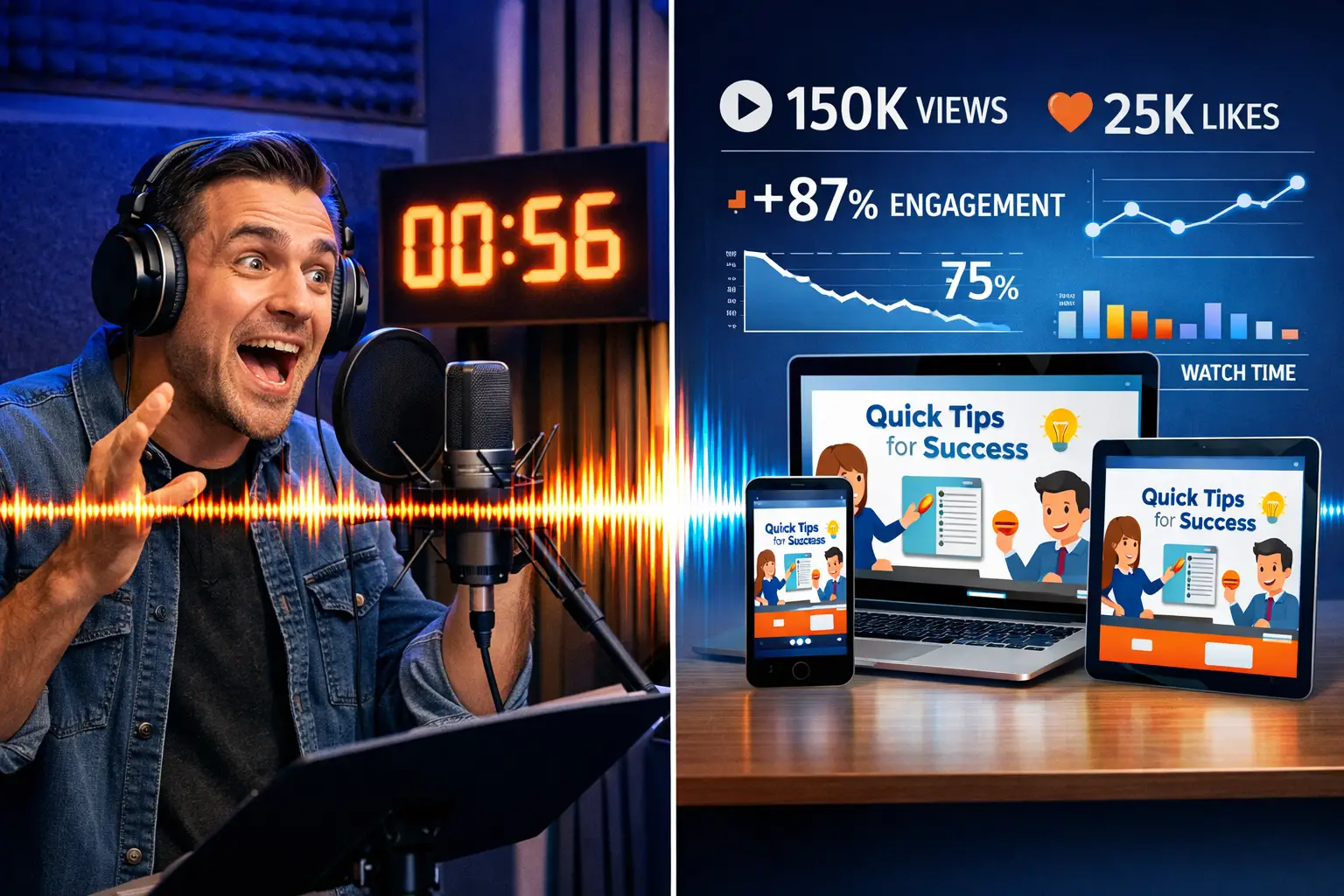
Let’s talk about that magical number: 58 seconds. Research shows that’s roughly how long the average viewer will stick with your content before their thumb starts itching to scroll. Some studies put it even lower. Think about that for a moment—you’ve got less time than it takes to microwave popcorn to hook them, deliver value, and inspire action.
I remember recording a pharmaceutical explainer back in 2015 that ran four minutes. The client was thrilled. Fast forward to 2026, and that same client now wants everything under 60 seconds, preferably 45. The script that once leisurely explained their product now needs to hit harder, faster, and smarter.
Why Traditional Voice Acting Techniques Fall Short
Here’s where many talented actors stumble. They’ve trained for years to develop beautiful resonance, perfect diction, and commanding presence. All valuable skills! But short-form digital content doesn’t care about your classical training if you can’t make someone stop scrolling in the first three seconds.
Traditional narration taught us to:
- Build gradually to key points
- Maintain consistent energy throughout
- Let the script breathe with natural pauses
- Project authority through vocal weight
Short-form content demands we:
- ⚡ Hook immediately with energy and intrigue
- 🎯 Front-load the most compelling information
- ⏱️ Compress without feeling rushed
- 💬 Sound like a helpful friend, not an announcer
The difference? Think of traditional narration as a leisurely dinner party conversation. Short-form content is speed dating—you’ve got seconds to make an impression or you’re out.
Voice Acting for Explainer Videos: Pacing and Energy Management Techniques
Pacing in the attention economy is an art form that took me years to truly understand. I learned this lesson the hard way during a tech startup explainer that bombed in testing. My delivery was technically perfect—clear, well-paced by traditional standards, professional. The problem? Viewers checked out after 12 seconds because I hadn’t given them a reason to stay.
The Front-Load Strategy
The first 5-8 seconds of your read are worth their weight in gold. This is where you either capture attention or lose it forever. Here’s what works:
Energy burst opening: Start with 20% more energy than you think you need. Seriously. What feels slightly “too much” in the booth often translates to “just right” for a viewer scrolling through their feed at a coffee shop.
Immediate value proposition: Your opening line should answer “Why should I care?” within three seconds. Not three sentences—three seconds. This isn’t about rushing; it’s about precision.
Vocal variety from the start: Monotone is death. Even if you’re explaining tax software (and I’ve done plenty of those), find the human interest angle and lead with vocal color that reflects it.
Strategic Pacing Patterns
Here’s a technique I call the “Pulse and Pull” method:
| Phase | Duration | Energy Level | Purpose |
|---|---|---|---|
| Hook | 0-8 sec | 90-100% | Grab attention, establish value |
| Build | 8-25 sec | 70-80% | Deliver core information, maintain interest |
| Pivot | 25-35 sec | 85-95% | Introduce solution/key benefit |
| Close | 35-58 sec | 95-100% | Call to action, memorable finish |
Notice the energy doesn’t stay flat. You’re creating a micro-journey with peaks and valleys that keep the ear engaged. It’s like conducting a symphony, except your orchestra is your voice and you’ve got 58 seconds instead of 58 minutes.
Breath Control and Compression
One of my favorite analogies: your breath is currency in short-form content. Spend it wisely.
Shallow breathing stations: Unlike audiobook work where you can take luxurious breaths between paragraphs, explainer videos require quick, strategic breath catches. Practice taking efficient breaths that don’t interrupt the flow—think of them as commas, not periods.
Compression without rushing: This is the holy grail. You need to deliver information quickly without sounding frantic. The secret? It’s not about talking faster; it’s about eliminating dead space. Cut the fat from your pauses, tighten transitions, and maintain forward momentum.
I practice this by recording a 90-second script and then trimming it to 60 seconds without changing my read speed—just by being more economical with silence. It’s a game-changer.
Mastering Conversational Delivery for Maximum Engagement
“Be conversational” is the most common direction in explainer video scripts, and the most misunderstood. Conversational doesn’t mean sloppy. It doesn’t mean dropping your professional standards. It means sounding like the smartest, most helpful person at the party who genuinely wants to solve someone’s problem.
The Authenticity Paradox
Here’s something that messed with my head for years: the more “real” you try to sound, the faker you can come across. True conversational delivery in voice acting for explainer videos requires careful craft disguised as effortlessness.
Think about how you actually talk to a friend when explaining something you’re excited about:
- You use contractions naturally
- Your pitch varies wildly based on emphasis
- You might repeat words for effect
- You pause for impact, not just grammar
- Your energy reflects genuine enthusiasm
Now do all of that while hitting exact timing marks, maintaining broadcast-quality audio, and nailing the client’s key messaging points. That’s the job.
Building Trust Through Vocal Choices
In 2026’s skeptical digital landscape, trust is everything. Viewers have been burned by clickbait, scammed by fake reviews, and exhausted by hard sells. Your voice needs to cut through that noise.
Techniques that build instant credibility:
🎯 Smile through complex information: When explaining something technical, a smile in your voice signals “I know this seems complicated, but I’ve got you.” Listeners hear it even if they can’t see you.
💡 Strategic vulnerability: Slight imperfections—a natural pause, a subtle emphasis shift—can make you sound more human and trustworthy. This isn’t about making mistakes; it’s about not sounding like a robot.
🤝 Inclusive language delivery: When the script says “we” or “you,” lean into those pronouns. Make them feel personal. The difference between “You can save money” delivered generically versus with genuine emphasis on “you” is massive.
The Power of Micro-Pauses
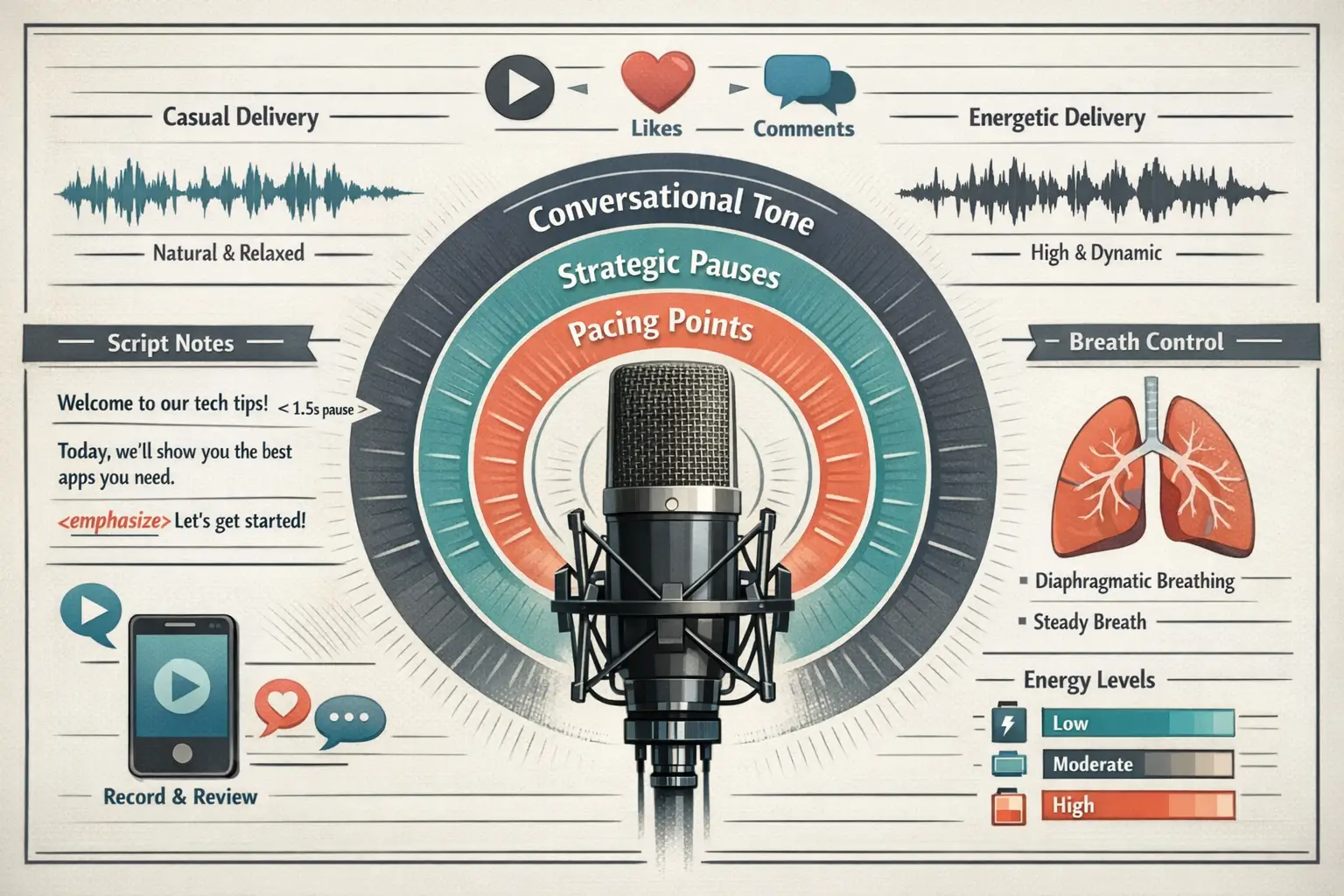
This technique revolutionized my explainer work. A micro-pause is exactly what it sounds like—a tiny beat of silence (0.3-0.5 seconds) placed strategically to:
- Create anticipation before a key benefit
- Allow an important stat to land
- Separate distinct ideas without losing momentum
- Give the listener a mental “breath” without breaking flow
Example: “Our platform helps you save time [micro-pause] money [micro-pause] and your sanity.”
Those tiny gaps let each benefit register individually while maintaining the punchy pace that short-form content demands.
Voice Acting for Short-Form Digital Content: Platform-Specific Strategies
Not all short-form content is created equal, and this is where many voice actors leave money on the table. A LinkedIn explainer video serves a completely different purpose—and audience—than a TikTok ad or Instagram Reel. Your delivery should reflect that.
Platform Personality Profiles
LinkedIn & Professional Platforms:
- Tone: Authoritative but approachable
- Pacing: Moderate, room to breathe
- Energy: Confident, solution-focused
- Typical length: 45-90 seconds
- Delivery style: “Trusted advisor”
Instagram Reels & TikTok:
- Tone: Energetic, relatable, sometimes playful
- Pacing: Quick, punchy, high-energy
- Energy: Enthusiastic without being annoying
- Typical length: 15-60 seconds
- Delivery style: “Cool friend with insider knowledge”
YouTube Shorts:
- Tone: Informative but entertaining
- Pacing: Balanced, strategic variety
- Energy: Sustained interest throughout
- Typical length: 30-60 seconds
- Delivery style: “Expert educator”
Twitter/X Video:
- Tone: Direct, no-nonsense
- Pacing: Rapid-fire, information-dense
- Energy: Sharp, attention-grabbing
- Typical length: 20-45 seconds
- Delivery style: “Quick insight provider”
I learned these distinctions by bombing auditions early on. I’d submit the same read for different platforms, wondering why I wasn’t booking. Once I started tailoring my approach, my success rate tripled.
Adapting Your Read on the Fly
Here’s a skill that separates working voice actors from struggling ones: the ability to pivot your delivery based on platform without needing to completely re-record.
The Three-Take Method:
- Standard read: Your best interpretation of the script as written
- Compressed energy: Same script, 15% faster, 20% more energy (for social platforms)
- Extended authority: Same script, slightly slower, more gravitas (for professional contexts)
Deliver all three in your audition or session. Clients love options, and you’ll often find they use different versions for different platforms. You’ve just tripled your value.
Script Optimization: The Voice Actor’s Secret Weapon
Here’s something they don’t teach in most voice acting classes: your job isn’t just to read the script—it’s to make the script work. In the attention economy, a poorly structured script will fail no matter how brilliantly you perform it.
After 30 years, I’ve learned that the best voice actors are collaborative partners in the writing process, not just performers. This doesn’t mean rewriting the client’s work (unless invited to), but it does mean understanding what makes short-form scripts effective.
Red Flags in Explainer Scripts
When you receive a script, scan for these engagement killers:
❌ Buried lede: If the main benefit doesn’t appear in the first 10 seconds, flag it ❌ Jargon overload: Technical terms without context lose audiences fast ❌ Passive voice: “Results can be achieved” is weaker than “You’ll achieve results” ❌ Too many ideas: Trying to cover five benefits in 60 seconds means none land ❌ Weak call-to-action: Ending with “Learn more” instead of specific next steps
Timing Optimization Techniques
Here’s my pre-recording ritual for every explainer script:
Step 1: The Cold Read Timer Read the script naturally without trying to hit a specific time. If a “60-second” script runs 90 seconds at natural pace, you’ve got a problem that energy alone won’t fix.
Step 2: Identify Compression Opportunities
- Redundant phrases that can be cut
- Long words that have shorter synonyms
- Sentences that can be split for better pacing
- Setup information that could be visual instead
Step 3: Mark Strategic Emphasis I use a simple notation system:
- BOLD = key emphasis
- [PAUSE] = strategic silence
- ↑ = pitch rise for interest
- → = maintain energy through transition
Step 4: The Client Conversation If timing is genuinely impossible without sacrificing quality, I’ll reach out: “I want to deliver this perfectly, and I’m finding the 60-second target challenging while maintaining the conversational pace you requested. Would you be open to either trimming to these suggested edits or extending to 75 seconds?”
Most clients appreciate this professionalism. You’re solving their problem, not creating one.
Writing for the Ear vs. The Eye
Scripts written by copywriters who primarily work in print often don’t translate well to voice. Here’s the difference:
Written for the eye: “Our revolutionary platform utilizes advanced algorithmic processes to optimize your workflow efficiency.”
Written for the ear: “Our platform uses smart technology to make your work faster and easier.”
Same meaning, half the words, triple the impact. If you can gently guide clients toward ear-friendly language, you’ll book more and deliver better results.
Advanced Techniques for Maximizing Engagement and Conversions
Let’s get into the ninja-level stuff—the techniques that turn a good explainer video into a conversion machine. Because here’s the reality: clients don’t just want views; they want results. Your voice is a sales tool, and understanding that changes everything.
The Psychology of Vocal Persuasion
Anchoring through emphasis: When you emphasize specific words, you anchor the listener’s attention and memory. In a 60-second explainer, you might have 5-7 key anchor points. Choose them strategically.
Example: “Save up to 40% on your energy bills starting this month.”
Those emphasized phrases become the takeaways listeners remember.
Pacing for perceived value: Slightly slowing down on benefit statements makes them feel more substantial. Speed through the problem, slow through the solution. This creates contrast that highlights value.
Vocal mirroring: Match your energy to the desired emotional outcome. Excited about possibilities? Let that excitement live in your voice. Concerned about a problem? Reflect appropriate gravity. Then shift to optimism when presenting the solution.
Creating Urgency Without Pressure
Nobody likes a hard sell, especially in 2026 when consumers are more sophisticated than ever. But urgency—when done right—drives action.
Soft urgency techniques:
- “While you’re here…” (capitalizes on current attention)
- “In just 60 seconds…” (acknowledges their time investment)
- “Before you scroll…” (playful acknowledgment of the medium)
- “Right now, you can…” (present-tense immediacy)
Hard urgency (use sparingly):
- “Limited time offer”
- “Only available today”
- “Before it’s gone”
The delivery makes all the difference. Hard urgency delivered with genuine helpfulness works. Delivered with pressure? Instant scroll.
The Callback Technique
This is borrowed from comedy but works brilliantly in explainer videos. Reference something from your opening in your close. It creates a satisfying loop that feels complete.
Opening: “Tired of spending hours on tasks that should take minutes?” Closing: “Get those hours back. Try [Product] free today.”
That connection between “hours” in both segments creates subconscious satisfaction and memorability.
Technical Considerations for Short-Form Excellence
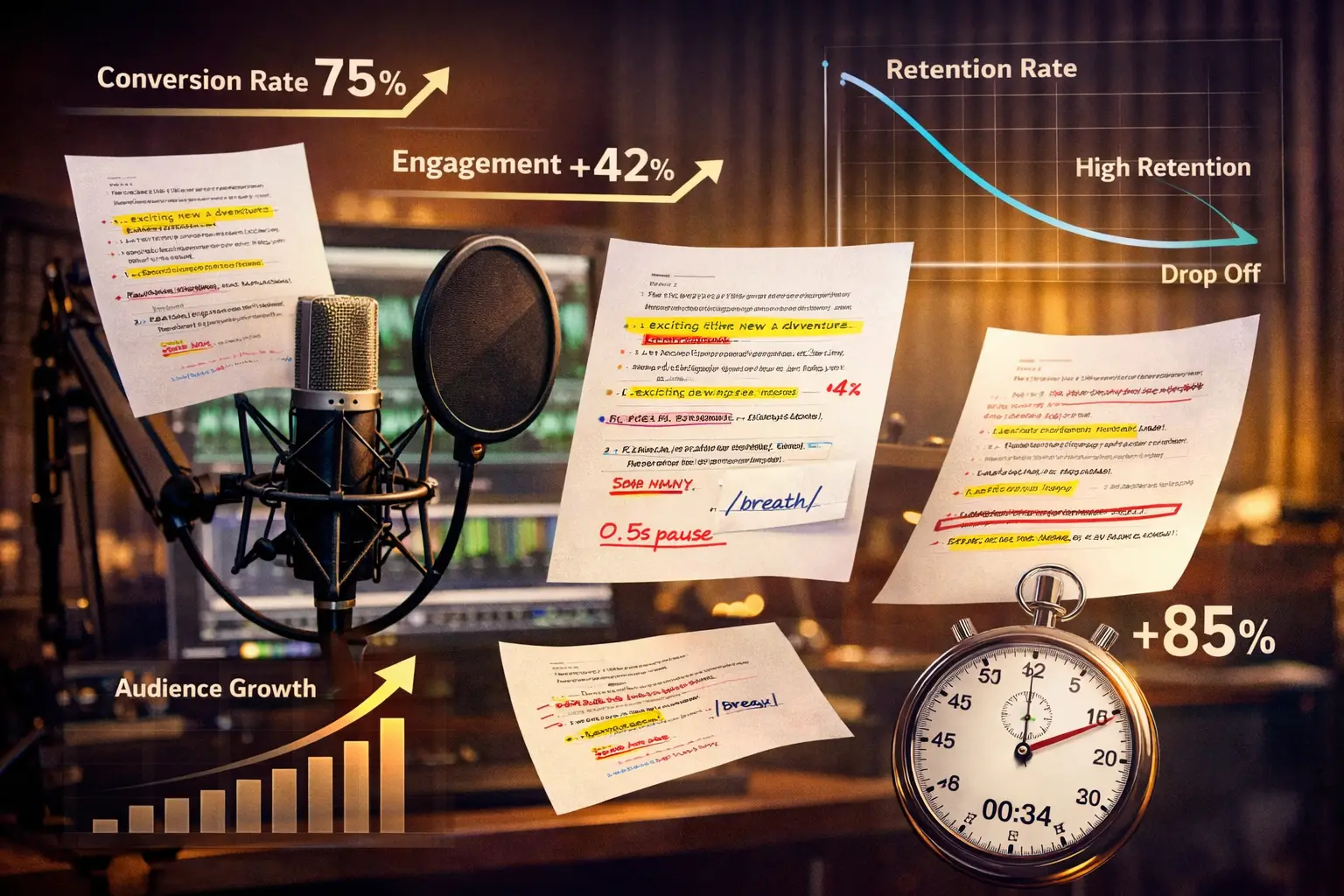
The technical side matters more than ever in voice acting for explainer videos and short-form digital content. Poor audio quality will tank engagement faster than a bad script.
Recording for Multiple Platforms
Different platforms have different audio specifications and playback environments. Your recording approach should account for this.
Mobile-first mixing: Most short-form content is consumed on smartphones, often without headphones. This means:
- Slightly brighter EQ to cut through phone speakers
- Compression that maintains clarity at low volumes
- Careful de-essing (sibilance is harsh on phone speakers)
- Consistent levels throughout (no dynamic range that requires volume adjustment)
Noise floor awareness: Background noise you’d never notice on a TV commercial becomes obvious on earbuds. Keep your recording environment pristine.
Punch and Roll for Efficiency
In short-form work where timing is critical, mastering punch and roll recording saves massive time. You can correct a single word without losing the energy and flow of the surrounding read.
Practice this until it’s second nature. Your editing time will drop by 60%, and your reads will sound more cohesive.
File Delivery Best Practices
For explainer videos, deliver:
- Full read (with any pickup alternatives)
- Individual sentence files (for editing flexibility)
- Room tone (30 seconds minimum)
- Two mix versions: one with natural dynamics, one compressed for mobile
This professionalism sets you apart and makes the editor’s life easier—which means they’ll call you back.
Building Your Career in the Attention Economy
The market for explainer videos and short-form content isn’t slowing down—it’s accelerating. In 2026, every brand needs this content, which means opportunity for voice actors who truly understand the medium.
Positioning Yourself as a Specialist
While versatility is valuable, positioning yourself as an expert in short-form digital content can command premium rates. Consider:
Developing a specialty niche:
- SaaS explainer videos
- E-commerce product videos
- Educational content for social platforms
- App onboarding videos
- Financial services explainers
Creating platform-specific demos: Instead of one general demo, create targeted samples for LinkedIn, Instagram, TikTok, and YouTube. Show clients you understand their specific needs.
Showcasing results: If possible, get permission to share engagement metrics from past projects. “This explainer I voiced achieved a 78% completion rate” is powerful marketing.
Continuous Skill Development
The techniques that work today will evolve tomorrow. Stay current by:
📚 Studying successful content: Spend 30 minutes weekly watching top-performing explainer videos. What patterns do you notice in pacing, energy, and structure?
🎯 A/B testing your approaches: When possible, deliver multiple read styles and track which performs better. Build a personal database of what works.
🤝 Networking with content creators: Video editors, motion graphics artists, and content strategists can provide insights into what makes voice work effective from their perspective.
💪 Practicing compression: Regularly challenge yourself to deliver the same message in less time without sacrificing clarity or engagement.
The Business Side
Understanding voice acting for explainer videos and short-form digital content from a business perspective makes you a better partner to clients.
Pricing considerations:
- Short-form doesn’t mean cheap—your rate should reflect the specialized skill required
- Consider usage rights carefully (social media content often has broad distribution)
- Offer package deals for multiple platform versions
- Build in revision allowances for timing adjustments
Client education: Many clients don’t understand why a 30-second explainer might cost the same as a 2-minute narration. Be prepared to articulate the value: specialized pacing, platform optimization, higher engagement rates, and conversion focus.
Conclusion: Thriving in the 58-Second Economy
Look, I won’t sugarcoat it—voice acting for explainer videos and short-form digital content in the 58-second attention span economy is demanding work. It requires you to unlearn some traditional techniques, embrace new ones, and constantly adapt to platform changes and audience evolution.
But here’s the beautiful part: this is where the work is. This is where brands are investing. This is where your voice can directly impact business results in measurable ways. And when you master these skills—the front-loaded energy, the conversational authenticity, the platform-specific adaptation, the script optimization—you become invaluable.
The actors I see thriving in 2026 aren’t necessarily the ones with the most classical training or the deepest voices. They’re the ones who understand that every second counts, every word matters, and engagement is the currency that pays the bills.
Your Next Steps
Ready to level up your short-form voice acting game? Here’s your action plan:
Audit your current approach: Record yourself reading a 60-second explainer script. Time it. Analyze your energy distribution. Be honest about what’s working and what isn’t.
Practice platform-specific reads: Take one script and record three versions—one for LinkedIn, one for Instagram, one for TikTok. Feel the difference in your delivery.
Study the competition: Watch 20 explainer videos in your niche. Note what keeps you engaged and what makes you scroll.
Optimize your demo: Create a short-form specific demo that showcases your ability to hook attention, maintain energy, and drive action—all in under 60 seconds.
Reach out to one new client: Target a brand or agency that specializes in short-form content. Show them you understand their specific needs.
The 58-second attention economy isn’t going away. The question is: will you adapt and thrive, or watch opportunities scroll past?
After 30 years in this business, I can tell you with certainty—the actors who embrace this evolution, who put in the work to master these specialized skills, who understand that short-form content is an art form all its own… those are the actors who’ll still be working when others are wondering where the gigs went.
Now get in that booth and make those 58 seconds count. Your future self will thank you. 🎤