

In boardrooms across the world, marketing executives are discovering a powerful truth: speaking your customer’s language isn’t enough anymore. You need to sound like them, understand their cultural references, and deliver content that feels authentically local. The Rise of Localized Voice Over: Capturing Global Markets Through Authentic Regional Content represents one of the most significant shifts in global marketing and content strategy in 2026, creating unprecedented opportunities for multilingual voice talent while reshaping how brands connect with international audiences.
This transformation goes far beyond simple translation. As audiences worldwide demand content that reflects their own languages, cultures, and local nuances, businesses face a critical choice: invest in authentic localization or risk losing market share to competitors who understand the value of cultural resonance. The stakes have never been higher, and the opportunities for skilled voice actors have never been more abundant.
Key Takeaways
- 58% of surveyed buyers have already worked with or plan to work with non-English voice talent, signaling massive global demand for localized content across industries[2]
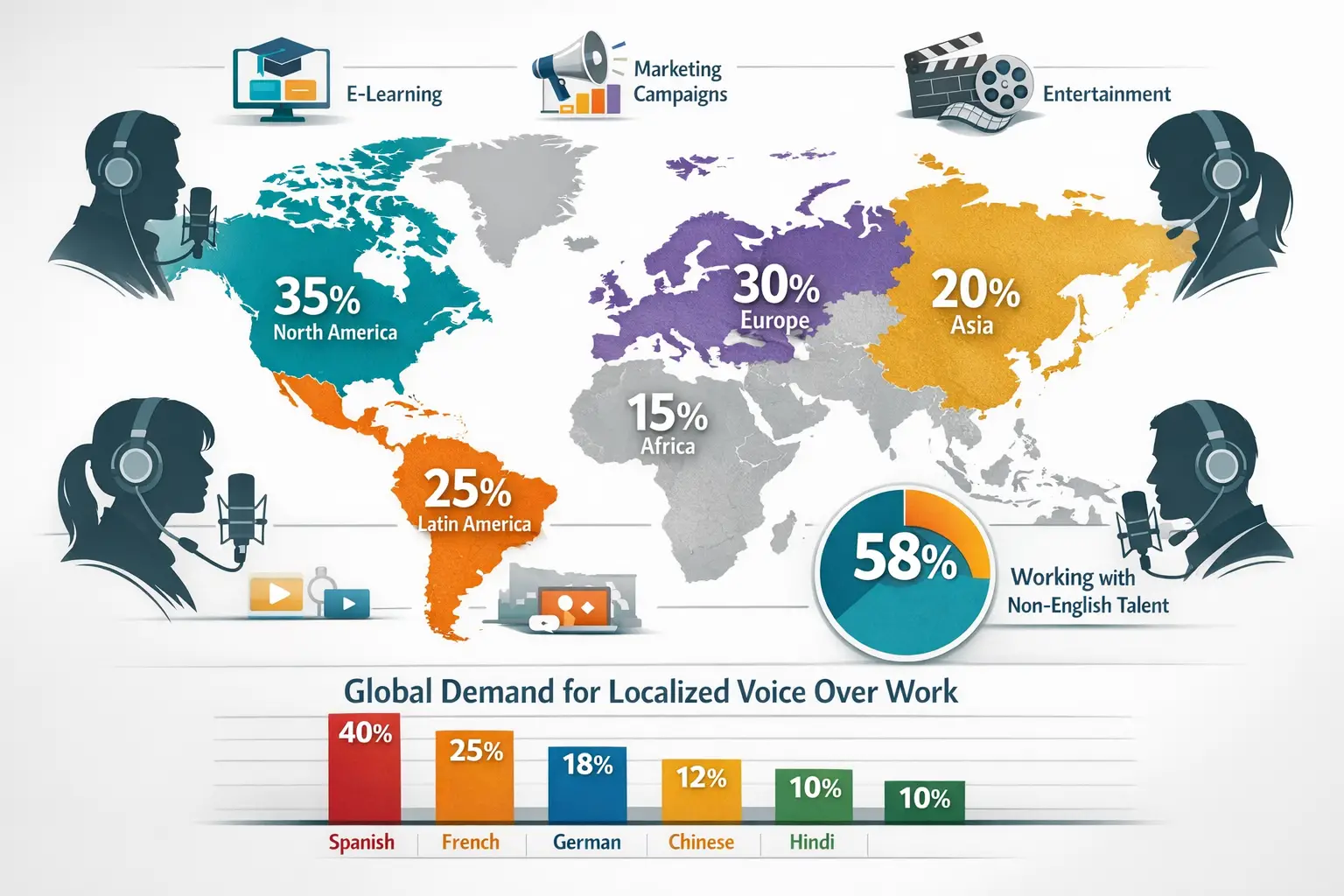
- Spanish, French, German, Chinese, and Hindi represent the highest-growth languages for voice over work, with Spanish leading as the most requested language after English[2]
- AI dubbing technology can reduce costs by up to 90% and compress production timelines from months to days, but 79% of business leaders report that inauthentic AI voices harm brand perception[4][6]
- Native speakers are increasingly preferred for dubbing work because they deliver natural delivery and understand local idioms, cultural nuances in tone, pace, and delivery[1]
- The combination of human authenticity and AI efficiency is creating a hybrid model that maximizes both quality and scalability in localized voice over production
Understanding the Global Demand for Localized Voice Over
The landscape of international content creation has fundamentally changed. Gone are the days when companies could simply translate scripts and hire any bilingual voice actor. Today’s audiences possess sophisticated cultural awareness and can instantly detect when content feels foreign or inauthentic to their regional experience.
The Numbers Behind the Localization Boom
The data reveals a clear trend: 58% of surveyed buyers have already worked with or plan to work with non-English voice talent[2]. This statistic represents more than just a preference—it signals a fundamental shift in how global businesses approach content creation. Companies recognize that authentic localization directly impacts their bottom line, influencing everything from brand perception to conversion rates.
Spanish emerges as the most requested language after English, followed closely by French[2]. This ranking reflects both demographic realities and economic opportunities. The Spanish-speaking market encompasses over 500 million native speakers across multiple continents, representing enormous purchasing power and cultural diversity. French maintains its position as a global business language, particularly important in African markets experiencing rapid economic growth.
The priority languages for business growth in 2026 include:
- 🌎 Spanish – Dominant in Latin America, growing in the United States
- 🇫🇷 French – Critical for European and African markets
- 🇩🇪 German – Essential for European business and technical content
- 🇨🇳 Chinese – Mandatory for Asia-Pacific expansion
- 🇮🇳 Hindi – Gateway to India’s massive consumer market
Why Authentic Regional Content Matters
Audiences increasingly demand content reflecting their own languages, cultures, and local nuances, driving a surge in localized voiceover work across e-learning platforms and global marketing campaigns[1]. This demand stems from several interconnected factors:
Cultural Identity and Connection: When people hear content in their native language, delivered with authentic regional accents and cultural references, they form stronger emotional connections with brands. A Mexican audience responds differently to Castilian Spanish than to Latin American Spanish. Similarly, Brazilian Portuguese and European Portuguese require distinct approaches.
Trust and Credibility: Research consistently shows that consumers trust brands more when they communicate in the consumer’s native language with cultural authenticity. A poorly localized voice over can undermine years of brand building, while authentic localization builds credibility and trust.
Competitive Necessity: As Spanish, French, German, Chinese, and Hindi remain key growth languages, businesses that fail to invest in quality localization find themselves at a significant competitive disadvantage[2]. Global markets have matured to the point where multilingual content isn’t a luxury—it’s a baseline expectation.
The Technology Revolution: AI and Human Talent in Localized Voice Over
The conversation around The Rise of Localized Voice Over: Capturing Global Markets Through Authentic Regional Content cannot ignore the technological revolution reshaping the industry. Artificial intelligence has introduced capabilities that seemed impossible just a few years ago, while simultaneously highlighting the irreplaceable value of human talent.
The Power and Limitations of AI Dubbing
AI dubbing can reduce costs by up to 90% and compress production timelines from months to days, removing major barriers to global content deployment[4]. These numbers represent transformative potential for businesses that previously couldn’t afford comprehensive localization strategies.
Consider the practical implications:
| Traditional Dubbing | AI-Enhanced Dubbing |
|---|---|
| 2-3 months production time | 3-7 days production time |
| High per-language costs | 90% cost reduction |
| Limited revision flexibility | Rapid iteration capability |
| Scheduling challenges | On-demand availability |
VistatecSpeech AI workflows achieve 20% reduction in project lifecycle and 78% cost savings compared to traditional voiceover methods[5]. These efficiency gains enable businesses to localize content into more languages, reaching previously inaccessible markets.
The technology continues advancing rapidly. AI lip-syncing and neural rendering technology now allow brands to modify video lip movements to match target language phonemes, addressing the “Uncanny Valley” effect that previously made dubbed content feel unnatural[3]. AI systems can analyze a speaker’s voice and recreate it across languages while maintaining pitch, pace, and inflection, preserving authenticity and speaker identity[4].
The Human Element Remains Critical
Despite these technological advances, the data reveals a crucial truth: audiences and business leaders still value human authenticity. 79% of business leaders report that inauthentic AI voices harm brand perception, emphasizing the competitive advantage of authentic human voice talent[6].
This statistic deserves careful consideration. In an era when AI can technically produce voice content in any language, why do nearly four out of five business leaders worry about authenticity? The answer lies in the subtle elements that distinguish truly native content from technically accurate but culturally hollow reproductions.
“The future of localized voice over isn’t about choosing between AI and human talent—it’s about understanding when each approach serves the content best and how they can work together to achieve both authenticity and scale.”
Additional research reinforces this perspective:
- 79% of business leaders believe AI voices should originate from real voice actors, indicating strong preference for human-centered AI solutions[6]
- 77% of business leaders value exclusive voice licensing as a way to stand out in a crowded AI landscape[6]
These findings suggest an emerging hybrid model where AI handles scale and efficiency while human voice actors provide the authentic foundation that makes localized content genuinely resonate with target audiences.
The Hybrid Future: Combining AI Efficiency with Human Authenticity
Forward-thinking companies are developing workflows that leverage both AI capabilities and human expertise. This approach typically involves:
- Human Recording Sessions: Native-speaker voice actors record master content with authentic cultural delivery
- AI Voice Cloning: Technology creates voice models that preserve the actor’s unique characteristics
- Automated Localization: AI generates content in additional languages or variations
- Human Quality Control: Native speakers review and refine AI-generated content
- Continuous Improvement: Feedback loops enhance both AI models and human performance
This hybrid model addresses the core challenge of The Rise of Localized Voice Over: Capturing Global Markets Through Authentic Regional Content: how to achieve both cultural authenticity and operational scalability.
The Growing Opportunities for Multilingual Voice Talent
For voice actors, the current landscape presents extraordinary opportunities alongside new challenges. The demand for authentic, culturally-aware voice talent has never been higher, but the skills required to thrive in this market have evolved significantly.
Why Native Speakers Are in High Demand
Native speakers are increasingly preferred for dubbing work because they deliver natural delivery and understand local idioms, cultural nuances in tone, pace, and delivery[1]. This preference creates substantial opportunities for voice actors who can offer genuine regional expertise.
The advantages native speakers bring include:
Idiomatic Accuracy: Native speakers naturally understand which phrases sound authentic and which feel translated. They can adapt scripts to maintain meaning while ensuring cultural appropriateness.
Tonal Nuance: Different cultures express emotion, formality, and emphasis in distinct ways. A native speaker inherently understands these subtleties, delivering performances that feel genuine rather than technically correct but emotionally flat.
Cultural Context: References to holidays, social customs, humor, and shared experiences require deep cultural knowledge. Native speakers can identify when content needs adaptation to resonate with local audiences.
Accent Authenticity: Within languages, regional accents carry significant meaning. A voice actor from Madrid delivers Spanish differently than someone from Buenos Aires or Mexico City. Clients increasingly seek specific regional authenticity rather than generic language proficiency.
Skills That Set Voice Actors Apart in 2026
The most successful voice actors in the localized content market possess several key competencies:
🎯 Cultural Consultation: Beyond reading scripts, top voice actors serve as cultural advisors, helping clients understand how content will be received in specific markets.
🎯 Technical Adaptability: Familiarity with remote recording technology, AI voice cloning processes, and digital collaboration tools has become essential.
🎯 Linguistic Range: Many successful voice actors offer multiple regional variants of their native language or proficiency in closely related languages.
🎯 Industry Specialization: Expertise in specific sectors—medical terminology, technical jargon, gaming culture, or financial services—increases marketability.
🎯 Collaboration Skills: Working effectively with translators, localization managers, and AI technologists requires strong communication and flexibility.
Market Segments Driving Demand
Several industries are particularly active in hiring localized voice talent:
E-Learning and Corporate Training: Companies expanding globally need training materials localized for diverse workforces. This sector values clear, professional delivery and cultural sensitivity[1].
Entertainment and Gaming: Streaming platforms and game developers invest heavily in localization to maximize global audience reach. This market demands expressive, character-driven performances.
Marketing and Advertising: Brands launching international campaigns require authentic voices that connect with local audiences while maintaining brand consistency.
Healthcare and Pharmaceutical: Patient education, medical device instructions, and pharmaceutical information must be both linguistically accurate and culturally appropriate.
Technology and Software: User interfaces, tutorial videos, and customer support content need localization as tech companies pursue global markets.
Navigating Cultural Nuance in Localized Voice Over Production

The technical aspects of voice recording—microphone technique, audio quality, pacing—remain important, but The Rise of Localized Voice Over: Capturing Global Markets Through Authentic Regional Content fundamentally depends on cultural intelligence. Understanding and delivering cultural nuance separates adequate localization from exceptional work that truly captures global markets.
Understanding Regional Variations Within Languages
Many businesses make the mistake of treating languages as monolithic entities. In reality, significant variations exist within language groups:
Spanish Variations:
- Castilian Spanish (Spain) uses different vocabulary and pronunciation than Latin American variants
- Mexican Spanish differs from Argentine Spanish in vocabulary, pronunciation, and cultural references
- Caribbean Spanish has distinct characteristics from Andean Spanish
French Variations:
- European French maintains different formality levels than Canadian French
- African Francophone markets have unique expressions and cultural contexts
- Swiss and Belgian French include regional particularities
Chinese Variations:
- Mandarin serves as the official language but regional accents vary significantly
- Cantonese remains important in Hong Kong and parts of southern China
- Simplified versus Traditional characters affect written content
Arabic Variations:
- Modern Standard Arabic works for formal content
- Regional dialects (Egyptian, Levantine, Gulf) are preferred for conversational content
- Cultural sensitivities vary significantly across Arabic-speaking regions
Cultural Adaptation Beyond Translation
Effective localization requires adapting content to cultural contexts, not just converting words between languages. This involves:
Humor and Wordplay: Jokes rarely translate directly. Localized content often requires creating culturally equivalent humor rather than literal translation.
Metaphors and Idioms: Expressions that resonate in one culture may confuse or offend in another. “Hitting a home run” means nothing in markets where baseball isn’t popular.
Formality Levels: Some cultures maintain strict formal/informal distinctions in language, while others use more casual communication across contexts.
Gender and Inclusivity: Different languages handle gender differently, and cultural expectations around inclusive language vary significantly.
Religious and Social Sensitivity: Content must respect religious practices, social taboos, and cultural values that differ across markets.
The Voice Actor’s Role as Cultural Bridge
Professional voice actors working in localization serve as more than performers—they function as cultural bridges between content creators and target audiences. This role involves:
Script Consultation: Identifying potential cultural issues before recording begins, suggesting alternatives that maintain intent while improving cultural fit.
Performance Adaptation: Adjusting delivery style, energy level, and emotional expression to match cultural communication norms.
Quality Assurance: Catching errors or awkward phrasing that might slip past non-native translators or localization managers.
Client Education: Helping international clients understand why certain approaches work better in specific markets.
Best Practices for Brands Investing in Localized Voice Over
For businesses seeking to capture global markets through authentic regional content, several best practices have emerged from industry leaders successfully navigating this landscape.
Start with Strategic Language Prioritization
Rather than attempting to localize content into every possible language simultaneously, successful companies prioritize based on:
- Market size and revenue potential: Focus on languages representing the largest addressable markets
- Competitive landscape: Enter markets where localization provides competitive advantage
- Strategic importance: Consider languages critical to long-term business strategy
- Content ROI: Evaluate which content types deliver the highest return when localized
Given that Spanish, French, German, Chinese, and Hindi remain key growth languages[2], most businesses begin with these markets before expanding to additional languages.
Invest in Native-Speaker Talent
The data clearly shows that 79% of business leaders believe AI voices should originate from real voice actors[6]. This finding suggests a clear strategy: build your localization program on a foundation of authentic human talent, then scale with technology where appropriate.
When hiring voice talent:
✅ Prioritize native speakers from your target markets ✅ Request samples demonstrating cultural knowledge, not just language fluency ✅ Consider regional specificity within languages ✅ Evaluate technical capabilities and remote recording setup ✅ Assess collaborative skills and cultural consultation abilities
Build Collaborative Workflows
Effective localization requires coordination across multiple specialists:
- Translators: Convert content while maintaining meaning and cultural appropriateness
- Localization Managers: Oversee the entire process and ensure consistency
- Voice Actors: Deliver authentic performances and provide cultural feedback
- Audio Engineers: Ensure technical quality across all language versions
- Cultural Consultants: Review content for cultural sensitivity and relevance
Creating clear communication channels and collaborative processes ensures all team members can contribute their expertise effectively.
Balance Technology and Human Touch
Given that AI dubbing can reduce costs by up to 90%[4] while 79% of business leaders report that inauthentic AI voices harm brand perception[6], the optimal approach combines both:
Use AI for:
- High-volume, lower-stakes content
- Rapid prototyping and testing
- Scaling proven content to additional markets
- Updating evergreen content with minor changes
Use Human Talent for:
- Brand-defining content
- Emotionally resonant storytelling
- Complex cultural contexts
- High-value customer touchpoints
- Content requiring nuanced performance
Measure and Optimize
Track metrics that reveal localization effectiveness:
- Engagement rates by language and region
- Conversion rates for localized versus non-localized content
- Customer feedback on content authenticity and relevance
- Brand perception across different markets
- ROI for localization investments by language
Use these insights to continuously refine your approach, investing more heavily in what works and adjusting strategies that underperform.
The Future of Localized Voice Over: Trends Shaping 2026 and Beyond
As we progress through 2026, several trends are shaping the future of The Rise of Localized Voice Over: Capturing Global Markets Through Authentic Regional Content.
Hyper-Localization Becomes Standard
Beyond translating content into major languages, brands are increasingly creating hyper-localized versions targeting specific regions, cities, or demographic groups. A campaign for the Spanish market might include distinct versions for Madrid, Barcelona, and Seville, each with appropriate regional accents and cultural references.
Real-Time Localization Capabilities
Technology is advancing toward real-time voice localization, where live presentations, webinars, or customer service interactions can be instantly translated and delivered in authentic voices. While this capability is still developing, early implementations show promising results for specific use cases.
Ethical AI and Voice Rights
As 77% of business leaders value exclusive voice licensing[6], the industry is developing clearer frameworks around voice rights, AI training data, and ethical use of voice cloning technology. Voice actors are increasingly negotiating contracts that specify how their voices can be used in AI applications.
Expanded Language Coverage
While Spanish, French, German, Chinese, and Hindi currently dominate demand[2], businesses are expanding into additional languages as markets develop. Languages like Portuguese, Arabic, Japanese, Korean, and various African languages are seeing increased investment.
Integration with Visual Localization
AI lip-syncing and neural rendering technology[3] is becoming more sophisticated, enabling seamless integration of localized voice over with visual content. This advancement is particularly important for video marketing, entertainment, and educational content.
Conclusion: Seizing Opportunities in the Localized Voice Over Market
The Rise of Localized Voice Over: Capturing Global Markets Through Authentic Regional Content represents far more than a passing trend—it reflects fundamental changes in how global business operates and how audiences consume content. As markets become increasingly interconnected yet culturally diverse, the ability to communicate authentically across languages and cultures has become a critical competitive advantage.
For businesses, the message is clear: investing in quality localization delivers measurable returns through improved engagement, stronger brand perception, and increased market penetration. The combination of AI efficiency and human authenticity offers unprecedented opportunities to scale global content while maintaining the cultural resonance that drives results.
For voice actors, particularly native speakers with cultural expertise, the opportunities have never been more abundant. 58% of surveyed buyers have already worked with or plan to work with non-English voice talent[2], and this demand continues growing as businesses recognize the value of authentic localization.
Actionable Next Steps
For Businesses:
- Audit your current content to identify high-value localization opportunities
- Prioritize languages based on market potential and strategic importance
- Build relationships with native-speaker voice talent in your target markets
- Develop workflows that combine AI efficiency with human authenticity
- Measure localization ROI and continuously optimize your approach
For Voice Actors:
- Invest in technical capabilities for remote recording and digital collaboration
- Develop expertise in specific industries or content types
- Build cultural consultation skills beyond pure performance
- Understand AI technologies and how they complement human talent
- Network with localization agencies and international brands
For Both:
- Stay informed about emerging technologies and industry best practices
- Prioritize authentic cultural representation over purely technical accuracy
- Build collaborative relationships across the localization ecosystem
- Recognize that quality localization requires investment but delivers substantial returns
The global marketplace rewards those who understand that speaking to international audiences means more than translating words—it means capturing the authentic voice, cultural nuance, and regional identity that makes content truly resonate. As we move forward through 2026 and beyond, the businesses and voice actors who master this art will capture the opportunities that The Rise of Localized Voice Over: Capturing Global Markets Through Authentic Regional Content continues to create.
References
[1] Voice Over Trends For 2026 – https://www.voicecrafters.com/blog/voice-over-trends-for-2026/
[2] Voice Acting In 2025 2026 Trends Insights And The Future – https://www.gravyforthebrain.com/voice-acting-in-2025-2026-trends-insights-and-the-future/
[3] The Top 10 Localization Trends To Watch In 2026 – https://www.getblend.com/blog/the-top-10-localization-trends-to-watch-in-2026/
[4] Ai Dubbing In 2026 – https://www.rws.com/blog/ai-dubbing-in-2026/
[5] Ai Driven Localization Trends To Watch In 2026 – https://www.vistatec.com/ai-driven-localization-trends-to-watch-in-2026/
[6] Amplified 2026 The State Of Voice Report – https://www.voices.com/blog/amplified-2026-the-state-of-voice-report/